UP Police Computer Operator Exam Pattern: Written and Typing Skill Stages
Understand the UP Police Computer Operator written and typing stages, run two practical diagnostics, and build a weekly plan around your weakest skill.
KnowledgeGate Team
Exam prep & CS education
Updated 8 Aug 20265 min read
A computer-knowledge paper and clean timed typing are different jobs. Preparing only theory, or only speed, leaves a gap in whichever one you neglected. UP Police Computer Operator selection turns on two measurable gates: a 160-question objective paper, and a Hindi plus English typing test set at 25 and 30 words per minute. Both numbers come from the Uttar Pradesh Police Recruitment and Promotion Board (UPPRPB) notice dated 29 December 2023, a past cycle rather than a promise for the next recruitment.
Related reading: typing speed and accuracy and computer science syllabus.
The selection path has a knowledge gate and an execution gate
The objective examination tests knowledge and decisions under time. Typing tests fast, accurate reproduction on the specified setup. Document scrutiny checks application claims.
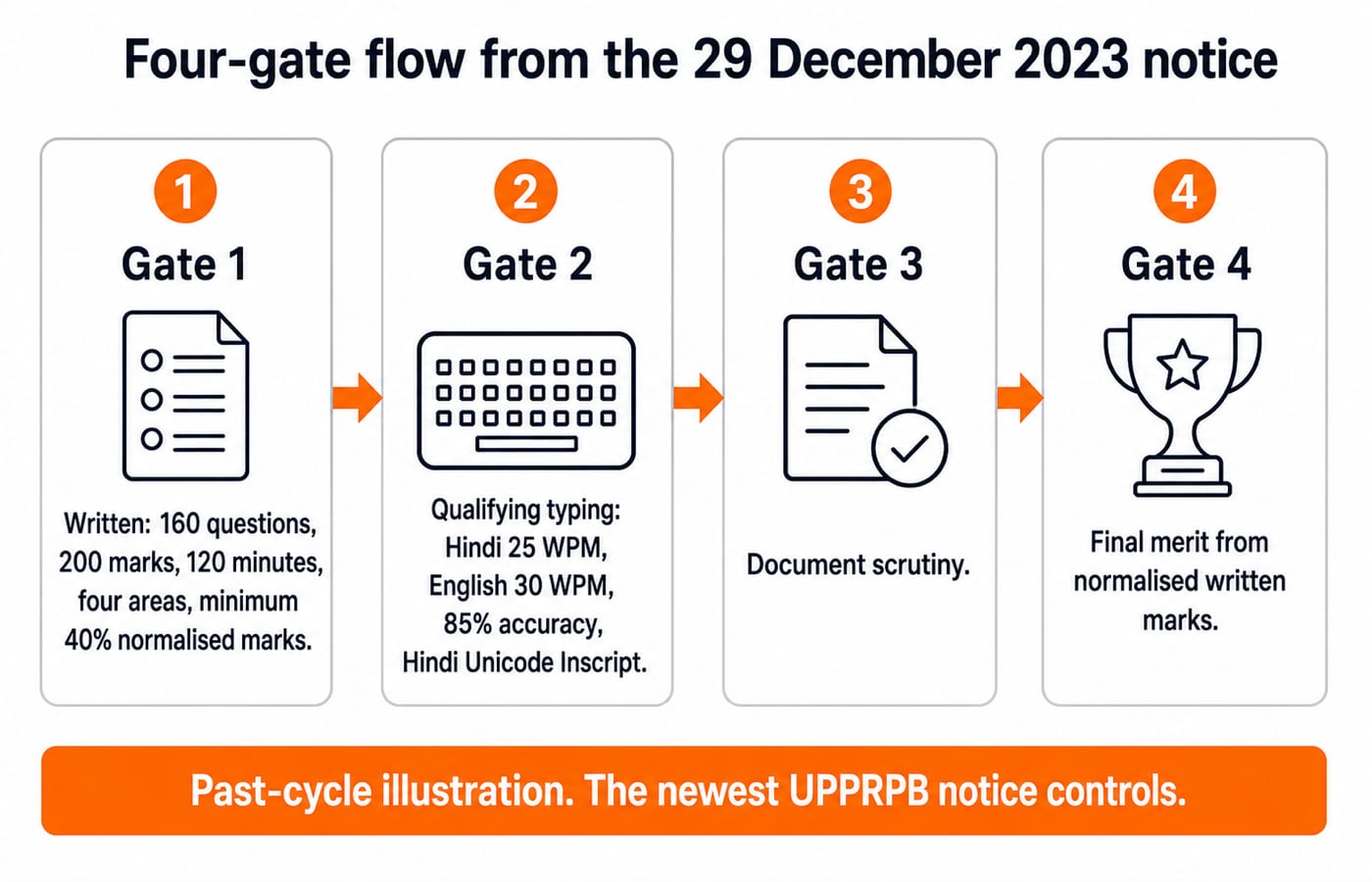
The 29 December 2023 notice specified an online objective examination, shortlisting for a qualifying Hindi and English typing test, document scrutiny, then merit based on normalised written marks. Typing added no marks to merit, so a candidate who types 45 words per minute and one who only just clears the floor stand level on the list, and every mark that decides the job is earned in the objective paper. A new notice may reorder these stages. Everything we run for this role sits on the UP Police Computer Operator exam-prep page.
What the written stage is designed to measure
The past-cycle pattern was:
Item | 29 December 2023 notice |
|---|---|
Mode | Online objective examination |
Questions and marks | 160 questions, 200 marks |
Marks per question | 1.25 |
Duration | 120 minutes |
Areas | General Knowledge, Mental Aptitude, Reasoning and Computer Science |
Written qualifying standard | 40% of normalised marks |
That notice published no per-area question split and no negative-marking rule, so treat both as unknown rather than assuming the four areas carry 40 questions each.
The paper-wide average was 120 minutes / 160 questions = 0.75 minute = 45 seconds per question. That is an average, not a per-question rule: the one-line general-knowledge recalls have to run well under 45 seconds so a reasoning set can run well over it. General Knowledge needs controlled revision, aptitude and reasoning need pattern recognition, and Computer Science needs recall plus application.
Worked written diagnostic: turn one block into a repair plan
Run this 40-question, 30-minute home diagnostic, weighted towards computer science because that is the area closest to the job and the one a Computer Operator paper can go deepest on.
Area | Set | Attempted | Correct | Wrong | Attempted accuracy |
|---|---|---|---|---|---|
General Knowledge | 8 | 7 | 5 | 2 |
|
Aptitude and reasoning | 8 | 7 | 6 | 1 |
|
Computer Science | 24 | 22 | 19 | 3 |
|
Correct:
5 + 6 + 19 = 30Wrong:
2 + 1 + 3 = 6Attempted accuracy:
30 / 36 × 100 = 83.3%Completion:
36 / 40 × 100 = 90%Budgeted pace:
30 minutes / 40 = 45 seconds per questionPace actually used:
30 minutes / 36 attempted = 50 seconds per question
That 83.3% is a home figure, not a scaled score. General Knowledge is the weak block: two wrong and one skipped, 71.4% attempted accuracy against 86.4% in computer science. Repair those three items across the next three sessions while preserving timed CS work, then repeat the block aiming for at least 35 correct and no area below 80% attempted accuracy.
What the computer typing stage is designed to measure
That same notice set 25 words per minute in Hindi, 30 in English, 85% accuracy, and Hindi on the Unicode Inscript layout. Inscript is the load-bearing detail. It places Devanagari characters at positions a Remington or phonetic typist has never used, so Hindi speed built on another layout does not carry over, and the layout is the first thing to confirm in the newest notice.
Keyboard familiarity prevents search-and-peck pauses, rhythm stabilises speed, and proofreading limits errors. Written work improves through concept correction, but typing needs repeated measured runs and an error log. Start it alongside theory, not after the written result.
Worked typing diagnostic: measure speed and accuracy together
For home practice, use gross speed = typed words / minutes and practice accuracy = (typed words - error words) / typed words × 100. These are diagnostic formulas, not UPPRPB's scoring method.
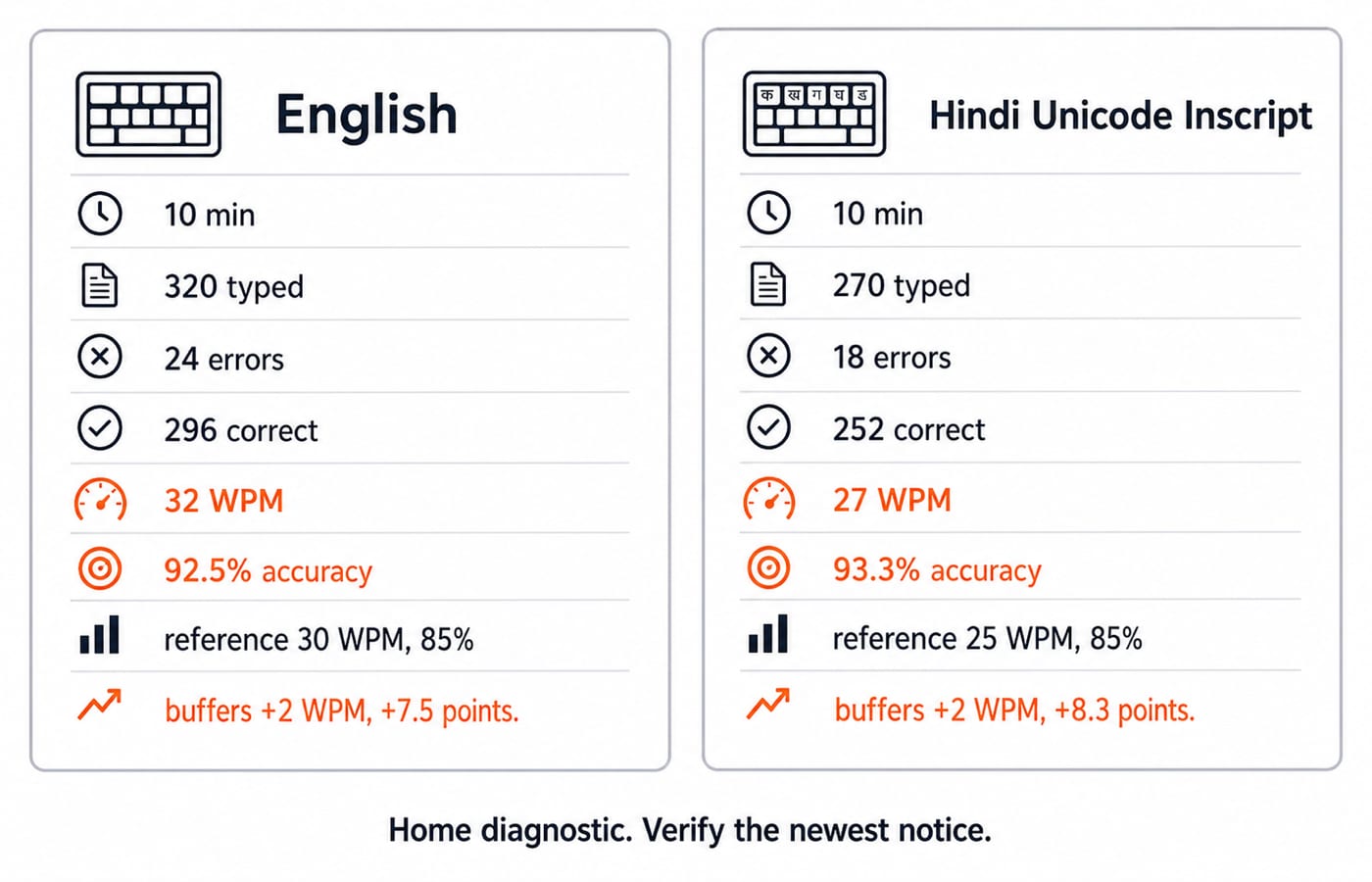
English, 10 minutes: 320 words, 10 omissions, 8 substitutions and 6 extras. Errors: 10 + 8 + 6 = 24; correct: 320 - 24 = 296; speed: 320 / 10 = 32 WPM; accuracy: 296 / 320 × 100 = 92.5%. Past-cycle buffers: 2 WPM and 7.5 percentage points.
Hindi Unicode Inscript, 10 minutes: 270 words, 6 omissions, 7 substitutions and 5 extras. Errors: 6 + 7 + 5 = 18; correct: 270 - 18 = 252; speed: 270 / 10 = 27 WPM; accuracy: 252 / 270 × 100 = 93.3%. Buffers: 2 WPM and 8.3 percentage points.
Build a buffer. Log omissions, substitutions, insertions and keyboard-location hesitations. Repeat the passage after 48 hours, then test transfer on a new passage. Memorised-text speed is not progress.
Train both demands in one repeatable week
Monday, Wednesday and Friday: 50 minutes of study plus a 40-question block in 30 minutes. Tuesday, Thursday and Saturday: 20 minutes each of Hindi and English typing, then 10 minutes on the error log. Sunday: 80 questions in 60 minutes, a proper break, then one 10-minute run per language.
Then tilt it towards whichever diagnostic came out worse. If the written block is the weaker result, add a second 40-question block on Tuesday and cut that day's typing to 15 minutes a language. If a language carries the thinner margin, which on the runs above is English at 7.5 accuracy points against Hindi's 8.3, move Wednesday's question block to Sunday and give Wednesday a third 20-minute English run. Open every written block with your lowest attempted-accuracy area, General Knowledge at 71.4% above. The eight-week version of this rebalancing is in the UP Police Computer Operator Preparation Plan: 8 Weeks for Theory, Typing and Office Skills.
Use the UP Police Computer Operator course for coverage and concept repair. Use the UP Police Computer Operator Test Series for timed tests, mocks and previous papers.
Missed a day? Resume the schedule and move only the error review to Sunday. Each week must produce a subject-ranked written error list and a bilingual typing log with WPM, accuracy and error type.
Read the newest notification before locking the plan
Audit the newest notice for post name, stage order, mode, questions, marks, duration, sections, negative marking, written qualifying standard, shortlisting, typing languages, keyboard layout, WPM floors, accuracy floor, test duration, error formula, merit status and documents. Write that notice's date beside every number you copy, so a 2023 figure never survives quietly into your 2026 plan.
The Uttar Pradesh Police Recruitment and Promotion Board portal carries the notice that controls.
The short version
Written success needs broad, paced decisions. Typing success needs repeatable, clean output. Run the 40-question written block and both 10-minute typing runs, record the three baselines, then use the course for concept gaps or the test series for timed-practice gaps.
Keep learning
UP Police Computer Operator DBMS and SQL: Learn Tables, Keys and Queries with a Police-Records Database
Build one fictional police-records database from schema to SQL. Learn key types, relationships, 3NF, table constraints and exact query results from consistent data.
Updated 18 Aug 20266 min read70 viewsUP Police Computer Operator
UP Police Computer Operator Typing Test: Build Speed Without Losing Accuracy
Build typing speed without letting errors undo the gain. This practice plan separates Hindi and English, tracks accuracy, and turns each weak attempt into a focused repair drill.
Updated 16 Aug 20265 min readUP Police Computer Operator

UP Police Computer Operator PYQs: Diagnose Recurring Skill Gaps
Turn solved papers into a ranked repair list. Tag the recurring errors, repair the exact skill behind each one, then measure the change with a fresh 18-question mixed check.
Updated 14 Aug 20265 min readUP Police Computer Operator

UP Police Computer Operator Job Profile: Salary, Duties and Promotion Path
Understand the UP Police Computer Operator Grade-A role, its duties, historical pay matrix, probation, transfers, and selection-based promotion path.
Updated 12 Aug 20265 min read112 viewsUP Police Computer Operator