UP Police Computer Operator Syllabus: Map Theory to Practical Skills
Turn a topic list into practical computer skills. Fundamentals, office work, data handling, reasoning and instruction accuracy each get a task you can perform, plus a 14-day sequence to practise it.
KnowledgeGate Team
Exam prep & CS education
Updated 31 Jul 20265 min read63 views
A syllabus list tells you what to read, but not what each topic should enable you to do. That gap makes preparation feel theoretical even when the role demands careful computer work.
The KnowledgeGate UP Police Computer Operator course covers Computer Fundamentals, Operating Systems, MS Office, Programming Basics, Database Concepts, Networking, Internet and IT Awareness, along with General Knowledge, Reasoning and related aptitude. Each of those topics carries a task you should be able to perform at a keyboard, not just recite. Check the current notice on the Uttar Pradesh Police Recruitment and Promotion Board website for the official syllabus and rules.
Turn the syllabus into four skill lanes
Treat the course topics as four preparation lanes, not as an official section-wise weightage.
Fundamentals and logic | Systems and office work | Data flow and safety | Reasoning and context |
|---|---|---|---|
Explain hardware, data and simple program logic | Manage files and complete document or spreadsheet tasks | Trace stored data across databases and networks, then protect it | Interpret instructions, detect patterns and verify context |
Keep the two sources apart. UPPRPB notices decide marks, dates, qualifications and task thresholds. Courses and practice sets, including those in the Govt Jobs category, build the skills those notices ask for.
Computer fundamentals should end in a diagnosis
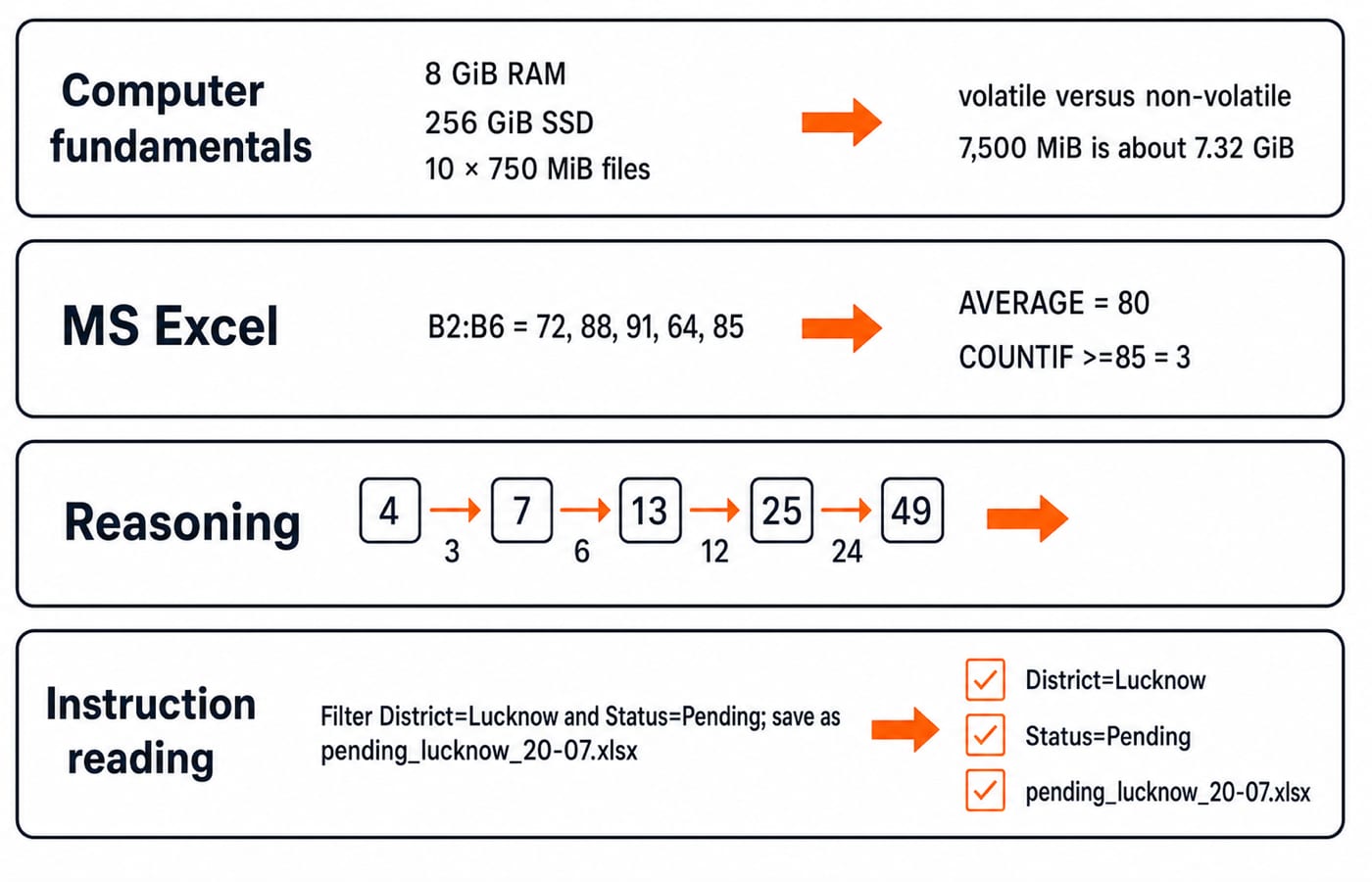
Suppose a workstation has 8 GiB RAM and a 256 GiB SSD. Ten evidence files of 750 MiB each use 10 x 750 = 7,500 MiB. Since 1 GiB = 1,024 MiB, the files occupy 7,500 / 1,024 = 7.32421875 GiB, or about 7.32 GiB. They remain after shutdown because the SSD is non-volatile storage. RAM is volatile working memory, so confusing memory with storage gives the wrong diagnosis.
Programming basics should also produce a predictable result. Start with count = 3, run count = count + 2, then test count >= 5. The state changes from 3 to 5, and the condition is true. Revise binary, memory types and the operating-system basics behind them in UP Police Computer Operator Computer Fundamentals: Binary, OS and Network Basics, then return to small diagnostic questions.
Turn operating systems, files and MS Office into a desk task
Create UP-Police-Practice/Week-01 and save notice-notes.docx inside it. Copy source-table.xlsx into the folder, then rename the copy district-scores.xlsx. The folder now contains exactly two files. Save updates the current file, Save As creates a separately named version, Copy leaves the source in place, and Move changes its location.
Now enter 72, 88, 91, 64 and 85 in B2:B6. Their sum is 400, so =AVERAGE(B2:B6) gives 400 / 5 = 80. =MAX(B2:B6) returns 91. Three values, 88, 91 and 85, meet the threshold, so =COUNTIF(B2:B6,">=85") returns 3. The trap is =COUNT(B2:B6), which returns 5 because it counts every numeric cell. Repeat these actions on your own machine, and use UP Police Computer Operator MS Office: File Types and Keyboard Shortcuts for the file types and shortcuts worth having in your fingers.
Put databases, networks and security into one data-flow story
Consider this OperatorLog table:
operator_id | district | status |
|---|---|---|
1042 | Lucknow | Pending |
1043 | Kanpur | Complete |
1044 | Lucknow | Complete |
1045 | Lucknow | Pending |
In SELECT operator_id FROM OperatorLog WHERE district='Lucknow' AND status='Pending';, each record is a row, each field is a column, and both filter conditions must match. The result is 1042 and 1045.
Next, a workstation at 192.168.10.24/24, gateway 192.168.10.1 and printer 192.168.10.50 share the 192.168.10.0/24 local network. If support@uppbpb-help.example asks for an OTP, reject it. The .example address is not the official UPPRPB domain, and an OTP must never be shared.
Make reasoning practice model careful computer work
For 4, 7, 13, 25, ?, the increments are 3, 6 and 12. They double each time, so the next increment is 24 and 25 + 24 = 49. Adding 12 again and choosing 37 is tempting, but it ignores the established rule.
Use the same discipline at work: read all values, state the rule, apply it once, then verify the output. For ticket times 09:10, 09:25, 09:05, 09:40, ascending order is 09:05, 09:10, 09:25, 09:40. Most reasoning drills are written for exams in general, so pick the ones that mirror operator work: sequences, sorting and instructions with more than one condition.
Use language and general awareness for instruction accuracy
Read this task exactly: "Filter District=Lucknow and Status=Pending; save as pending_lucknow_20-07.xlsx; do not overwrite the original." Correct execution requires two filters, that exact output name and a separate saved copy. Missing Status=Pending or overwriting the source is wrong even if every formula is correct.
Language practice should sharpen constraint words such as only, except, before, after and not. General awareness should strengthen source recognition and context checking. A forwarded message or coaching graphic cannot confirm recruitment rules, and only the Board notice settles a language or awareness split.
Follow a 14-day theory-to-practice sequence
Fourteen days is enough to turn topics you have already read into tasks you can perform. It is not a full preparation timeline, and it leaves the typing test to dedicated practice. Use one 120-minute block daily: 25 minutes for concepts, 35 for guided examples, 30 for objective questions, 20 for practical computer work and 10 for error-log review. The parts total 25 + 35 + 30 + 20 + 10 = 120 minutes.
Days 1 to 3 cover fundamentals and programming logic. Days 4 and 5 cover operating systems, files and MS Office. Day 6 covers databases, networking and security, and Day 7 is a mixed checkpoint. On Days 8 to 13, repeat the cycle with extra attention to weak topics. Use Day 14 for a timed mixed test and error review. If you miss a day, move its weakest 30-minute block to the next checkpoint instead of doubling the following day.
The short version
Learn the topics in sequence with the complete UP Police Computer Operator course. Then use the UP Police Computer Operator test series to diagnose weak areas. It lists 13 unit tests, 7 full-length mocks and 6 previous-year papers, 26 tests in all. Those counts describe the practice set; the exam pattern itself stays with the Board notice.
Keep learning
UP Police Computer Operator DBMS and SQL: Learn Tables, Keys and Queries with a Police-Records Database
Build one fictional police-records database from schema to SQL. Learn key types, relationships, 3NF, table constraints and exact query results from consistent data.
Updated 18 Aug 20266 min read70 viewsUP Police Computer Operator
UP Police Computer Operator Typing Test: Build Speed Without Losing Accuracy
Build typing speed without letting errors undo the gain. This practice plan separates Hindi and English, tracks accuracy, and turns each weak attempt into a focused repair drill.
Updated 16 Aug 20265 min readUP Police Computer Operator
UP Police Computer Operator PYQs: Diagnose Recurring Skill Gaps
Turn solved papers into a ranked repair list. Tag the recurring errors, repair the exact skill behind each one, then measure the change with a fresh 18-question mixed check.
Updated 14 Aug 20265 min readUP Police Computer Operator
UP Police Computer Operator Job Profile: Salary, Duties and Promotion Path
Understand the UP Police Computer Operator Grade-A role, its duties, historical pay matrix, probation, transfers, and selection-based promotion path.
Updated 12 Aug 20265 min read112 viewsUP Police Computer Operator