UP LT Grade Computer Science: Subject Weightage and a Preparation Plan
Build a practical UP LT Grade Computer Science plan around priority tiers, a capped general-studies slot, protected mock practice and clear recovery rules.
KnowledgeGate Team
Exam prep & CS education
Updated 13 Aug 20266 min read
UP LT Grade Computer Science aspirants often prepare without a local classroom or a clear way to divide the syllabus. The natural response is to give every subject equal time, but that leaves too little practice for the core blocks. A stronger plan gives the Computer Science portion most of the week, keeps the general portion capped and protects timed tests near the end.
1. The two things the exam scores you on
Preparation has two streams: the Computer Science subject component and the general-studies and teaching-aptitude component. The subject component contains most of the technical work you can improve through concepts, questions and revision. The general component still matters, but it should have a fixed boundary.
The current notification decides the exact division of marks, number of questions, duration and marking rule. Confirm those details on the UPPSC portal before calculating an attempt strategy.
Make that split visible in your calendar rather than in your intentions. Review needs its own protected slot, because solving more questions without correcting old mistakes creates false progress.
Entry conditions and paper structure sit in the UP LT Grade assistant teacher eligibility and exam-pattern guide. Settle those first, because an eligibility surprise in week six costs more than any scheduling mistake.
2. CS topic weightage tiers for LT Grade
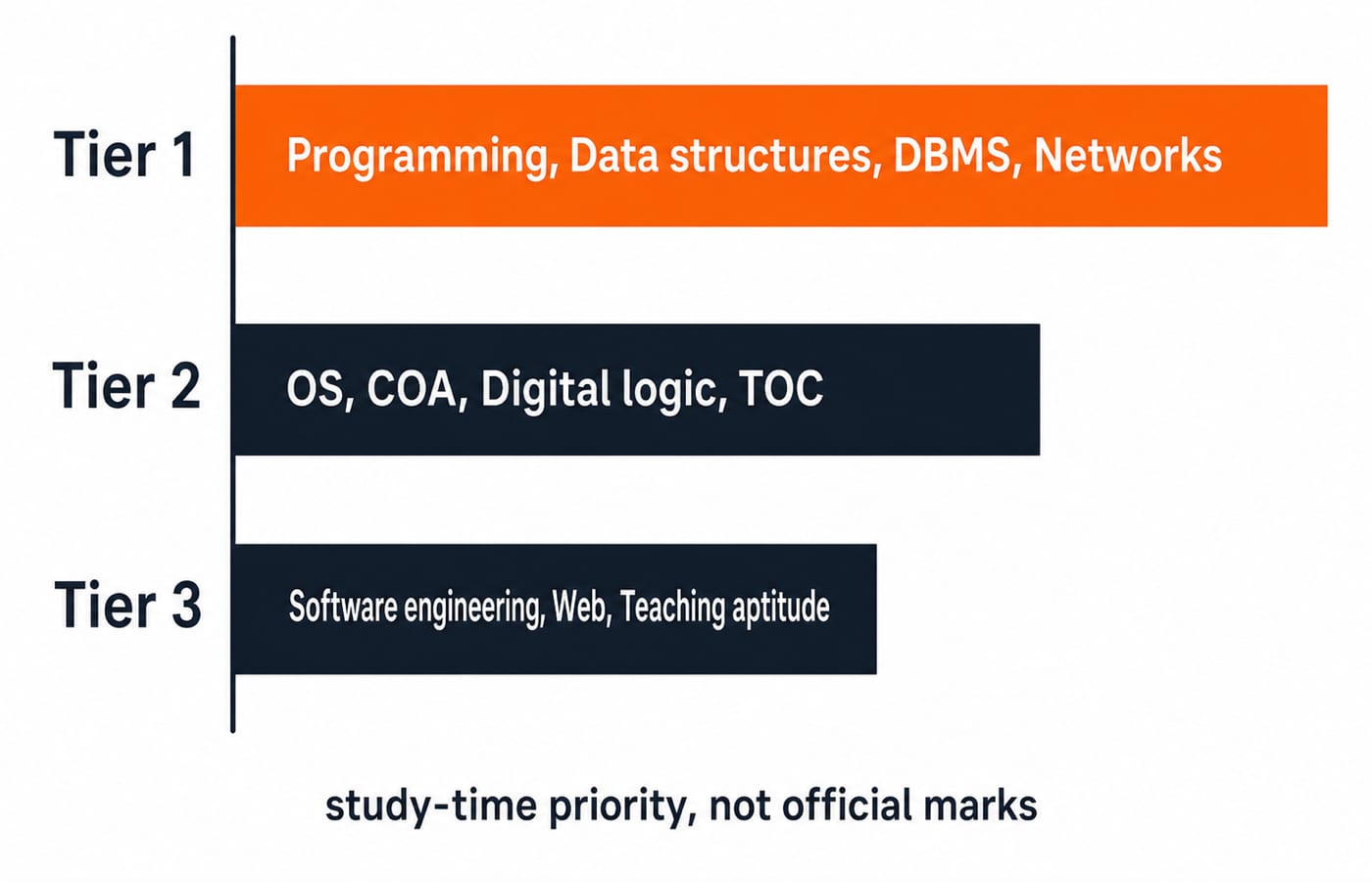
Pitch the technical depth at graduate school-teacher level. Questions reward clear fundamentals and standard applications more than rare advanced variants. Organise the syllabus into these study-priority tiers:
Priority | Subjects | How to treat them |
|---|---|---|
Tier 1 | Programming in C/C++, DBMS, Computer Networks, Operating Systems, computer fundamentals | Start here and revisit every week |
Tier 2 | Data structures, digital electronics, computer organisation | Build after Tier 1, with tracing and numericals |
Tier 3 | Software engineering, web basics, light theory of computation | Cover reliably, with a cap on advanced detail |
Give the three tiers study time in a 4:2:1 ratio. That weight governs your calendar; the mark split stays with the notification. Use the UP LT Grade Computer Teacher CS syllabus guide as the scope checklist, and if you want individual topics ranked inside a tier, the UP LT Grade CS weightage guide scores them by breadth, prerequisites and recurrence.
3. A weekly time model
Plan for roughly 14 to 16 hours a week over about 12 weeks. At the 15-hour midpoint, a 70:20:10 planning split works as follows:
Computer Science:
15 x 0.70 = 10.5 hours.General studies and teaching aptitude:
15 x 0.20 = 3 hours.Review and error-log work:
15 x 0.10 = 1.5 hours.Check:
10.5 + 3 + 1.5 = 15 hours.
Split those 10.5 Computer Science hours across the tiers in the same 4:2:1 ratio: 6 hours to Tier 1, 3 to Tier 2 and 1.5 to Tier 3. If your week runs to 14 or 16 hours, hold the proportions instead of chasing minute-perfect divisions.
One practical week is five shorter weekday sessions plus a longer weekend block. Reserve the weekend for a mixed test and its analysis once enough syllabus is covered. Keep the general slot fixed so it is never crowded out, but also never expands into the time reserved for programming, DBMS, Networks or Operating Systems.
4. Phase-by-phase plan
The 12 weeks divide cleanly into four phases:
Phase | Weeks | Work |
|---|---|---|
Tier 1 foundation | 1 to 5 | Concepts, compact notes and 25 to 30 MCQs per sub-topic |
Tier 2 and Tier 3 breadth | 6 to 9 | New coverage plus short Tier 1 recall sets |
Previous years and mocks | 10 to 11 | Timed papers alternating with analysis |
Final revision | 12 | Notes, formulas, error log and selected retests only |
The calendar check is 5 + 4 + 2 + 1 = 12 weeks. In Phase 1, build programming through code tracing and output questions. Take DBMS through SQL and normalisation, Networks through models, protocols and addressing, and Operating Systems through scheduling, synchronisation and memory.
In Phase 2, add data structures, digital electronics and computer organisation. Give software engineering, web basics and theory a clear first pass without allowing advanced corners to displace Tier 1 revision.
In Phase 3, alternate test and analysis days. Classify every wrong answer by cause and re-solve it without looking at the key. In Phase 4, learn nothing new unless the official syllabus reveals an actual omission. Revision should become narrower and more accurate, not broader.
The KnowledgeGate practice bank carries tens of thousands of questions across the Computer Science core and the teaching-aptitude areas. Select sets that match the syllabus and your current phase. Volume helps only when the review loop is intact.
5. Handling the general and teaching-aptitude slice
The general portion can return useful marks for controlled effort because its scope can be scheduled separately. Cover the current-affairs, general-awareness and basic teaching-aptitude areas named by the applicable syllabus within the planned three-hour midpoint allocation.
Avoid irregular binges. A recurring weekly slot supports recall better and prevents the general stream from becoming a second unbounded syllabus. Keep separate notes for facts, pedagogy concepts and mistakes from practice sets.
The technical and teaching streams also need different revision methods. Technical subjects benefit from tracing, numericals and procedure recall. Teaching aptitude and awareness need short recall cycles, elimination practice and carefully updated notes.
6. When you fall behind
Put two buffer days inside each phase. A buffer day absorbs a missed session or an unusually difficult topic. Do not pre-fill it with optional content, because then it cannot perform its recovery job.
If lost time exceeds the buffer, cut work in this order:
Remove advanced Tier 3 detail.
Reduce repeat sets from already stable topics.
Keep weak Tier 1 and Tier 2 concepts.
Preserve timed mocks and full analysis in Phase 3.
Never repair a missed week by doubling every later session. That approach usually removes sleep, review or test analysis, then creates another missed week.
7. How UP LT Grade tests computer science
Prepare for direct, fundamentals-first objective questions across the CS core: the printed output of a short C loop, the normal form a given relation already satisfies, the class and default mask of an IP address, the page-fault count for a fixed reference string under FIFO, the output column of a small logic circuit. Definitions still appear, but the aspirant who can run a standard procedure quickly and eliminate two close options finishes the paper. Being able to explain a rule without being able to apply it inside a minute is unfinished preparation.
Let the subject component drive the plan and the general component support the total. Before your first full mock, check the current UPPSC pattern so the paper you simulate matches the one you will sit.
If you are also tracking KVS, NVS or state TGT cycles, the government teaching jobs category collects those recruitments in one place, which keeps the shared CS core visible while you prepare for UP LT Grade.
8. The short version and your next step
Give the CS core about 70 percent of a 14 to 16-hour week, keep general studies and teaching aptitude near 20 percent, and reserve the remaining time for review. Inside the CS hours, hold the 4:2:1 tier weight, protect the Phase 3 mocks and trim advanced Tier 3 detail when the calendar slips.
Turn the plan into a baseline by taking the UP LT Test Series. Record accuracy by tier, schedule the weakest Tier 1 block first and use the official notification to confirm that every listed topic is covered.
Keep learning

Mensuration and Geometry for Competitive Exams: Formulas, Shortcuts and Solved Examples
Learn how to choose the right mensuration formula, avoid common geometry traps, and solve 2D path and 3D recasting problems step by step.
Updated 6 Oct 20266 min readAptitude & Reasoning
Age Comparison and Multiple-Condition Problems: 12 Solved MCQs
Practise 12 age-problem MCQs with equations, timelines, back-checks, relation chains, changing ratios, birth years, and family conditions.
1 Oct 20268 min readAptitude & Reasoning

True, False and Cannot Say Questions: 10 Solved Passage MCQs
Learn how to separate contradictions from missing evidence, then apply the method to 10 previous-year passage MCQs with concise, evidence-led solutions.
26 Sep 20268 min readAptitude & Reasoning

TCS Aptitude Questions: High-Yield Quant and Reasoning Topics, Solved Step by Step
Learn the first move for common quant and reasoning question families through solved examples on ratios, work, trains, data, remainders, and seating.
Updated 25 Sep 20266 min read104 viewsAptitude & Reasoning