IISc Administrative Assistant Preparation: A Section-wise Study Plan for the Written Test
Build on familiar SSC and banking material instead of searching for secret IISc notes. Follow a practical eight-week cycle that survives missed days.
KnowledgeGate Team
Exam prep & CS education
Updated 15 Aug 20266 min read
The hardest part of IISc Administrative Assistant preparation is often not the syllabus. It is the hunt for special "IISc material" when four of the written test's five sections answer to the same aptitude discipline used for SSC and banking exams.
Use proven section-wise resources, confirm the current test structure from IISc, and put your hours into timed practice and review. Eight weeks at twelve to fifteen hours a week covers all five sections, provided the hours go to solving and repair rather than to collecting.
1. Stop looking for secret IISc material
Collecting files because somebody labels them IISc-specific buys nothing. The useful question is whether a resource trains a section the current notification names.
Quantitative aptitude needs clear arithmetic methods and timed sets. Reasoning needs repeated exposure to common structures. English needs grammar, comprehension and vocabulary practice. General awareness needs concise notes and weekly revision. Computer applications needs hands-on work in a document, a spreadsheet and a mail client, plus a short definition sheet.
Pick one dependable source per section and one error log, then stop. Resource hopping feels like study while it delays the solving that exposes your gaps.
2. What the written test actually contains
The written test is one scored aptitude paper built from five sections: Quantitative Ability, Verbal Ability, Logical and Numerical Reasoning, General Awareness, and Knowledge in Computer Applications. Reasoning is the widest of the five in the current cycle and computer applications the narrowest, but a plan that quietly drops either one gives away marks.
The exact question count, marks, duration, negative marking and selection process are cycle-specific. The IISc Administrative Assistant exam pattern guide sets out the current section-wise item split and the order of the selection stages, and the IISc positions-open page carries the notification itself. Check both before you choose a mock or fix your sectional timing.
Turn the notification into a one-page test map: the five sections down the left, their stated scope beside each, every current rule at the foot. That page is the boundary of your plan.
3. Why your SSC and banking prep transfers
The overlap is practical, not merely verbal. IISc-style quantitative aptitude uses the arithmetic and data-interpretation base familiar from SSC and banking preparation. Reasoning practice transfers through arrangements, puzzles, syllogisms and relation-based questions. English preparation transfers through error spotting, cloze work and reading comprehension. General awareness transfers as a routine rather than a syllabus: the same static notes plus rolling current affairs you already keep, held to the scope the IISc notification names.
Use the SSC CGL quantitative-aptitude strategy for a disciplined arithmetic sequence, and carry over from Bank PO practice the habit that pays most here: deciding within about ten seconds whether a question is worth attempting.
Transfer does not mean blind reuse. Check every topic against the IISc notification and shape timed sets around the actual test. Computer applications is the section your SSC and banking practice is least likely to have drilled in this form, so give it its own slot.
4. An 8-week plan at 12 to 15 hours a week
The phases overlap deliberately. A subject does not disappear when its foundation phase ends; it moves into maintenance and timed practice.
Weeks | Main work | Weekly allocation |
|---|---|---|
1-2 | Arithmetic foundation and reasoning basics | 5 hours quant, 4 reasoning, 3 English |
3 | Quant, reasoning and English together, computers begins | 5 hours quant, 5 reasoning, 4 English, 1 computers |
4 | Reasoning and English lead, quant on maintenance | 5 hours reasoning, 4 English, 3 quant, 2 computers |
5 | Reasoning, English and awareness | 4 hours reasoning, 3 English, 4 awareness, 2 computers |
6 | Awareness and computers, plus timed sectionals | 3 hours awareness, 2 computers, 3 quant maintenance, 5 sectional review |
7-8 | Full mock cycle | 12 to 15 hours of mocks, analysis and targeted repair |
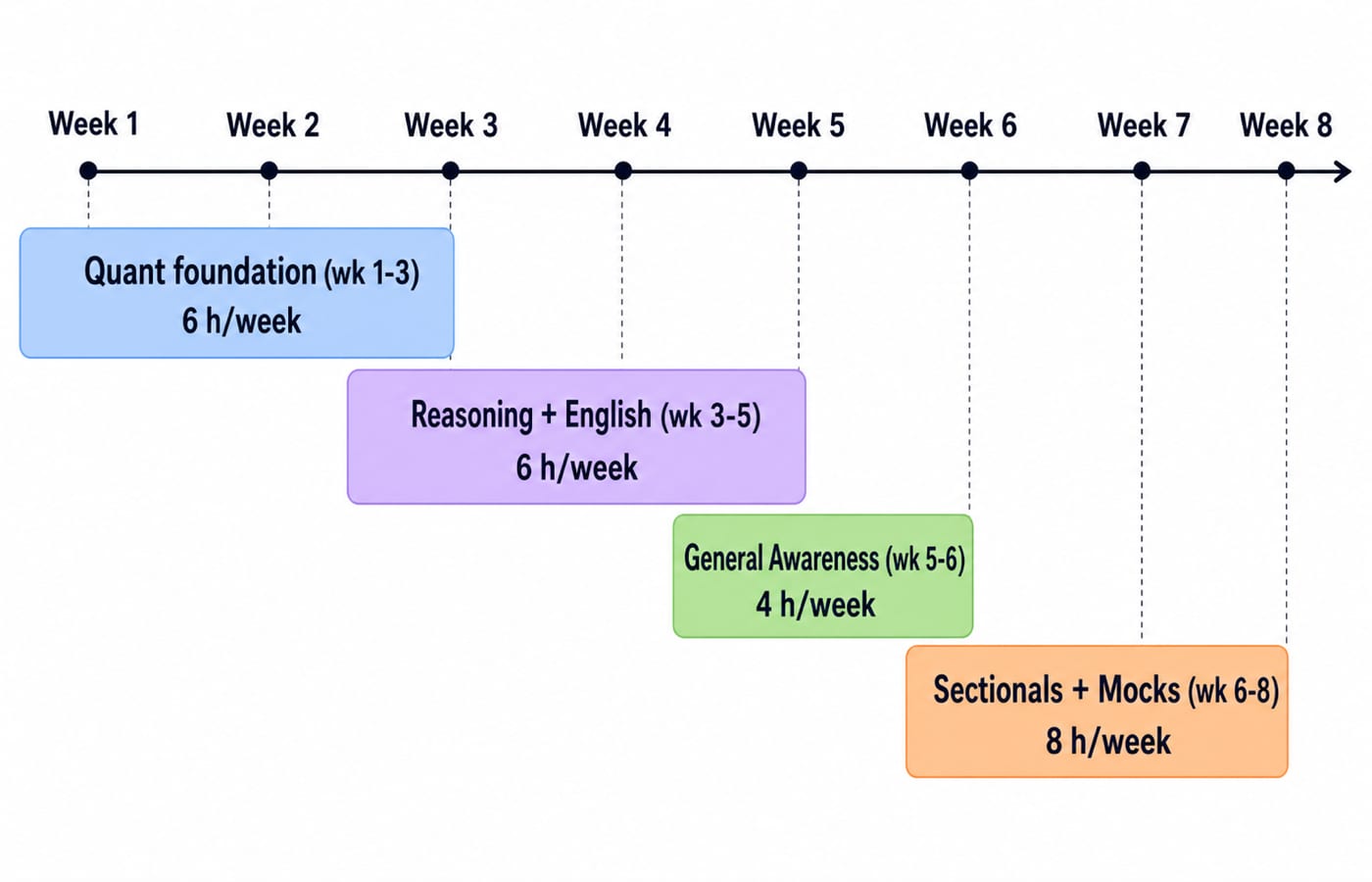
Weeks 1 to 3 cover percentages, ratios, averages, time-speed-distance and data interpretation. Weeks 3 to 5 add arrangements, syllogisms, grammar, cloze exercises and comprehension. Computer applications starts in week 3 at an hour or two: office operations first, then the computer-basics definitions the syllabus names, including operating-system basics, the IT Act, digital signatures and e-governance. Weeks 5 and 6 organise static awareness and a rolling current-affairs set, and from week 6 sectionals and full mocks become the main work.
Eight weeks at this intensity assumes you can protect twelve hours in most of them. If a full working day makes that unrealistic, the balanced 10-week plan for working candidates spreads the same five sections at a steadier twelve hours.
5. Section-by-section high-yield priorities
Quantitative aptitude
Begin with percentages, ratio and proportion, averages, time-speed-distance, simple and compound interest, and data interpretation. Learn one reliable method before chasing shortcuts. Speed comes from repeated correct execution.
Reasoning
Give puzzles and seating arrangements regular, timed practice. Use syllogisms, blood relations and short logical sets to build quick selection. Redraw every arrangement you get wrong and identify the first inference you missed.
English
Rotate error spotting, cloze tests and reading comprehension. Keep a daily vocabulary and grammar habit. When an answer is wrong, record the rule or textual clue, not just the correct option.
General awareness
Combine static topics with rolling current-affairs notes. Let the notification determine scope, and do not give this section unlimited reading time. The government-jobs category collects our courses for similar recruitment tests if you are sitting more than one, while the IISc notification remains the source for this test.
Computer applications
Practise the operations instead of reading about them. Each week, format a document, sort and filter a sheet, use one lookup and one percentage formula, and send an attachment with the copy field filled in. Keep a one-page definition sheet for computer organisation, operating-system basics, the IT Act, digital signatures and e-governance, and revise it weekly. The narrowest section on the paper is also the most repeatable, which makes it a poor one to postpone.
6. The daily mock loop and error log
KnowledgeGate's question bank carries well over 8,000 quantitative-aptitude questions, 6,000 reasoning questions, 6,000 English questions and 4,000 on general awareness. Use that breadth for sectional drills, but measure review quality rather than raw volume.
A workable daily loop is about 40 mixed questions, split the way the paper is built rather than by the section you enjoy: about eleven reasoning, eight each of quant, English and general awareness, and five on computer applications. Confirm the current section split in the notification, reset those counts once, and then leave them alone:
Solve the set under a fixed time limit.
Mark slow correct answers as well as wrong answers.
Re-solve every marked question without the solution.
Enter the cause in an error log.
Revisit the log at the end of the week.
Classify errors as concept, method, calculation, reading or time selection. If ten wrong answers come from one arithmetic idea, another mock will not fix them. A focused repair set will.
7. Being honest about missed days
If one or two days disappear, protect quant and reasoning first because fluency depends on repetition. Keep at least a short English contact session. Move awareness reading and the computer definition sheet into the weekend buffer.
Do not double the next day's workload. Resume the plan, use the weekend to close one gap, and drop low-value extras. A schedule that absorbs two missed days beats a perfect chart abandoned in week two.
In the final fortnight, recover a missed session through targeted review, not through an extra mock taken without analysis.
8. The short version and your next step
Prepare this as a five-section aptitude test, not as a hunt for hidden IISc notes. Reuse solid SSC and banking methods for quant, reasoning and English, give computer applications its own weekly slot, keep a same-day error log, and confirm every cycle-specific rule in the current notification.
The IISc Administrative Assistant 2026 course can anchor the complete cycle. Before the first study session, create five pages in your error log, one each for quant, reasoning, English, awareness and computer applications, and take a short baseline sectional.
Keep learning
Mensuration and Geometry for Competitive Exams: Formulas, Shortcuts and Solved Examples
Learn how to choose the right mensuration formula, avoid common geometry traps, and solve 2D path and 3D recasting problems step by step.
Updated 6 Oct 20266 min readAptitude & Reasoning
Age Comparison and Multiple-Condition Problems: 12 Solved MCQs
Practise 12 age-problem MCQs with equations, timelines, back-checks, relation chains, changing ratios, birth years, and family conditions.
1 Oct 20268 min readAptitude & Reasoning

True, False and Cannot Say Questions: 10 Solved Passage MCQs
Learn how to separate contradictions from missing evidence, then apply the method to 10 previous-year passage MCQs with concise, evidence-led solutions.
26 Sep 20268 min readAptitude & Reasoning
TCS Aptitude Questions: High-Yield Quant and Reasoning Topics, Solved Step by Step
Learn the first move for common quant and reasoning question families through solved examples on ratios, work, trains, data, remainders, and seating.
Updated 25 Sep 20266 min read104 viewsAptitude & Reasoning