UGC NET CS vs GATE CS Revision: Match the Question Style
Knowing the same CS concepts is not enough when the retrieval demand changes. Learn to convert one note page into breadth and depth drills, diagnose the weak layer, and plan the next 10 revision hours.
KnowledgeGate Team
Exam prep & CS education
Updated 30 Aug 20265 min read
You can know Operating Systems, DBMS and Algorithms yet find close conceptual choices uncomfortable in one paper and chained calculations slow in another. Calling one exam easier or harder does not explain that mismatch. This guide uses four lenses, one same-topic worked pair, two drill types and a diagnostic 10-hour block.
Scope note: The breadth and depth labels are revision lenses, not claims that every UGC NET item is recall-based or every GATE item is numerical. The worked prompts, 24-question diagnostic, 10-hour allocations and timing flag are illustrative tools created for this guide, not official formats, mock tests, timing limits, difficulty standards or previous-year questions. Calibrate them against current official guidance and past papers.
UGC NET CS vs GATE CS question style needs four lenses
revision lens | breadth-heavy evidence | depth-heavy evidence | training response |
|---|---|---|---|
retrieval range | many definitions, properties and exceptions across units | a smaller concept set held through several steps | spaced recall and contrast cards versus graded problems |
representation | verbal statement, match or close options | equation, trace, graph or state transition | explain each option versus build the model before calculating |
chain length | one decisive fact or distinction | two or more dependent inferences | exception lists versus written intermediate steps |
pace | many short decisions | fewer but longer solution paths | fast mixed checks versus timed multi-step sets |
Apply these lenses to conceptual, computational and multi-concept questions in past papers. Read UGC NET vs GATE CS: Differences and How to Prepare Both for purpose and common preparation.
Worked pair: one virtual-memory note, two revision drills
Breadth drill
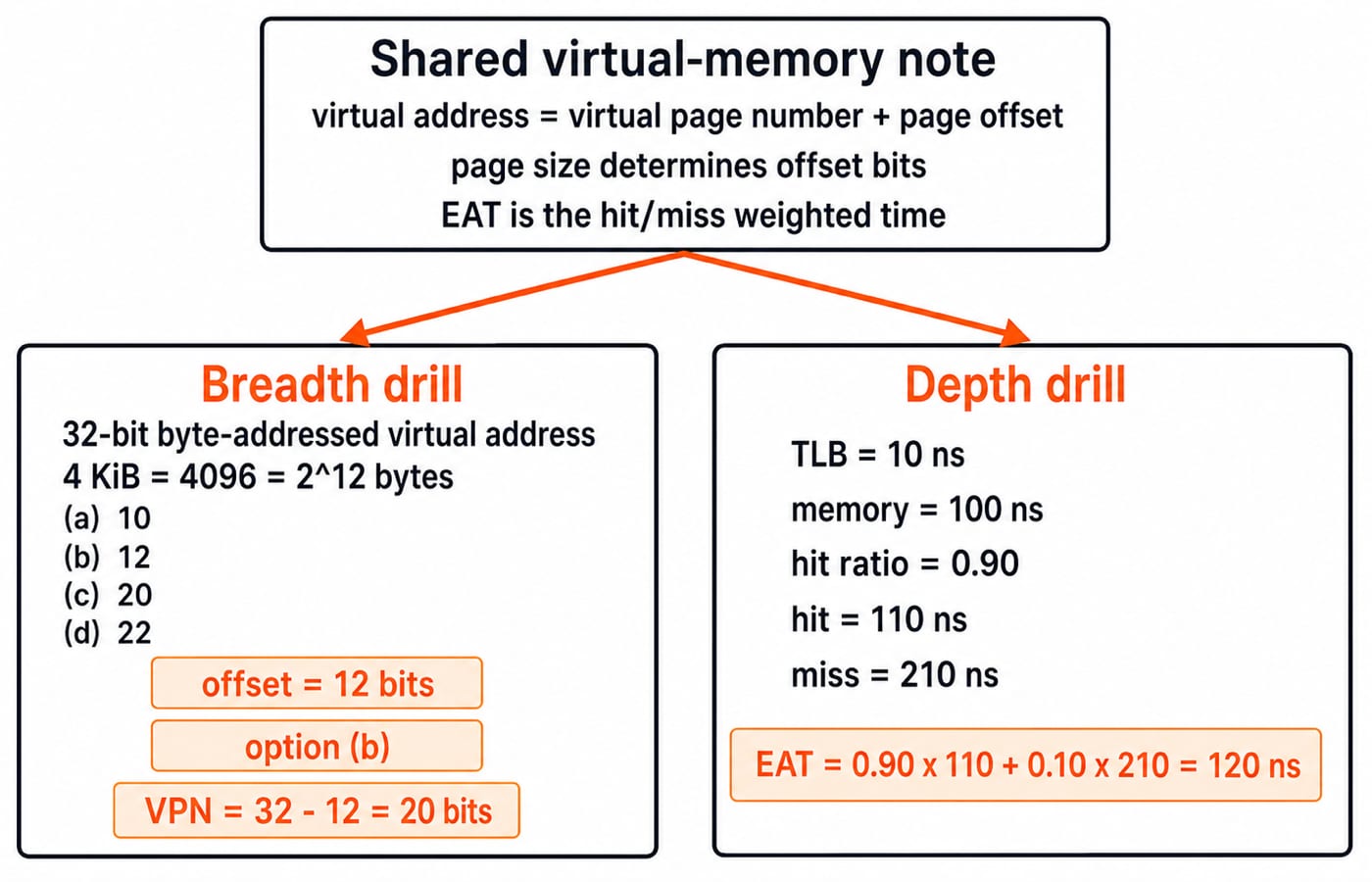
A 32-bit byte-addressed virtual address uses 4 KiB pages. How many bits form the page offset?
(a) 10
(b) 12
(c) 20
(d) 22
Since 4 KiB = 4096 bytes = 2^12 bytes, the offset is 12 bits, answer (b). The virtual page number is 32 - 12 = 20 bits. Retrieve the page-size rule quickly while rejecting the tempting 20-bit VPN answer.
Depth drill
Assume a 10 ns TLB lookup, one 100 ns memory access, a 0.90 hit ratio, a single-level page table, serial lookups and no page faults. A hit is 10 + 100 = 110 ns; a miss is 10 + 100 + 100 = 210 ns. Thus, EAT = 0.90(110) + 0.10(210) = 99 + 21 = 120 ns. This is sensible because 120 ns lies between 110 ns and 210 ns.
Both test virtual memory. One exposes retrieval and option discrimination, the other modelling, chaining and arithmetic.
Convert one note page into two revision outputs
Keep one canonical virtual-memory sheet and attach a NET-facing deck:
Page size sets offset bits.
VPN bits equal address bits minus offset bits.
A TLB caches recent translations.
A TLB miss is not automatically a page fault.
Moving from
4 KiB = 2^12to8 KiB = 2^13raises offset bits from12to13.EAT weights hit and miss paths.
GATE-facing ladder: 32-bit, 4 KiB gives offset 12 and VPN 20; 32-bit, 8 KiB gives offset 13 and VPN 19; the 0.90 case gives 120 ns; a 0.80 hit ratio gives 0.80(110) + 0.20(210) = 88 + 42 = 130 ns.
Reuse the method beyond memory management: one concept sheet, breadth deck and depth ladder. NTA-UGC-NET Paper - 2 offers optional structured NET Paper 2 coverage.
A 24-question diagnostic finds the missing revision layer
Build a diagnostic from studied common-syllabus areas: 12 breadth items and 12 depth or multi-concept items.
Learner A, moving from NET-first study towards GATE, gets 10/12 breadth and 5/12 depth, or 15/24 = 62.5%. The seven depth misses are 2 model-setup errors, 3 formula or substitution errors and 2 unit or sanity-check errors.
Learner B, moving from GATE-first study towards NET, gets 6/12 breadth and 10/12 depth, or 16/24 = 66.7% to one decimal. The six breadth misses are 3 terminology gaps, 2 exception gaps and 1 close-option misread.
Totals hide the repair. Learner B still lacks breadth; Learner A needs chained practice, not more definitions. Use UGC NET CS vs GATE CS Syllabus: Overlap and Extra Topics to select common-syllabus topics.
Build the next 10 revision hours from the evidence
Learner A: 2 hours rebuilding model diagrams and assumptions, 4 hours on graded multi-step problems, 2 hours on a timed mixed set, 1 hour checking units, bounds and special cases, and 1 hour re-solving every miss without notes. That is 2 + 4 + 2 + 1 + 1 = 10 hours. Seven depth misses justify this emphasis.
Learner B: 4 hours of active recall across units, 2 hours building definition, contrast and exception tables, 2 hours on close-option sets, 1 hour translating definitions into examples, and 1 hour re-solving every miss. That is 4 + 2 + 2 + 1 + 1 = 10 hours; six breadth misses justify the emphasis.
Retest with a fresh 12 + 12 diagnostic. GATE Guidance by Sanchit Sir offers optional GATE-focused problem practice and performance review.
Measure time pressure by question family
Sort 55, 70, 65, 190, 210, 80, 240, 90 seconds as 55, 65, 70, 80, 90, 190, 210, 240. The median is (80 + 90) / 2 = 85 seconds. Flag times above 2 x 85 = 170 seconds: 190, 210 and 240.
Classify causes: the 190-second recall miss goes to the breadth deck, the 210-second model-setup miss to the problem ladder and the 240-second repeated-arithmetic miss to a calculation drill. The UGC NET Mock Test Strategy: Score-Raising Plan expands the repair loop. The KnowledgeGate cross-exam bank has over 59,000 published questions, but filter practice by exam and syllabus.
UGC NET CS vs GATE CS revision: the short version
Audit questions with the four lenses. Keep one note page, create a breadth deck and depth ladder, take the 12 + 12 diagnostic, spend 10 hours by error split, then retest. Style changes retrieval practice, not the underlying CS truth. Use UGC NET CS Exam Preparation for the NET route. Today, convert the virtual-memory page into the six prompts and four problem rungs above.
Keep learning

Scope and Importance of International Business: UGC NET Commerce Examples
Exports, licensing and foreign investment cross borders in different ways. Separate their roles, compare entry modes and work through the opportunity-cost arithmetic behind comparative advantage.
Updated 13 Oct 20266 min readNET Strategy & Updates
FEMA Explained: Objectives, Key Provisions and UGC NET Commerce Examples
Two equal overseas payments can fall into different FEMA categories. Learn to classify transactions, apply an exporter checklist and calculate a penalty ceiling without counting the first day twice.
Updated 9 Oct 20265 min readNET Strategy & Updates
CSIR NET Normalization: Percentile and Normalised Marks Worked Out
Can 120 and 130 raw marks mean the same percentile? Follow a two-shift example from raw marks to percentile and normalised marks, then check which number belongs beside a cutoff.
Updated 5 Oct 20265 min readNET Strategy & Updates

UGC NET Eligibility for CA Holders: Equivalence, Marks and Subject Choice
Completed CA but have no MCom certificate? Understand the equivalence route, check the percentage requirement and resolve marks or subject-entry doubts before applying for NET.
30 Sep 20264 min readNET Strategy & Updates