UGC NET CS Paper 2 Preparation Order: A Subject-Wise Roadmap
Start with prerequisites, use fresh diagnostic sets to choose between eligible units, and promote a subject only after testing retention and mixed-question transfer.
KnowledgeGate Team
Exam prep & CS education
Updated 29 Aug 20265 min read70 views
The official syllabus tells a UGC NET CS candidate what Paper 2 covers, but its ten-unit list does not say what comes first. You need to know which subjects unlock later ones and when one is ready to leave. This dependency-led order uses two diagnostic scores, revision load and mixed-test evidence in a worked 12-week, 144-hour model.
Scope note: The UGC syllabus supplies the ten unit titles; confirm the version for your exam cycle on the NTA UGC-NET portal. The dependency order, repair-priority formula, revision blocks, test sizes, 12-week calendar, promotion thresholds and worked values below form one study model. They are not an NTA timetable, official specifications, weightage or marks, difficulty or importance ratings, or a rank prediction. KnowledgeGate's over 59,000 published-question count is platform-wide rather than specific to UGC NET CS or PYQs; label only verified previous-year questions as PYQs.
Start with the official ten-unit scope, not a weightage chart
The UGC NET syllabus directory lists Computer Science and Applications as subject code 87. Its ten official units are:
Unit | Official title |
|---|---|
1 | Discrete Structures and Optimization |
2 | Computer System Architecture |
3 | Programming Languages and Computer Graphics |
4 | Database Management Systems |
5 | System Software and Operating System |
6 | Software Engineering |
7 | Data Structures and Algorithms |
8 | Theory of Computation and Compilers |
9 | Data Communication and Computer Networks |
10 | Artificial Intelligence (AI) |
Use the UGC NET Computer Science syllabus and course map for topic-level scope.
Use a five-stage dependency order for the first pass
Stage | Order |
|---|---|
A | Unit 1 to Unit 3 |
B | Unit 7 to Unit 2 |
C | Unit 5 to Unit 4 |
D | Unit 8 to Unit 9 |
E | Unit 6 to Unit 10 |
The order is 1, 3, 7, 2, 5, 4, 8, 9, 6, 10. Unit 1 logic, relations, graphs and counting support algorithms, automata and AI. Unit 3 programming and translation support Unit 7 and the compiler half of Unit 8. Unit 2 gives machine context for operating systems and networks; Unit 5 supports systems communication. After Unit 1, move Unit 4 earlier when its diagnostics show greater repair need. Units 6 and 10 close the sequence for breadth and synthesis.
Let reliability and revision load choose the order inside a stage
After prerequisites, compare eligible units with this repair-priority measure:
Repair priority = (20 - lower score across two fresh 20-question sets) + score spread + planned 45-minute revision blocks.
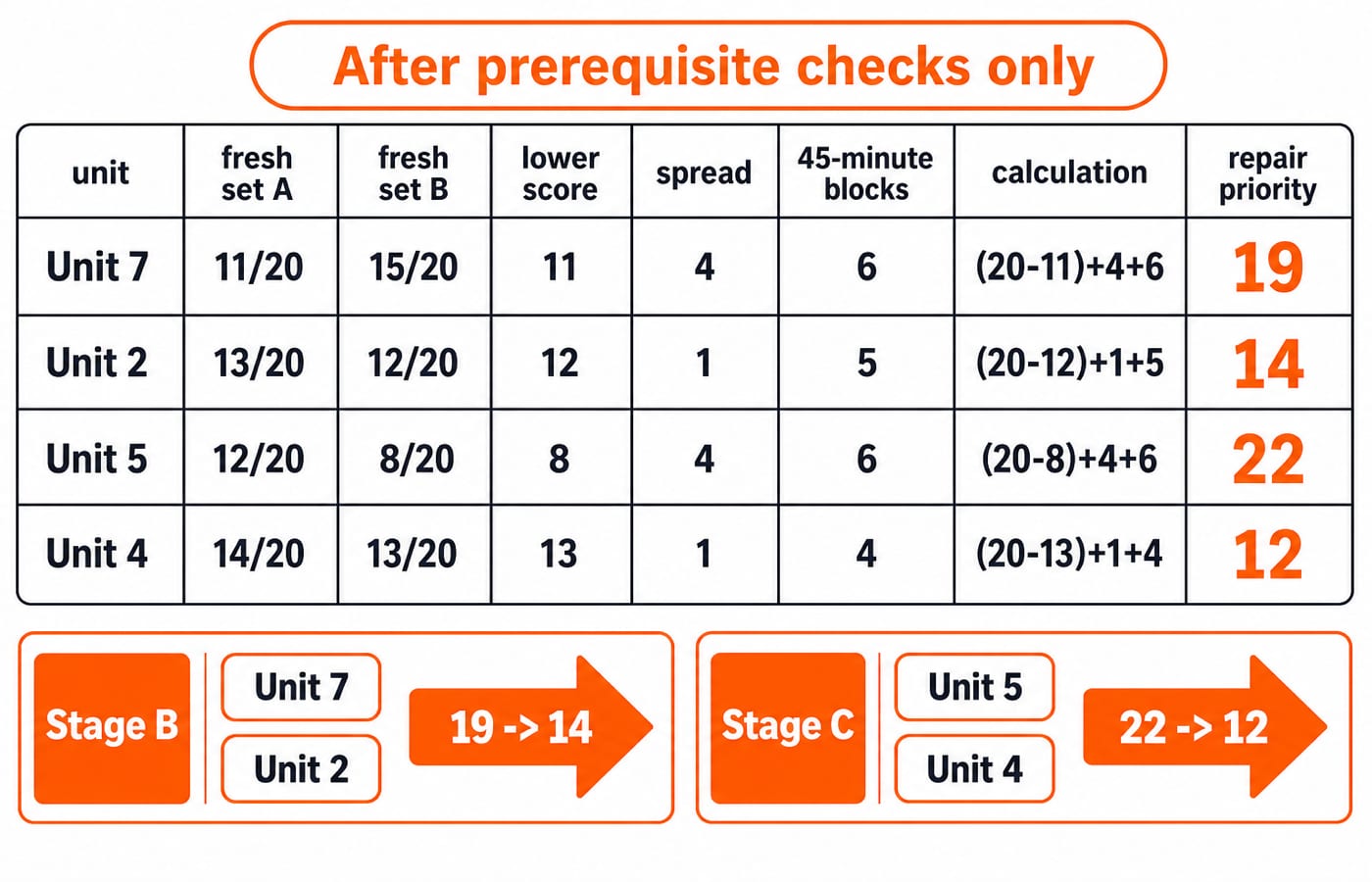
A higher result means more repair need. Unit 7 scores 11/20 and 15/20: (20 - 11) + (15 - 11) + 6 = 9 + 4 + 6 = 19. Unit 2 scores 13/20 and 12/20: (20 - 12) + (13 - 12) + 5 = 8 + 1 + 5 = 14. Keep Unit 7 first.
For Stage C, Unit 5 scores 12/20 and 8/20 with six blocks: (20 - 8) + (12 - 8) + 6 = 12 + 4 + 6 = 22. Unit 4 scores 14/20 and 13/20 with four blocks: (20 - 13) + (14 - 13) + 4 = 7 + 1 + 4 = 12. Keep Unit 5 before Unit 4. Then use the UGC NET Computer Science high-yield topics guide to choose topics within a unit.
Put the order into a 12-week, 144-hour first-pass calendar
Weeks 1 to 10 cover Units 1, 3, 7, 2, 5, 4, 8, 9, 6 and 10 respectively. Week 11 repairs the two weakest units. Week 12 uses mixed tests to close the error log.
For weeks 1 to 10, use 6 hours concept reconstruction + 3 hours verified PYQs + 2 hours self-timed testing + 1 hour error review = 12 hours. In weeks 2, 4, 6, 8 and 10, replace that testing slot with a 30-question, two-unit mixed test. The total is 12 weeks x 12 hours = 144 hours.
Week 11 uses six hours on the two weakest units, three on missed PYQs, two on one cross-unit test and one reviewing it. Week 12 has two 60-question self-timed mixed tests, each followed by review: 2 + 4 + 2 + 4 = 12 hours. The NTA-UGC-NET Paper 2 Complete Course offers a structured first-pass route.
Leave a subject only after fresh-set and retention gates
Set a promotion gate of at least 24/30 on two fresh subject tests and at least 8/10 on a seven-day closed-book recall check. If you begin the next subject, keep a smaller repair block for the old one; one familiar test does not complete it.
The first Unit 5 test has 21 correct + 6 wrong + 3 blank = 30, so accuracy is 21/30 = 70.0%. Its nine review items are 4 concept + 2 recall + 2 interpretation + 1 speed = 9. Repair for 2 hours concept + 1 hour recall + 30 minutes stem reading + 30 minutes timed solving = 4 hours. Fresh tests reach 24/30 = 80.0% and 25/30 = 83.3%; the seven-day check is 8/10 = 80.0%. The gate passes, but the nine original misses remain in the cumulative pool.
Pair every subject with PYQs, then prove transfer in mixed tests
Use two 15-question topic sets, one 20-question verified-PYQ set, then one 30-question mixed set containing the current unit and an earlier unit. Record unit, topic, source/year, correct, error type, time note and next repair for every review item.
The first Unit 5 plus Unit 4 mixed set is 18/30 = 60.0%. Repair its 12 items and repeat with fresh questions: 23/30 = 76.7%. A later Unit 2 plus Unit 5 plus Unit 4 set reaches 24/30 = 80.0%. Transfer across mixes beats rereading. KnowledgeGate has over 59,000 published questions platform-wide. The NTA UGC NET Paper 2 Test Series is a structured mixed-practice option.
If a week slips, stretch the calendar instead of doubling the next unit
If you finish 8 of 12 hours, 12 - 8 = 4 remain. Carry four hours forward and delay the next unit. Do not add them to a new 12-hour unit and create a 16-hour week.
At eight hours weekly, the workload needs 144 / 8 = 18 weeks. Keep the order and gates, but change dates. When 144 hours do not fit before the exam date, keep every syllabus unit and cut optional depth.
The short version: dependencies first, diagnostics second
Copy the ten official units and begin 1 -> 3. Use two fresh 20-question diagnostics to order eligible subjects. Give each unit verified PYQs, a mixed test and a seven-day recall gate. Carry errors into weeks 11 and 12.
Create columns for unit | prerequisite complete | set A | set B | spread | revision blocks | mixed result | status. For the wider route, use UGC NET CS Exam Preparation. Seek evidence for the next decision.
Keep learning

Scope and Importance of International Business: UGC NET Commerce Examples
Exports, licensing and foreign investment cross borders in different ways. Separate their roles, compare entry modes and work through the opportunity-cost arithmetic behind comparative advantage.
Updated 13 Oct 20266 min readNET Strategy & Updates
FEMA Explained: Objectives, Key Provisions and UGC NET Commerce Examples
Two equal overseas payments can fall into different FEMA categories. Learn to classify transactions, apply an exporter checklist and calculate a penalty ceiling without counting the first day twice.
Updated 9 Oct 20265 min readNET Strategy & Updates

CSIR NET Normalization: Percentile and Normalised Marks Worked Out
Can 120 and 130 raw marks mean the same percentile? Follow a two-shift example from raw marks to percentile and normalised marks, then check which number belongs beside a cutoff.
Updated 5 Oct 20265 min readNET Strategy & Updates

UGC NET Eligibility for CA Holders: Equivalence, Marks and Subject Choice
Completed CA but have no MCom certificate? Understand the equivalence route, check the percentage requirement and resolve marks or subject-entry doubts before applying for NET.
30 Sep 20264 min readNET Strategy & Updates