Types of Software MCQs: 12 Solved Questions with Clear Explanations
Twelve previous-year MCQs on software types and language translators, from BPSC, KVS, DSSSB, EMRS and UP Police papers. Each answer names the clue, the distractors and the concept to remember.
KnowledgeGate Team
Exam prep & CS education
Updated 5 Aug 20268 min read
Students often know compiler, interpreter and assembler but lose marks when a question switches among input language, translation amount, machine dependence and execution behaviour. The questions below come from BPSC, KVS, DSSSB, EMRS and UP Police papers between 2013 and 2026, and they turn on exactly those four switches plus one more: telling a piece of software apart from the company that sells it. Work out each answer before reading the explanation under it, then reattempt the same question on its practice page.
Types of software and language translators: the map before the MCQs
Area | Type | Role |
|---|---|---|
Software | System software | Includes the operating system, device drivers, utilities and language translators |
Software | Application software | Performs user-facing tasks |
Translator | Assembler | Translates assembly language |
Translator | Compiler | Translates a whole high-level source program before execution |
Translator | Interpreter | Translates and executes high-level source statement by statement |
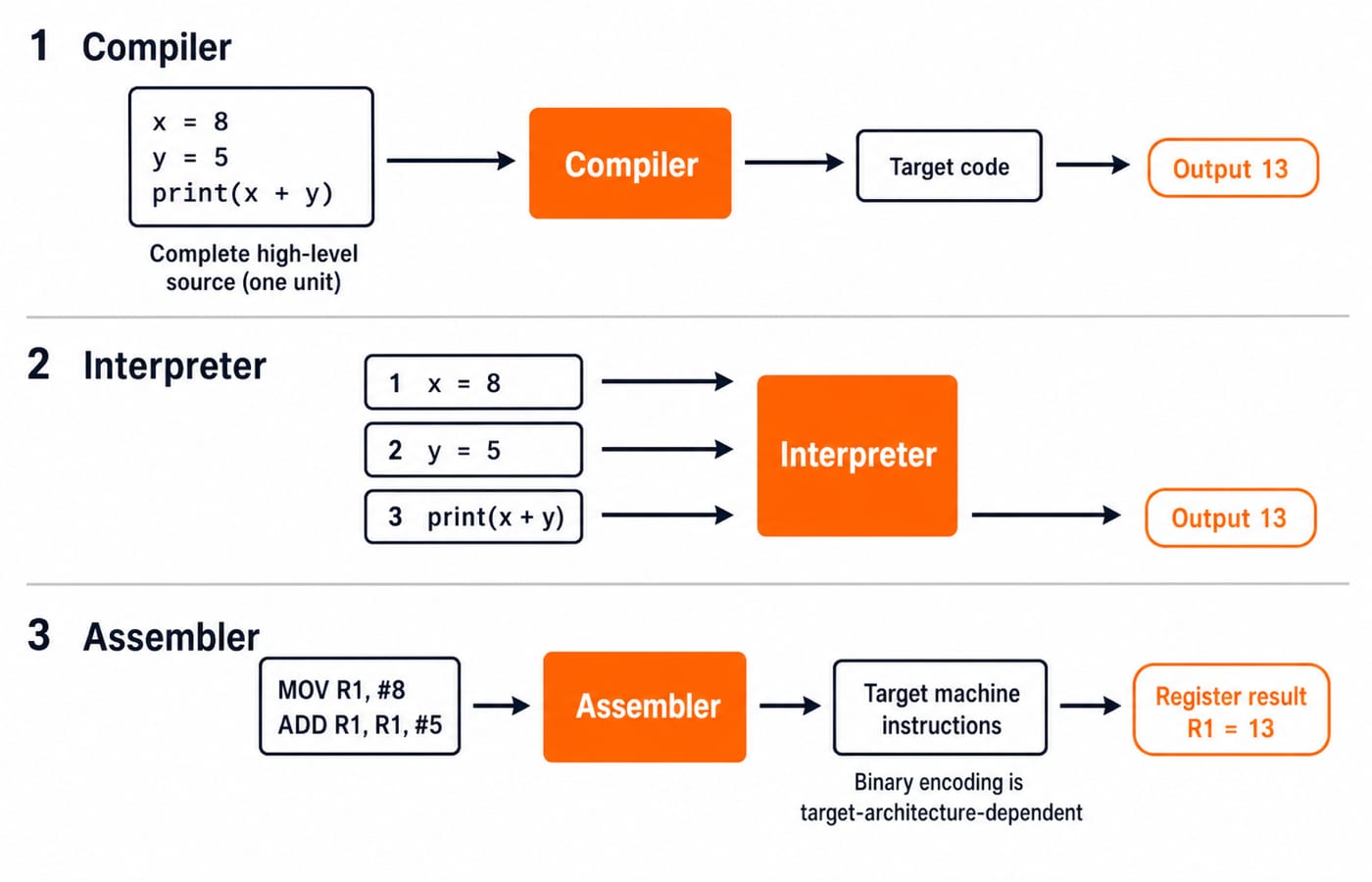
Machine language is binary and processor-dependent. Assembly uses mnemonics and symbolic operands but remains tied to a target architecture.
Consider three high-level statements: x = 8, y = 5, then print(x + y). Since 8 + 5 = 13, the result is 13. A compiler produces target code from all three statements before it runs. An interpreter processes statements 1, 2 and 3 in order, printing 13 at the third.
In illustrative pseudo-assembly, MOV R1, #8 places 8 in R1; ADD R1, R1, #5 leaves R1 = 13. An assembler turns those two mnemonics into the target processor's own machine instructions, and the bit pattern it emits differs from one architecture to the next.
Language levels and assembly mnemonics: Questions 1-3
Question 1, BPSC TGT 2023
An assembly language is a/an
A. Low-level programming language
B. Middle-level programming language
C. Internet-based programming language
D. More than one of the above
E. None of the above
Answer: A. Assembly is low-level because its instructions and registers correspond closely to one processor family. Mnemonics improve readability but do not make it machine-independent or middle-level. Practice.
Question 2, KVS 2023
Which of the following computer languages uses mnemonics?
A. High Level Language
B. Machine Language
C. Assembly Language
D. C Programming Language
Answer: C. A mnemonic is a short symbolic operation name, such as MOV or ADD. Machine language uses encoded bits, while C expresses operations at a higher level of abstraction. Practice.
Question 3, KVS 2023
Which of the following statement/s is/are correct about Assembly language?
(A) In this, mnemonics are used to represent operation codes
(B) Writing Assembly language programs is easy and time-saving
(C) It is machine independent
Choose the correct answer:
A. (A) and (B) are correct
B. (A) and (C) are correct
C. (B) and (C) are correct
D. Only (A) is correct
Answer: D. A is true because mnemonics represent operations. B is false because assembly programming is detailed and time-consuming; C is false because instructions and registers depend on the target architecture. Practice.
Assemblers and the language-processor family: Questions 4-5
Question 4, BPSC PGT Tier-2 2023
A computer program that converts an assembly language program into equivalent machine language program is called
A. compiler
B. assembler
C. linker
D. More than one of the above
E. None of the above
Answer: B. Assembly-language input requires an assembler. A compiler takes high-level source, while a linker combines object modules and resolves references. Practice.
Question 5, KVS 2018
Which of the following are language processors?
A. Assembler and Editor
B. Compiler and Word Processor
C. Only Assembler and Compiler
D. Assembler, Compiler and Interpreter
Answer: D. Assembler, compiler and interpreter all translate programs. Editors and word processors modify text without translating a programming language, while option C omits the interpreter. Practice.
What a compiler translates and produces: Questions 6-7
Question 6, BPSC TGT 2023
A compiler is a translating program which
A. Translates instruction of a high-level language into machine language
B. Translates entire source program into machine language program
C. It is not involved in program’s execution
D. More than one of the above
E. None of the above
Answer: D. All three statements hold at the same time. A compiler does convert high-level instructions into machine-level code, it does take the entire source program as one unit rather than one statement at a time, and once it has produced that output its own work is finished, so it plays no part in running the program. No single statement covers all three facts, which is why the option acknowledging more than one true statement is the one to mark. Practice.
Question 7, BPSC PGT Tier-1 2023
Select the true statement for compiler.
A. The input of the compiler is source program.
B. It translates the source code into object code as a whole.
C. The output of the compiler is object code.
D. More than one of the above
E. None of the above
Answer: D. The source program goes in, the whole of it is translated as a unit rather than statement by statement, and object code comes out. A, B and C are all true, so marking any single one leaves out two facts the question also states. Practice.
Both questions reward the same habit. Send the three-statement source through a compiler and nothing runs while translation happens: x = 8, y = 5 and print(x + y) are converted first, and only the program that comes out prints 8 + 5 = 13. The interpreter in the next section reaches the same 13 by a different route.
Interpreter definition, operation and trade-off: Questions 8-10
Question 8, EMRS 2023
What is an interpreter?
A. A program that converts machine language to high-level language
B. A program that converts whole of a program code into machine language in one step
C. A program that converts program into machine code line by line as the program is run
D. A program that writes instructions to perform tasks
Answer: C. An interpreter processes source line by line during execution. A reverses translation, B describes whole-program compilation, and D describes a source program rather than a translator. Practice.
Question 9, BPSC PGT Tier-2 2023
A computer program that translates high-level language program into machine language program statement-by-statement is called
A. compiler
B. loader
C. interpreter
D. More than one of the above
E. None of the above
Answer: C. “Statement-by-statement” is the phrase that settles it: an interpreter translates and runs one statement at a time. A compiler takes the entire source as a unit, and a loader translates nothing at all, it places an already translated program into memory. Practice.
Question 10, EMRS 2026
Which method of program translation in a computer executes code more slowly but provides easier error detection and debugging?
A. Loader
B. Compiler
C. Assembler
D. Interpreter
Answer: D. An interpreter halts at the statement that broke, so the error is easy to place, but it re-translates as it runs and pays for that in speed. Compiled code carries no translation cost at run time, so it usually runs faster, and its errors arrive in a batch from the compiler rather than at the line you were testing. Practice.
Change statement 2 to invalid text, y = ?. The interpreter completes statement 1, halts at statement 2 and never prints 13; the compiler rejects the source while translating all three statements together and produces no runnable program at all.
Machine-language properties and software identification: Questions 11-12
Question 11, DSSSB PGT 2021
Which of the following is false regarding the machine language?
A. It is machine dependent
B. It is easier to modify
C. It is made up of 1’s and 0’s
D. It is difficult to program
Answer: B. Machine language is processor-dependent, binary, and difficult for people to write or maintain. Because the question asks for the false option, the three true properties are distractors. Practice.
Question 12, UP Police 2013
Which is NOT a software in following list?
A. OpenOffice
B. Microsoft
C. DOS
D. Antivirus
Answer: B. OpenOffice is an application suite, DOS is an operating system, and antivirus is utility software, so all three are software. Microsoft is a company. The trap is reading “Microsoft” as “Microsoft Office”, which would be software and would leave the question with no answer. Practice.
The assembler half of this map is worked all the way through in Programming the Basic Computer (COA), which hand-assembles a complete program into machine code and shows why the assembler needs two passes.
Types of software MCQ patterns, traps and next step
Identify the language level and mnemonic clue in Questions 1-3.
Match the input language to its translator in Questions 4-5.
Recognise whole-program compilation in Questions 6-7, and check every listed statement before ruling out “more than one of the above”.
Recognise statement-by-statement interpretation and its debugging trade-off in Questions 8-10.
Spot a reversed property or category mismatch in Questions 11-12.
Symbolic mnemonics do not make assembly machine-independent.
An assembler takes assembly-language input.
Compilers and interpreters both take high-level source; what separates them is whole-program translation against statement-by-statement translation.
When several listed statements are separately true, “more than one of the above” is the answer, not whichever single statement sounds most precise.
A loader is not a translator.
A false-statement question reverses the selection rule.
A company name is not a piece of software, however familiar its products are.
The short version is: machine language -> binary and machine-dependent; assembly language -> mnemonics -> assembler; high-level source -> compiler as a whole or interpreter statement by statement; 8 + 5 -> 13. Now cover the answers and reattempt Questions 3, 5, 6, 7, 10, 11 and 12. Between them they test statement evaluation, family membership, “more than one of the above” twice over, the speed against debugging trade-off, false-option reading and exact noun classification.
Use the GATE CS Exam Preparation Courses & Test Series category for the broader route. Continue with Pipelining in Computer Architecture Explained, follow GATE Guidance by Sanchit Sir for structured Computer Organization learning, and use the GATE Test Series for timed practice.
Keep learning
Instruction Formats and Addressing Modes MCQs: 12 Solved Cross-Concept Questions
Solve 12 cross-concept COA questions that connect addressing-mode choices with PC rules, memory references, opcode fields, and byte-aligned instructions.
3 Oct 20267 min readComputer Organization MCQs
Interrupt-Driven I/O MCQs: 12 Solved Questions with Explanations
Attempt 12 previous-year interrupt-driven I/O questions, then check each answer with a concise explanation. The set covers ISR order, vectoring, priority, and CPU-time numericals.
28 Sep 20268 min readComputer Organization MCQs
Bitmap and Pixmap MCQs: 12 Solved Pixel Depth and Memory Questions
Build a reliable pixel-memory method through 12 live MCQs covering bitmaps, pixmaps, lookup tables, uncompressed storage, refresh rates, masks, and dithering.
Updated 25 Sep 20267 min readComputer Organization MCQs
Assembly & Assembler Design MCQs: 11 Solved PYQs Explained
Attempt 11 published PYQs on assembler directives, language levels, tables, register-pair instructions, debugging and fixed-width arithmetic, then check each worked explanation.
Updated 24 Sep 20267 min readComputer Organization MCQs