Types of Communication for Teaching Exams: Complete Notes with Solved Examples
Stop mixing oral, formal, interpersonal, downward and synchronous communication. These notes organise each label by axis and apply the map to a fully worked classroom example.
KnowledgeGate Team
Exam prep & CS education
Updated 6 Aug 20266 min read
Verbal, oral, formal, interpersonal, downward and synchronous are often memorised as one list, although each belongs to a different classification axis. One event can therefore carry several labels. For Govt Teaching Eligibility Tests papers, seven axes do the sorting: code, verbal subtype, participants, feedback, formality, organisational flow and time, and a single classroom instruction can take a label from every one of them.
1. Communication first: the process behind every type
Communication creates and exchanges meaning, rather than merely sending words. Its process is: sender or source, idea, encoding, message, channel, receiver, decoding, feedback, context and noise. Named models such as Shannon-Weaver, Berlo and Osgood-Schramm expand that same cycle, and Communication Basics for Teaching Exams works through them one by one.
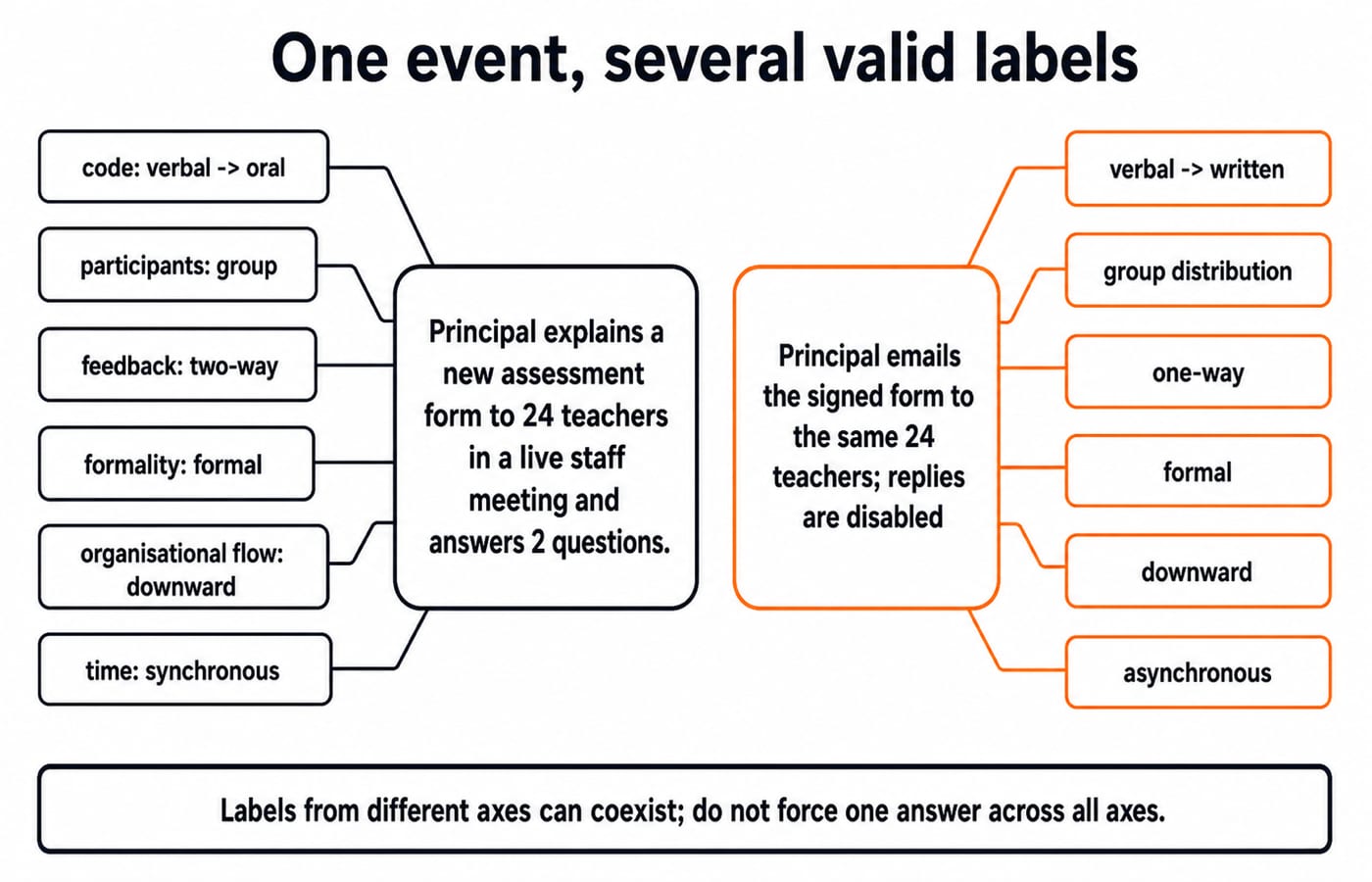
If a teacher says, Open page 18 and solve Questions 2 and 3 in four minutes, that sentence is the message and speech is the channel. Learners interpret it through decoding; their work or Do we write both answers? supplies feedback about that decoding. Noise is any physical, semantic, psychological, physiological or technical interference. This event may be oral, verbal, interpersonal, formal, downward, synchronous and two-way because those labels answer different questions.
2. Types by code: verbal, non-verbal and visual communication
Verbal communication uses words. Oral forms include lectures, discussions, calls and vivas; written forms include notices, emails, answer sheets and board instructions. Written is verbal. Verbal does not mean oral only.
Non-verbal communication covers facial expression, gesture, posture and movement (kinesics), eye contact, space (proxemics), culturally appropriate touch (haptics), time (chronemics), and paralanguage such as pitch, pace, pause and volume. Say
Please continuein a calm level tone, then a sharp rising tone. The words remain constant while attitude changes. Paralanguage is non-verbal because it concerns how words sound.Visual communication uses arrangement, shape or colour in grids, maps, charts and diagrams. A labelled chart combines verbal and visual codes. Textbooks classify visual communication differently, so use the question stem's framework.
3. Types by participants and reach
Intrapersonal: within one person, such as silently rehearsing
definition, example, trap.Interpersonal: between people, such as a teacher and learner discussing an error.
Group: members share a purpose, such as six learners comparing solutions.
Public: one speaker addresses a visible audience, such as a principal speaking to 240 learners.
Mass: a mediated message reaches a dispersed audience, such as educational radio across districts.
Classify the immediate setting. A teacher addressing 40 learners may be group or public communication under the stem's framework; a recorded lesson broadcast to thousands is mass or mediated. No universal head-count threshold separates them.
4. Types by feedback, formality, flow and time
Feedback: a recorded announcement without replies is one-way. A live session where learners ask two questions and the teacher adapts is two-way. A lecture changes category when usable feedback enters.
Formality: a signed circular from a principal to 24 teachers is formal; an unrecorded corridor conversation is informal. Oral need not be informal, nor written formal.
Organisational flow: principal to teachers is downward; a progress report to the principal is upward; same-level teachers coordinating an assessment is horizontal or lateral; a librarian coordinating with a mathematics teacher across units is diagonal. Relationship, not physical direction, decides.
Time: a live 10:00 to 10:40 class is synchronous; a post uploaded at 18:00 and answered next morning is asynchronous. An email thread can be asynchronous and two-way. A live broadcast without replies can be synchronous and one-way.
5. Worked classroom example: classify the complete cycle
A worksheet contains this 40-word passage:
Rina noticed that only twelve of forty saplings survived the dry week. She organised two watering teams, one for morning and one for evening. After seven days, thirty-six saplings were healthy, so the class kept the rota for another month.
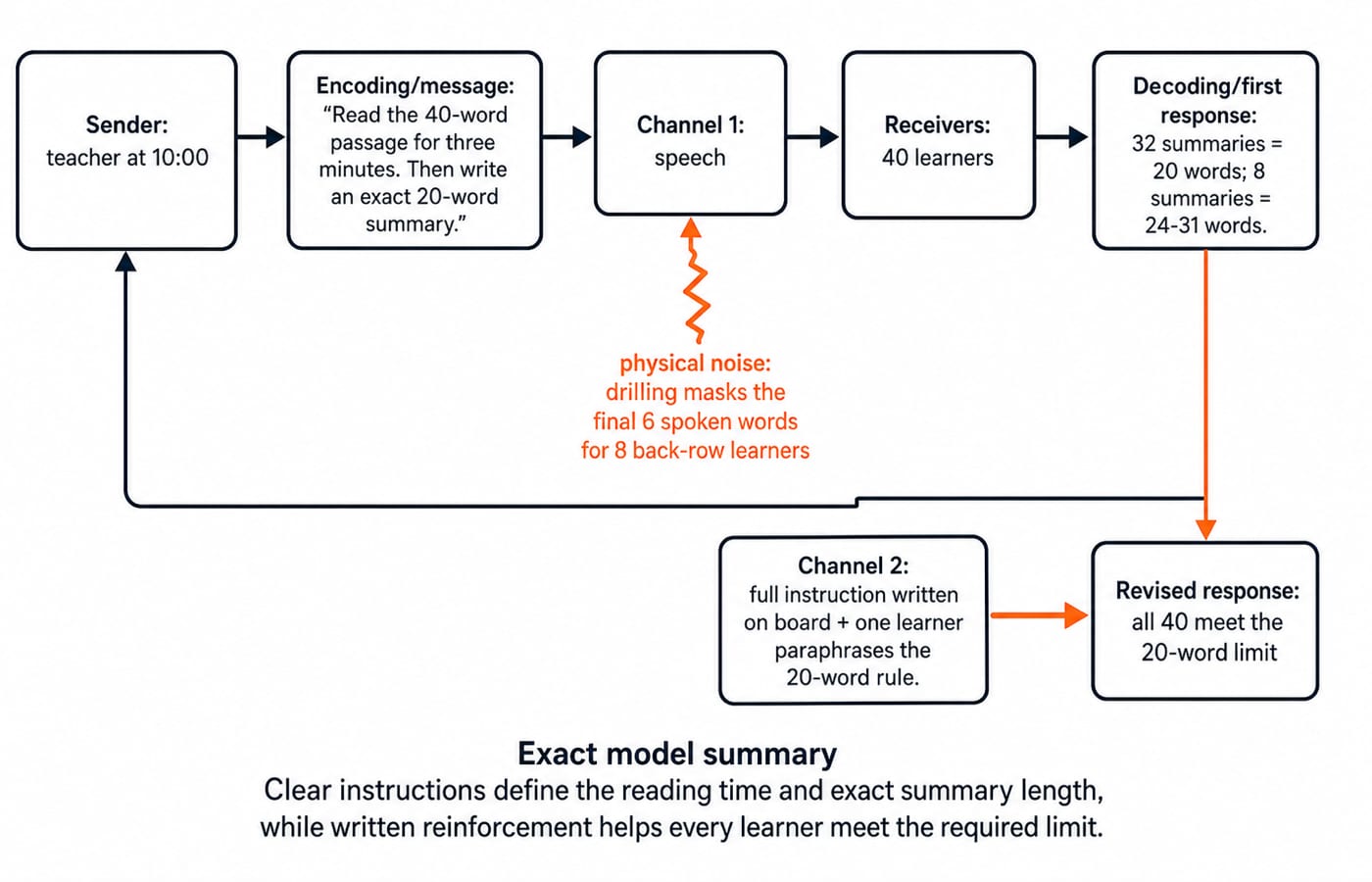
Its three sentences run 12 + 12 + 16 = 40 words. At 10:00, the teacher tells 40 learners: Read the 40-word passage for three minutes. Then write an exact 20-word summary.
Drilling masks the final six spoken words, Then write an exact 20-word summary, for eight back-row learners. On the first attempt, 32 learners submit 20 words and eight submit between 24 and 31 words. The teacher is the sender, the instruction is the encoded message, speech is the channel, the 40 learners are receivers, drilling is physical noise, interpretation is decoding, and the word counts are feedback. Check: 32 + 8 = 40 receivers.
The teacher writes the instruction on the board, asks one back-row learner to paraphrase The summary must have exactly 20 words, and lets eight revise. All 40 then meet the rule:
After only twelve of forty saplings survived, Rina created two daily watering teams that helped thirty-six recover in seven days.
Count four groups: After only twelve of forty (5), saplings survived Rina created two (10), daily watering teams that helped (15), thirty-six recover in seven days (20). The repair is verbal through oral plus written channels, group, formal, initially downward, synchronous and two-way after clarification. Feedback found a channel failure, redundancy moved the constraint into speech and writing, and paraphrase checked decoding.
6. Barriers and effective classroom communication
Barrier | Classroom sign | Useful repair |
|---|---|---|
Physical | Drilling masks six words | Pause, repeat or add a written channel |
Semantic |
| Replace it with |
Psychological | Fear of ridicule blocks questions | Offer anonymous response cards |
Physiological | A learner cannot hear clearly from the back | Change seating or use an accessible channel |
Technical | A frozen slide removes the example | Keep a board or printed fallback |
Effective communication needs clarity, suitable language and channel, learner context, feedback, consistent cues, and repair after failed decoding. Fluency or technology alone proves nothing. If a teacher says Questions are welcome but folds both arms, avoids eye contact and turns away after two seconds, the cues discourage feedback. The repair is to face the class, maintain neutral eye contact, wait eight seconds and accept the first question without interruption.
7. How teaching-exam questions test classifications
Four question forms recur: match a term to an example, pick the odd pair, classify a described scenario, and name the process component that failed. Marks, weightage, dates, question counts and paper structure differ by board and by cycle, so confirm those against the official notification, which for CTET is published at ctet.nic.in.
A candidate silently tells herself,
definition, example, trap. Intrapersonal, because sender and receiver are the same person.A principal sends a signed circular to 24 teachers with no reply route. Verbal-written, formal, downward, asynchronous and one-way.
Two same-grade teachers revise a rubric in a scheduled departmental meeting. Interpersonal or small-group by the stem's framework, formal, horizontal, synchronous and two-way.
A teacher says
well donewith unusually slow pace and falling volume. The words are verbal; pace and volume are non-verbal paralanguage.
For the repaired worked example, select verbal, oral plus written, group, formal, downward with upward feedback, synchronous and two-way. Reject mass because it is one class, intrapersonal because several people exchange meaning, and asynchronous because it is live. A single-axis question may have one best answer; multi-axis analysis may have several. Over 40 questions sit under the types-of-communication topic, most of them in the verbal and non-verbal communication practice set and the levels-of-communication set, which is where to test your labels against real stems.
8. One-minute revision and the next step
Code asks verbal, non-verbal or visual.
Verbal splits into oral and written.
Participants ask intra, inter, group, public or mass.
Feedback asks one-way or two-way.
Authority asks formal or informal.
Organisational relationship asks downward, upward, horizontal or diagonal.
Time asks synchronous or asynchronous.
One event can receive one label from several axes, and those labels never contradict each other. Run the seven checks above in order and the label set falls out.
Self-test: a live online class where 60 learners type questions and the teacher answers three of them. It is verbal through oral plus written chat, group or public, synchronous and two-way. Formality depends on whether it is authorised.
For a structured route through both levels, the CTET 2026 (Paper 1 and 2) plan builds primary and upper-primary preparation together. If you only need the upper-primary paper, CTET Paper 2 stands on its own. Keep the axes separate and practise applying them together.
Keep learning

सामान्य अशुद्धियाँ (Samanya Ashuddhiyaan): Complete Hindi Grammar Notes for CTET and TET Exams
Learn to identify and correct Hindi word-form, agreement, pronoun and redundancy errors through exact examples, a worked MCQ and a scored diagnostic.
Updated 6 Oct 20266 min readCTET & UPTET

Universities and Learning Programmes for Teaching Exams: Types, Modes and Solved Examples
Separate university status, delivery mode and programme purpose with a repeatable method, then test it on five UGC NET-style classification cases.
Updated 2 Oct 20265 min readCTET & UPTET

National Education Policy (NEP) 2020 Notes for Teaching Exams: 5+3+3+4, Reforms and MCQ Traps
Build an exam-ready map of NEP 2020, from the age-stage structure to pedagogy, language, PARAKH, B.Ed. routes and reliable distractor elimination.
Updated 26 Sep 20265 min readCTET & UPTET

Miscellaneous Pedagogy Topics for Teaching Exams: Complete Notes and Worked Examples
Turn a loose syllabus label into a five-part concept map, then use classroom evidence to distinguish sound pedagogy from attractive but incomplete options.
Updated 25 Sep 20266 min readCTET & UPTET