Mass Communication, Mass Media and Journalism: Complete Notes for Teaching Exams
Separate mass communication, mass media and journalism with clear definitions, newsroom vocabulary, theory recall cues and two fully worked examples.
KnowledgeGate Team
Exam prep & CS education
Updated 9 Aug 20266 min read
Mass communication, mass media and journalism are related, but they are not interchangeable. Teaching exams exploit the boundaries between the process, the channels and the professional practice: an item hands you a scenario and asks which of the three it names. The same trap runs through the model names, the newsroom vocabulary and the reach figures, where the plausible wrong option is usually the one that swaps a process for a channel, or a response for an audience.
Mass communication, mass media and journalism are not synonyms
Communication exchanges meaning. Mass communication is an organised source sending mediated messages to a large, dispersed, heterogeneous audience. Mass media are its channels and institutions. Journalism gathers, verifies, selects and presents public-interest information. Advertising and public relations use the same media, but are not journalism.
Term | What it names | Typical source and audience | Example |
|---|---|---|---|
Communication | Meaning exchange | Teacher, 35 pupils | Classroom communication |
Mass communication | Mediated process | Organised source, dispersed audience | Citywide radio bulletin |
Mass media | Channels, institutions | Broadcaster, users | Radio is the medium |
Journalism | Verified public-interest work | Newsroom, public | Verified newsroom report |
Computer Science Pedagogy for Teacher Exams develops the classroom-communication contrast in more depth. Syllabus wording for this area differs between recruiting bodies, so check which of these terms your own notification names, then organise study through the government teaching jobs category.
The mass-communication process and the role of models
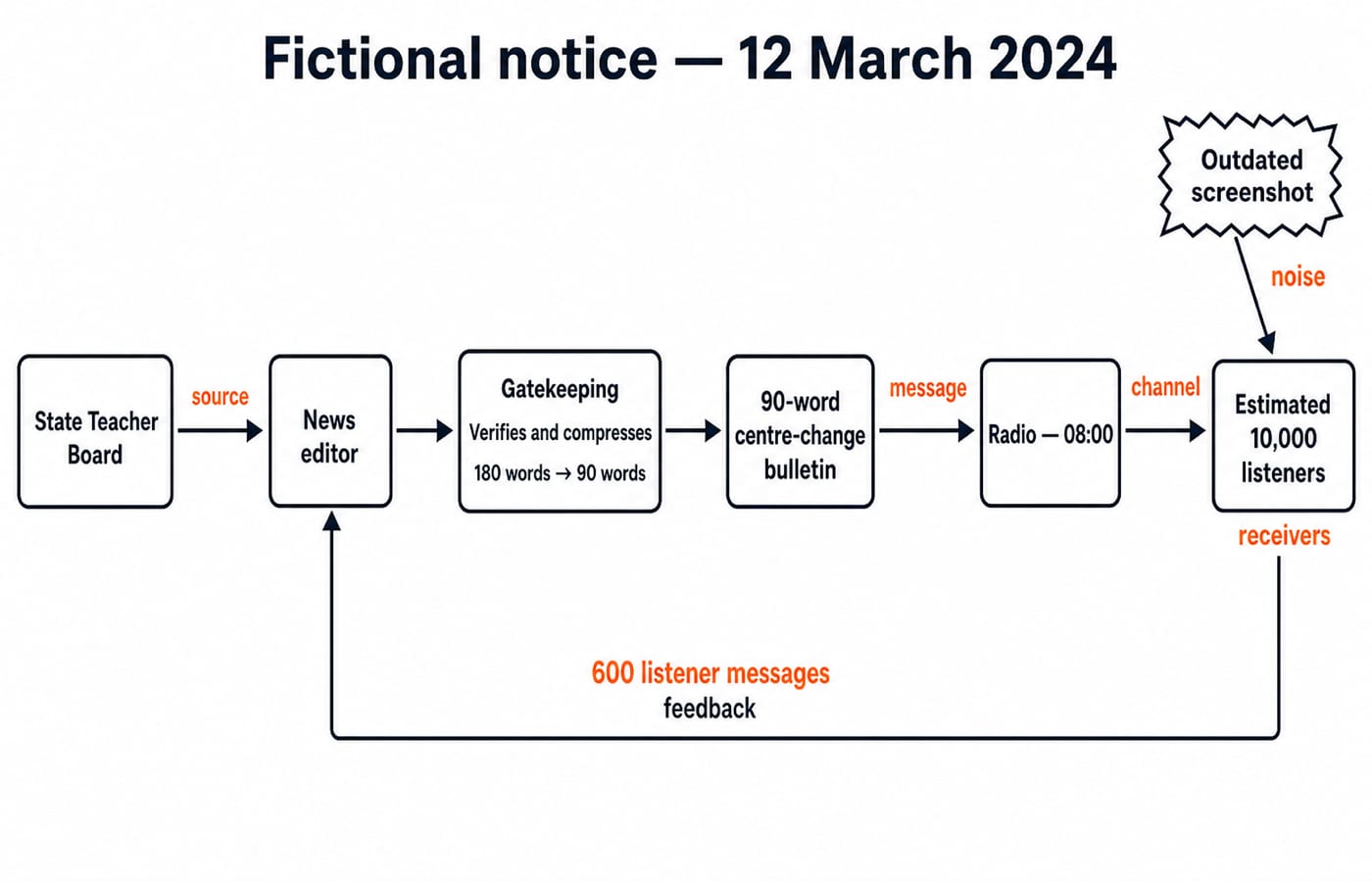
The basic chain is source -> encoding -> message -> channel -> receiver -> feedback. Gatekeeping affects what passes through the chain, while noise distorts or competes with the message. A model is a deliberate simplification of that chain: it fixes attention on one part so that part can be questioned on its own. Lasswell asks who says what, through which channel, to whom and with what effect. Shannon-Weaver inspects transmission, noise and received signal. These are different analytical lenses, not successive historical stages. The wider family, Berlo, Schramm, Barnlund and the rest, is taken model by model in Communication Models Explained: All 10 for Teaching Exams.
Consider a fictional case. At 08:00 on 12 March 2024, a State Teacher Board gives a newsroom a 180-word centre-change notice. The board is the source. The editor verifies and compresses it, which is encoding plus gatekeeping. The 90-word bulletin is the message, radio is the channel, and the estimated 10,000 listeners are the dispersed receivers. An outdated screenshot is noise. The 600 listener messages are feedback, not reach. Reading the bulletin does not make the editor its source.
Types, characteristics and convergence of mass media
Medium | Dominant sensory form | Permanence | Speed and feedback | One use |
|---|---|---|---|---|
Text, still image | High | Slower, delayed | Detailed report | |
Radio | Sound | Recorded if needed | Fast, usually indirect | Live bulletin |
Television | Sound, moving image | Recordable | Fast, delayed or connected | Visual report |
Film | Sound, moving image | Archivable | Slower production, later response | Documentary |
Digital or social | Multimedia | Searchable, editable | Rapid, often immediate | Live update |
Broadcasts receive calls or messages, so “radio has no feedback” is false. Print expanded reproducibility; telegraph and telephone reduced distance; cinema and radio scaled image or sound; television combined them at home; and satellite, cable, internet and mobile increased reach, choice, speed and interactivity.
One verified education report may become a 600-word web article, 90-second audio bulletin, 30-second vertical video and one-page infographic. The story is the message, those outputs are media products, and reuse is convergence.
Journalism basics through one inverted-pyramid report
News value explains an event's importance. A beat is a reporter's subject; a source supplies information; verification checks it. The lead or lede opens the report. Headline, byline, dateline and caption name it, credit the writer, locate the event and explain an image. Hard news prioritises timely facts; a feature adds context; an editorial gives institutional opinion; an op-ed gives signed opinion.
Use 5W1H, who, what, when, where, why and how. The inverted pyramid orders verified facts before background. Here is an invented brief whose lead runs to 29 words, followed by the next most useful fact rather than the background:
The State Teacher Board moved 12 examination centres across Jaipur, Kota and Ajmer on 12 March after flooding made the original buildings inaccessible before the 17 March recruitment test.
Candidates must download revised allotment slips from the board portal; the test date remains unchanged.
The 5W1H labels are: the board; moving 12 centres; 12 March, before the 17 March test; Jaipur, Kota and Ajmer; flooding; revised portal allotments. The unchanged date and the download instruction outrank the weather background, which is why they sit in the lead and the paragraph straight after it. Omit an unverified cancellation claim. 12 centres is a checkable fact in this brief, flooding is the stated cause, and “the board was careless” is opinion.
Media theories and thinkers without name-matching confusion
McLuhan's “the medium is the message” focuses on how a medium's form reshapes experience and social organisation. Agenda-setting concerns issue salience, not guaranteed control of opinion. Gatekeeping concerns selection and passage of information. Two-step flow places opinion leaders between media and parts of an audience. Keep Lasswell and Shannon-Weaver under communication models rather than relabelling them as media-effects theories.
Take a sample of 20 bulletins: school safety leads 8, nutrition 5, recruitment 4 and sports 3. First check the total: 8 + 5 + 4 + 3 = 20. The safe inference is that safety received the most prominence in this sample. It is unsafe to claim that every listener was made to support one safety policy.
Recall cue | Exact association |
|---|---|
McLuhan | Form of the medium |
Agenda-setting | Topic salience |
Gatekeeping | Selection |
Two-step flow | Opinion leaders |
Shannon-Weaver | Noise |
Lasswell | Who, says what, channel, whom, effect |
Digital media and a worked cross-media reach calculation
Reach counts unique people, impressions count exposures, and average frequency is impressions / reach. Shares, comments and clicks measure response, not persuasion, learning or truth. Digital features include interactivity, searchable archives, user content, algorithms, rapid correction and rapid misinformation.
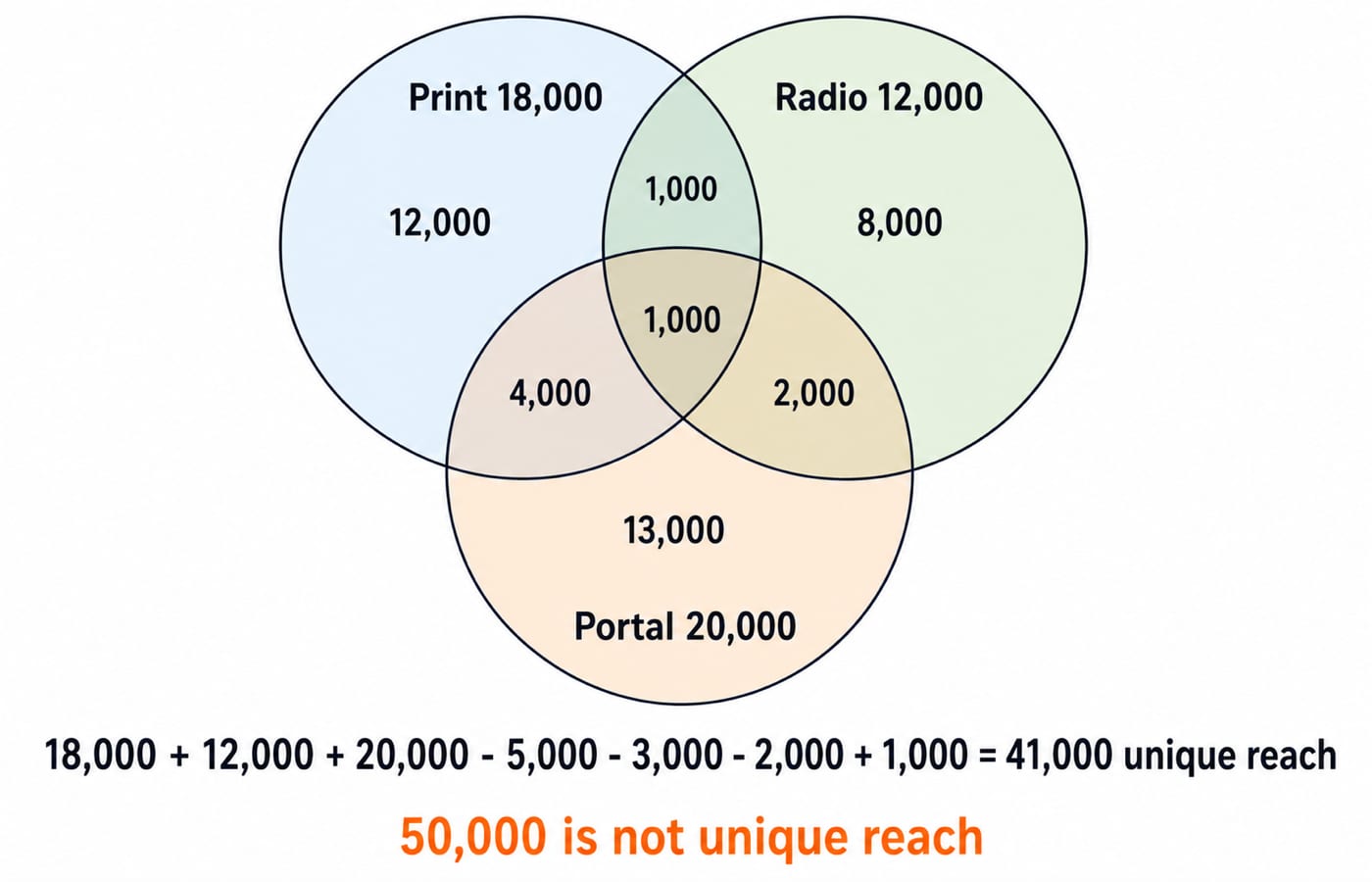
In an invented campaign, print reaches 18,000, radio 12,000 and a portal 20,000. The pairwise overlaps are 5,000 print-portal, 3,000 radio-portal and 2,000 print-radio, and 1,000 people saw all three. Each pair figure already contains those 1,000, which is what makes the last step below necessary.
Add totals:
18,000 + 12,000 + 20,000 = 50,000.Remove pair overlaps:
50,000 - 5,000 - 3,000 - 2,000 = 40,000.Restore the over-subtracted three-way overlap:
40,000 + 1,000 = 41,000.
So, 18,000 + 12,000 + 20,000 - 5,000 - 3,000 - 2,000 + 1,000 = 41,000; 50,000 double-counts people. Check the disjoint regions: print only 12,000; radio only 8,000; portal only 13,000; print-radio 1,000; print-portal 4,000; radio-portal 2,000; all three 1,000. Their sum is 41,000.
How teaching exams can test the topic, plus the traps to remove
Items in this area usually take one of five shapes: definition contrast, matching, sequence, statement evaluation and scenario classification.
Radio: medium.Broadcasting a bulletin to a dispersed audience: mass communication.8 of 20 bulletins cover safety: prominence, not proved persuasion.Removing an unverified pre-publication claim: gatekeeping.
Match: McLuhan, medium form; agenda-setting, salience; gatekeeping, selection; two-step flow, opinion leaders; Shannon-Weaver, noise; Lasswell, who, what, channel, whom, effect.
Trap | Why it fails | Replacement check |
|---|---|---|
Mass communication vs mass media | Process ≠ channel | Action or channel? |
Feedback vs audience size | Response ≠ reach | Identify return |
Gatekeeping vs censorship | Selection ≠ suppression | Check purpose |
Reach vs impressions | Repeats inflate totals | Count unique people |
Editorial vs news report | Opinion ≠ reporting | Fact or view? |
Agenda-setting vs direct attitude control | Salience ≠ persuasion | Infer prominence |
Over 70 practice questions on this topic sit in our question bank, so there is enough to test yourself properly. Solve 15 mixed questions. Tag each error as definition, model, theory, term or calculation, repair the weakest category, and retest after 48 hours. Then follow Teaching Exam Mock Test Strategy.
The short version and next step
Remember three layers: process means mass communication, channels and institutions mean mass media, and verified public-interest reporting means journalism. Match each theory to its claim, and remove overlap in reach calculations.
Copy your exam's current official syllabus, mark its communication terms, and practise both examples without notes. For UGC NET Paper 1, the NTA UGC NET Paper 1 Course is an optional structured route after confirming the syllabus.
Keep learning

सामान्य अशुद्धियाँ (Samanya Ashuddhiyaan): Complete Hindi Grammar Notes for CTET and TET Exams
Learn to identify and correct Hindi word-form, agreement, pronoun and redundancy errors through exact examples, a worked MCQ and a scored diagnostic.
Updated 6 Oct 20266 min readCTET & UPTET

Universities and Learning Programmes for Teaching Exams: Types, Modes and Solved Examples
Separate university status, delivery mode and programme purpose with a repeatable method, then test it on five UGC NET-style classification cases.
Updated 2 Oct 20265 min readCTET & UPTET

National Education Policy (NEP) 2020 Notes for Teaching Exams: 5+3+3+4, Reforms and MCQ Traps
Build an exam-ready map of NEP 2020, from the age-stage structure to pedagogy, language, PARAKH, B.Ed. routes and reliable distractor elimination.
Updated 26 Sep 20265 min readCTET & UPTET

Miscellaneous Pedagogy Topics for Teaching Exams: Complete Notes and Worked Examples
Turn a loose syllabus label into a five-part concept map, then use classroom evidence to distinguish sound pedagogy from attractive but incomplete options.
Updated 25 Sep 20266 min readCTET & UPTET