Multi-Topic General Hindi for Teaching Exams: Cross-Concept Notes and Worked Set
Learn to separate meaning, word formation, usage, and comprehension when one Hindi passage supports several question types. Then practise the method on a fully solved set.
KnowledgeGate Team
Exam prep & CS education
Updated 4 Aug 20266 min read
You may solve संधि, समास, विलोम, मुहावरा, and गद्यांश separately, then hesitate when one passage combines all of them. The habit that fixes this is small: sort every demand into four baskets (शब्द-ज्ञान, शब्द-रचना, प्रयोग और शुद्धि, अर्थ-बोध), read the stem for the basket it wants, and answer only that basket. A single three-sentence Hindi passage can carry seven correct answers this way, and विद्यालय alone supplies two of them at different layers. CTET and UPTET both pull Hindi into their Language I and Language II sections, so the sorting habit pays across teaching eligibility course routes.
1. What multi-topic General Hindi actually tests
A multi-topic Hindi question set mixes concepts you already know; it does not introduce a new grammar rule. One source line can support several concepts at once. Identify the unit the stem is asking about, then apply only that unit's rule.
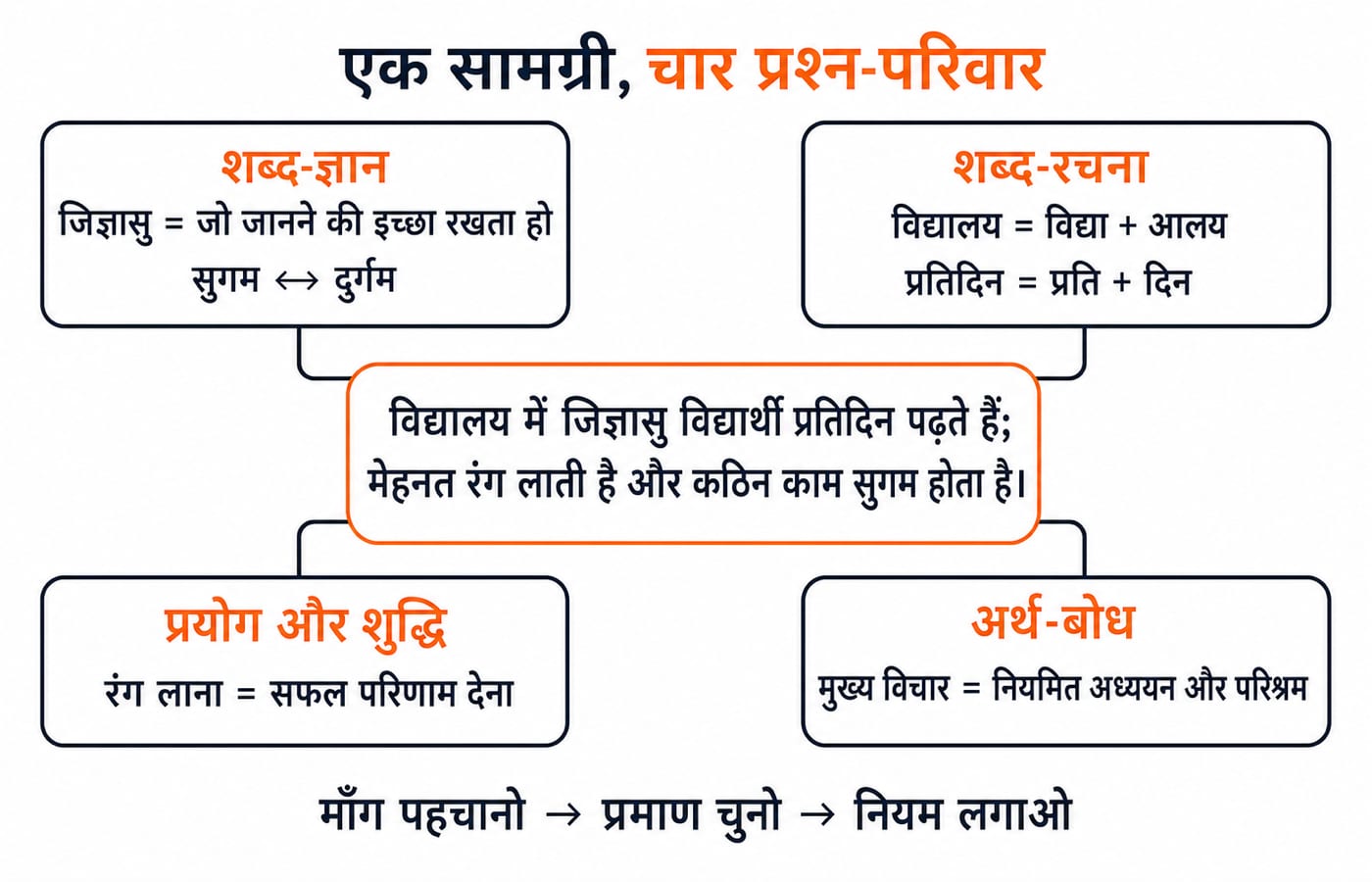
Four baskets organise the work: शब्द-ज्ञान for पर्यायवाची, विलोम, and वाक्यांश के लिए एक शब्द; शब्द-रचना for संधि and समास; प्रयोग और शुद्धि for मुहावरा, लोकोक्ति, वर्तनी, and agreement; अर्थ-बोध for meaning, inference, title, and central idea. Five words carry the worked passage: विद्यालय and प्रतिदिन sit in शब्द-रचना, जिज्ञासु and सुगम in शब्द-ज्ञान, and रंग लाना in प्रयोग और शुद्धि.
Follow माँग पहचानो -> प्रमाण चुनो -> नियम लगाओ. Underline the संधि-विच्छेद, समास-विग्रह, विलोम or आशय the stem actually names, copy the line that proves it, then apply the rule for that basket alone. In CTET both language papers test language ability rather than the pedagogy of Hindi, a split a CTET Language I and II strategy works through section by section.
2. Word meaning and fixed expressions
पर्यायवाची are context-close: सूर्य can take रवि or भानु, but शशि means moon. Exact विलोम pairs include सुगम and दुर्गम, उन्नति and अवनति, आलस्य and परिश्रम. Match context, not a guessed prefix.
वाक्यांश के लिए एक शब्द compresses meaning: जो जानने की इच्छा रखता हो is जिज्ञासु, जो कभी न मरे is अमर, and जिसे जीता न जा सके is अजेय. Check role before choosing जिज्ञासा, जिज्ञासु, or जिज्ञासापूर्ण.
A मुहावरा works in sentences. उसकी मेहनत रंग लाई means सफल परिणाम देना, not bringing colour. A लोकोक्ति is complete, such as जहाँ चाह, वहाँ राह.
3. Word formation: separate संधि and समास
संधि examines boundary sound change; समास examines a suppressed word relation. विद्यालय splits as विद्या + आलय; आ + आ -> आ makes दीर्घ संधि. Its विग्रह विद्या का आलय makes षष्ठी तत्पुरुष. Both fit different layers.
Expose the hidden relation before naming a समास:
प्रतिदिन = प्रत्येक दिन, अव्ययीभाव, with प्रति governing the compound.
नीलकमल = नीला है जो कमल, कर्मधारय.
माता-पिता = माता और पिता, द्वंद्व.
Different split or sound change means संधि; different विग्रह or relation means समास. Not every compound changes sound, and the first word alone cannot determine its type.
4. Sentence correctness and evidence
Correct लड़कियाँ मैदान में खेल रहा है। to लड़कियाँ मैदान में खेल रही हैं। A feminine plural subject requires रही and हैं; changing only है fails. In मुझे केवल मात्र दो पुस्तकें चाहिए।, keep either केवल or मात्र.
Separate fact, contextual meaning, inference, title, and main idea. Use supplied lines first. A true claim may lack evidence; a title must cover the passage.
सुगम may supply a विलोम while its sentence supports a conclusion. The stem decides between विलोम, आशय, and मुख्य विचार.
5. Worked example: one passage, seven questions
Original exam-style passage:
विद्यालय के जिज्ञासु विद्यार्थियों ने प्रतिदिन एक घंटा अध्ययन करने का निश्चय किया। प्रधानाचार्य ने कहा, “परिश्रम रंग लाता है; आलस्य छोड़ो।” नियमित अभ्यास से कठिन कार्य भी सुगम हो जाता है।
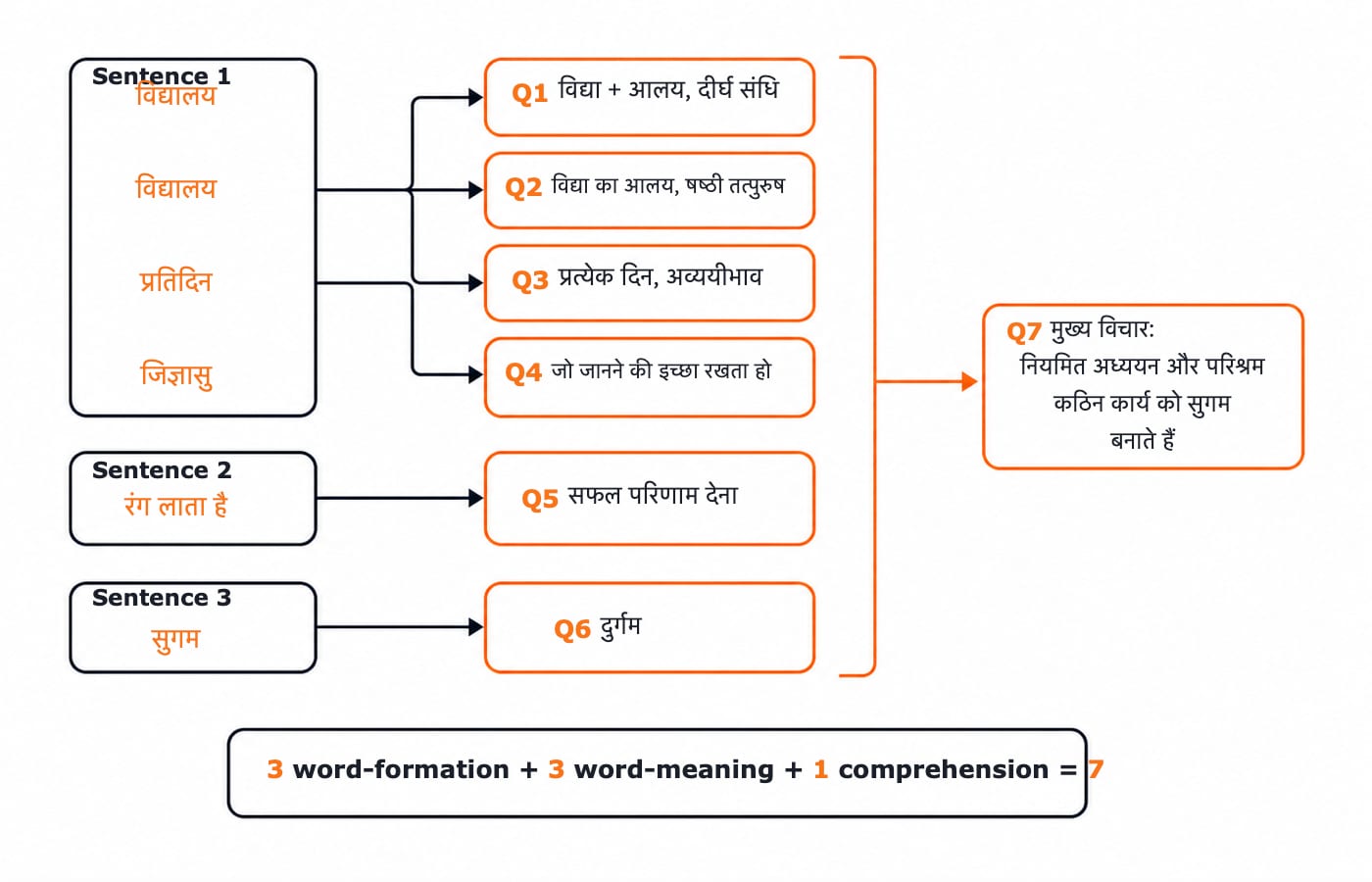
Three sentences state one duration, एक घंटा, and support seven questions that touch all four baskets: शब्द-रचना for Questions 1 to 3, शब्द-ज्ञान for Questions 4 and 6, प्रयोग और शुद्धि for the मुहावरा in Question 5, and अर्थ-बोध for Question 7.
क्रम | माँग | प्रमाण | नियम | उत्तर |
|---|---|---|---|---|
1 | विद्यालय: संधि | विद्यालय | आ + आ -> आ | विद्या + आलय, दीर्घ संधि |
2 | विद्यालय: समास | विद्यालय | का relation | विद्या का आलय, षष्ठी तत्पुरुष |
3 | प्रतिदिन: समास | प्रतिदिन | प्रति governs | प्रत्येक दिन, अव्ययीभाव |
4 | phrase to word | जो जानने की इच्छा रखता हो | compression | जिज्ञासु |
5 | रंग लाना: meaning | परिश्रम रंग लाता है | मुहावरा | सफल परिणाम देना |
6 | सुगम: विलोम | सुगम | exact opposite | दुर्गम |
7 | मुख्य विचार | all three sentences | combine evidence | नियमित अध्ययन और परिश्रम कठिन कार्य को सुगम बनाते हैं |
Questions 1 and 2 read one word, विद्यालय, at two layers. Question 3 needs a विग्रह, Questions 4 to 6 all turn on meaning, and Question 7 needs all three sentences together. Grouped that coarser way the split is 3 word-formation, 3 word-meaning and 1 comprehension, which is 7.
6. Common traps and elimination
Trap | Why | Error | Fix |
|---|---|---|---|
समास answer for संधि | One word supports both | Wrong operation | Mark the demanded operation |
Literal मुहावरा | Words look familiar | Context lost | Test the phrase in a sentence |
शशि for सूर्य | Familiar distractor | Moon replaces sun | Recall exact meaning |
Outside knowledge | The claim is true in general | No support | Cite a line |
Correcting only है | The visible mismatch draws the eye | खेल रहा mismatches | Check predicate |
One-line title | One vivid phrase looks like the point | Passage is narrowed | Cover the central idea |
Mark the demanded operation, reject the wrong family, test the evidence line, then reread the stem. विद्या का आलय cannot answer a संधि-विच्छेद stem, however correct it is as a विग्रह. Reset with one of four questions: संधि नियम, समास संबंध, शब्द अर्थ, or पाठ प्रमाण. The same discipline heads off several of the common CTET mistakes that cost marks elsewhere in the paper.
7. Cross-concept Hindi question frames
Stems may ask you to match pairs, pick a संधि-विच्छेद or a समास-विग्रह, replace a phrase with one word, interpret a मुहावरा, correct a sentence, or draw an inference and choose a title. Which of these your paper carries, and in what proportion, is set by the notification for your exam, and for CTET that notification lives at ctet.nic.in.
Try these original checks:
विद्यालय का सही संधि-विच्छेद है: A विद्या + लय, B विद्या + आलय, C विद् + यालय, D विद्या + अलय. B, because आ + आ -> आ.
प्रतिदिन में कौन-सा समास है? A द्वंद्व, B कर्मधारय, C अव्ययीभाव, D बहुव्रीहि. C, because its विग्रह is प्रत्येक दिन.
“उसकी मेहनत रंग लाई” में रंग लाना का अर्थ है: A रंग खरीदना, B सफल परिणाम देना, C काम रोकना, D रूप बदलना. B, effort produces success.
शुद्ध वाक्य चुनिए: A लड़कियाँ खेल रहा है। B लड़कियाँ खेल रही हैं। C लड़कियाँ खेल रहे है। D लड़कियाँ खेलती है। B, because the predicate agrees with a feminine plural subject.
Answer all four from the passage words alone before you look at the keys, then redo them from memory the next day. The first move is always naming the basket: reach for a rule before you have named the demand and the wrong-family trap catches you again.
8. Short version and retrieval drill
A mixed Hindi set is a format, not a new grammar rule.
Identify the demanded concept first.
शब्द-ज्ञान asks about meaning relations.
शब्द-रचना asks about form and component relations.
प्रयोग और शुद्धि asks about sentence use.
अर्थ-बोध asks what the text supports.
One word can have correct analyses at different layers.
Eight-minute drill:
2 minutes: विद्यालय. Key: विद्या + आलय, दीर्घ संधि; विद्या का आलय, षष्ठी तत्पुरुष.
1 minute: प्रतिदिन. Key: प्रत्येक दिन, अव्ययीभाव.
1 minute: रंग लाना. Key: सफल परिणाम देना.
1 minute: सुगम. Key: दुर्गम.
2 minutes: लड़कियाँ मैदान में खेल रहा है। Key: लड़कियाँ मैदान में खेल रही हैं।
1 minute: main idea. Key: नियमित अध्ययन और परिश्रम कठिन कार्य को सुगम बनाते हैं.
If you want this sorting habit built into a full Hindi plan, the CTET 2026 course bundle for Paper 1 and Paper 2 and the UPTET Paper 1 course are built around the papers your Hindi section sits in. If you only need the drills, the four-basket sort and the eight-minute key stand on their own.
Keep learning
सामान्य अशुद्धियाँ (Samanya Ashuddhiyaan): Complete Hindi Grammar Notes for CTET and TET Exams
Learn to identify and correct Hindi word-form, agreement, pronoun and redundancy errors through exact examples, a worked MCQ and a scored diagnostic.
Updated 6 Oct 20266 min readCTET & UPTET
Universities and Learning Programmes for Teaching Exams: Types, Modes and Solved Examples
Separate university status, delivery mode and programme purpose with a repeatable method, then test it on five UGC NET-style classification cases.
Updated 2 Oct 20265 min readCTET & UPTET
National Education Policy (NEP) 2020 Notes for Teaching Exams: 5+3+3+4, Reforms and MCQ Traps
Build an exam-ready map of NEP 2020, from the age-stage structure to pedagogy, language, PARAKH, B.Ed. routes and reliable distractor elimination.
Updated 26 Sep 20265 min readCTET & UPTET
Miscellaneous Pedagogy Topics for Teaching Exams: Complete Notes and Worked Examples
Turn a loose syllabus label into a five-part concept map, then use classroom evidence to distinguish sound pedagogy from attractive but incomplete options.
Updated 25 Sep 20266 min readCTET & UPTET