BTSC Lab Assistant (CS) Preparation: Subject Weightage and a 60-Day Study Plan
Turn the broad BTSC Lab Assistant Computer Science syllabus into a practical priority order, then follow a 60-day plan built around recall, questions, mocks and recovery time.
KnowledgeGate Team
Exam prep & CS education
Updated 6 Aug 20265 min read
Most BTSC Lab Assistant (CS) aspirants do not have a syllabus problem. They have a sequencing problem: too many subjects, too little time, and no clear answer to what should come first.
The Computer Science portion spans the undergraduate core and practical fundamentals. Sixty days is enough to cover it once properly, provided the heavy subjects take the early weeks and the difficult corners get a hard time limit.
1. What the CS paper actually rewards
An objective Computer Science paper rewards broad recall, clean concepts and quick elimination. Build enough depth to reject tempting distractors without starting with every subject's hardest material.
Start from the BTSC Lab Assistant syllabus topic map, then split the Computer Science subjects into three tiers and give each tier a fixed share of your hours. Any official subject-wise marks split is in the current notification; the shares below are study-time weightings, set by how much of the syllabus each block covers and how fast it repays the hours. At three hours on weekdays and five at weekends, the plan runs about 25 hours a week and roughly 210 hours across the 60 days.
Priority | Subjects | What to secure | Share of the 210 hours |
|---|---|---|---|
Tier 1, study first | Computer fundamentals and IT tools, DBMS, Operating Systems, Computer Networks | Definitions, standard procedures, common comparisons and direct applications | About 85 hours (40 percent) |
Tier 2, build next | C and C++, data structures, digital electronics | Output tracing, basic complexity, standard operations and circuit logic | About 50 hours (25 percent) |
Tier 3, cap the depth | Computer organisation, software engineering, office tools, theory of computation | Core terms, standard results and frequently confused pairs | About 20 hours (10 percent) |
The remaining quarter, about 55 hours, belongs to timed tests, written analysis and final revision in Phases 3 and 4. Confirm the live paper structure, eligibility and selection stages on the official BTSC portal before you commit to the schedule, because a plan built against a superseded notification wastes weeks.
Use the Government Jobs category to compare BTSC with related technical recruitments.
2. The 60-day plan at a glance
Each phase spends that same 25-hour week differently. Every block should produce notes, solved questions or reviewed errors.
The six buffer days sit inside the 60-day window. Use them for illness, travel or difficult topics; otherwise spend them on cumulative revision.
Phase | Days | Main job | Measurable output |
|---|---|---|---|
Phase 1 | 1 to 24 | Tier 1 theory | Crisp notes, daily recall and topic MCQs |
Phase 2 | 25 to 44 | Tier 2 plus a controlled Tier 3 pass | Programming traces, data-structure drills and digital practice |
Phase 3 | 45 to 56 | Previous-year questions and full tests | Timed attempts followed by written analysis |
Phase 4 | 57 to 60 | Final revision and weak-area sprints | Error-log closure and short mixed drills |
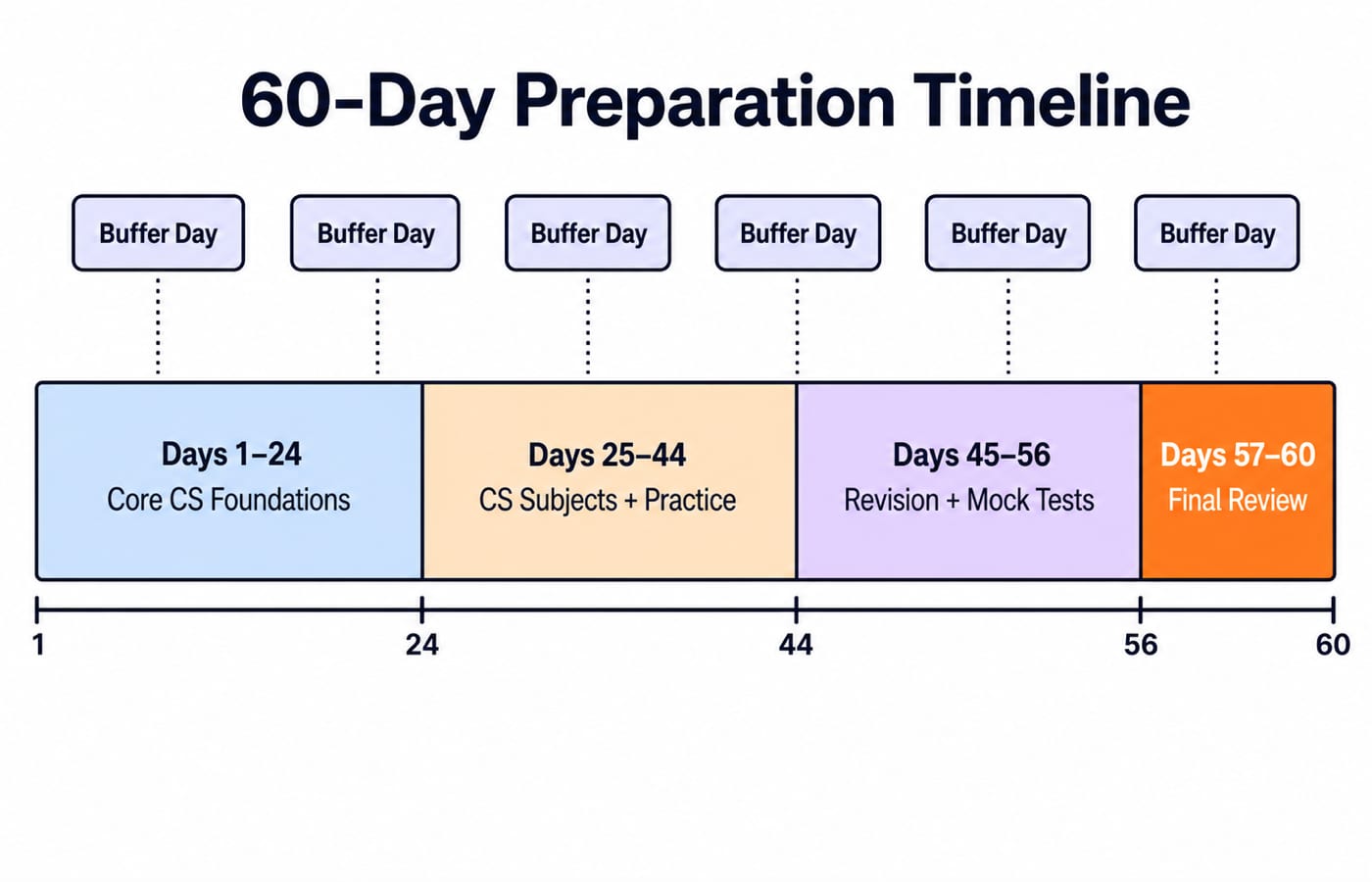
The phase boundaries protect the sequence: secure dependable theory, add breadth, convert it through tests, and spend the final days on weaknesses the tests expose.
3. Phase 1 (Days 1-24): lock the Tier 1 theory
Begin with computer fundamentals and IT tools, then cover DBMS keys, normalisation and SQL; OS processes, scheduling and memory; and network models, devices, addressing and major protocols.
Use a simple three-block weekday routine:
Spend the first block learning one compact concept set.
Use the second block to write one page of notes without copying paragraphs.
Use the final block to solve 25 to 30 questions from the day's primary subject and analyse every error.
The one-page limit keeps notes to definitions, conditions, formulas and exceptions. Put every wrong or guessed answer in an error log with the topic, cause and correct rule.
Review that log at the start of the next session and mark an entry closed only after answering a fresh question correctly.
KnowledgeGate's question bank carries more than 16,000 practice questions across these subjects. Use that depth to review mistakes, not merely accumulate attempts.
4. Phase 2 (Days 25-44): breadth plus programming
Now add C and C++, data structures and digital electronics. Trace code on paper; cover standard structures and sorting methods; and practise number systems, Boolean simplification, K-maps and basic circuits.
For each stack, queue, tree or linked-list operation, draw the state after every step and label the pointer or index that changes.
Solve 10 to 15 output or complexity questions daily. Write each variable change and draw every stack, queue or linked-list state instead of simulating it mentally.
Give Tier 3 a bounded pass through computer organisation, software engineering, office tools and central theory-of-computation definitions. Do not sacrifice a weak Tier 1 subject for a difficult corner.
Keep earlier material active with a 20-minute closed-note recall drill, then compare your answer with the notes.
5. Phase 3 (Days 45-56): previous years and full tests
Open Phase 3 with previous-year papers rather than fresh mocks: solve one untimed to learn the question styles and the wording of the options, then run the rest as timed attempts. Alternate a timed test day with an analysis day, and on the analysis day re-solve every missed, guessed or slow question before reading the explanation.
Classify each loss in the error log:
Concept gap: you did not know the rule.
Recall gap: you had studied it but could not retrieve it.
Process error: you skipped a step in tracing or calculation.
Speed error: you knew the method but spent too long.
Reading error: you missed a qualifier such as NOT, only or incorrect.
Use the BTSC Lab Assistant (CS) Test Series to find weak tiers. Reallocate time only when a weakness repeats across attempts.
6. Phase 4 (Days 57-60): revision and weak-area sprints
Do not begin a large new topic. Revise the one-page notes and error log, then run 30-question drills on your two weakest subjects.
Keep one final mixed drill for subject switching. Use the remaining time for repair, sleep, travel planning, identification documents and reporting-time checks.
The final evening should protect recall and logistics rather than introduce material that cannot be tested and reviewed before the exam.
7. When you miss days (the honest part)
If you miss a day, use a floating buffer block and restart at the next unfinished task. Do not double every remaining session.
If you lose more than the buffer can absorb, cut Tier 3 depth first. Keep Tier 1, programming practice, test analysis and final revision. A dependable 70 percent of the syllabus is more useful than a rushed first reading of everything.
When cutting work, protect prerequisites and topics that repeatedly hurt test performance, especially where one focused session can remove the weakness.
8. The short version and your next step
Study Tier 1 first, add programming and breadth, then use timed tests and final weak-area repair. Keep all six buffer days inside the plan.
Use the BTSC Lab Assistant (CS) complete course for structured coverage, pair it with graded tests, and confirm the live pattern and dates at BTSC. Make each day produce a page of notes, a solved set or one fewer repeated error.
Keep learning

Mensuration and Geometry for Competitive Exams: Formulas, Shortcuts and Solved Examples
Learn how to choose the right mensuration formula, avoid common geometry traps, and solve 2D path and 3D recasting problems step by step.
Updated 6 Oct 20266 min readAptitude & Reasoning
Age Comparison and Multiple-Condition Problems: 12 Solved MCQs
Practise 12 age-problem MCQs with equations, timelines, back-checks, relation chains, changing ratios, birth years, and family conditions.
1 Oct 20268 min readAptitude & Reasoning

True, False and Cannot Say Questions: 10 Solved Passage MCQs
Learn how to separate contradictions from missing evidence, then apply the method to 10 previous-year passage MCQs with concise, evidence-led solutions.
26 Sep 20268 min readAptitude & Reasoning

TCS Aptitude Questions: High-Yield Quant and Reasoning Topics, Solved Step by Step
Learn the first move for common quant and reasoning question families through solved examples on ratios, work, trains, data, remainders, and seating.
Updated 25 Sep 20266 min read104 viewsAptitude & Reasoning