MPPSC Assistant Professor (CS) Preparation: How Your UGC NET Prep Transfers
Reuse the CS core you prepared for UGC NET, identify the MPPSC-specific delta, and spend your next eight weeks consolidating, repairing and practising.
KnowledgeGate Team
Exam prep & CS education
Updated 9 Aug 20266 min read
If you prepared seriously for UGC NET Computer Science, restarting every subject for MPPSC wastes your strongest advantage, and treating the two exams as identical costs you just as much. Most of the computer-science core transfers. The general paper, the interview and the state exam format do not.
1. What transfers one to one
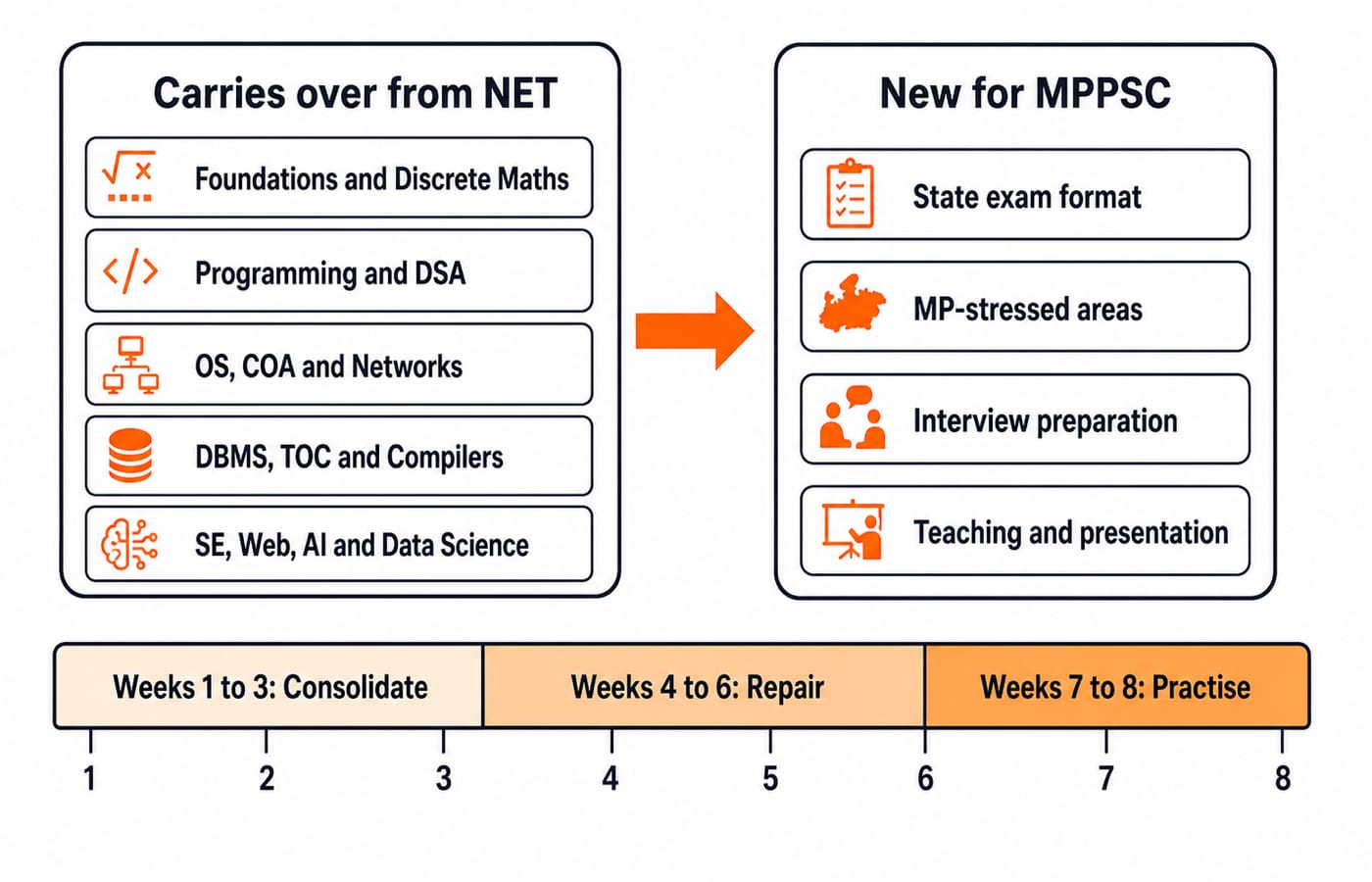
Your NET preparation should already cover these clusters:
discrete structures and mathematical foundations;
programming, data structures and algorithms;
computer organisation and architecture;
operating systems and database management systems;
computer networks;
theory of computation and compilers;
software engineering and related CS foundations.
This broadly matches UGC NET Paper 2 Computer Science. Use UGC NET Computer Science syllabus areas to inventory what you studied. Mark each cluster green, amber or red: green means timed questions remain comfortable, amber means faded speed, and red means weak or skipped material.
Transfer means consolidate before relearning. Start with a mixed diagnostic set. For a green topic, revise its summary and move on; for a red topic, schedule focused repair.
The same practice pool serves both exams because the subject core overlaps; our question bank holds well over 18,000 computer-science questions across these areas. Reuse them to measure retention, then align selection and difficulty with the MPPSC syllabus.
2. What is genuinely new
MPPSC is a state recruitment, not a renamed national eligibility test. Two whole blocks of work sit outside everything your NET preparation built.
The general paper is the larger gap. UGC NET Paper 1 tests teaching and research aptitude, reasoning, comprehension and general awareness; MPPSC Assistant Professor Paper 1 is General Knowledge and General Studies with special emphasis on Madhya Pradesh. UGC NET Paper 1 vs Paper 2 for Computer Science covers the NET side, and almost none of it transfers. MP history, geography, polity, economy and current affairs need a weekly slot from week one.
The interview is the second. NET ends at the answer sheet, while the Assistant Professor route runs a written examination, document scrutiny, an interview, and a final merit built from written and interview performance. Spoken subject explanation is scored, not a formality.
With those two named, compare the MPPSC syllabus line by line against your NET checklist and record each verdict in a delta sheet:
Comparison result | NET status | Action |
|---|---|---|
Fully covered | Strong and recent | Timed consolidation |
Covered but weak | Old or error-prone | Targeted repair |
New or stressed differently | Not in your working notes | Learn and practise |
Invest heavily only where the evidence shows a gap, not where the syllabus merely looks long.
3. A transfer-focused study plan
If your NET preparation is recent, 10 to 12 focused hours a week for about eight weeks is a workable shape. Adjust it after the first diagnostic.
Weeks 1 to 3, consolidate. Sweep the entire shared core using existing notes and timed subject sets. Do not rewrite notes. Record only forgotten formulas, confused pairs and recurring errors. By the end of week 3, every cluster should have a current diagnostic result.
Weeks 4 to 6, repair. Concentrate on amber and red clusters, plus any MPPSC-specific or differently stressed syllabus line. A repair block should contain a concept review, solved examples and a fresh timed set, because familiarity with old answers can imitate mastery.
Weeks 7 to 8, practise. Shift toward full-length or exam-shaped practice, rapid revision and interview groundwork. Analyse each test on the same day if possible. Classify errors as concept, calculation, reading, recall or time management, then change the following week's work accordingly.
Build two buffer days into each phase. A buffer is not a promise to work harder later; it is reserved space for a delayed topic, illness, or a test that exposes a larger repair. If the plan slips, protect the practice and interview phase rather than extending consolidation.
4. Reusing your NET practice pool
Start subject-wise. Take a short timed set in each shared cluster and compare accuracy with the time taken. A correct answer reached too slowly is not yet exam-ready. A wrong answer caused by a forgotten condition needs a different repair from one caused by a weak concept.
After the first sweep, mix subjects. Mixed sets force you to identify the topic and method without a chapter heading giving the clue, and they show whether switching between discrete mathematics, systems and theory costs time.
Use the MPPSC Assistant Professor (CS) Test Series as the measurement layer. Keep an error log with four fields: topic, reason, correction and retest date. Closing the loop is the point; a log of wrong answers is a tidy notebook, not a better score.
5. The interview and presentation prep NET did not require
The written paper is not the last gate, so objective recall is not the last skill. Rehearse three abilities: explain a core idea clearly, defend your stated area of interest, and answer a classroom-oriented question.
Choose several foundational topics and explain each at three levels: a one-minute definition, a five-minute board or slide presentation, and a deeper follow-up discussion. Good candidates can adjust depth without losing correctness. Record yourself once. Filler words, missing definitions and unexplained notation become obvious when heard back.
For your specialisation, prepare the fundamentals, a recent academic direction and why the area matters, without pretending expertise you do not have. For teaching questions, think about sequencing, examples, misconceptions and assessment. Knowing a topic and teaching it are related but distinct skills.
6. When you are rusty
If your NET preparation is old, the first sweep may turn more clusters amber than expected. That is useful: lengthen repair, do not abandon the transfer model and rewrite every notebook.
Use retrieval before review. Close the notes and write what you remember about a topic, solve two or three representative questions, then open the source. The gap between recall and the source identifies the repair. Passive rereading feels smooth because the page is familiar, not because the answer can be produced.
Review progress weekly. When time is lost, cut note polishing first, because it is the only activity here that never tells you whether the knowledge can be produced under pressure.
7. How MPPSC tests it
Paper 2 asks for postgraduate computer-science depth across the shared core, answered as objective questions under exam timing; depth is half of it, producing it fast and accurately is the other half. Set your practice targets from the current advertisement on the official MPPSC portal, including any later corrigendum, since marks, question count, duration and negative marking are fixed there.
Then give every stage its own activity. Paper 2 gets timed subject sets and error analysis. Paper 1 gets short, frequent general-studies contact rather than a late cram. The interview gets spoken explanation and teaching discussion.
If you are also weighing DSSSB, UPPSC, HPSC or BPSC teaching posts, the government teaching jobs category carries the courses and test series for those routes.
8. The short version and your next step
Treat MPPSC preparation as UGC NET subject work plus a defined delta. Diagnose the shared CS core, consolidate what remains strong, repair the weak areas, and add the two things NET never asked of you: MP-focused general studies for Paper 1, and spoken subject explanation for the interview.
Your next action is to compare the current MPPSC syllabus with your NET checklist and create the three-column delta sheet. Then use the MPPSC Assistant Professor Computer Science 2026 bundle (Paper 1 + Paper 2) for the gaps and the test series for timed confirmation.
Keep learning

Mensuration and Geometry for Competitive Exams: Formulas, Shortcuts and Solved Examples
Learn how to choose the right mensuration formula, avoid common geometry traps, and solve 2D path and 3D recasting problems step by step.
Updated 6 Oct 20266 min readAptitude & Reasoning
Age Comparison and Multiple-Condition Problems: 12 Solved MCQs
Practise 12 age-problem MCQs with equations, timelines, back-checks, relation chains, changing ratios, birth years, and family conditions.
1 Oct 20268 min readAptitude & Reasoning
True, False and Cannot Say Questions: 10 Solved Passage MCQs
Learn how to separate contradictions from missing evidence, then apply the method to 10 previous-year passage MCQs with concise, evidence-led solutions.
26 Sep 20268 min readAptitude & Reasoning

TCS Aptitude Questions: High-Yield Quant and Reasoning Topics, Solved Step by Step
Learn the first move for common quant and reasoning question families through solved examples on ratios, work, trains, data, remainders, and seating.
Updated 25 Sep 20266 min read104 viewsAptitude & Reasoning