TPSC Computer Science 14-Week Study Plan: Weekly Topics, PYQs and Mocks
Turn 8 to 12 reliable study hours into a practical weekly cycle of CS repair, PYQs, unit tests, full mocks and two evidence-led revision passes.
KnowledgeGate Team
Exam prep & CS education
Updated 26 Jul 20266 min read
A college student, teacher or full-time employee may have only 8 to 12 reliable weekly hours, so an ambitious timetable can collapse after one missed day. This 14-week route spends Weeks 1 and 2 on diagnosis and foundation repair, Weeks 3 to 8 on first coverage with PYQ sets and 18 unit tests, and the last six weeks on mixed practice, seven full mocks and two revision passes. Every block below is sized so that one bad week costs you a session, not the plan.
1. Lock the TPSC source and preparation scope before Week 1
Before Week 1, save the official TPSC website and obtain the current notice, syllabus and scheme. Only that notice specifies paper format, marking, eligibility and dates. Do not import details from another teaching exam.
Use the TPSC ATO Computer Science preparation category to pick your material. What is filed there covers Digital Logic, COA, C, Data Structures, Algorithms, Compiler Design, OS, DBMS, Software Engineering, Networks, Web Technologies, Cyber Security, Cloud, Probability, English, Reasoning and General Knowledge. Tick each of those against your saved syllabus copy before you allot hours to it.
Create four tracker columns: official syllabus topic, confidence from 0 to 3, last-practised date, and next action. Add every topic before watching lessons.
2. Use a 12-hour week that survives college or a job
Use five weekdays at 75 minutes, Saturday at 165 and Sunday at 180. Then 5 x 75 = 375 and 375 + 165 + 180 = 720 minutes, or 12 hours. The constrained version gives 5 x 45 = 225 and 225 + 120 + 135 = 480 minutes, or 8 hours.
Day | Concepts or repair | Timed work or recall | Review or error log | Total |
|---|---|---|---|---|
Monday | 50 min concepts | 25 min recall | 0 | 75 min |
Tuesday | 50 min concepts | 25 min recall | 0 | 75 min |
Wednesday | 0 | 45 min PYQ set | 30 min review | 75 min |
Thursday | 0 | 35 min unit test | 40 min analysis | 75 min |
Friday | 50 min weak-topic repair | 0 | 25 min error log | 75 min |
Saturday | 90 min concepts | 75 min practice | 0 | 165 min |
Sunday | 0 | 90 min test | 90 min analysis | 180 min |
The table totals 75 x 5 + 165 + 180 = 720 minutes. Until your error log is stable, match every timed-practice minute with a review minute. Videos and notes fit around testing, not instead of it.
3. Weeks 1 and 2: diagnose and repair the foundation
In Week 1, build your own 40-question diagnostic from four 10-question clusters and score each cluster on its own. A first attempt often lands like this:
Digital Logic and COA:
6 / 10 x 100 = 60%C and Data Structures:
9 / 10 x 100 = 90%OS and DBMS:
5 / 10 x 100 = 50%Networks and Software Engineering:
7 / 10 x 100 = 70%
Mark below 60% red, 60% to 79% amber, and 80% or more green. Repair OS and DBMS at 50% first. Maintain C and Data Structures at 90%.
In Week 2, give six concept blocks to the two weakest clusters, here OS and DBMS plus Digital Logic and COA, then complete two 25-question PYQ blocks. Log each error as topic, plausible wrong reasoning, correct rule and retest date. Use Computer Fundamentals for CS Teaching Exams if gaps appear in number systems, CPU and memory basics, or software categories. The TPSC Assistant Technical Officer complete course supplies the topic order for that repair, so you are not choosing what to fix next at 10 pm.
4. Weeks 3 to 8: finish first coverage, PYQs and all 18 unit tests
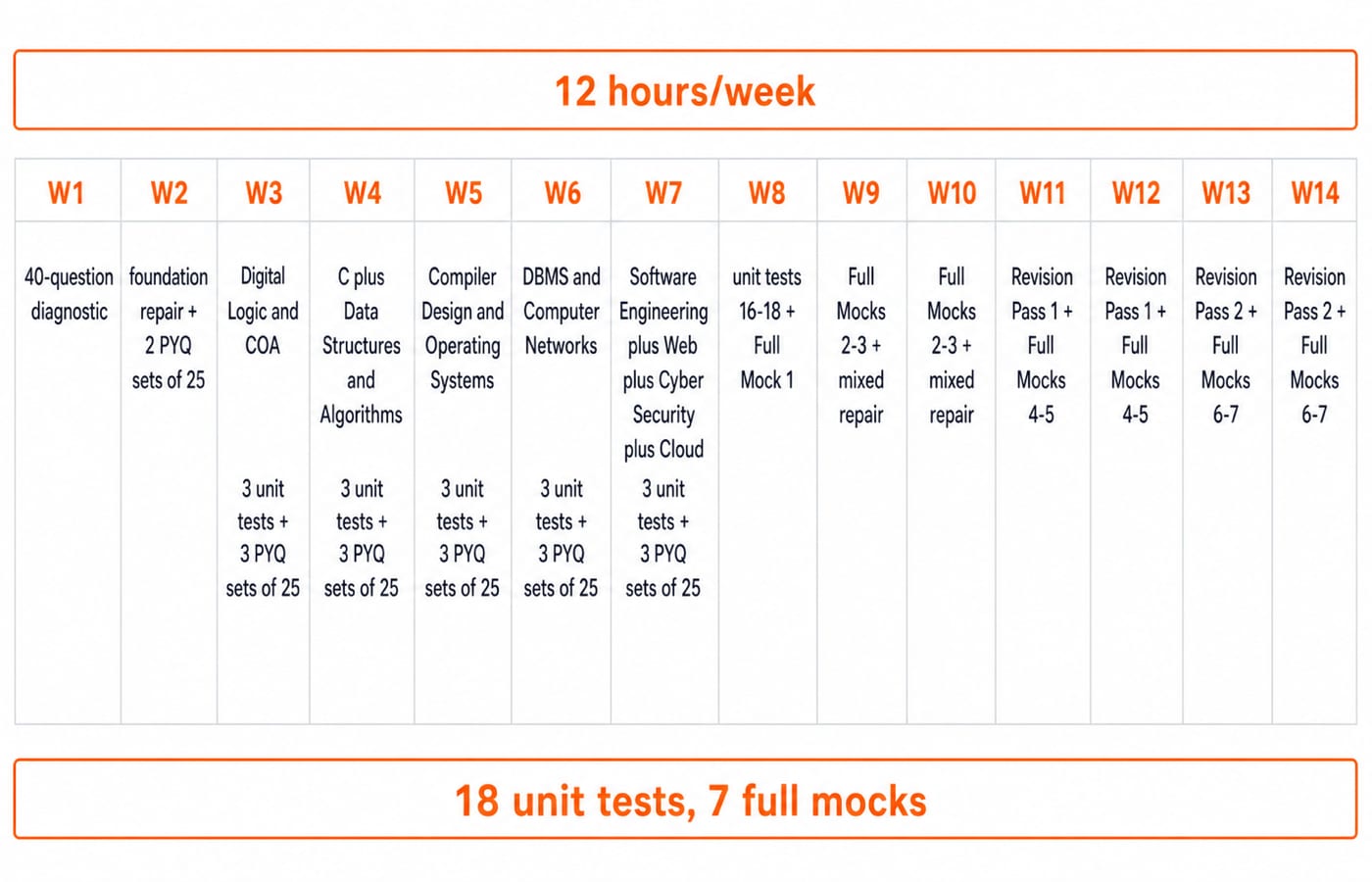
The TPSC Assistant Technical Officer test series carries 18 unit tests. Three a week clears all 18 across Weeks 3 to 8, which is why this block runs six weeks and not five.
Week | Main clusters | Timed work | Exit condition |
|---|---|---|---|
3 | Digital Logic and COA | 3 unit tests + 3 PYQ sets of 25 | Retest every red error once |
4 | C, Data Structures and Algorithms | 3 unit tests + 3 PYQ sets of 25 | Trace code without notes |
5 | Compiler Design and Operating Systems | 3 unit tests + 3 PYQ sets of 25 | Explain each wrong option |
6 | DBMS and Computer Networks | 3 unit tests + 3 PYQ sets of 25 | Redo wrong numericals cold |
7 | Software Engineering, Web, Cyber Security and Cloud | 3 unit tests + 3 PYQ sets of 25 | One-page recall sheet only |
8 | Probability, English, Reasoning and GK system | 3 unit tests + 1 PYQ set of 25 + Full Mock 1 | Full analysis within 24 hours |
Weeks 3 to 7 each contain 3 x 25 = 75 PYQs. Week 8 drops to 25 because Full Mock 1 enters. Replace any row that the current official syllabus omits or expands.
5. Weeks 9 and 10: switch to mixed performance
In Week 9, take Full Mock 2 and analyse it within 24 hours using the Teaching Exam Mock Strategy for CS Papers. Then complete four mixed sets of 25, each combining at least four official-syllabus clusters. This trains topic switching, not chapter recall.
In Week 10, take Full Mock 3 and repeat four mixed sets of 25. Let the error log set the mix: 40% for the weakest cluster, 30% for the next, and 15% each for two stronger areas. Thus 40 + 30 + 15 + 15 = 100 questions.
6. Weeks 11 to 14: complete two revision passes and Full Mocks 4 to 7
In Revision Pass 1, Weeks 11 and 12, revisit every red and amber syllabus row, solve from the full error log, and take Full Mocks 4 and 5. Finish with no official-syllabus row untested.
In Revision Pass 2, Weeks 13 and 14, use only condensed recall sheets, previous errors and time-management drills. Take Full Mocks 6 and 7. Put Mock 7 early in Week 14 so its analysis can still change behaviour. Add no new resource.
Read every mock back in counts. Say a 100-question practice paper comes back as 82 attempted, 61 correct, 21 wrong and 18 unattempted. Check 61 + 21 = 82 and 82 + 18 = 100. Attempt accuracy is 61 / 82 x 100 = 74.39%, rounded to 74.4%. Split the 21 errors into 9 concept, 6 recall, 4 reading and 2 pacing errors, with 9 + 6 + 4 + 2 = 21. Assign the next four 75-minute repair blocks as two concept, one recall and one combined reading and pacing block. A split like that tells you what to fix on Monday; a projected score tells you nothing you can act on.
7. Apply the missed-week recovery rule, then resume
For one missed 75-minute session, add 15 minutes to five weekdays: 15 x 5 = 75. For two, add 30 minutes daily: 30 x 5 = 150, equal to 2 x 75 = 150.
If you lose 3 to 6 hours, cap the next week at 12. Drop duplicate videos and neat notes, but retain syllabus coverage, PYQs, analysis and the next mock. If a full week disappears, use 2-4-1: repair two red topics, solve four mixed PYQ blocks of 25, and take one timed test with full analysis. Move one lower-priority amber topic into Revision Pass 1.
The short version
Protect the 8 to 12-hour floor, review every test and preserve all seven mocks. Use the complete course for structure and the test series for timed practice. Let evidence set the next task, while the current TPSC notice sets the scope.
Keep learning
TPSC vs BPSC Teaching Exams: Which State CS Route Fits You?
Compare TPSC and BPSC as conditional Computer Science teaching routes through a five-gate audit that separates official eligibility from personal readiness.
Updated 3 Aug 20266 min readTPSC Computer Science
TPSC Computer Science PYQs: A No-Guesswork Trend Analysis Method
Turn a small set of Computer Science papers into a careful personal study plan. This method separates observed patterns from guesses and converts errors into scheduled drills.
Updated 1 Aug 20266 min readTPSC Computer Science
TPSC Computer Science Weightage: Rank High-Return Topics with Syllabus and PYQs
A fixed TPSC CS weightage chart would be convenient, but the official syllabus does not provide one. Learn to turn verified papers and diagnostic gaps into a personal revision order.
Updated 29 Jul 20265 min readTPSC Computer Science
TPSC Computer Science: C Programming and Data Structures Worked Playbook
Trace one complete C program from recursive pointer calls to exact stack and queue output, then extend the same state-table method to linked lists, trees and complexity.
Updated 29 Jul 20267 min readTPSC Computer Science