TPSC Computer Science Weightage: Rank High-Return Topics with Syllabus and PYQs
A fixed TPSC CS weightage chart would be convenient, but the official syllabus does not provide one. Learn to turn verified papers and diagnostic gaps into a personal revision order.
KnowledgeGate Team
Exam prep & CS education
Updated 29 Jul 20265 min read
A long TPSC Computer Science syllabus naturally makes you search for one fixed weightage table. The current official document tells you what can be tested, but it does not allot marks to individual technical sections. An unlabelled PYQ count can also make a small sample look more authoritative than it is. A better TPSC ATO Computer Science preparation method combines official syllabus coverage, reliable previous-paper evidence and your own diagnostic gap.
Start with what TPSC actually fixes
According to TPSC Advt. No. 02/2026, Annexures B and C, the written examination carries 170 marks over 180 minutes. General Ability Paper I carries 50 marks, while Job Oriented Technical Paper II carries 120 marks and consists of 120 one-mark, OMR-based MCQs.
The technical syllabus has 14 numbered sections: Engineering Mathematics; Digital Logic; Computer Organization and Architecture; Analog and Digital Communication; Data Structures and Programming; Algorithms; Compiler Design; Operating System; Databases; Information Systems and Software Engineering; Computer Networks; Web Technologies; Cyber Security and Emerging Technologies; and Cloud Technology.
A named section proves scope, not frequency. The document does not give any section a fixed percentage, so the 14 headings are a coverage checklist, not a ranking. The prerequisite order between those blocks is worked out in TPSC Computer Science Syllabus: ATO Core Blocks in Prerequisite Order. Recheck the active notice and any corrigendum before you freeze your own section list, because a structural change resets every count built on top of it.
Build a TPSC PYQ sample that can be audited
Use a spreadsheet with these exact columns: paper or exam | date/year | series | question number | official section | subtopic | primary tag | secondary tag | official answer-key status | correct in diagnostic? | seconds used.
Every row must lead back to TPSC's Old Question Paper repository and be checked against its Answer Key page. Set the status to final, provisional or not found. A paper with a final official key is strongest; keep a provisional key flagged. Exclude coaching recalls, unsourced screenshots and rewritten questions. If no comparable ATO paper exists, adjacent papers are practice, not ATO weightage evidence.
Count each question once. An SQL indexing question may use Databases as primary and Data Structures as secondary, but only Databases gets the count. Record the secondary tag anyway: it is what later tells you whether a section is genuinely thin or merely hidden inside another section's questions.
Decide whether the PYQ sample is large enough
Print the sample size, paper count, source window and exclusions beside every result. Write the finding in this exact shape: Databases: 9 of 40 tagged questions across 4 verified papers, then the years and the exclusions. Do not call this 22.5% TPSC weightage. Record each exclusion reason so another learner can reproduce the sample.
Use a conservative stop rule. With fewer than three comparable official papers, or one paper supplying more than half the usable questions, call the result an early signal, not a stable ranking. Separate changed syllabi, incomparable roles and duplicate series. Current-syllabus matching is the gate; recurrence across papers adds support. An absent topic remains examinable.
Worked example: calculate a personal priority index
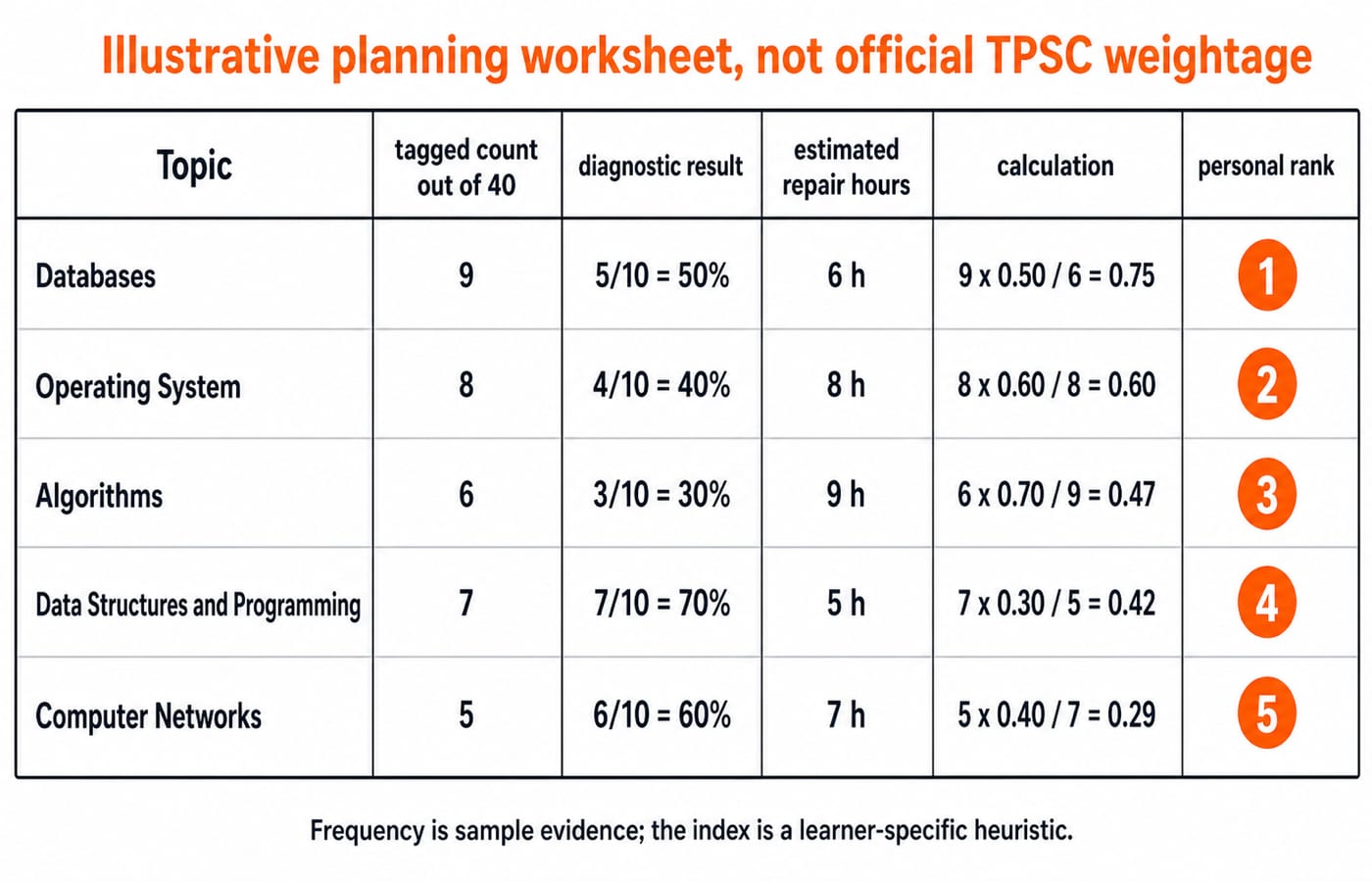
Run the method on a small sheet before you trust it on real papers. The counts below come from an example 40-question worksheet, not from any TPSC paper set: Databases 9, Operating System 8, Data Structures and Programming 7, Algorithms 6, Computer Networks 5, and all other official sections combined 5. The total is 9 + 8 + 7 + 6 + 5 + 5 = 40.
Rank the sections with this planning heuristic. It weighs how often a topic appeared against how badly you scored on it and how long the repair will take:
priority index = observed sample count x (1 - diagnostic accuracy) / estimated repair hours
Topic | Diagnostic and repair time | Calculation | Index |
|---|---|---|---|
Databases | 5/10, 50%, 6 h |
| 0.75 |
Operating System | 4/10, 40%, 8 h |
| 0.60 |
Algorithms | 3/10, 30%, 9 h |
| 0.47 |
Data Structures and Programming | 7/10, 70%, 5 h |
| 0.42 |
Computer Networks | 6/10, 60%, 7 h |
| 0.29 |
The personal order is Databases, Operating System, Algorithms, Data Structures and Programming, then Computer Networks. Algorithms rises above Data Structures despite appearing once less because this learner's measured gap is larger.
Turn the ranking into a 24-hour revision cycle
Cycle | Allocation | Total |
|---|---|---|
Week 1 | Databases 4 h, Operating System 4 h, Algorithms 3 h, mixed retest and error log 1 h | 12 h |
Week 2 | Databases 2 h, Operating System 2 h, Algorithms 2 h, Data Structures and Programming 3 h, Computer Networks 2 h, mixed retest and error log 1 h | 12 h |
The allocation is 6 + 6 + 5 + 3 + 2 + 2 = 24 hours, including two mixed-retest hours. If Databases rises from 5/10 to 8/10, its index becomes 9 x 0.20 / 6 = 1.80 / 6 = 0.30. It falls below Operating System 0.60, Algorithms 0.47 and Data Structures and Programming 0.42, so move its hours next cycle.
Avoid four TPSC weightage traps
Syllabus order becomes importance. Section 2 is not automatically more important than Section 12. Use section numbers only as stable labels.
Toy precision becomes a prediction.
9/40 = 22.5%describes only this example sheet. Always shown=40, the paper count and source window.Overlap is counted twice. A Networks question with a Cyber Security secondary tag still contributes one primary count.
Another exam becomes TPSC evidence. GATE, UGC NET and unrelated TPSC technical papers can provide practice, but not ATO topic frequency. The same ranking habit run over a much larger corpus is worked through in GATE CS Subject Weightage: Where Hours Pay Off, which is why the method transfers even when the numbers do not. Keep
direct evidence,adjacent practiceandpersonal diagnosticin separate columns.
The short version and the next action
Copy the 14 official sections, collect only auditable papers, tag each question once, disclose the sample limits, and combine observed recurrence with your accuracy and repair time. The result is an adjustable revision order, not an official weightage chart.
Resource | Best use |
|---|---|
Structured coverage of the named syllabus sections | |
Practice, error logging and re-diagnosis |
Tag the first verified paper, run a ten-question diagnostic for each leading section, schedule your first 24-hour cycle, and recheck the active TPSC notice and corrigenda before acting on any exam-specific detail.
Keep learning
TPSC vs BPSC Teaching Exams: Which State CS Route Fits You?
Compare TPSC and BPSC as conditional Computer Science teaching routes through a five-gate audit that separates official eligibility from personal readiness.
Updated 3 Aug 20266 min readTPSC Computer Science
TPSC Computer Science PYQs: A No-Guesswork Trend Analysis Method
Turn a small set of Computer Science papers into a careful personal study plan. This method separates observed patterns from guesses and converts errors into scheduled drills.
Updated 1 Aug 20266 min readTPSC Computer Science
TPSC Computer Science 14-Week Study Plan: Weekly Topics, PYQs and Mocks
Turn 8 to 12 reliable study hours into a practical weekly cycle of CS repair, PYQs, unit tests, full mocks and two evidence-led revision passes.
Updated 26 Jul 20266 min readTPSC Computer Science
TPSC Computer Science: C Programming and Data Structures Worked Playbook
Trace one complete C program from recursive pointer calls to exact stack and queue output, then extend the same state-table method to linked lists, trees and complexity.
Updated 29 Jul 20267 min readTPSC Computer Science