Research Paradigms and Types of Research: Teaching Exam Notes with a Worked Study
Connect paradigms, approaches, designs and methods. Then classify a hypothetical classroom study and calculate its mean gains step by step.
KnowledgeGate Team
Exam prep & CS education
Updated 22 Aug 20266 min read

Positivism, constructivism, ontology, qualitative research and action research are easy to memorise separately. Confusion begins when a short scenario has two plausible labels within the same question stem. Research paradigms, approaches, designs and methods form one framework illustrated by a classification map and a numerical study. A method alone cannot reveal the paradigm. This is directly useful where a syllabus includes research aptitude, especially UGC NET Paper 1, but not every teaching-recruitment paper includes it.
Related reading: UGC NET paper coverage and assessment and evaluation.
Research paradigm, approach, design and method are different layers
A research paradigm is the worldview behind accepted reality and knowledge. Ontology asks what reality is. Epistemology asks how it is known and how researcher and participants relate. Axiology asks how values enter. Methodology is the investigative logic.
Quantitative, qualitative and mixed are approaches. Experiment, quasi-experiment, case study, ethnography and action research are designs or strategies. Questionnaire, interview, observation and test score are methods. Questionnaires are not paradigms; interviews are not designs.
Use one stable chain: research question -> assumptions -> paradigm -> approach -> design -> methods -> analysis -> claim.
Major research paradigms compared through their assumptions
Compare assumptions, not names.
Paradigm | Reality | Knowledge, values, evidence and clue |
|---|---|---|
Positivism | Observable and measurable | Detached, deductive, value-controlled. Compare controlled scores; look for prediction and objectivity. |
Post-positivism | External but imperfectly knowable | Fallible, probabilistic, bias-aware. Estimate an effect with uncertainty and possible confounders. |
Constructivism or interpretivism | Multiple, context-shaped meanings | Co-interpreted and value-aware. Interview eight trainees about trustworthy evidence. |
Pragmatism | Framed by the practical problem | Methods and values serve useful consequences. Combine 120 surveys and 12 interviews to redesign a course. |
Critical realism | Independent and layered | Mediated, revisable and value-aware. Separate an attendance pattern from deeper institutional mechanisms. |
These are tendencies, not identities. Quantitative is often positivist or post-positivist, qualitative often interpretivist, and mixed often pragmatic. Assumptions decide.
Types of research form a classification grid
Each basis differs, so labels overlap.
Basis | Labels, defining questions and examples |
|---|---|
Purpose | Basic: extend understanding? Memory. Applied: solve a problem? Recall. Action: practitioner cycle? Revise teaching. Evaluation: judge a programme? Assess training. |
Approach | Quantitative: numerical evidence? Scores. Qualitative: meanings? Interviews. Mixed: integrate both? Explain scores with interviews. |
Reasoning | Deductive: prediction to observation? Test a hypothesis. Inductive: observations to concepts? Build themes. Abductive: explain a surprise? Investigate an attendance gap. |
Control or design | Experimental: random allocation and control? Random assignment. Quasi-experimental: randomisation or control missing? Intact sections. Observational: no intervention? Record habits. |
Time | Cross-sectional: one time? Week 6 survey. Longitudinal: over time? Weeks 0 and 6. Cohort: shared entry or characteristic? Follow one intake. |
Inquiry form | Survey: standard responses? Questionnaire. Case study: bounded case? College. Ethnography: sustained group study? Staffroom. Historical: past records? Archives. |
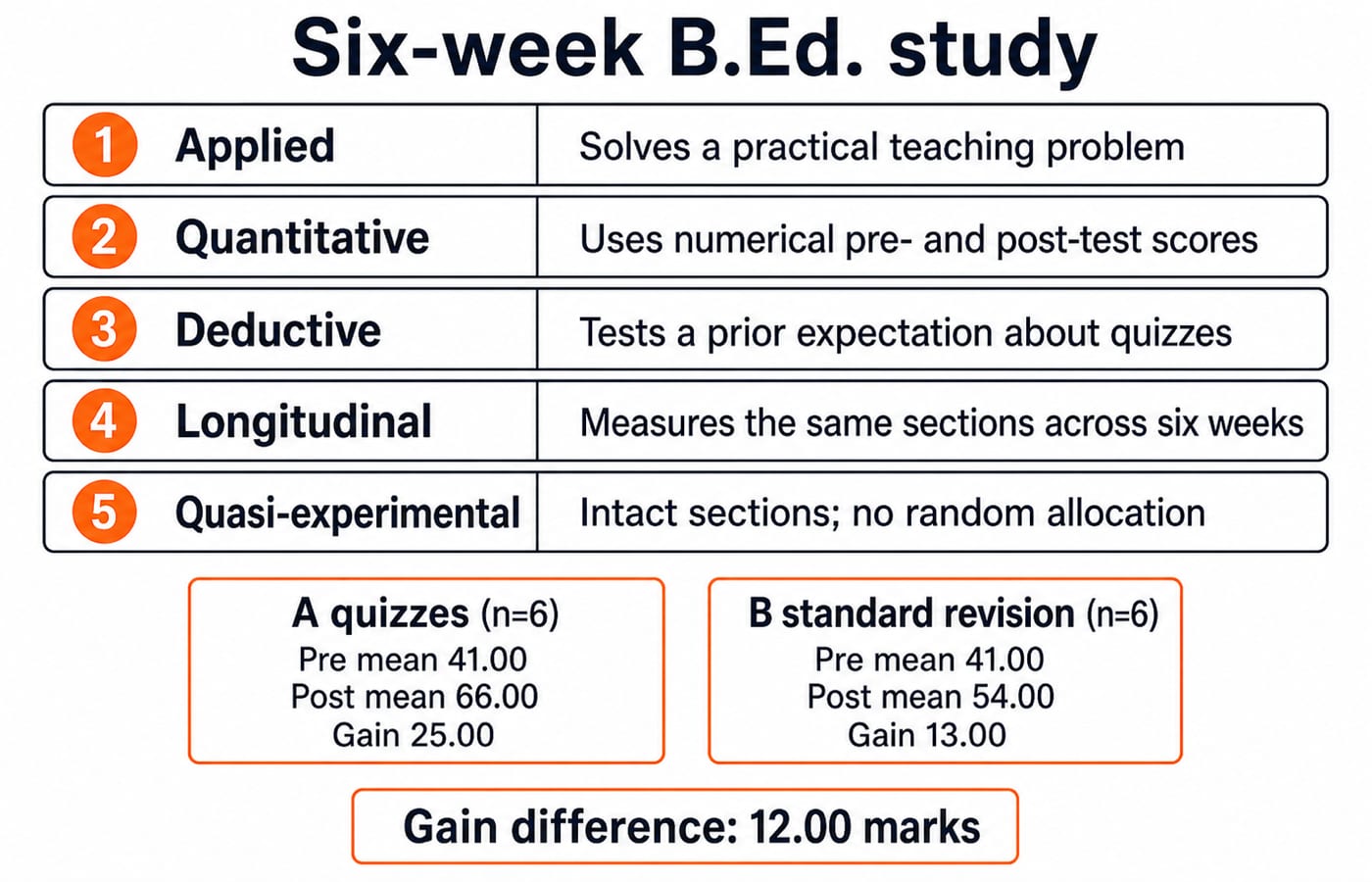
The study below is applied, quantitative, deductive, longitudinal and quasi-experimental. Each label answers differently. Basic research extends understanding; applied solves a practical problem. Action research needs a practitioner-led diagnose-act-observe-reflect cycle. A true experiment uses random allocation; a quasi-experiment lacks it or full control.
Worked example: classify and calculate a quasi-experimental study
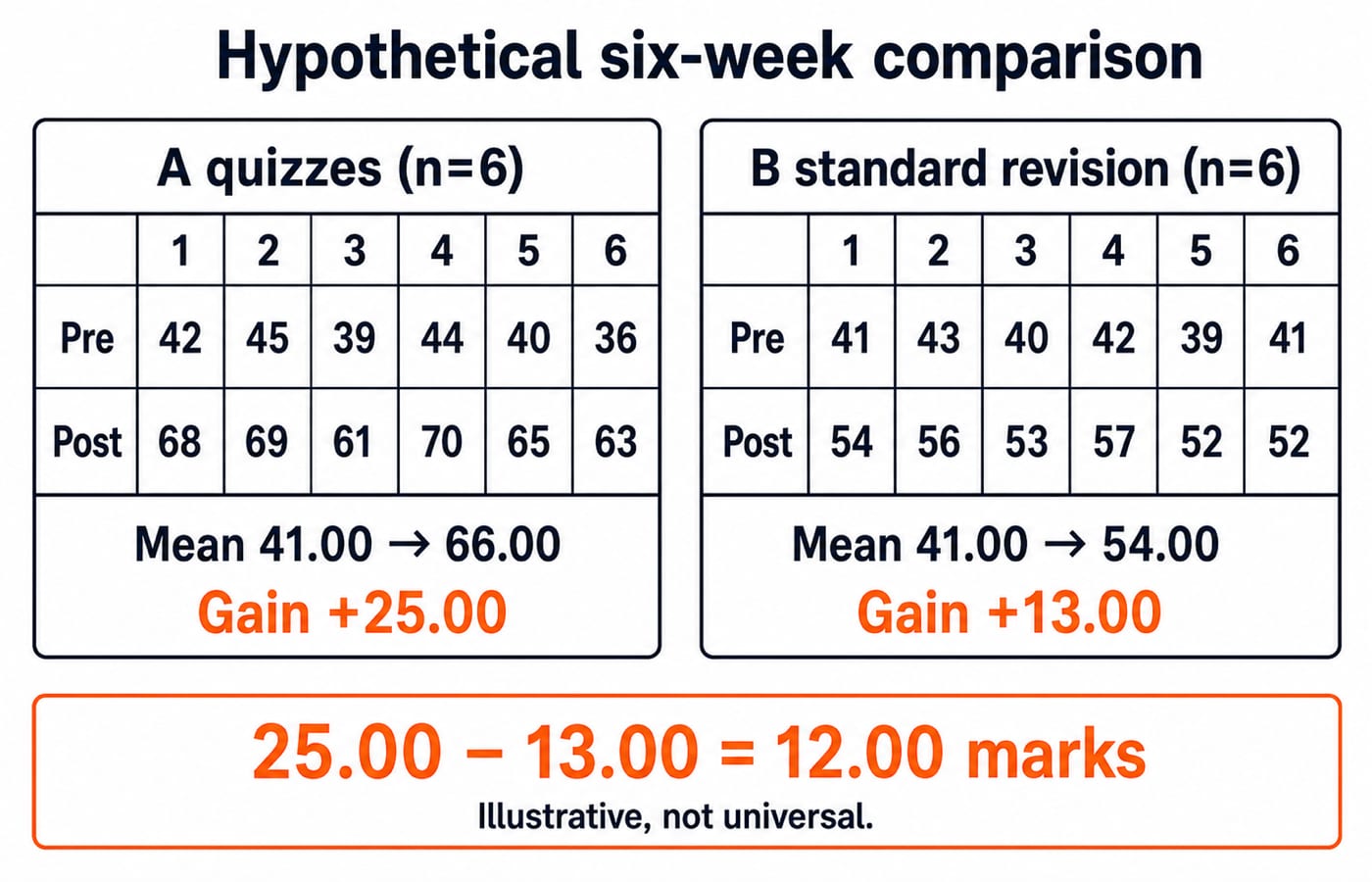
This is a hypothetical teaching example: "Does one retrieval quiz per week improve research-aptitude scores over six weeks?" Intact Section A receives quizzes; Section B uses standard revision. Without random allocation, both take the same 100-mark test before and after.
Section | Pre-test scores | Post-test scores |
|---|---|---|
A | 42, 45, 39, 44, 40, 36 | 68, 69, 61, 70, 65, 63 |
B | 41, 43, 40, 42, 39, 41 | 54, 56, 53, 57, 52, 52 |
A pre total:
42 + 45 + 39 + 44 + 40 + 36 = 246; mean:246 / 6 = 41.00.A post total:
68 + 69 + 61 + 70 + 65 + 63 = 396; mean:396 / 6 = 66.00.A mean gain:
66.00 - 41.00 = 25.00.B pre total:
41 + 43 + 40 + 42 + 39 + 41 = 246; mean:246 / 6 = 41.00.B post total:
54 + 56 + 53 + 57 + 52 + 52 = 324; mean:324 / 6 = 54.00.B mean gain:
54.00 - 41.00 = 13.00.Difference in mean gains:
25.00 - 13.00 = 12.00marks.
It is applied, quantitative, deductive and longitudinal. Intact sections make it quasi-experimental; treating its result as fallible evidence makes it post-positivist.
Section A gains 12 marks more. A formal significance test or standardised effect size would be fragile with only six learners per intact section, and neither would repair the missing random allocation. Treat the 12-mark gain difference as descriptive, not as a population estimate or universal causal claim.
Change the question and the research type changes
For a constructivist qualitative version, interview eight trainees, code transcripts and build context-bound themes. A pragmatic mixed study could compare 120 learners, then interview 12 from high-, medium- and low-gain groups. In action research, the teacher diagnoses weak recall, adds quizzes, observes, reflects and revises.
Basic research could ask how retrieval alters memory organisation without a local decision. One Week 6 survey is cross-sectional; measuring the same learners in Weeks 0 and 6 is longitudinal. A cohort shares an entry event or characteristic and may be followed.
Choose labels from purpose and procedure, not trigger words such as interview or survey.
How teaching exams turn these concepts into questions
Questions ask you to identify paradigms from assumptions; match ontology, epistemology and axiology; classify one study across dimensions; distinguish pairs; or order an action-research or research-process sequence.
KnowledgeGate currently offers over 140 practice questions on Research Paradigms & Types of Research. Use them for classification practice; the current syllabus and exam pattern belong to the official notification.
Multiple context-shaped realities plus participant interviews point to constructivism.
The same 80 teachers measured in January and July form a longitudinal study.
Diagnose weak source evaluation, change instruction, observe and revise the next cycle describes action research.
The worked difference in mean gains is 12 marks, but no arithmetic can turn intact sections into random allocation.
UGC NET Paper 1 vs Paper 2: what each tests locates research aptitude in preparation. The UGC NET Paper 1 Test Series is a practice route.
Research-paradigm traps and their corrections
Trap | Correction |
|---|---|
Paradigm equals method. | Paradigm is worldview; method handles evidence. |
Qualitative bans numbers. | It focuses on meaning and context. |
Quantitative always means positivism. | It can fit post-positivism. |
Mixed means two quantitative tools. | It integrates quantitative and qualitative evidence. |
Action equals applied. | Action needs a practitioner improvement cycle. |
Every classroom comparison is experimental. | Without random allocation or full control, it may be quasi-experimental. |
Survey is a purpose. | It is a design or collection choice. |
Longitudinal means large sample. | It means observations over time. |
Cohort equals cross-sectional. | Cohort identifies a group; cross-sectional, one time point. |
Induction starts with a hypothesis; deduction with observations. | Deduction moves theory to observations; induction builds concepts from them. |
A teaching method differs from research on it. Computer Science Pedagogy: Methods, Assessment, Exams develops the teaching side. Recall: worldview -> purpose -> approach -> design -> method -> claim.
Research paradigms and types of research: the short version and next step
A paradigm is a worldview. Ontology concerns reality; epistemology concerns knowledge. One study can carry several labels. Random allocation separates a true experiment from this quasi-experiment. Reclassify it, then recompute 25, 13 and 12.
For the full sequence, explore NTA UGC NET Paper 1 Course. Use the UGC NET Preparation Courses & Test Series to compare options.
Keep learning

ICT in Education MCQs: 12 Solved Questions on Digital Learning Tools
Solve 12 ICT in Education MCQs, then use clear explanations and a five-layer model to separate files, tools, platforms and public initiatives.
Updated 3 Oct 20268 min readUGC NET Computer Science

Requirements Elicitation Techniques and Use Case Development: Worked Library Example
Follow a fictional library reservation from interviews and observation through testable requirements, a UML use-case model, UC-07, and acceptance checks.
Updated 28 Sep 20266 min readUGC NET Computer Science

Quality Factors: McCall’s and ISO 9126 Models with a Worked Scoring Example
Build both quality models around one maintainability audit. This guide maps their vocabulary, calculates McCall-style and ISO-style scores, and ends with exam-focused checks.
Updated 25 Sep 20265 min readUGC NET Computer Science

Cohesion and Coupling MCQs: 10 Solved Questions on Functional Independence
Practise 10 solved MCQs on cohesion, coupling, functional independence, module dependencies, and the distinctions that make closely matched options easier to separate.
Updated 24 Sep 20267 min readUGC NET Computer Science