

Methods of Teaching for Teaching Exams: Complete Notes, Worked Lesson, and Exam Traps
Learn how lecture, demonstration, inquiry, project, flipped, blended, and cooperative methods differ. Then apply them in a worked lesson and exam elimination routine.
KnowledgeGate Team
Exam prep & CS education
Updated 28 Oct 20266 min read

Lecture, demonstration, discussion, project, inquiry, simulation, flipped classroom, and blended learning are easy to list. The difficult case-based question asks which method fits a particular outcome, learner group, and constraint. Select methods by purpose, distinguish close options, analyse a 45-minute lesson, and apply an elimination method.
Methods of teaching: classify by action, task, and delivery
A teaching method is an organised way of arranging teacher action, learner activity, content, resources, interaction, and feedback to reach an outcome. It is not the same as a technique or medium. Discussion is a method; think-pair-share can be a technique inside it. Online is a delivery mode, not automatic proof of learner-centred teaching.
Use three broad families:
Teacher-directed: lecture and demonstration.
Shared or interactive: guided discussion, brainstorming, role play, and simulation.
Learner-centred: project, problem-solving, inquiry, discovery, cooperative learning, and seminar.
They form a continuum, not sealed boxes. Choose by outcome, learner readiness, class size, time, resources, safety, and the evidence required. The wider shift from knowing a subject to representing it clearly for learners is developed in Computer Science Pedagogy for Teacher Exams.
Lecture and demonstration: teacher direction need not be passive
A lecture efficiently introduces, organises, explains, or summarises content for many learners. Its weakness is uninterrupted one-way delivery without retrieval, examples, questions, or feedback. Compare a 20-minute monologue with four cycles of 4 minutes of explanation plus 1 minute of retrieval. Both take 20 minutes, but the second design creates four checks.
A demonstration shows a process, procedure, skill, or observable relationship while making each step visible. To solve 3x + 5 = 20, subtract 5 to get 3x = 15, divide by 3 to get x = 5, then verify: 3(5) + 5 = 15 + 5 = 20. After each transformation, ask a learner to explain what changed and why.
The distinction is simple. Lecture mainly explains ideas and relationships; demonstration makes performance or change observable. Watching alone can still be passive. Add prediction, observation, guided practice, and feedback when learners must apply the process.
Discussion, problem-solving, inquiry, project, and cooperation
Discussion develops and tests ideas. Problem-solving starts with a defined problem and seeks a defensible solution. Inquiry starts with a question and uses evidence. Discovery uses structured examples to infer a principle. A project produces a product or performance through planning, execution, and review.
Consider school water use. Discussion asks, “Which daily practices waste water, and why?” Problem-solving asks a group to reduce measured use of 500 litres per day by 20%. The reduction is 500 x 0.20 = 100 litres, so the proposed ceiling is 500 - 100 = 400 litres. Inquiry collects five days of evidence before explaining the largest source. A project designs, tests, and presents a four-week conservation plan.
Cooperative learning means structured interdependence plus individual accountability, not group seating. For 40 learners, make 8 groups of 5 with predictor, observer, recorder, checker, and reporter roles. Rotate them to share the task.
Brainstorming, role play, simulation, flipped, and blended learning
Brainstorming rapidly generates ideas before evaluation. Role play explores communication or a social situation from a perspective. Simulation uses a simplified system with rules, variables, or consequences. A mock parent-teacher conversation is role play. Allocating a fixed 60-minute school timetable among competing activities under stated rules is simulation.
Flipped and blended differ. A flipped sequence moves first exposure before the session and uses time for questions, practice, or feedback. For example, use a 12-minute pre-class explanation and a 30-minute in-class problem set. Blended learning combines face-to-face and digital activity, but need not be flipped. One design uses a 20-minute demonstration, a 15-minute online quiz, and a 10-minute feedback conference, totalling 45 minutes.
Online learning can remain a lecture, while face-to-face inquiry can be learner-centred. Access, captions, devices, and an offline alternative belong in the design.
Worked method-selection lesson: condensation in a class of 40
Outcome: after 45 minutes, 40 learners use observations to explain why droplets form outside a chilled steel tumbler and predict how relative surface temperature changes condensation. One illustrative classroom case uses tumblers at 8°C and 28°C; neither temperature is a universal threshold.
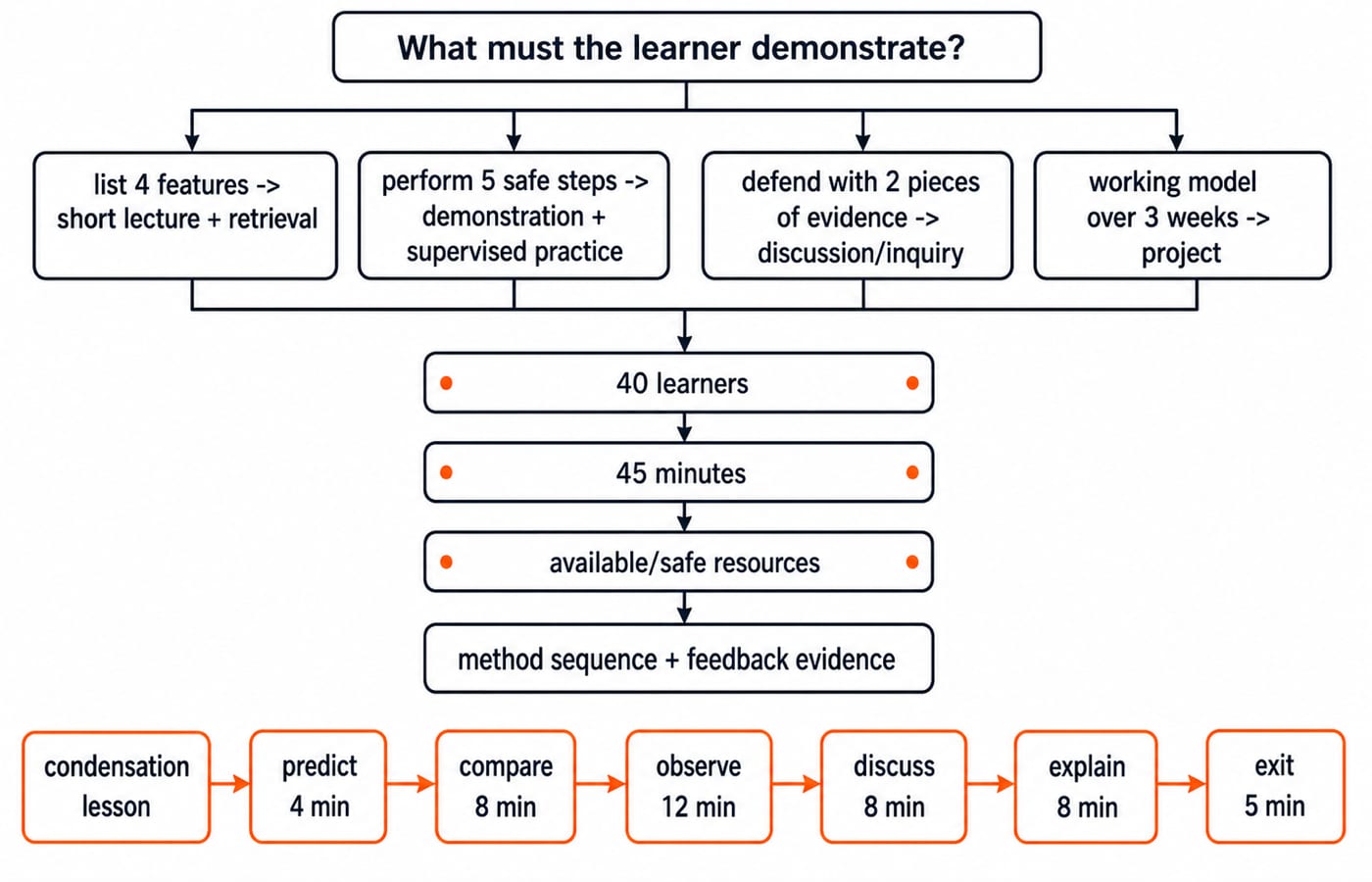
Build the lesson as a sequence in which each method has a distinct job:
Prediction, 4 minutes: each learner answers, “Where could the outside droplets come from?” before seeing either tumbler. The written prediction exposes the starting idea without turning it into a marks comparison.
Comparison demonstration, 8 minutes: dry both steel tumblers, expose them together, and keep their positions and observation time the same. The teacher models safe handling but does not supply the explanation.
Group observation, 12 minutes: 8 groups of 5 use predictor, observer, recorder, checker, and reporter roles. They record which surface develops more droplets after 6 minutes and note that the liquid is outside the tumbler.
Guided discussion, 8 minutes: groups compare evidence and test the claim that water leaked through the steel. The teacher introduces condensation only after learners connect surrounding water vapour with the cooler surface.
Individual explanation and prediction, 8 minutes: every learner explains the droplets and predicts which tumbler should collect more under the same room conditions, using relative cooling rather than treating 8°C as a magic cutoff.
Exit transfer, 5 minutes: apply the same reasoning to a cold bottle taken outdoors. A complete answer identifies water vapour in the surrounding air, the cooler surface, condensation, and the predicted observation.
The timing check is 4 + 8 + 12 + 8 + 8 + 5 = 45 minutes. Demonstration makes the comparison visible, inquiry organises the evidence, cooperative learning distributes responsibility, discussion tests explanations, and individual writing checks accountability.
Choose a teaching method from outcome, constraints, and evidence
Use five passes:
Write the observable outcome.
Identify what learners must do to demonstrate it.
Check prior knowledge and access needs.
List time, class-size, resource, and safety constraints.
Choose the smallest useful combination of methods and feedback checks.
“List four features” may start with a short lecture plus retrieval. “Perform five steps safely” needs demonstration and supervised practice. “Defend one option using two pieces of evidence” needs discussion or inquiry. “Produce and revise a working model across three weeks” suits a project. Evidence and constraints still decide the sequence.
In the condensation lesson, lecture supplies vocabulary, demonstration makes change observable, inquiry organises evidence, cooperative learning distributes roles, discussion tests explanations, and individual writing checks accountability. The best caselet answer is often a justified sequence, not an ideological choice between teacher-centred and learner-centred teaching.
How teaching exams test methods and set close-option traps
Study definition matching, teacher-centred versus learner-centred classification, suitable-method caselets, flipped versus blended, method versus technique or medium, and assertion-reason items on participation, feedback, or resources. No official frequency is established.
Four eliminations handle many close options:
A home video is pre-class online content. Call the design flipped only if the shared session changes to application, questions, or feedback.
Group seating while one learner copies lacks cooperative accountability.
Generating 20 ideas before judging any is brainstorming, not discussion.
Following fixed crisis-response rules with changing consequences is simulation, not role play merely because positions are assigned.
Practise these distinctions through Teaching Exam Mock Strategy: Cadence and Review Plan, which explains how to schedule, attempt, and review mocks. These method classifications do not establish official weightage.
Methods of teaching: the short version and a 20-minute drill
Recall: method follows outcome; direction and activity are continuous; demonstration shows, inquiry investigates; project joins planning and production; flipped sequences, blended combines modes.
In a 20-minute drill, spend 5 minutes redrawing the method map, 6 rebuilding the condensation sequence and checking 4 + 8 + 12 + 8 + 8 + 5 = 45, 5 classifying close-option traps, and 4 justifying a method sequence. Continue with the CTET Paper 1 Course or CTET Paper 2 Course. Choose via the Govt Teaching Eligibility Tests category.
Keep learning

Evaluation, Assessment and Measurement for Teaching Exams: Concepts, Types and Worked Examples
Learn how a score becomes evidence and then a teaching decision through clear distinctions, classroom cycles, an eight-learner quiz, and exam-style traps.
Updated 27 Oct 20265 min readCTET & UPTET

Curriculum and School Environment for Teaching Exams: Concepts, Caselets and Worked Examples
Learn to separate curriculum from syllabus, diagnose school conditions, audit alignment with numbers, and solve teaching-exam caselets logically.
Updated 26 Oct 20266 min readCTET & UPTET

Inclusive Education and Special Needs for Teaching Exams: Concepts, Cases, and Common Traps
Learn to separate inclusion from integration, match barriers to supports, and solve teaching-exam caselets through one fully worked classroom redesign.
Updated 25 Oct 20266 min readCTET & UPTET

Guidance, Counselling and Mental Health for Teaching Exams: Concepts, Cases and Exam Traps
Learn to separate guidance, counselling and mental-health support, then apply the distinctions to learner cases without crossing a teacher's professional boundaries.
Updated 23 Oct 20266 min readCTET & UPTET