MPPSC Teaching CS PYQs: Diagnose Concept Gaps, Slow Methods and Distractor Traps
Turn a PYQ score into precise next actions. Build a three-column review board, repair each failure differently and prove the repair on fresh questions.
KnowledgeGate Team
Exam prep & CS education
Updated 2 Aug 20267 min read
Finishing a CS practice set with 17/24 can leave an MPPSC aspirant unsure what to do next. A missing rule, a slow method and a misread qualifier all produce the same wrong answer, and each needs a different repair. Sort every wrong, guessed, slow and unattempted item into one of three columns, drill each column its own way, then prove the repair on fresh values. The MPPSC Assistant Professor (CS) preparation category is the place to start if you do not yet have a scored set to work on.
1. Put every risky PYQ into one of three action columns
Record question ID | source and paper label | topic | result | time | expected rule or route | actual failure | primary column | corrective drill | retest dates. Use C = correct with reason, G = guessed correct, W = wrong, U = unattempted. Queue every G, W, U and slow C. Start paper-first with Why PYQs Beat Buying Another Question Bank.
CONCEPT GAP: Cannot state the rule or first step without notes.
SLOW METHOD: Correct route, but redundant work pushes it past the time target you set for that question type.
DISTRACTOR TRAP: Available method, but a qualifier, unit or boundary is misread.
Tag the earliest failure, not the visible one. An unknown rule that then caused a timeout is a gap; a fast wrong answer that missed NOT is a trap. "Silly mistake" is not a column, because it prescribes nothing. Write the real paper label and year in the source column, and mark coaching or bank items as such, because a pattern read off mixed material is not one in the real paper.
2. Work a 24-question baseline without letting the score hide risk
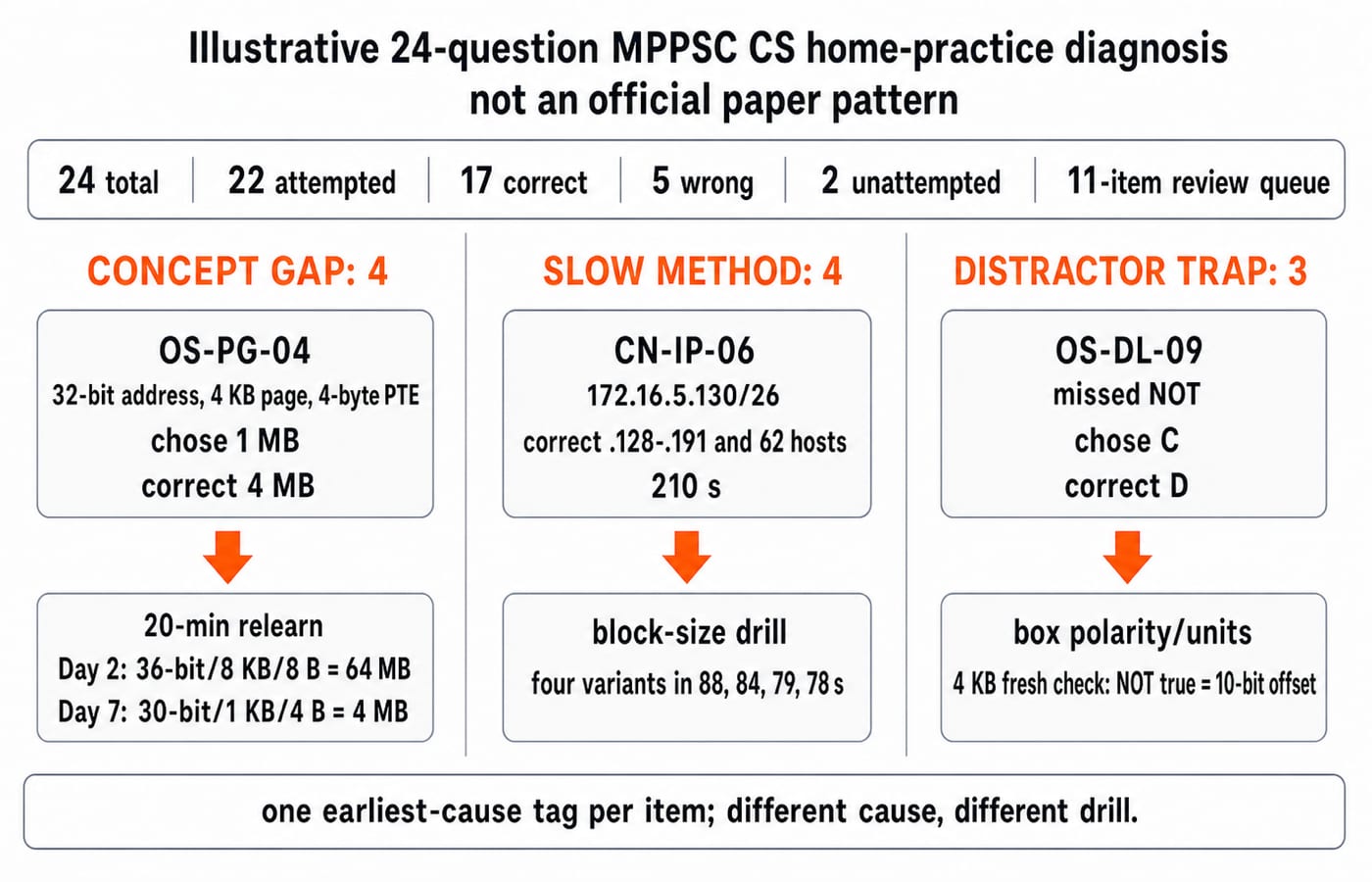
In 42 minutes a learner attempts 22 of 24 mixed CS questions from a home set, not an MPPSC paper: 17 correct, 5 wrong, 2 unattempted. Of the correct answers, 13 are reproducible, 3 were slow and 1 was a guess that landed.
Attempted accuracy:
17 / 22 x 100 = 77.3%.Completion:
22 / 24 x 100 = 91.7%.Clean reproducible performance:
13 / 24 x 100 = 54.2%.Review queue:
3 slow + 1 guessed + 5 wrong + 2 unattempted = 11.
Assign gaps 4 (1 guessed, 2 wrong, 1 unattempted), slow methods 4 (3 slow, 1 unattempted), traps 3 (all wrong). Reviewing only the 7 wrong or unattempted items discards 4 risky correct answers, and those 4 are exactly the gap between the 17 answers the sheet calls correct and the 13 the learner can reproduce on demand.
3. Diagnose three exact questions before prescribing a drill
OS-PG-04, concept gap. For a 32-bit byte-addressable address, 4 KB pages and 4-byte PTE, the learner chooses 1 MB in 74 seconds. But 4 KB = 2^12 bytes, page-number bits are 32 - 12 = 20, entries 2^20, and one-level table size 2^20 x 4 = 2^22 bytes = 4 MB. The gap is not arithmetic: it is not knowing that table size equals number of entries times PTE size.
CN-IP-06, slow method. For 172.16.5.130/26, enumeration finds network .128, broadcast .191 and 62 hosts in 210 seconds. Use 6 host bits, block size 2^6 = 64, and ranges 0-63, 64-127, 128-191, 192-255. Since 130 is in 128-191, usable addresses are .129-.190, or 64 - 2 = 62.
OS-DL-09, trap. The stem reads, "Which is NOT a necessary condition for deadlock?" Options: A mutual exclusion, B hold and wait, C circular wait, D resource preemption is allowed. The four necessary conditions are mutual exclusion, hold and wait, no preemption and circular wait, so D asserts the opposite of one of them and is the answer. The learner picks C in 32 seconds, then recites all four conditions correctly a minute later: the rule was known, the NOT was not read.
4. Match the repair to the diagnosis, then retest on fresh values
For a concept gap, relearn 20 minutes, explain closed book and apply fresh values. Day 2 uses 36 address bits, 8 KB = 2^13 and an 8-byte PTE, so 36 - 13 = 23 page-number bits and 2^23 x 8 = 2^26 bytes = 64 MB. Day 7 uses 30 bits, 1 KB = 2^10 and 4 bytes, so 30 - 10 = 20 bits and 2^20 x 4 = 2^22 bytes = 4 MB. Exit after both correct unit chains. When the gap is a whole unstudied topic rather than one identity, the MPPSC Assistant Professor Computer Science Paper 2 2026 course teaches that subject in study order.
For a slow method, use block size. 192.168.7.203/27 gives network .192, broadcast .223, usable .193-.222, 30 hosts. 10.0.0.174/28 gives .160, .175, .161-.174, 14 hosts. Four correct variants in 88, 84, 79 and 78 seconds clear the 90-second target the learner set.
For a distractor trap, box polarity, units and boundaries before options in eight stems. Fresh check: "Which is NOT true for a 4 KB page?" A offset 12 bits, B 4096 bytes, C offset 10 bits, D size 2^12 bytes. Box NOT, select C in 41 seconds and justify the rest. Exit after two error-free mixed sets.
5. Run the three-column loop inside a six-week, 10-hour model
Use 600 minutes = 10 hours: Monday to Thursday 60 each, Friday 45, Saturday 195, Sunday 120. Check: 240 + 45 + 195 + 120 = 600. Monday handles concepts, Tuesday speed, Wednesday traps, Thursday mixing, Friday retests. Saturday: 45 solve + 90 classify + 60 repair. Sunday: 60 retest + 30 audit + 30 queue.
Weeks 1-2:
180 diagnostic + 180 review + 180 repair + 60 retests = 600.Weeks 3-4:
120 concept + 140 speed + 100 trap + 160 mixed + 80 retests = 600.Weeks 5-6:
200 mixed + 200 review + 120 repair + 80 retests = 600.
Lose one weekday and replace 30 minutes of Saturday's new work with that day's priority drill, carrying the other 30 into next week's new-question block. Lose two and the retests plus the 10-hour ceiling survive first: move new questions out rather than doubling a session. This six-week loop is a review engine, not a coverage schedule, so it runs alongside whatever syllabus plan you are on. Once repairs reach mixed sets, Teaching Exam Mock Strategy for CS Papers sets the mock cadence, and the MPPSC Assistant Professor (CS) Paper 2 Test Series keeps the weekly diagnostic supplied with fresh timed questions.
6. Audit repeated causes, not just the new percentage
At Sunday audit, gaps fall from 4 to 2, slow methods 4 to 1, traps 3 to 1. Thus 2 + 1 + 1 = 4 remain. Track fresh success by micro-concept, repeats by column and median correct time. Sort 78, 79, 84, 88; median is (79 + 84) / 2 = 81.5 seconds, down from the 210 seconds that item first took.
Then aggregate by subject rather than by chapter, using the thirteen Paper 2 blocks our course is built on: discrete mathematical structures, computer organisation and architecture, C, programming languages and OOP, Python, data structures and algorithms, operating systems, theory of computation, compiler design, DBMS, computer networks and information security, software engineering, and current trends. If both remaining gaps sit in DBMS normalisation, the slow item is a compiler trace and the trap is polarity, schedule two 60-minute DBMS blocks, one 40-minute compiler block and one 20-minute stem-reading block.
Progress is fewer repeated causes under fresh conditions, not only a higher percentage. Keep the board honest about its sources: paper structure, syllabus and eligibility for the post are whatever the issued advertisement says, so work from the current documents on the Madhya Pradesh Public Service Commission website rather than a coaching summary. Its Previous Year Question Papers section is where the board's paper-labelled rows should come from, not a reconstructed compilation.
7. The short version and the next 60 minutes
Solve, queue every wrong, guessed, slow and unattempted item, diagnose the earliest cause, match the drill to it, then demand proof on fresh values. Spend the next 60 minutes as 25 on a 12-question diagnostic, 25 on classifying what went wrong, and 10 on writing Day 2 and Day 7 retest dates against each item. If the audit keeps returning concept gaps in one subject, rebuilding that subject beats re-drilling it; if it keeps returning slow methods, more timed sets are what you need.
Keep learning

MPPSC Eligibility Criteria 2026: Age Limit, Qualification & Nationality
A practical eligibility checklist for MPPSC Assistant Professor Computer Science Advertisement 28/2025, separating age, nationality, domicile, subject equivalence, marks, qualifying routes and the revised deadline.
23 Oct 20266 min readMPPSC Teaching

MPPSC Application Form 2026: Apply Online, Last Date, Fees & Registration Process
An application-focused guide for MPPSC Assistant Professor Computer Science Advertisement 28/2025, covering revised deadlines, base and late fees, photo/signature preparation, submission, payment proof and corrections.
23 Oct 20266 min readMPPSC Teaching

MPPSC Assistant Professor CS Exam 2026: Notification, Eligibility, Exam Pattern, Syllabus & Selection Process
A Computer Science-specific guide to MPPSC Advertisement 28/2025: revised application windows, the 1 October qualification cutoff, 29 November exam, eligibility, syllabus preparation and selection.
23 Oct 20266 min readMPPSC Teaching
MPPSC vs HPSC Teaching: A Decision Rule for CS Graduates
Compare MPPSC and HPSC teaching routes with a qualification gate, a syllabus portability map and a weighted fit score before committing your study hours.
Updated 7 Aug 20266 min readMPPSC Teaching