

System Analysis and Design for GATE: What the CS Syllabus Includes and What to Skip
Audit System Analysis and Design against the official GATE CS syllabus, keep examinable overlaps in their proper subjects, and redirect study time with two worked examples.
KnowledgeGate Team
Exam prep & CS education
Updated 12 Nov 20264 min read
System Analysis and Design appears in college syllabi, coaching lists and search results, so it is easy to give it a separate GATE block. The official GATE 2026 Computer Science and Information Technology syllabus does not name that block. Related concepts and study time belong under the named syllabus sections that actually contain them.
System Analysis and Design for GATE: check the official scope first
The official GATE 2026 test-papers and syllabus page links the two-page CS syllabus, which names ten technical sections: Engineering Mathematics, Digital Logic, Computer Organization and Architecture, Programming and Data Structures, Algorithms, Theory of Computation, Compiler Design, Operating System, Databases, and Computer Networks.
System Analysis and Design is not named there. This describes the explicit GATE CS scope for the 2026 cycle, not the subject's wider value. Check the official syllabus for your own exam cycle before you plan.
The same official material specifies 15 marks for General Aptitude and 85 marks for the test-paper syllabus. That is a paper-level split, not a published subject-wise weightage table.
System analysis terms that look relevant but are not the same topic
Match the exact official noun phrase, not a loose keyword.
Term a student sees | Explicit GATE CS home | Keep for GATE? | Reason |
|---|---|---|---|
SDLC models, feasibility study, requirements elicitation, DFDs, UML | No explicit named home | No separate GATE block | These are not explicitly listed in the official CS syllabus. |
ER model | Databases | Yes | ER model is explicitly listed under Databases. |
System calls, processes, threads | Operating System | Yes | These are OS concepts. The word “system” does not make them System Analysis. |
Data flow analyses, including constant propagation and liveness analysis | Compiler Design | Yes | Compiler data-flow analysis is explicit, but it is not a software-engineering data-flow diagram. |
“Data flow” and “system” recur across CS. The surrounding syllabus section controls what you must study.
System Analysis and Design weightage follows named syllabus sections
Because the official syllabus has no standalone System Analysis and Design section, there is no official standalone weightage. Related concepts can still appear when they belong to a named section, and a paper can test an explicit concept through an unfamiliar scenario.
Keep three ideas separate: the official paper split, named syllabus coverage, and past-paper trends. Only the first two come from official material. Past-paper frequency is a planning aid, not a promise. Use GATE CS Subject Weightage: Where Hours Pay Off to compare patterns across actual GATE CS subjects, not to assign a fixed future distribution.
Worked example: repair a 300-minute study plan
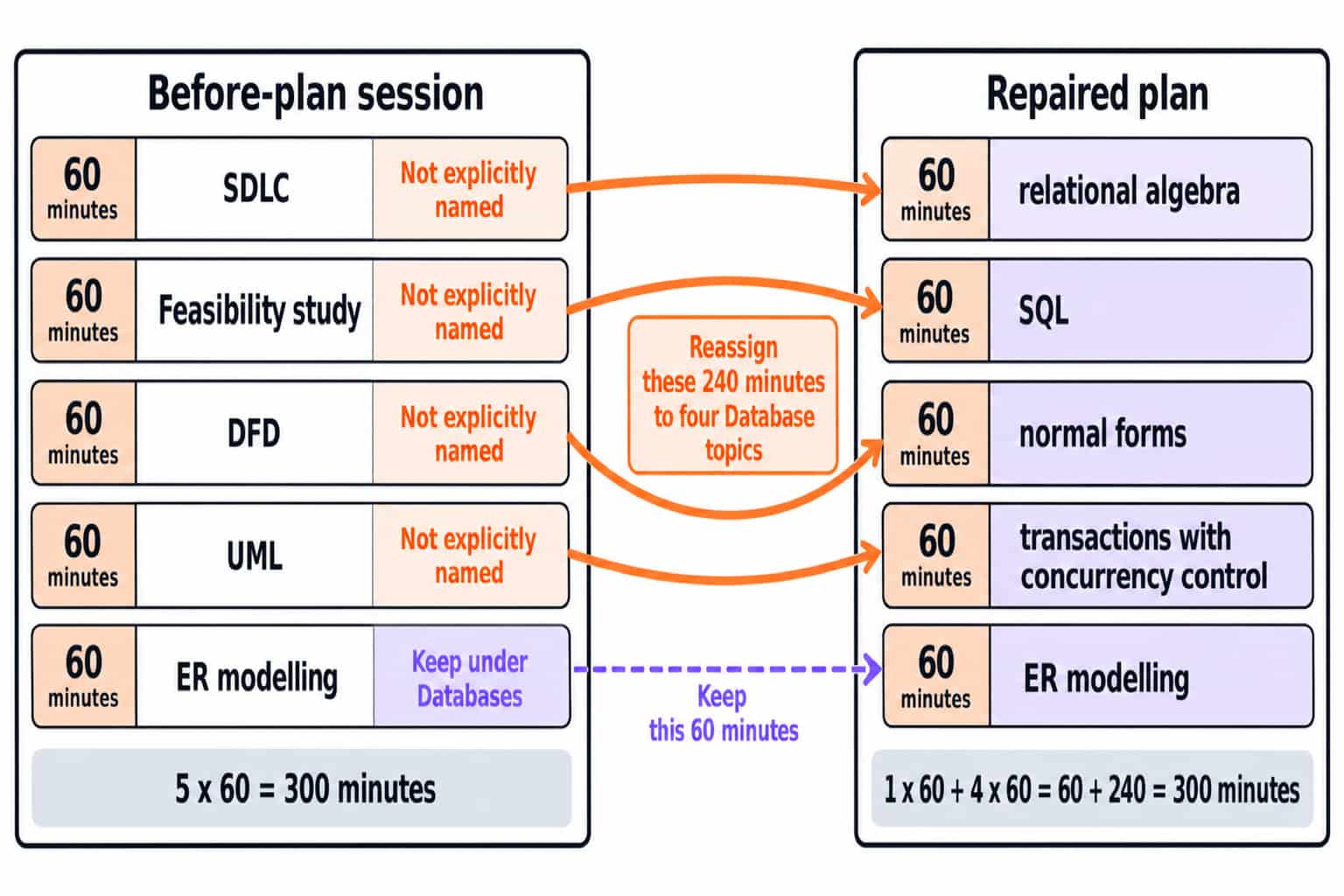
Suppose a GATE-only learner plans five 60-minute sessions:
Before-plan session | Minutes | Syllabus audit |
|---|---|---|
SDLC | 60 | Not explicitly named |
Feasibility study | 60 | Not explicitly named |
DFD | 60 | Not explicitly named |
UML | 60 | Not explicitly named |
ER modelling | 60 | Keep under Databases |
The original total is 5 x 60 = 300 minutes.
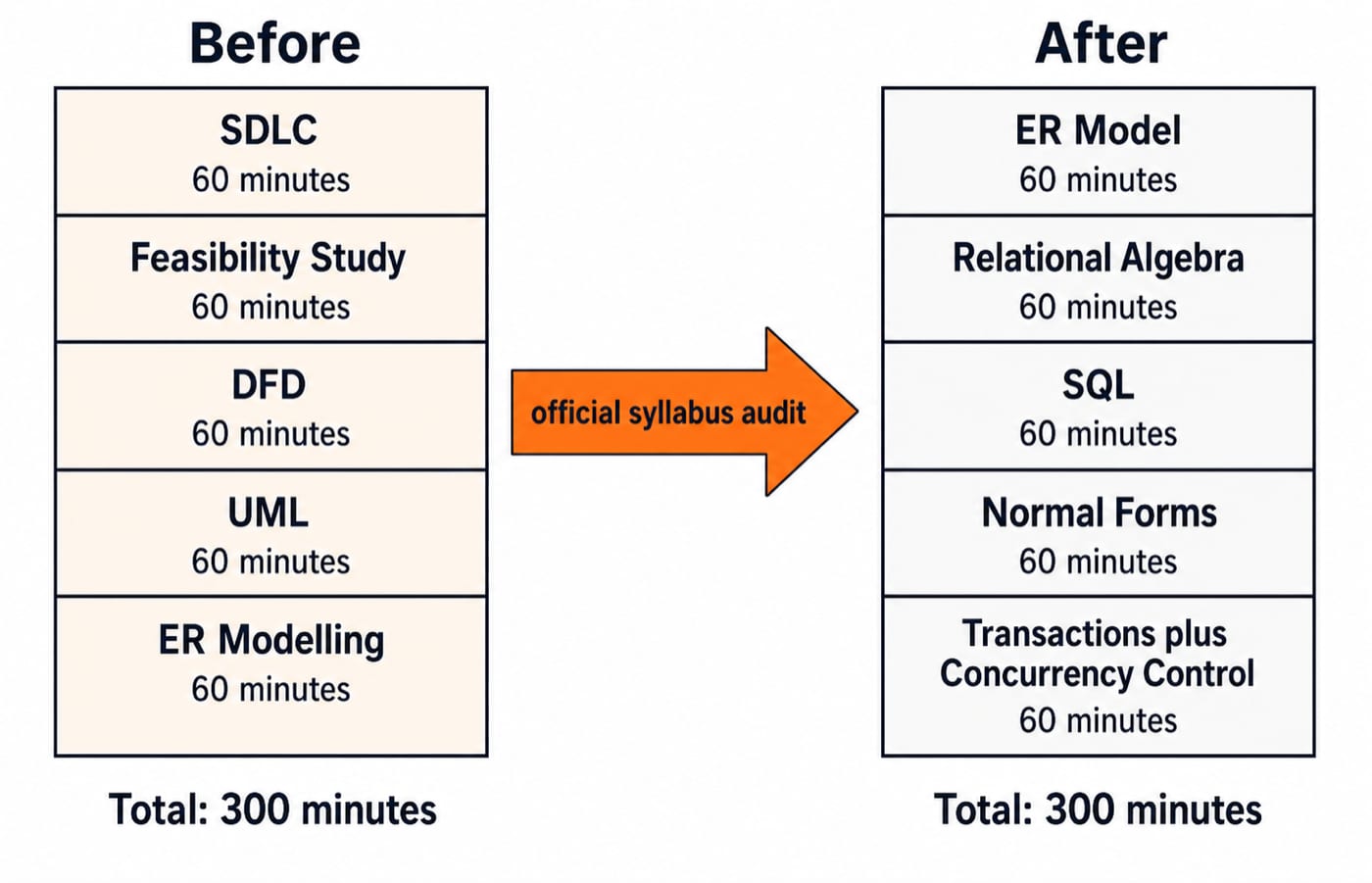
Keep the 60-minute ER-model session. Reassign the remaining 240 minutes to four 60-minute sessions on relational algebra, SQL, normal forms, and transactions with concurrency control. All are explicitly listed under Databases. The repaired total is 1 x 60 + 4 x 60 = 60 + 240 = 300 minutes.
This reallocation is for a learner targeting GATE CS only. For another exam that explicitly lists the subject, SDLC and Development Approaches in System Analysis and Design covers model selection and a 16-week portal case. For GATE CS, allocate time only through the named syllabus sections.
What an actually in-syllabus design question can look like
Consider AUTHOR(AuthorId, Name) and BOOK(BookId, Title), connected by a many-to-many WRITES relationship with attribute RoyaltyPercent.
Map the entity sets first:
AUTHOR(AuthorId primary key, Name)BOOK(BookId primary key, Title)
Map the relationship as WRITES(AuthorId foreign key, BookId foreign key, RoyaltyPercent), with composite primary key (AuthorId, BookId). RoyaltyPercent belongs on the relationship, not on BOOK, because a book with three authors would need three shares in one column. This is database design under the explicit ER-model and relational-model syllabus, not a DFD or UML exercise.
For a key check, (A21, B07, 40) and (A21, B12, 60) are valid because the key is the pair (AuthorId, BookId). A second (A21, B07, 25) repeats that key pair, despite the different royalty share, and violates the primary key.
Match the resource to the job
Need | Resource | Honest use |
|---|---|---|
Complete subject sequencing | Structured GATE CS preparation when you need a complete learning path. | |
Timed topic and mock practice | The testing layer after concept study. | |
Browse the current GATE line-up | Use this when you need a subject-specific course rather than a complete path. |
System Analysis and Design for GATE: the final syllabus boundary
System Analysis and Design is not a standalone named section in the official GATE 2026 CS syllabus. A GATE-only learner should not assign it a fabricated weightage or a separate revision lane. Keep explicit overlaps in their real homes, especially ER modelling in Databases, system calls in Operating System, and compiler data-flow analysis in Compiler Design. Open the official syllabus, audit your next 300 minutes with the worked method, then choose structured guidance if the gap is learning or the test series if the gap is timed practice.
Go deeper with the full courseGATE Guidance by Sanchit Sir
Keep learning

Lexical Analysis and Tokens in Compiler Design: Worked Examples for GATE CS
See how a lexer turns source characters into tokens. The worked scan follows one complete line, builds symbol-table references, and exposes common traps.
Updated 31 Aug 20265 min read72 viewsCompiler Design

Operating System for GATE: Syllabus, Weightage Pattern and Prep Order
See what GATE officially includes under Operating System, how we classified two 2026 CS papers, and how to turn that scope into a 30-hour study plan.
Updated 30 Oct 20265 min read211 viewsOperating Systems

Compiler Design for GATE: Syllabus Areas, Weightage Pattern and How to Prepare
See what GATE Compiler Design covers, where practice questions concentrate, how to solve a complete FIRST/FOLLOW example, and which topics to study first.
Updated 27 Jul 20264 min read77 viewsCompiler Design

Security, Risk Management and Maintenance in System Analysis and Design: A Worked Risk Register
Follow one university registration system from testable security requirements through risk ranking, maintenance classification, and a controlled production change.
Updated 7 Nov 20266 min readGATE Strategy & Roadmap