

Advanced System Types: Classification Axes, a Worked Feedback Example and Exam Traps
Learn to classify one system across independent axes, then calculate how queue feedback changes an admissions portal's capacity and final backlog.
KnowledgeGate Team
Exam prep & CS education
Updated 13 Nov 20266 min read
You may know these labels but struggle when several fit one system. Classify each axis by inspecting boundary, environment, uncertainty, time and feedback. Apply the method to a calculated admissions portal.
Advanced system types: classify one system on several independent axes
A system is an organised set of interdependent components working towards an objective. First identify its boundary, environment, inputs, process, outputs and feedback.
Open or closed, deterministic or probabilistic, static or dynamic, and adaptive or non-adaptive answer different questions. One system can be open, probabilistic, dynamic and adaptive together.
Axis | Diagnostic question | Type A | Type B |
|---|---|---|---|
Exchange | What crosses the boundary? | Open | Closed |
Uncertainty | Do inputs and rules force one output? | Deterministic | Probabilistic |
Time | Does state change? | Static | Dynamic |
Response | Does feedback change behaviour? | Adaptive | Non-adaptive |
Structure | How interdependent are the parts? | Simple | Complex |
Form | Conceptual or tangible? | Abstract | Physical |
Origin | Who created it? | Natural | Man-made |
Time horizon | Limited purpose or lasting role? | Temporary | Permanent |
Operation | Are people inside the boundary? | Machine-only | Human-machine |
CS Fundamentals for Exams & Placements supports broader concept-first CS study.
Open, closed, adaptive and non-adaptive systems: environment is not feedback
An open system exchanges information, material or energy with its environment. A closed system is an idealised model without significant environmental exchange. Such information systems are rare, so state boundary and purpose.
An adaptive system changes a rule, parameter or structure after feedback or environmental change. A non-adaptive one keeps its rule and parameters despite the result. A queue controller that raises hourly capacity from 300 to 350 after observing backlog changes an operating parameter. A dashboard that only displays the backlog is monitoring.
Open concerns exchange across the boundary. Closed-loop control concerns internal feedback. A portal may exchange data with applicants and banks while using closed-loop feedback to change capacity. Closed system and closed-loop system are not synonyms.
Deterministic, probabilistic, static, dynamic, simple and complex systems
Stated inputs and rules force the output of a deterministic system. Thus final fee = 500 + 20 x late_days gives 500 + 20 x 6 = 620. A probabilistic system includes relevant uncertainty, such as tomorrow's 400 forecast arrivals with a plausible range of 320 to 480. Large does not mean probabilistic.
Static and dynamic concern time. A 10:00 snapshot showing 1,200 available seats is static for that instant. An allocation changing availability to 1,200 - 270 = 930 is dynamic.
Simple and complex concern components, rules, feedback paths and their interdependence, not physical size. A large multiplication chart can be simple; a small workflow linked to identity checks, payment, review and allocation can be complex. Complexity depends on the boundary and level of detail.
Physical, abstract, natural, man-made, permanent, temporary and human-machine systems
An abstract system is conceptual, such as an algorithm, policy or data model. A physical system has tangible components. An admissions service contains abstract rules and data plus servers, networks and people. Its boundary decides the answer.
A river ecosystem is natural; an admissions portal is man-made. A batch job can be machine-only within a narrow execution boundary, while validation containing reviewers and software is human-machine. Manual is not the opposite of man-made.
Permanent and temporary depend on purpose and time horizon. The platform may persist while a four-hour surge-control arrangement is temporary. Expanding the boundary from controller to platform can legitimately change the label without changing the facts.
Advanced system types worked example: classify and calculate an adaptive admissions portal
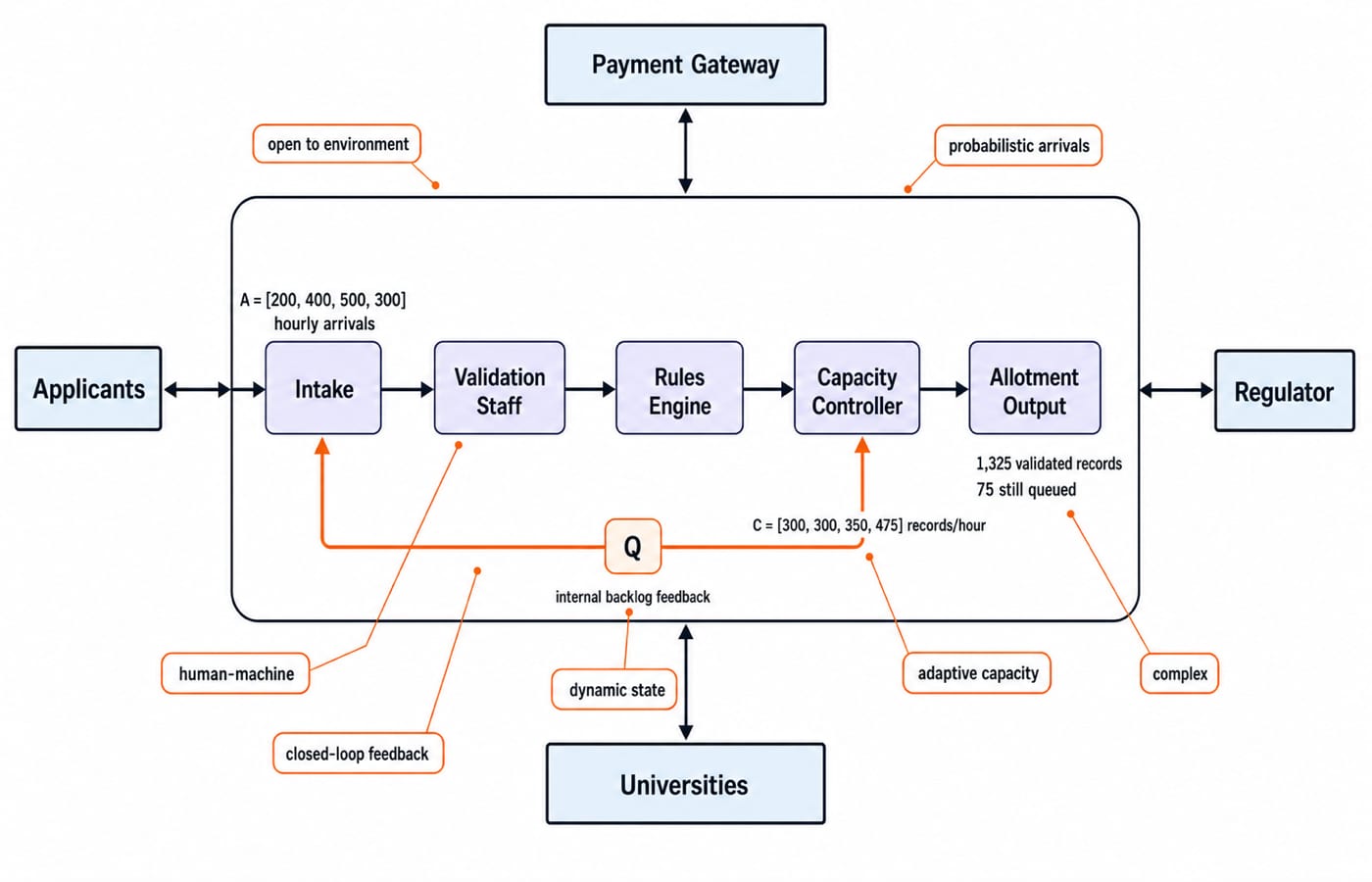
The boundary contains intake, automated checks, validation staff and a capacity controller. Applicants, payment gateway, institutions and regulator are outside. Across four hours, arrivals are A = [200, 400, 500, 300], initial capacity is C1 = 300 records/hour, Q0 = 0, and the capacity ceiling is 500.
Let At be arrivals, Ct capacity and Qt ending queue in hour t. Use Qt = max(0, Q(t-1) + At - Ct) and C(t+1) = min(500, Ct + Qt/2).
Hour | Starting queue | Arrivals At | Capacity Ct | Records validated | Ending queue Qt | Next capacity |
|---|---|---|---|---|---|---|
1 | 0 | 200 | 300 | 200 | 0 | 300 |
2 | 0 | 400 | 300 | 300 | 100 | 350 |
3 | 100 | 500 | 350 | 350 | 250 | 475 |
4 | 250 | 300 | 475 | 475 | 75 | 500 |
Hour 1:
max(0, 0 + 200 - 300) = 0; validate 200;C2 = 300.Hour 2:
max(0, 0 + 400 - 300) = 100; validate 300;C3 = 300 + 100/2 = 350.Hour 3:
max(0, 100 + 500 - 350) = 250; validate 350;C4 = 350 + 250/2 = 475.Hour 4:
max(0, 250 + 300 - 475) = 75; validate 475;C5 = min(500, 475 + 75/2) = 500.
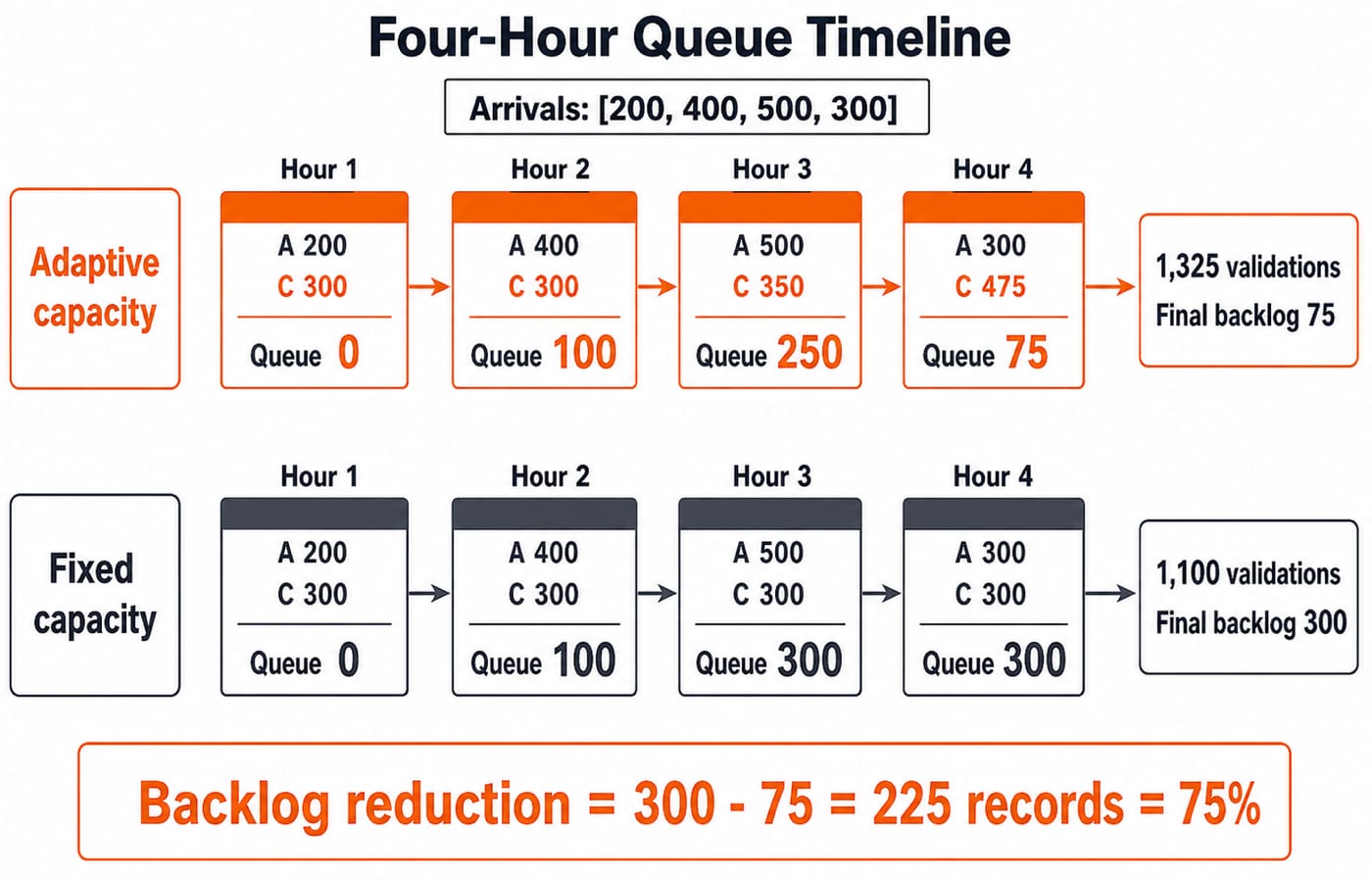
Independently, arrivals total 200 + 400 + 500 + 300 = 1,400; validations total 200 + 300 + 350 + 475 = 1,325; and 1,400 - 1,325 = 75, matching the queue. At fixed capacity 300, queues are [0, 100, 300, 300] and validations total 1,100. Feedback cuts backlog by 300 - 75 = 225, or 225/300 x 100 = 75%.
Before demand is realised, uncertain arrival counts make the operating portal probabilistic. Given the realised arrival vector and update equation, the trace itself is deterministic. Its changing queue and capacity make it dynamic and adaptive; its boundary also makes it open, human-machine, complex and man-made. The four-hour control arrangement is temporary although the portal persists. Zero to Hero: Complete CS Course provides a structured fundamentals-to-advanced CS route.
Advanced system types exam patterns: identify the axis before choosing the label
Questions can use definitions, scenarios, axis matching, assertion-reason, several fitting labels or feedback-state calculation. Underline the boundary, time window and changing variable before reading the options.
A payroll formula repeats its result for the same inputs: deterministic, because its rules force the output.
A traffic controller changes signal time after observing queue length: adaptive and dynamic, because feedback changes behaviour over time.
An online marketplace exchanges orders and payments with users: open, even with an internal fraud-feedback loop.
MCQ, MSQ or NAT? GATE Question Types Explained distinguishes response formats.
Advanced system types traps: boundary errors, mixed axes and unsupported labels
Trap | Why it fails | Correction |
|---|---|---|
Open means open-source | Wrong domain | Inspect environmental exchange. |
Closed means closed-loop | Exchange and feedback differ | Classify both axes. |
Random-looking means probabilistic | Complexity is not uncertainty | Can identical stated inputs differ? |
Feedback means adaptive | Observation may change nothing | Find a changed rule or parameter. |
Whole portal is machine-only | Validators are inside | Human-machine. |
Four-hour campaign is permanent | Platform life is irrelevant | Temporary arrangement. |
Deployed portal is purely abstract | Servers and staff are included | It has physical components. |
Hour 3 starts with 100 queued, so its ending queue is 100 + 500 - 350 = 250, not 150. Hour 4 begins with 250 queued and receives 300 more, so 550 records are available; capacity 475 leaves 75. Without a service-order rule, the split between old and new validations is unspecified. The 75% is reduction against fixed backlog 300, not processing speed, marks or weightage.
Advanced system types: the short version and the next step
Ask six questions:
What is inside the boundary?
What crosses it?
Do the same stated inputs force the same output?
Does state change with time?
Does feedback merely get observed, or change behaviour?
Are people inside the operating boundary?
The checkpoint is 1,400 arrivals, 1,325 validations, adaptive queue 75, fixed queue 300, and reduction 225/300 = 75%. Under this boundary, the portal is open, dynamic, adaptive, complex, man-made and human-machine. Its operating demand is probabilistic before arrivals are realised; the shown trace is deterministic conditional on its arrival vector.
GATE Guidance by Sanchit Sir is an optional broader study sequence; Zero to Hero is the alternative CS path. Change Hour 3 arrivals from 500 to 600, recompute both queue paths, and reclassify only if the evidence changes.
Go deeper with the full courseGATE Guidance by Sanchit Sir
Keep learning
Static vs Dynamic Typing: Errors, Feedback Loops and Refactoring Flexibility
Follow one OrderLine model from an integer price to an INR Money value. See what Java catches during checking, what Python reveals during execution, and what both still need tests to prove.
Updated 25 Sep 20265 min readProgramming Languages Survey

Behavioural Interview Failure Questions: Show Ownership, Feedback and Learning
Learn how to select a genuine failure story, explain its consequence without blame, and show that feedback produced a repeatable change in behaviour.
Updated 30 Oct 20265 min readInterview Corner

Advanced Counting Theorems Questions with Solutions: 10 Worked Problems
Choose the counting model before reaching for a formula. Solve six MCQs and four numerical-answer questions, with worked explanations of overlaps, initial conditions and identical objects.
Updated 6 Nov 20268 min readDiscrete Mathematics MCQs

Advanced and Financial Cyber Attacks: Concepts, Worked Analysis and Exam Traps
Learn to separate APTs, zero-days, credential attacks and financial attack methods, then analyse a fictional login-to-transaction signal funnel step by step.
Updated 3 Nov 20266 min readUGC NET Computer Science