Compiler Design for GATE: Syllabus Areas, Weightage Pattern and How to Prepare
See what GATE Compiler Design covers, where practice questions concentrate, how to solve a complete FIRST/FOLLOW example, and which topics to study first.
KnowledgeGate Team
Exam prep & CS education
Updated 27 Jul 20264 min read
Compiler Design is the subject many GATE CS aspirants push to the end because it feels niche beside Algorithms or Operating Systems. That delay is a mistake. The syllabus is compact, its questions are procedure-driven, and accuracy improves once you drill the procedures. Parsing, with the grammar work underneath it, accounts for close to half the practice questions, so that is where most of the time goes.
What the GATE syllabus lists under Compiler Design
Recent GATE CS bulletins have listed these areas: lexical analysis, parsing, syntax-directed translation, runtime environments, intermediate code generation, and local optimisation with the basics of data-flow analysis. The named data-flow topics are constant propagation, liveness analysis, and common subexpression elimination. Download the syllabus PDF once from the organising institute's GATE portal (the host IIT changes every year) and pin it beside your study plan.
Full undergraduate textbooks tempt students into detailed code-generation algorithms, garbage-collection internals, and linker or loader theory. The GATE syllabus does not list these, so learn only the background needed for the named areas.
Where questions concentrate: the weightage pattern
GATE publishes no fixed per-subject weightage. The useful pattern comes from counting previous-year questions, which you can check against the question papers on the official portal. Compiler Design is a smaller core subject, but repeatable templates make it efficient to prepare.
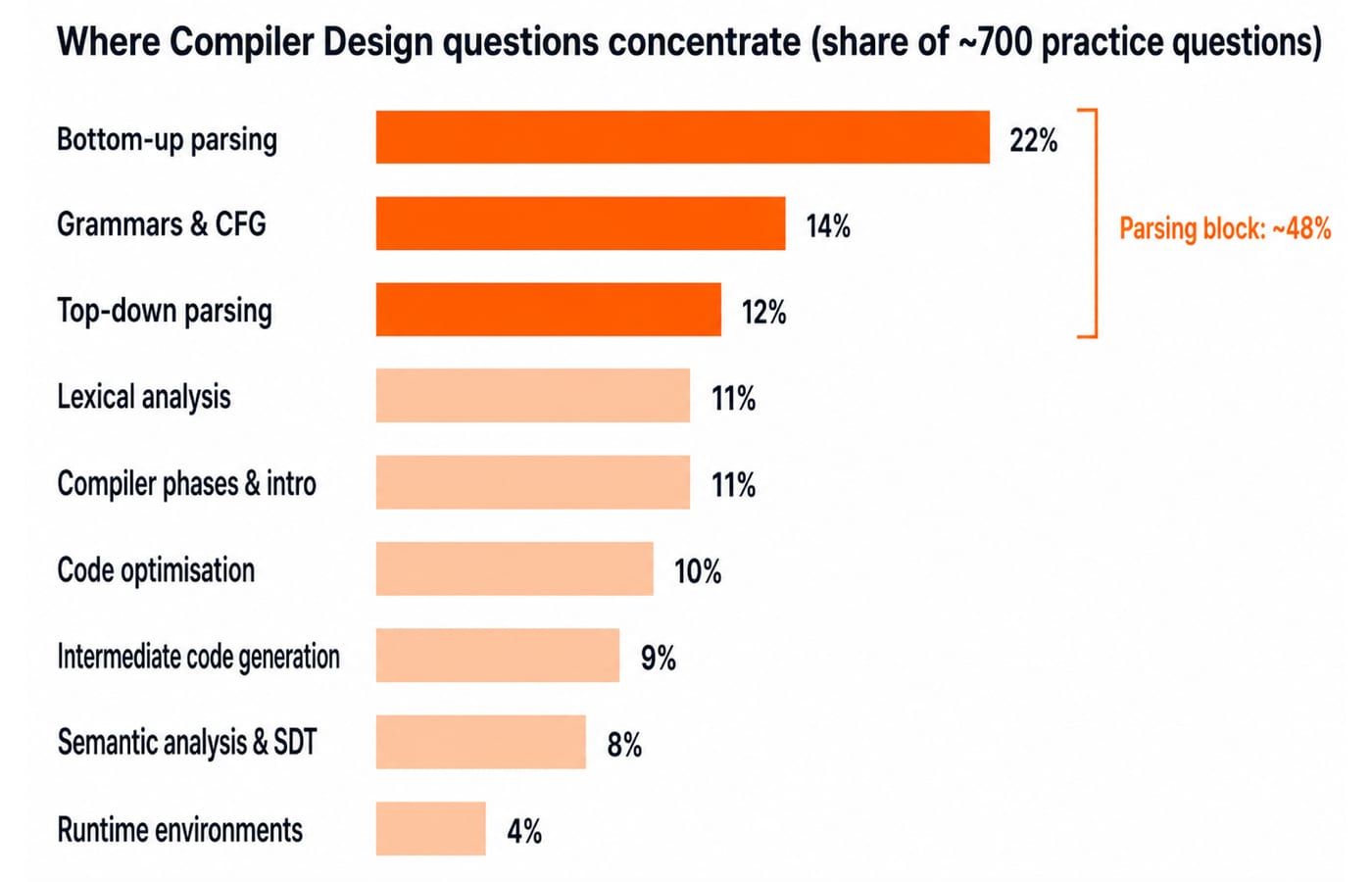
KnowledgeGate's Compiler Design practice set, about 700 questions, gives a useful topic map rather than official GATE weightage. Approximate shares are bottom-up parsing 22%, grammars and CFG fundamentals 14%, top-down parsing 12%, lexical analysis 11%, compiler phases and introduction 11%, code optimisation 10%, intermediate code generation 9%, semantic analysis and SDT 8%, and runtime environments 4%. Parsing, including its grammar groundwork, is close to half of that, so prepare it first and deepest.
What each Compiler Design area actually asks
Lexical analysis: Count tokens or lexemes and identify what reaches the parser.
Top-down parsing: Compute FIRST and FOLLOW, test LL(1), or fill a parse-table cell.
Bottom-up parsing: Count LR items, find conflicts, and compare SLR, CLR, and LALR.
Syntax-directed translation: Evaluate an attribute grammar or classify it as S-attributed or L-attributed.
Intermediate code: Write or count three-address-code instructions and compare quadruples with triples.
Runtime environments: Reason about activation records, scoping, and parameter passing.
Optimisation: Identify basic blocks or common subexpressions in a flow graph.
A worked FIRST and FOLLOW example
Use the classic expression grammar:
E  -> T E'
E' -> + T E' | epsilon
T  -> F T'
T' -> * F T' | epsilon
F  -> ( E ) | id
Start with FIRST. Since F begins with ( or id, and both T and E begin through F:
FIRST(F) = FIRST(T) = FIRST(E) = { (, id }FIRST(E') = { +, epsilon }FIRST(T') = { *, epsilon }
Now compute FOLLOW mechanically. E is the start symbol, so $ follows it; the production F -> ( E ) adds ). Hence FOLLOW(E) = { ), $ }. Since E' ends E -> T E', it inherits that set: FOLLOW(E') = { ), $ }.
In E -> T E', + from FIRST(E') follows T. Because E' can vanish, T also inherits FOLLOW(E). Therefore FOLLOW(T) = { +, ), $ }. Since T' ends T -> F T', FOLLOW(T') = { +, ), $ }. Finally, * from FIRST(T') follows F; because T' can vanish, add FOLLOW(T). Thus FOLLOW(F) = { *, +, ), $ }.
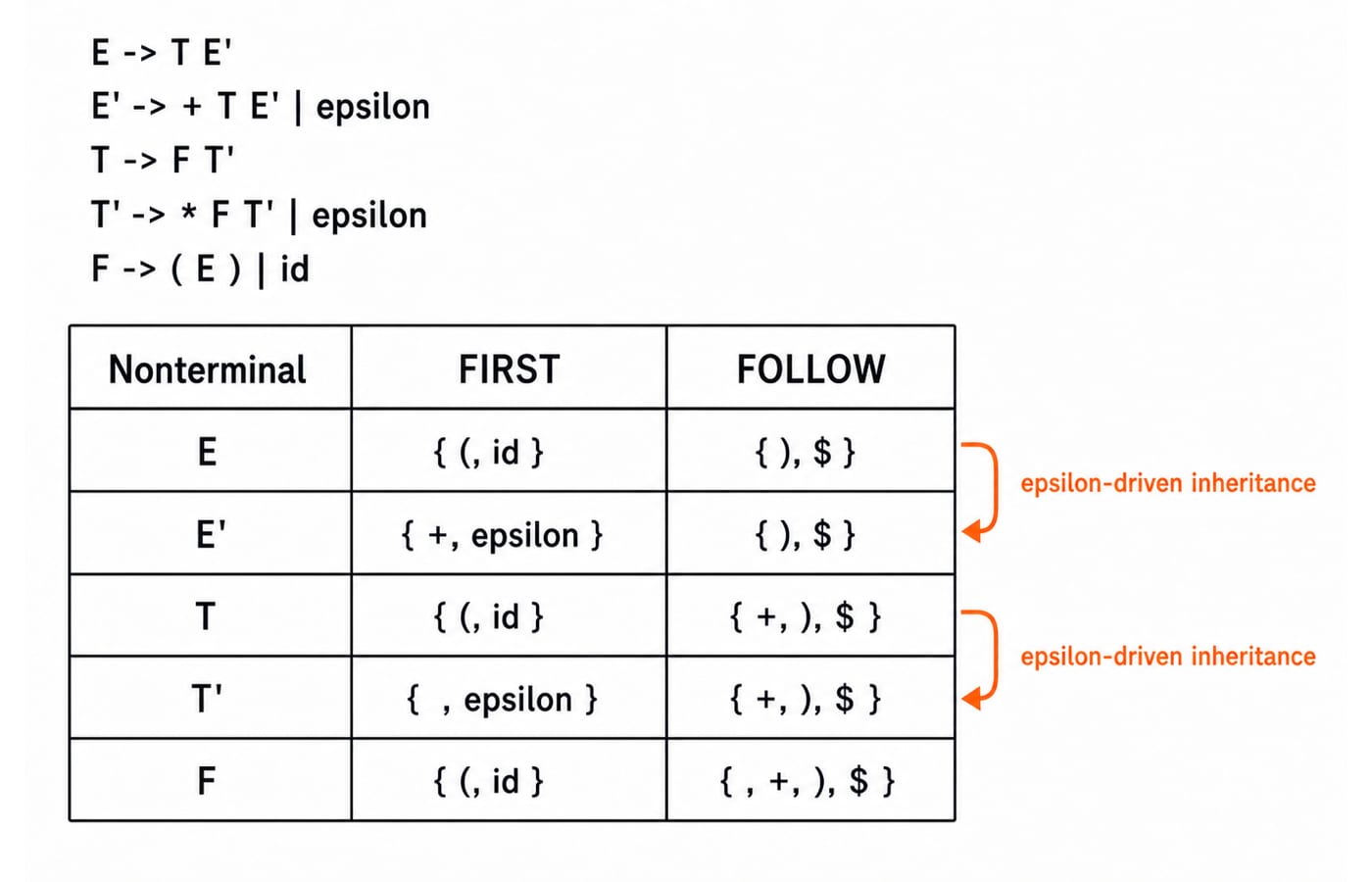
Every FOLLOW set above uses two rules: add what can appear immediately after the nonterminal, then inherit the parent's FOLLOW when the remaining suffix can vanish. The same drill returns inside LL(1) tables and SLR conflict questions, so it pays more than once.
The right preparation order
Start with grammar fundamentals because every parser depends on CFG fluency. Use Context-Free Grammars and Pushdown Automata as the bridge from TOC.
Finish lexical analysis, which is small and self-contained.
Learn top-down parsing and become fluent with FIRST and FOLLOW.
Take up bottom-up parsing next. It is the largest block, and earlier work makes item sets easier.
Study SDT with intermediate code because both use annotated parse trees.
Keep runtime environments and optimisation for the end; they have fewer dependencies.
As a planning estimate, a first pass can take roughly two weeks at 1.5 to 2 hours daily if you remember an undergraduate compilers course, or closer to three weeks from scratch. Give parsing about half that time.
The practice loop: PYQs first, then topic-wise drills
Begin with previous-year questions because templates return with new grammars and values. Working through roughly fifteen years of Compiler Design PYQs maps the question universe faster than a second textbook. Then widen out across the practice set for coverage.
Move from topic-wise tests to full mocks in the GATE Test Series. Record which areas still leak marks, then re-drill only those until parsing computations fit comfortably into test conditions.
Where Compiler Design fits, and the next step
Compiler Design works well in the middle of preparation, after TOC feeds its grammar base and before revision-heavy subjects. Use the GATE CS subject weightage guide for the cross-subject allocation view and the GATE CS course path for the surrounding preparation options.
The short version is simple: the syllabus is small, parsing is about half the practice-bank picture, and one grammar drilled from FIRST and FOLLOW through LL(1) and LR conflicts covers much of the reusable method. For structured sequencing and mentor-led planning, continue with GATE Guidance by Sanchit Sir.
Keep learning
Intermediate Code Generation in Compiler Design: TAC, Backpatching and DAGs
Connect expressions, short-circuit control flow and local optimisation through a single worked translation, from source code to resolved TAC and a reusable DAG.
Updated 5 Oct 20265 min readCompiler Design
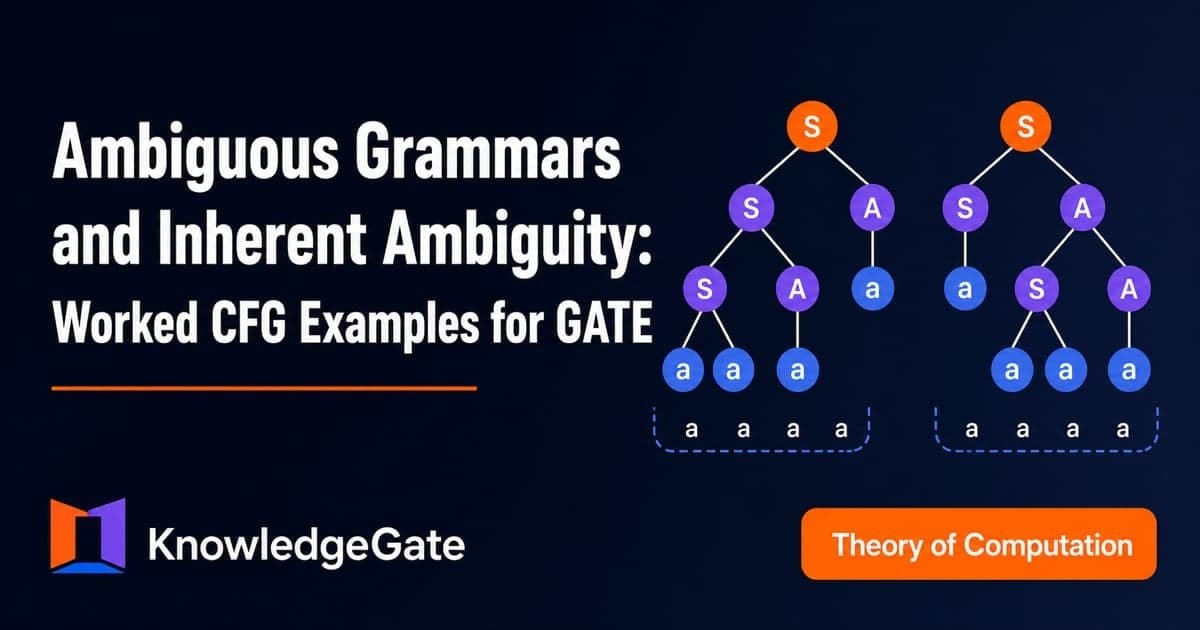
Ambiguous Grammars and Inherent Ambiguity: Worked CFG Examples for GATE
Learn what two derivations really prove, resolve expression ambiguity with precedence, and trace the classic inherently ambiguous language through aabbcc.
Updated 1 Oct 20266 min readCompiler Design
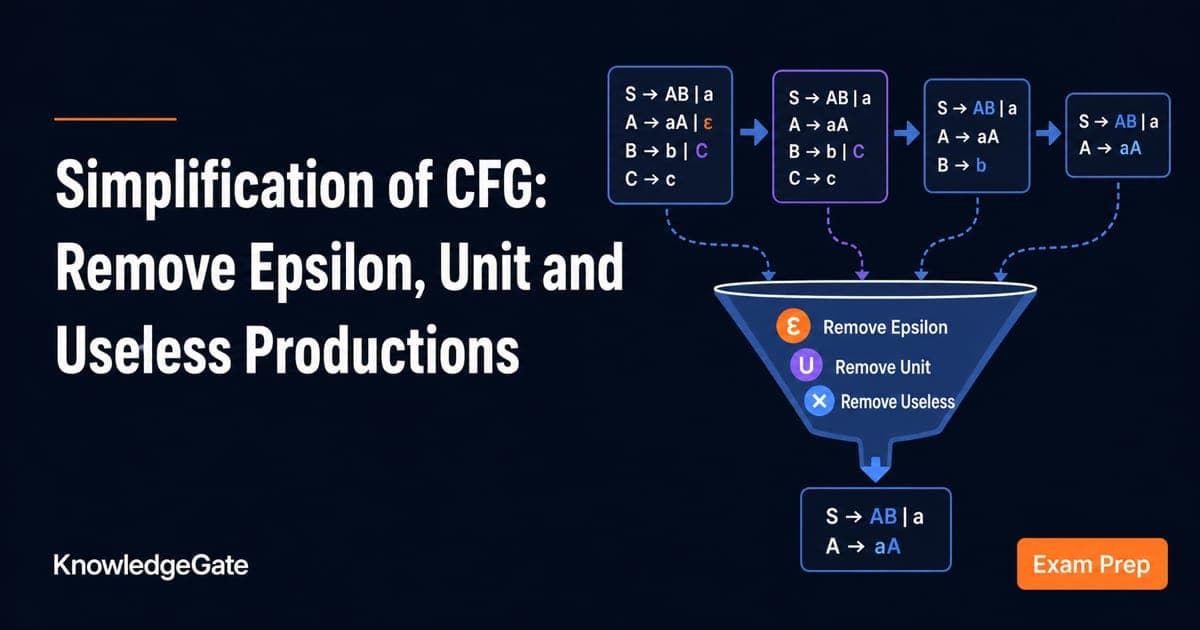
Simplification of CFG: Remove Epsilon, Unit and Useless Productions Step by Step
Simplify one context-free grammar from nine nonterminals to six. See each intermediate grammar, complete unit closures, symbol checks and final derivations.
Updated 26 Sep 20266 min readCompiler Design
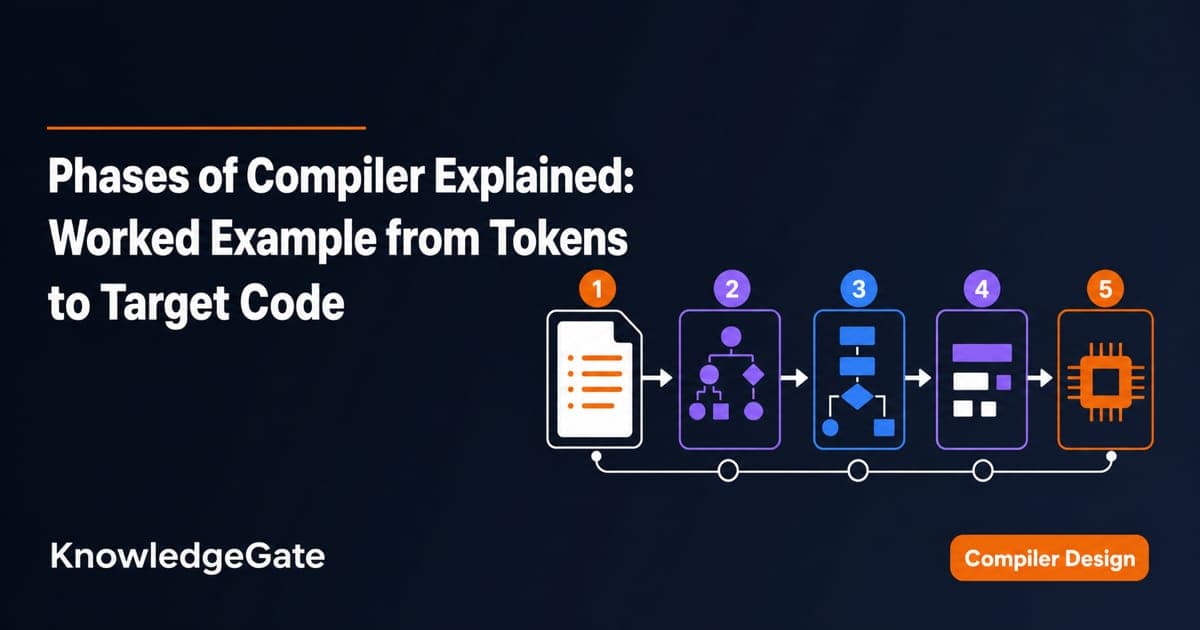
Phases of Compiler Explained: Worked Example from Tokens to Target Code
Follow one four-line program through lexical, syntax and semantic analysis, then see its intermediate code optimized to a final stored value of 24.0.
Updated 24 Sep 20266 min readCompiler Design