

Security, Risk Management and Maintenance in System Analysis and Design: A Worked Risk Register
Follow one university registration system from testable security requirements through risk ranking, maintenance classification, and a controlled production change.
KnowledgeGate Team
Exam prep & CS education
Updated 7 Nov 20266 min read
Security, risk management, and maintenance are memorised as disconnected lists, so scenario questions become confusing. One university registration system connects secure requirements, a computed risk register, maintenance classification, and change control. Security defines what to protect, risk management decides what to treat first, and maintenance controls change without losing protection.
1. Security in system analysis and design: turn goals into testable requirements
An asset is worth protecting. A threat can cause harm through a vulnerability, an exploitable weakness. Risk combines likelihood with impact; a control changes either or both.
Confidentiality prevents unauthorised disclosure, integrity prevents improper change, and availability supports authorised use. Authentication proves identity, authorisation decides allowed actions, and accountability records who acted.
Our system has actors Student and DepartmentAdmin; assets StudentProfile, CourseChoice, SeatLimit, and AuditLog; and a trust boundary around the Registration API between browsers and data. Replace "the portal must be secure" with testable requirements:
A student may update only their own
CourseChoice.Only
DepartmentAdminmay changeSeatLimit.Each limit change records who acted, the previous and new values, and when it happened.
After 5 failed logins within 10 minutes, the next attempt requires secondary verification.
These numbers belong only to this scenario. Least privilege limits access, separation of duties splits sensitive power, layered defence avoids one-point dependence, secure defaults deny ungranted actions, input validation rejects bad data, and fail-safe behaviour preserves a safe state.
2. Risk management: identify, analyse, respond, and monitor
A migration may corrupt course choices is a pre-deployment risk. The migration has corrupted 18 records is an issue requiring incident handling. The loop sets context, identifies events, analyses them, selects responses, assigns owners, monitors triggers, and reviews assumptions.
A register records ID, event and consequence, owner, probability P, impact I, exposure P x I, response, controls, trigger, and residual exposure. Here, P runs from 0.00 to 1.00 and I from 1 to 10. This local ranking scale is not universal or monetary.
Responses are: avoid the activity, mitigate probability or impact, transfer suitable responsibility or loss, or accept with monitoring and contingency. Inherent exposure is before controls; residual exposure is after them. Below-threshold risk still exists.
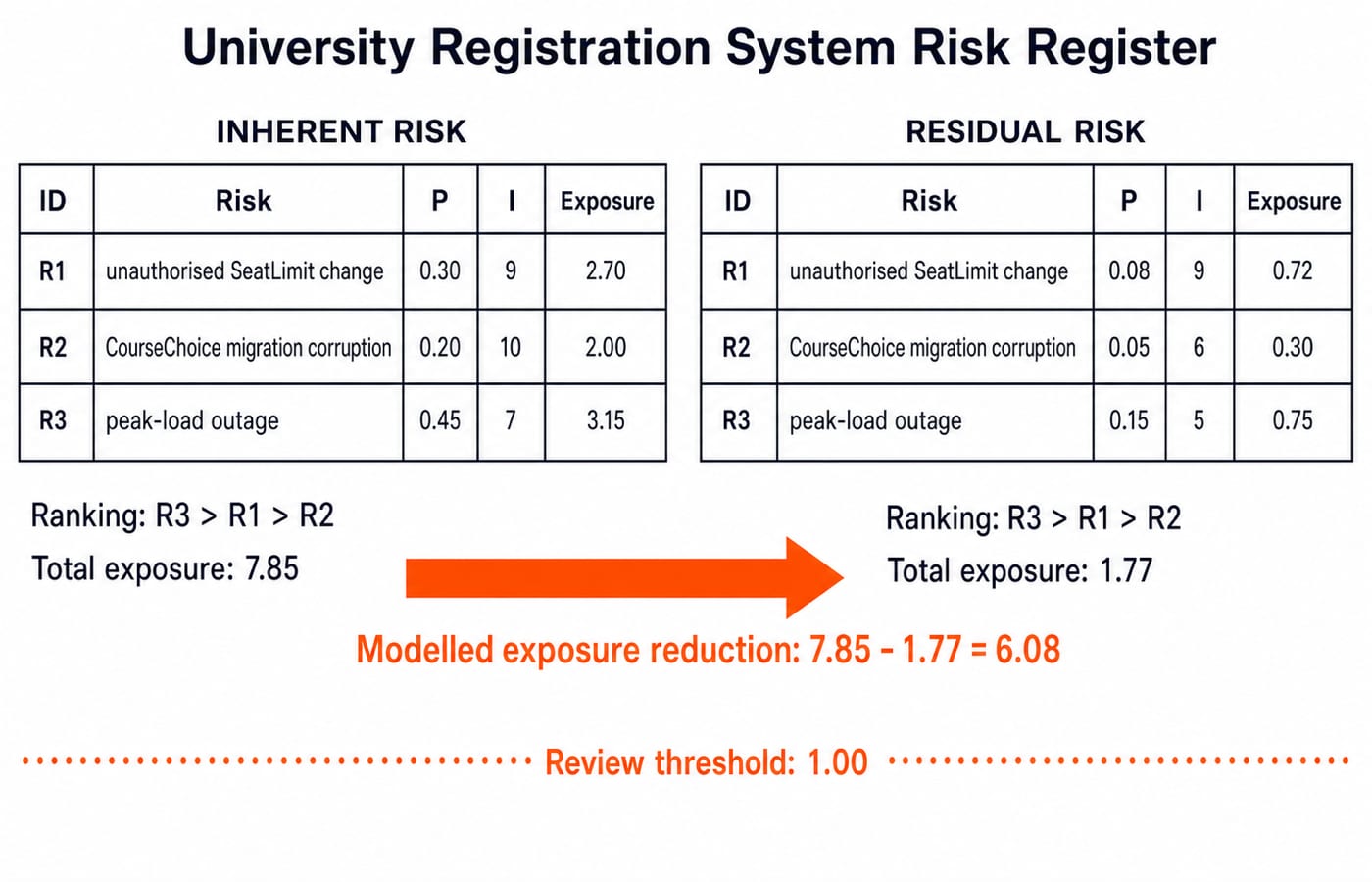
3. Worked risk register: rank three registration-system risks before and after controls
ID | Event and consequence | Owner | P | I | Exposure P x I | Response | Controls | Trigger | Residual exposure |
|---|---|---|---|---|---|---|---|---|---|
R1 | Unauthorised | Access owner | 0.30 | 9 | 0.30 x 9 = 2.70 | Mitigate | Role-based access, secondary verification, immutable audit | Change alert | 0.08 x 9 = 0.72 |
R2 | Migration corrupts | Release owner | 0.20 | 10 | 0.20 x 10 = 2.00 | Mitigate | Verified backup, canary, rehearsed rollback | Canary mismatch | 0.05 x 6 = 0.30 |
R3 | Peak load blocks registration | Service owner | 0.45 | 7 | 0.45 x 7 = 3.15 | Mitigate | Load test, request queue, capacity scaling | Latency alert | 0.15 x 5 = 0.75 |
Before controls, R3 3.15 > R1 2.70 > R2 2.00, so treat R3 first; total exposure is 2.70 + 2.00 + 3.15 = 7.85. Residual ranking is R3 0.75 > R1 0.72 > R2 0.30; total is 0.72 + 0.30 + 0.75 = 1.77. Reduction is 7.85 - 1.77 = 6.08.
All fall below the example threshold 1.00, but retain an owner, trigger, contingency, and monitoring. Evidence must revise estimates. Low residual exposure never means zero risk.
4. Software maintenance types: classify the trigger, not the coding technique
After delivery, maintenance still uses analysis, design, coding, testing, configuration control, deployment, and documentation. Corrective fixes defects, adaptive answers changed rules or environments, perfective improves the system, and preventive reduces future failure or maintainability risk.
Two requests within
100 mscreate duplicate enrolment. A unique constraint and idempotency key are corrective.The credit limit changes from
24to22. Updating rules and validation is adaptive.Course-search p95 latency is
4.8 s; indexing and caching target1.5 s. That is perfective.An obsolete authentication library is replaced and its regression set grows from
36to52tests before failure. That is preventive.
A security patch is corrective when removing an exploitable defect, or preventive before failure. Classification follows why; security review follows possible exposure.
5. Maintenance change control: carry CR-17 from request to rollback
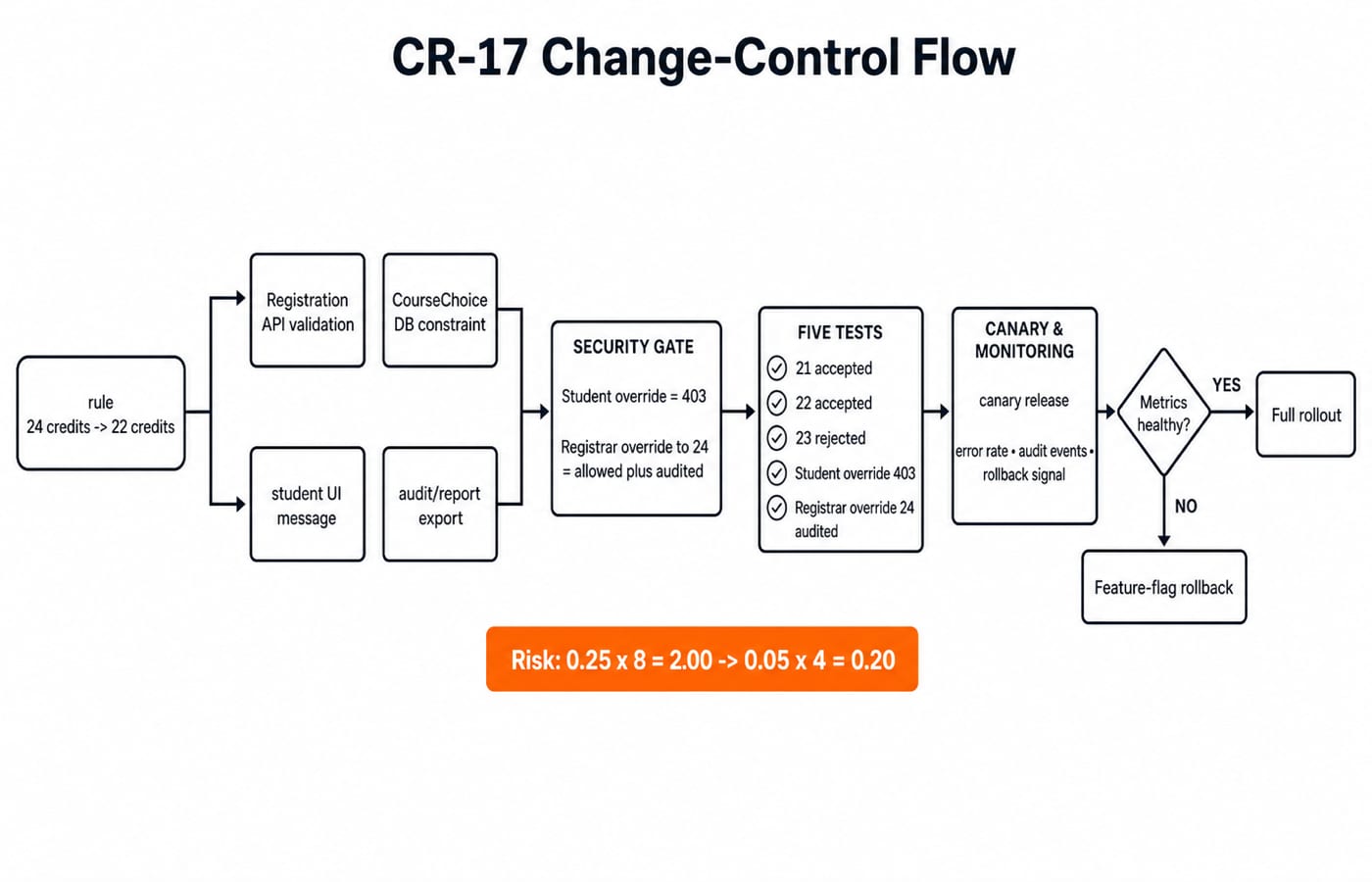
CR-17 reduces the ordinary credit limit from 24 to 22, with a Registrar override. It affects Registration API validation, the CourseChoice database constraint, the student UI message, and audit/report export. Student cannot override. Registrar can, with actor, student, reason, previous limit, approved limit, and timestamp recorded.
Incorrect rejection of valid registrations has P = 0.25, I = 8, and exposure 0.25 x 8 = 2.00. A feature flag, canary, validated backup, and tested rollback reduce it to P = 0.05, I = 4, and 0.05 x 4 = 0.20. The values are scenario test inputs, not operating thresholds.
Checks are exact: 21 credits accepted; 22 accepted; 23 rejected ordinarily; Student override returns 403; Registrar override to 24 succeeds with the complete audit entry. Then request, analyse impact, approve, implement behind the flag, test, canary, monitor, roll out or roll back, document, and close.
6. Security, risk, and maintenance traps that scenario questions exploit
Trap | Why it fails | Better test in this system |
|---|---|---|
Threat versus vulnerability | Cause is not weakness | Attacker is threat; missing role check is vulnerability |
Authentication versus authorisation | Identity proof grants no action | Login proves |
Inherent versus residual risk | Controls change estimates | Compare R1 before, |
Risk versus issue | Possibility differs from occurrence | Possible corruption is risk; corrupted records are an issue |
Backup versus tested recovery | A copy does not prove recovery | Restore |
Maintenance versus routine operation | Running is not changing | Monitoring is operation; changing the limit is maintenance |
A feature required by a changed rule is adaptive, not automatically perfective. A security patch is not automatically preventive. Deployment needs regression evidence, monitoring, rollback readiness, and documentation before closure.
P x I ranks, it does not predict precisely. Equal scores may differ in legal, safety, dependency, or recovery constraints. 0.72 is not a 72% loss chance; it is probability times local impact.
7. How objective exams and interviews test security, risk management, and maintenance, with GATE syllabus context
Objective questions match scenarios to confidentiality, integrity, availability, a response, or a maintenance type. Numericals reprioritise: A at 0.40 x 6 = 2.40 leads B at 0.25 x 9 = 2.25; after A becomes 0.10 x 6 = 0.60, B leads. In interviews, use requirement, asset, threat, control, score, tests, release, monitoring, rollback.
IIT Guwahati's completed-cycle GATE 2026 CS syllabus lists ten CS sections. It does not name System Analysis and Design, Software Engineering, security risk management, or maintenance as standalone sections. The syllabus does not establish marks, frequency, or guaranteed appearance. For another cycle, recheck the applicable organising institute's official syllabus.
The UGC NET Computer Science Syllabus Areas and IBPS SO IT Officer Professional Knowledge Topic Map place Software Engineering in CS preparation. They are not official notifications.
8. Security, risk management, and maintenance: practical checklist
Name the asset.
Write the testable security requirement.
Identify the event and consequence.
Compute inherent exposure.
Select and verify controls.
Classify and control every live-system change.
The portfolio moved from 7.85 to 1.77, and CR-17 from 2.00 to 0.20, without becoming risk-free. For a familiar portal, write one confidentiality requirement, integrity requirement, availability risk, and maintenance change. Add owner, trigger, controls, residual score, five tests, and rollback. "Use encryption" or "take a backup" is incomplete without threat, verification, and recovery.
For targeted practice, the UP LT Grade Test Series includes System Analysis and Design. For broader Software Engineering, design, quality, configuration-management, and security context, use the Zero to Hero Complete CS Course.
Go deeper with the full courseGATE Guidance by Sanchit Sir
Keep learning
Physical Security Assets and Risk Factors: Worked Audit, Controls and Exam Traps
Follow a fictional college server-room audit from asset inventory to residual risk. Calculate four priorities, test power continuity, and avoid common exam traps.
Updated 6 Nov 20266 min readUGC NET Computer Science
System Analysis and Design for GATE: What the CS Syllabus Includes and What to Skip
Audit System Analysis and Design against the official GATE CS syllabus, keep examinable overlaps in their proper subjects, and redirect study time with two worked examples.
Updated 12 Nov 20264 min readGATE Strategy & Roadmap
SDLC and Development Approaches in System Analysis and Design: Models, Selection Rules, and a 16-Week Worked Example
Learn how analysis, design, traceability, and major SDLC models fit together. Then use project conditions and risk exposure to plan a 16-week examination portal.
Updated 6 Nov 20265 min readGATE Strategy & Roadmap
SDD and Quality Assurance in System Analysis and Design: Structure, Traceability and Worked QA Metrics
Learn how an SDD turns requirements into inspectable design decisions, then trace one course-registration service through tests and quality metrics.
Updated 4 Nov 20266 min readGATE Strategy & Roadmap