

Static vs Dynamic Binding: Compile-Time Selection and Runtime Dispatch with a Worked Java Trace
See exactly what the Java compiler selects and what the runtime receiver can change. One program, six outputs, and declared-type variations make the two stages visible.
KnowledgeGate Team
Exam prep & CS education
Updated 9 Nov 20266 min read
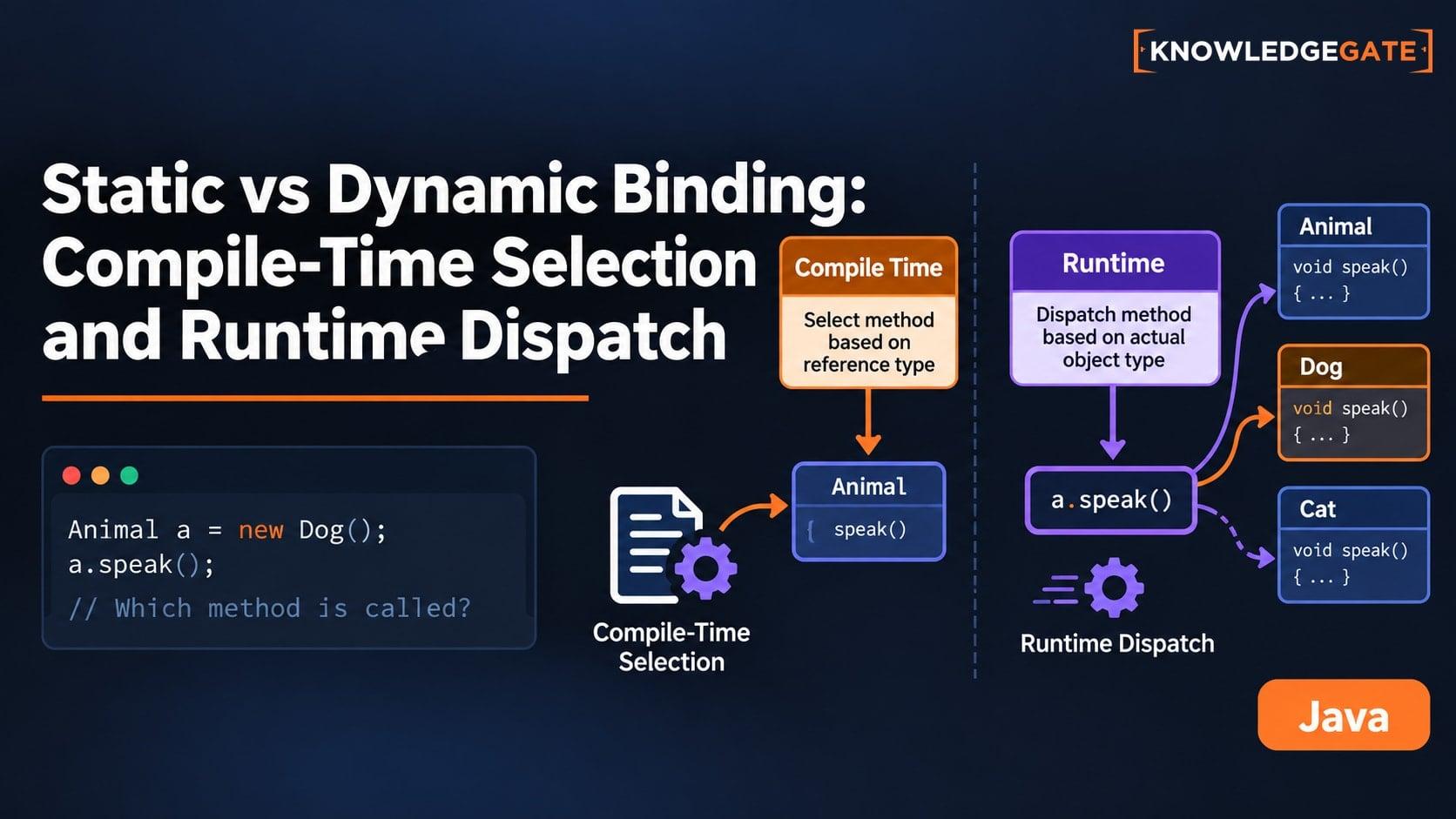
In Printer p = new LaserPrinter(), the reference says Printer, but the object is a LaserPrinter. A learner may assume one actor, the compiler or the runtime, decides the entire call, then cannot explain the line that prints. The sharper rule is two-stage: declared types select the member and overload signature first, then the runtime object may select an override of that signature. A short runnable Java program makes both stages visible, and changing only the declared types shifts the result predictably. Working through such traces, predicting each printed line before running the code, is the everyday work of Coding & Skills.
Binding is an association made at a particular time
Binding is an association: an identifier with its declaration, a variable with a type or storage location, or a call site with an implementation. In int marks = 12;, the name and declared type are fixed before execution. Each method invocation has its own local-variable storage, and the assignment gives that invocation's variable the value 12 when the statement executes.
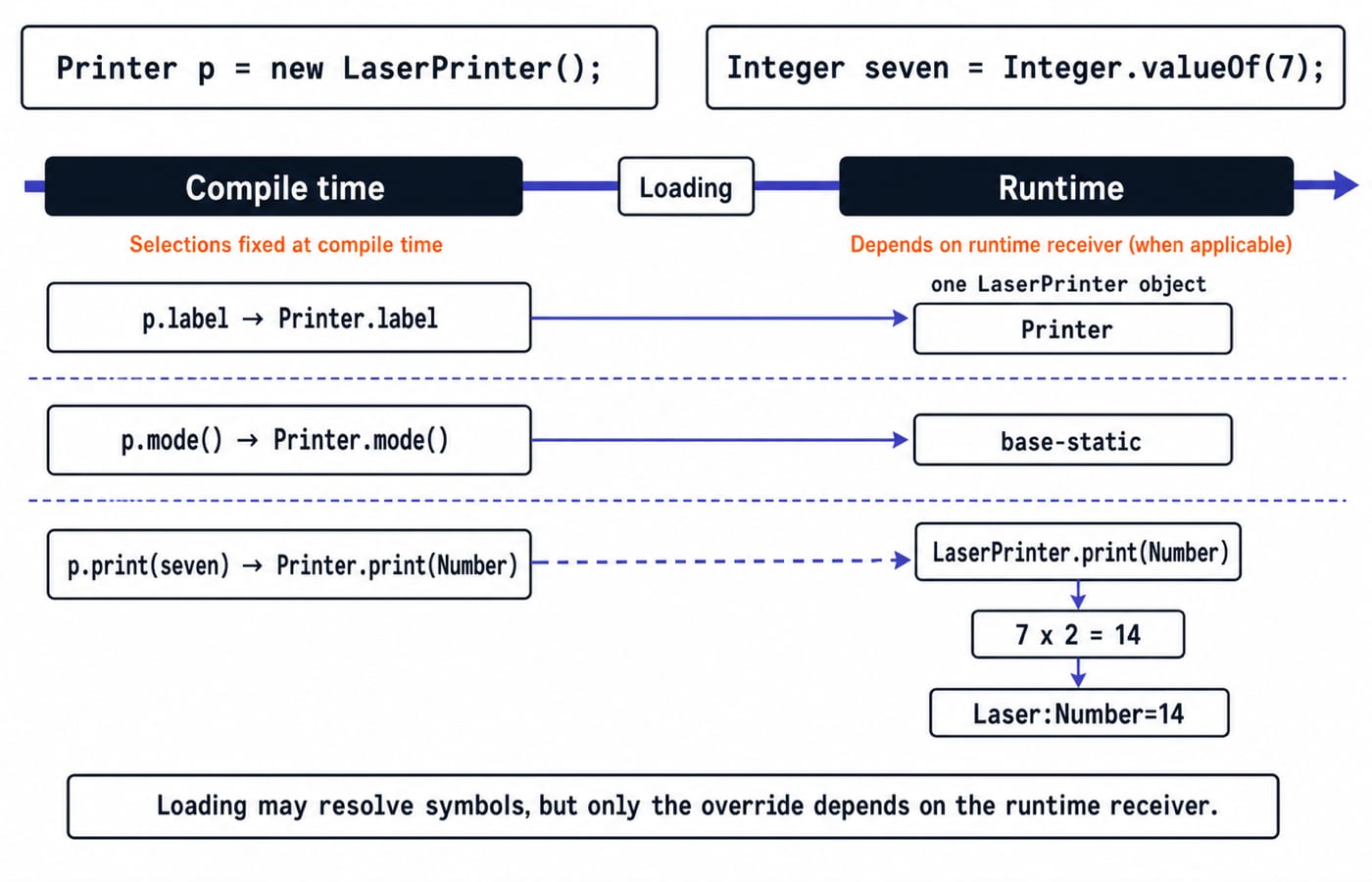
Binding times include language design, translation, linking or loading, and execution. Static or early binding here means the choice does not depend on the runtime receiver. Dynamic or late binding inspects runtime state, usually the receiver's class. Resolving a symbol during loading does not make a receiver-independent choice dynamic. Static binding is broader than Java's static keyword, and dynamic binding is unrelated to dynamic memory allocation. The overriding and polymorphism context behind dynamic binding is developed in Object Oriented Technology Explained.
Static binding fixes a declaration or signature
The declared type of p is Printer, while that of seven is Integer. Thus p.label denotes Printer.label, p.mode() denotes Printer.mode(), and the visible, applicable overload is print(Number). An Integer can be passed where a Number is expected.
Overload resolution uses declared receiver and argument types, arity, and applicable conversions. Runtime does not reopen it after finding a LaserPrinter.
Construct | Java rule |
|---|---|
Field or hidden static method | Compile-time types select it; no runtime lookup follows |
Instance method call | Compile time selects its signature; runtime may select an override |
Java uses these rules for the calls shown here; other languages may bind the same constructs differently.
Dynamic binding chooses an override from the runtime receiver
Overriding is a subclass supplying another implementation of the same instance-method signature. After compilation fixes print(Number), p.print(seven) inspects the receiver. Since it is a LaserPrinter, Java runs LaserPrinter.print(Number), calculates 7 x 2 = 14, and returns Laser:Number=14.
Dynamic dispatch chooses only among overrides of the compile-time-selected signature. Even though LaserPrinter defines print(Integer), the call cannot switch from print(Number) to print(Integer), because the signature was already fixed at compile time from the declared types. Base-type code can therefore obtain subclass behaviour without a type test at every call. This does not mean every method in every object-oriented language is dynamically dispatched.
Work one Java program from declarations to six outputs
Run this exact program. Calling a static method through an instance exposes hiding, though Printer.mode() and LaserPrinter.mode() are clearer production style.
class Printer {
    String label = "Printer";

    static String mode() {
        return "base-static";
    }

    String print(Number x) {
        return "Printer:Number=" + x.intValue();
    }
}

class LaserPrinter extends Printer {
    String label = "Laser";

    static String mode() {
        return "laser-static";
    }

    @Override
    String print(Number x) {
        return "Laser:Number=" + (x.intValue() * 2);
    }

    String print(Integer x) {
        return "Laser:Integer=" + (x + 10);
    }
}

class Demo {
    public static void main(String[] args) {
        Printer p = new LaserPrinter();
        LaserPrinter q = new LaserPrinter();
        Integer seven = Integer.valueOf(7);

        System.out.println(p.label);
        System.out.println(p.mode());
        System.out.println(p.print(seven));
        System.out.println(q.label);
        System.out.println(q.mode());
        System.out.println(q.print(seven));
    }
}
The exact output is:
Printer
base-static
Laser:Number=14
Laser
laser-static
Laser:Integer=17
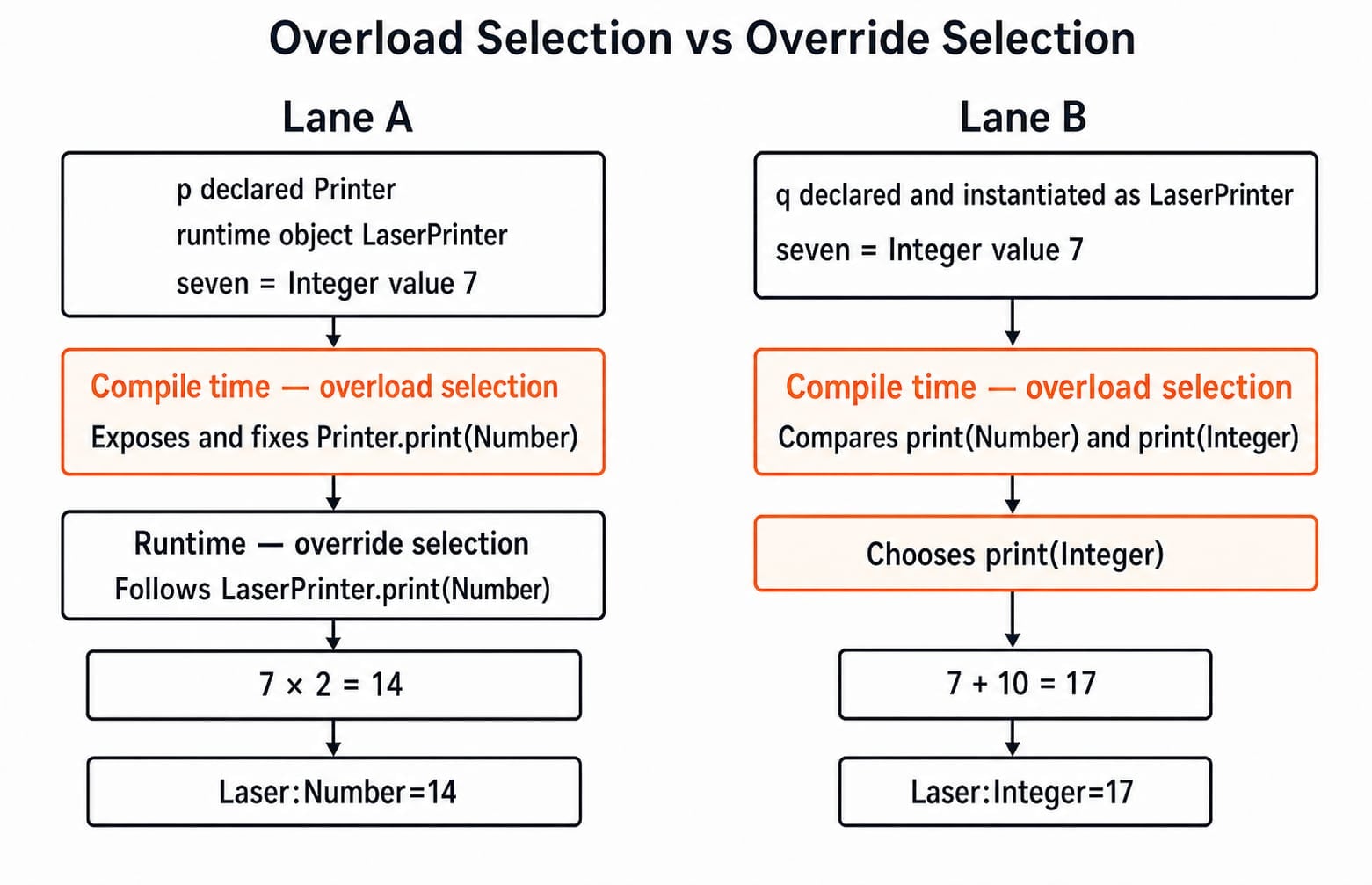
For p, the declared type fixes the field, static method, and print(Number) signature. Only its implementation is dynamically selected. For q, compilation sees both overloads and chooses the more specific print(Integer), which calculates 7 + 10 = 17.
Expression | Compile-time choice | Runtime choice | Result |
|---|---|---|---|
|
| none |
|
|
| none |
|
|
|
|
|
|
| none |
|
|
| none |
|
|
| same method |
|
Change one declared type and predict the result
Reuse the same classes. Cover the result column and ask: which signature compiles, then which implementation runs?
Call | Compile-time signature | Runtime implementation | Result |
|---|---|---|---|
|
|
|
|
|
|
|
|
|
|
|
|
|
|
|
|
The last cast changes the visible overloads, not the object, which remains a LaserPrinter.
Repair the common binding traps
Pair each trap with its correction:
Runtime object chooses the overload: the object's class seems to pick everything, but overloads are chosen at compile time from the declared reference and argument types, and the runtime only supplies the override body for that signature.
Fields are overridden like methods: a same-name subclass field looks overridden but is only hidden, so the reference type picks which you read, and
p.labelreadsPrinterthough the object is aLaserPrinter.A static method is dynamically overridden: a same-signature subclass static hides the parent's rather than overriding it, so the declared type resolves it and
p.mode()staysbase-staticwhatever the object.Dynamic means any late decision: late linking or loading is not dynamic binding; a choice is dynamic only when it depends on the runtime receiver, so name the association and the runtime information it needs.
One more separation to make: binding is not the same as scope. Let global x = 10, let show() print x, and let caller() declare local x = 20 before calling show(). Under lexical or static scope, show() uses its defining context and prints 10. Dynamic scope follows the active caller and would print 20. That free-name lookup is variable resolution, not Java method dispatch. Languages set their own dispatch rules: in C++ only functions marked virtual dispatch on the runtime object, a non-virtual call uses the declared type, so the two-stage reasoning must be re-checked per language.
Exam-style questions test both decision stages
Attempt each question first, then check the answer:
Predict the six printed lines, in order. Answer:
Printer,base-static,Laser:Number=14,Laser,laser-static,Laser:Integer=17.In
p.print(seven), which parts are decided at compile time and which at runtime? Answer:p.label,p.mode(), and theprint(Number)signature are compile-time decisions; only the override that runs is selected from the runtime receiver.With
Number n = Integer.valueOf(7);, what doesq.print(n)return and why? Answer: the declared typeNumberselectsprint(Number); theLaserPrinterreceiver dispatches to its override, givingLaser:Number=14.
Association | Expected timing |
|---|---|
Identifier to declaration | Translation under lexical rules |
Call to overload signature | Translation |
Virtual call to override implementation | Runtime |
Local variable to one invocation's storage | Runtime activation |
A toolchain may link or load later. The core remains whether the choice depends on the runtime receiver. For the wider inheritance and polymorphism setting, OOP for Teaching CS Exams: Classes and Inheritance gives adjacent revision, and its practice questions let you rehearse the two-stage decision on fresh code.
The short rule and your next practice step
Remember three lines. Declared receiver and argument types select the member and overload signature. Fields and static methods stop there. An eligible instance call uses the runtime receiver to choose an override of that signature.
Test 11: p.print(Integer.valueOf(11)) returns Laser:Number=22 from 11 x 2; q.print(Integer.valueOf(11)) returns Laser:Integer=21 from 11 + 10. State both stages before checking. Continue with the Java course, then use the C++ programming course for comparison.
Keep learning
Data Abstraction Explained: Hide Implementation Details with a Worked Java Example
See how a stable Account contract protects its invariant while the Java implementation changes from a running balance to a transaction ledger.
Updated 16 Nov 20265 min readProgramming Languages Survey
Programming Paradigms Explained: Concepts, Classifications and Worked Examples
Learn how imperative, procedural, object-oriented, functional and declarative styles organise the same computation, and how to classify code from visible evidence.
Updated 15 Nov 20265 min readProgramming Languages Survey
Introduction to Visual Basic (VB): Concepts, Worked Code and Exam Patterns
Learn how a VB.NET form turns text-box input and a button click into a traced result. Then practise operators, loops, procedures, scope and debugging.
Updated 14 Nov 20266 min readProgramming Languages Survey
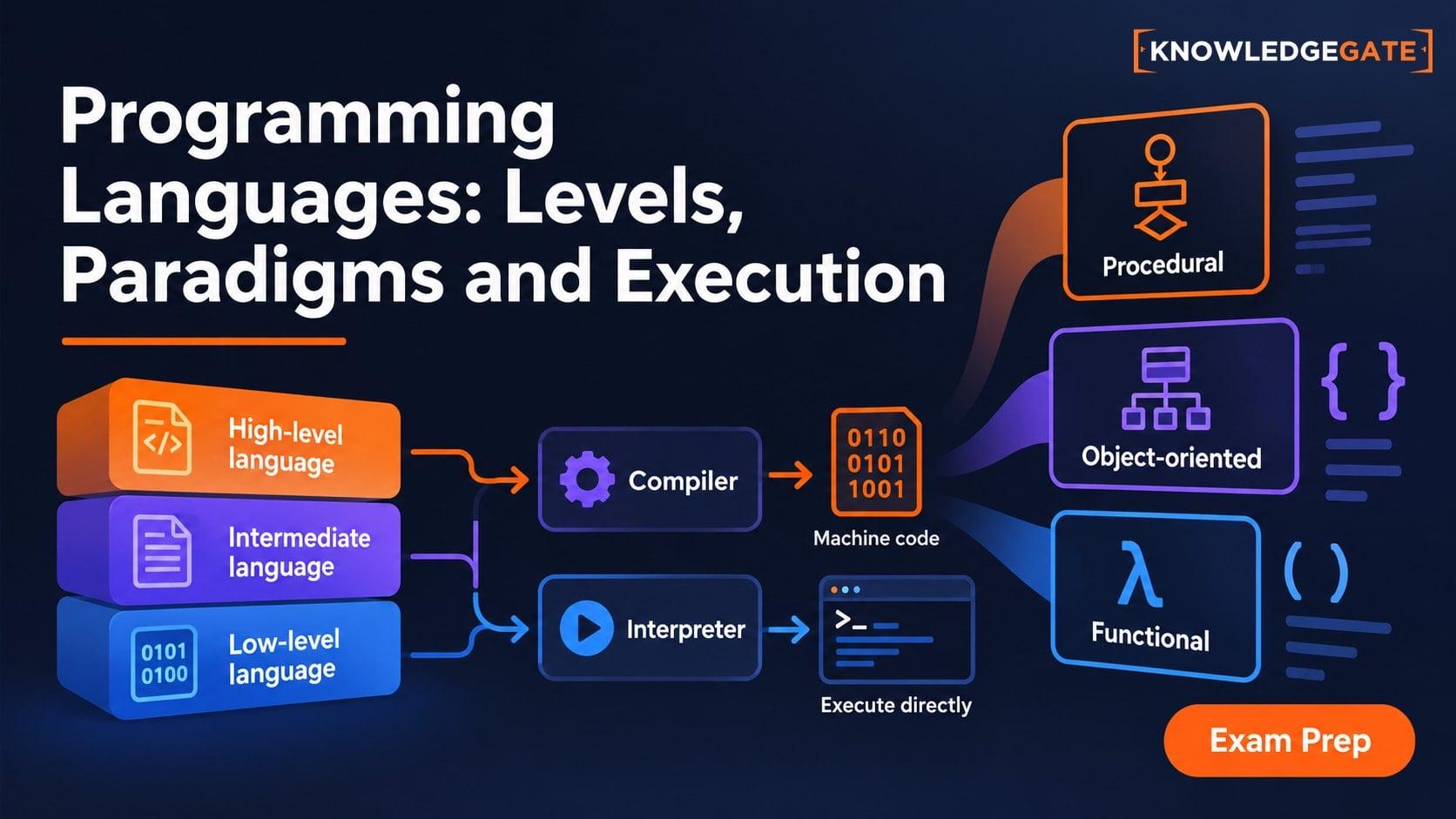
Types of Programming Languages: Levels, Paradigms and Execution Models
Learn why low-level, object-oriented, compiled and dynamically typed describe different axes. Build a clear classification map through one result expressed three ways.
Updated 13 Nov 20266 min readProgramming Languages Survey