OOP for CS teaching exams: classes, inheritance and polymorphism explained
OOP for teaching CS exams: encapsulation, abstraction, inheritance and polymorphism, plus constructors and access specifiers, with a worked class example.
KnowledgeGate Team
Exam prep & CS education
Updated 18 Jul 20266 min read
Object-oriented programming is the part of the syllabus where teaching CS papers separate candidates who memorised definitions from those who actually understand code. Whether the paper frames it in C++ or Java, the same four pillars and the same class mechanics come up in exam after exam. Our question bank carries over 1,200 programming-language questions, and OOP runs right through them.
DSSSB, KVS, NVS and state TGT and PGT computer papers ask OOP two ways: name a concept exactly, or read a few lines of a class and say what they demonstrate. Both go wrong in the same place, on definitions that sound right but blur into each other, encapsulation with abstraction, overloading with overriding. Getting those boundaries sharp, along with access specifiers and constructors, is where the marks are.
From procedures to objects
Procedural code, like plain C, organises a program around functions that act on separate data. Object-oriented programming instead bundles data and the functions that operate on it into a single unit called an object, described by a class. A class is the blueprint; an object is a concrete instance built from it. That one shift, data and behaviour living together, is what the rest of OOP is built on. Papers ask the contrast head-on: which paradigm gives more attention to data than to functions, the answer being object-oriented. If your C is shaky, revise the procedural half of that contrast first, because C programming for teaching CS exams starts there.
The four pillars of OOP
Four ideas define the paradigm, and naming them correctly is the single most common OOP question.
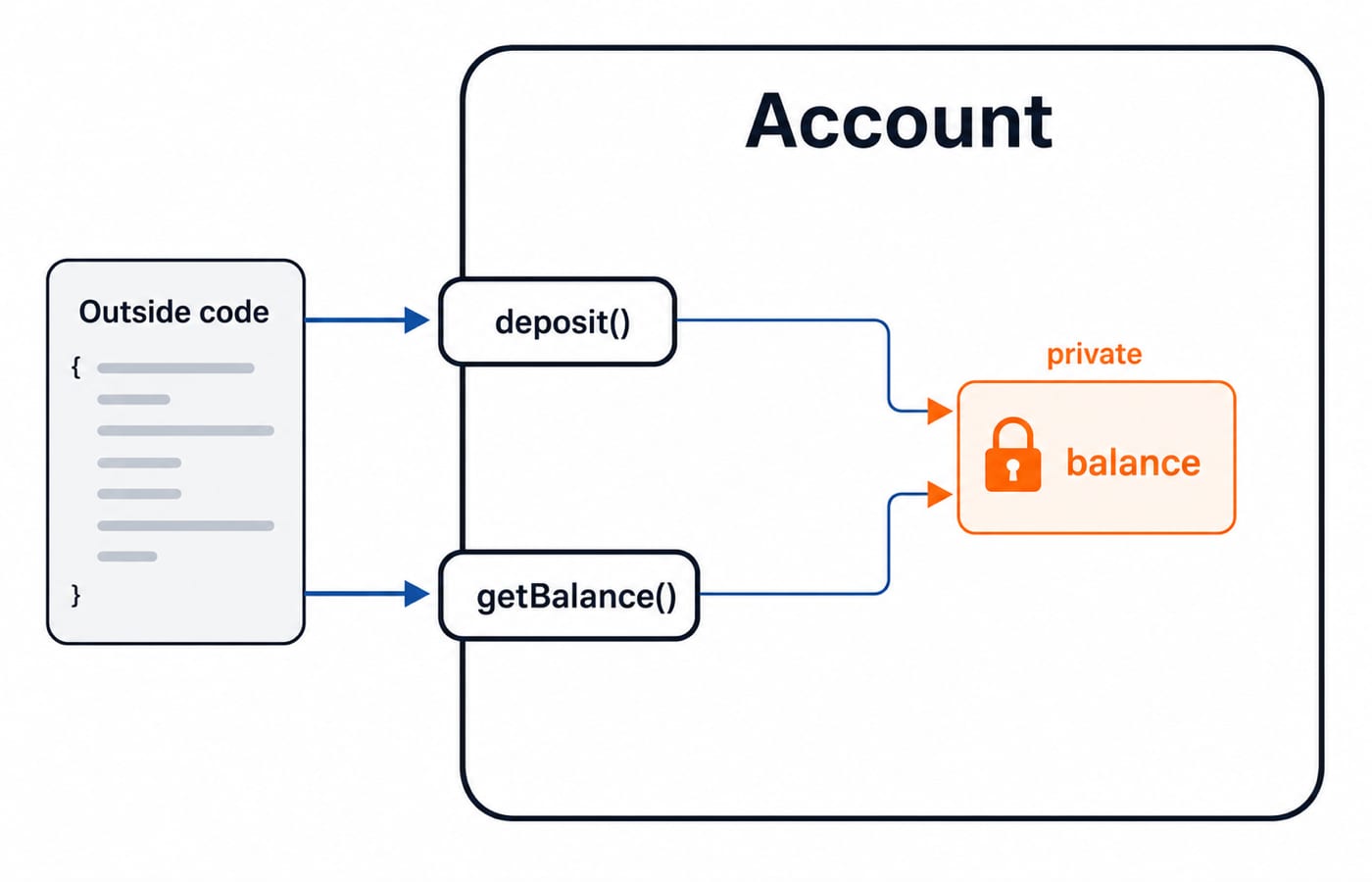
Encapsulation. Bundling data and methods inside a class and controlling access to that data, usually by keeping fields private and exposing them through public methods. It protects an object's internal state from uncontrolled outside change.
Abstraction. Showing only the essential features and hiding the implementation detail. A driver uses a steering wheel without knowing the mechanism beneath it; a class exposes what it does, not how.
Inheritance. A new class (the derived or child class) reuses the members of an existing class (the base or parent), then extends or specialises them. It models an "is-a" relationship, a Car is a Vehicle, and it is the mechanism for code reuse.
Polymorphism. One name behaving in different ways depending on context. Literally "many forms", and the pillar with the most exam depth.
A clean way to hold them: encapsulation hides data, abstraction hides detail, inheritance reuses, polymorphism gives many forms.
Classes, objects and access specifiers
A class declares its members once; every object built from it gets its own copy of the data members, while the methods are shared behaviour acting on whichever object called them. Inside the class, access specifiers control who can reach each member:
private: accessible only within the same class. This is where encapsulation lives.
public: accessible from anywhere.
protected: accessible within the class and its derived classes, which matters for inheritance.
The exam point is that private members are not inherited as accessible; a child class cannot touch a parent's private field directly, only through the parent's public or protected methods. That is encapsulation and inheritance interacting, and it is a favourite trap.
Constructors and destructors
A constructor is a special method that runs automatically when an object is created, used to initialise its data. It shares the class name and has no return type. A class can have several constructors with different parameter lists, which is constructor overloading.
A destructor runs automatically when an object is destroyed, used to release resources. In C++ it is written ~ClassName(). Java has no explicit destructor; it relies on garbage collection to reclaim memory automatically. Knowing that C++ uses destructors while Java uses garbage collection is a standard comparison question.
Polymorphism: compile-time versus run-time
Polymorphism splits into two kinds, and telling them apart is the highest-value OOP fact in these papers.
Compile-time (static) polymorphism is resolved when the program is compiled. It is achieved by:
Function (method) overloading: several methods with the same name but different parameter lists. The compiler picks the right one from the arguments.
Operator overloading (in C++): giving an operator like
+a meaning for your own class.
Run-time (dynamic) polymorphism is resolved while the program runs. It is achieved by method overriding: a derived class provides its own version of a method already defined in the base class, and which version runs is decided by the actual object type at run time, through a base-class reference. In C++ this needs virtual functions; in Java, instance methods are virtual by default.
The distinction in one line: overloading is compile-time and about same name, different parameters; overriding is run-time and about a child redefining a parent's method with the same signature. Mixing these two up is the most common mistake examiners bank on.
A worked class example
Read this small C++-style class the way an exam expects:
class Account {
  private:
    double balance;          // encapsulated data
  public:
    Account(double b) {      // constructor
        balance = b;
    }
    void deposit(double amt) {
        balance = balance + amt;
    }
    double getBalance() {
        return balance;
    }
};
Trace what it demonstrates:
balanceis private, so outside code cannot change it directly, that is encapsulation.The
Account(double b)constructor runs when an object is made, setting the starting balance.depositandgetBalanceare public, the controlled interface, an example of abstraction: a caller adds money and reads the balance without touching the field.
If a SavingsAccount class then extended Account and added interest, that would be inheritance; if it redefined getBalance to include interest, that redefinition would be overriding, resolved at run time. Two pillars sit in the code as written, and the other two are one short extension away.
How OOP is tested in teaching CS exams
Teaching papers keep OOP at concept and short-code level:
Definitions and matching. Name the four pillars, match a description to the right pillar, define a constructor or an access specifier.
The overloading-versus-overriding distinction. Which is compile-time, which is run-time, which needs the same signature.
Language contrasts. C++ destructors versus Java garbage collection,
virtualin C++ versus default-virtual methods in Java.Short output or spotting. What a small class exposes, why a private field is unreachable from outside.
How many OOP questions a paper carries, and what each one is worth, differs across DSSSB, KVS and state cycles, so check the notification for the paper you are sitting (DSSSB publishes its own at dsssb.delhi.gov.in). The concepts themselves do not move, which is why they are worth learning cold rather than predicting.
The short version
OOP for teaching exams rests on four pillars, encapsulation, abstraction, inheritance, polymorphism, plus class mechanics: access specifiers, constructors, and the compile-time (overloading) versus run-time (overriding) split. Read one small class until you can point at encapsulation and abstraction in it, and say exactly where inheritance and overriding would attach, and keep the overloading-overriding line memorised.
If you want OOP sequenced with the rest of the syllabus, the Teaching Recruitment Exams bundle covers it with the CS core, and the DSSSB TGT Computer Science bundle targets the Delhi papers. Since these same OOP ideas power coding interviews, aspirants eyeing private jobs can also work the placement preparation category. For the full teaching set, browse the government teaching jobs category. Learn the pillars and the polymorphism split cold, and OOP becomes marks you count on.
Keep learning
Office Mixed Concepts Explained: Access, Clipboard, File Formats and Exam Traps
Learn how Word, Excel, PowerPoint and Access differ, then trace six learner records through a query, an export, a linked chart and a static picture.
Updated 25 Oct 20265 min readTeaching Recruitment (Computer Science)
MS Word Basics: Editing, Formatting, a Worked Document and Exam Traps
Learn how Word applies commands to characters, paragraphs, pages and files. Build an ICT revision plan, audit every state change and avoid common exam traps.
Updated 23 Oct 20266 min readTeaching Recruitment (Computer Science)
Excel Functions and Charts Explained: Formulas, a Worked Sheet and Exam Traps
Learn how Excel formulas, references and charts work by building one mock-test worksheet from scratch. Every output is calculated and every common trap has a fix.
Updated 19 Oct 20265 min readTeaching Recruitment (Computer Science)
Digital Society Explained: Core Concepts, a Worked Inclusion Audit and Exam Patterns
Learn to separate access, skills and outcomes, audit digital inclusion with a worked funnel, apply data minimisation and solve common exam cases.
Updated 15 Oct 20266 min readTeaching Recruitment (Computer Science)