SSC CHSL Cutoff Trends: Compare Results and Set a Target Score
Compare the right CHSL result rows before choosing a practice target. Work through a historical benchmark, a personal buffer and two mock-test blocks to decide what to improve next.
KnowledgeGate Team
Exam prep & CS education
Updated 30 Sep 20264 min read
You see several SSC CHSL cutoff numbers and want one score to aim for in practice. The useful method is to identify your result list, compare historical observations, then choose and test a personal buffer. Use your target to guide training through a worksheet you can update after each mock-test block.
Start with the cutoff that applies to your goal
Label every result row with five fields: examination year, tier, post/list, category and score type. For example:
2025 | Tier-I | LDC/JSA/Clerk-Cum-Typist | UR | normalised
Keep that label beside the number when copying it into your notebook. It stops an attractive but irrelevant cutoff from entering your calculation.
Track minimum qualifying percentages and category/post shortlisting cutoffs separately. Clearing the minimum qualifying requirement and meeting the applicable shortlisting cutoff are different checks. Keep Tier-II and final-allocation numbers outside this Tier-I worksheet.
For broader resource navigation, browse KnowledgeGate's government-exam preparation resources, then check each resource's named exam before using it.
Read the 2024 and 2025 figures without mixing lists
SSC's CHSLE 2024 Tier-I result write-up (6 September 2024), available on ssc.gov.in, and CHSLE 2025 Tier-I result write-up (27 February 2026) report these selected-category cutoffs:
Category | 2024 Tier-I LDC/JSA | 2025 Tier-I LDC/JSA/Clerk-Cum-Typist |
|---|---|---|
UR | 157.36168 | 144.25858 |
OBC | 156.61665 | 143.83055 |
EWS | 150.51731 | 141.42492 |
These are related clerical-post snapshots; retain the changed list wording. The 2025 column concerns examination year 2025, although its result appeared in 2026. Other categories need their own rows.
The 2024 document separates LDC/JSA and DEO/DEO Grade 'A'. The 2025 document has clerical List 1 and two separate DEO lists, Lists 2 and 3. DEO cutoffs are higher in both documents; retrieve the relevant PDF list instead of reusing clerical figures.
For UR, the observed change is 144.25858 − 157.36168 = −13.10310 marks, approximately a 13.10-mark fall. Record that fall alongside the two years and list labels in your worksheet.
Separate a historical cutoff from your mock score
SSC uses normalised marks in these results; its 2025 write-up references the methodology dated 2 June 2025. Record each cycle's stated methodology and keep mock totals as scored.
Compare the candidate pool, paper and selection context when investigating a change between cycles. The CGL illustration of comparing tiers, posts and categories teaches the same comparison discipline; apply that method to your CHSL rows.
These are two historical Tier-I snapshots, not a forecast. Raw mock totals and official normalised scores are not interchangeable. A practice target gives no selection guarantee. Check the applicable notification, result and corrigenda on ssc.gov.in before deciding eligibility or qualification.
Build a buffer with a transparent worked example
For a UR clerical-post exercise, take the higher observed benchmark and add a personal training buffer:
Higher benchmark: max(157.36168, 144.25858) = 157.36168.
Chosen buffer: 10 marks.
Subtotal: 157.36168 + 10 = 167.36168.
Round upwards to a convenient practice milestone: 170.
The buffer and rounding are personal choices. Write both decisions down so you can explain how you reached the milestone.
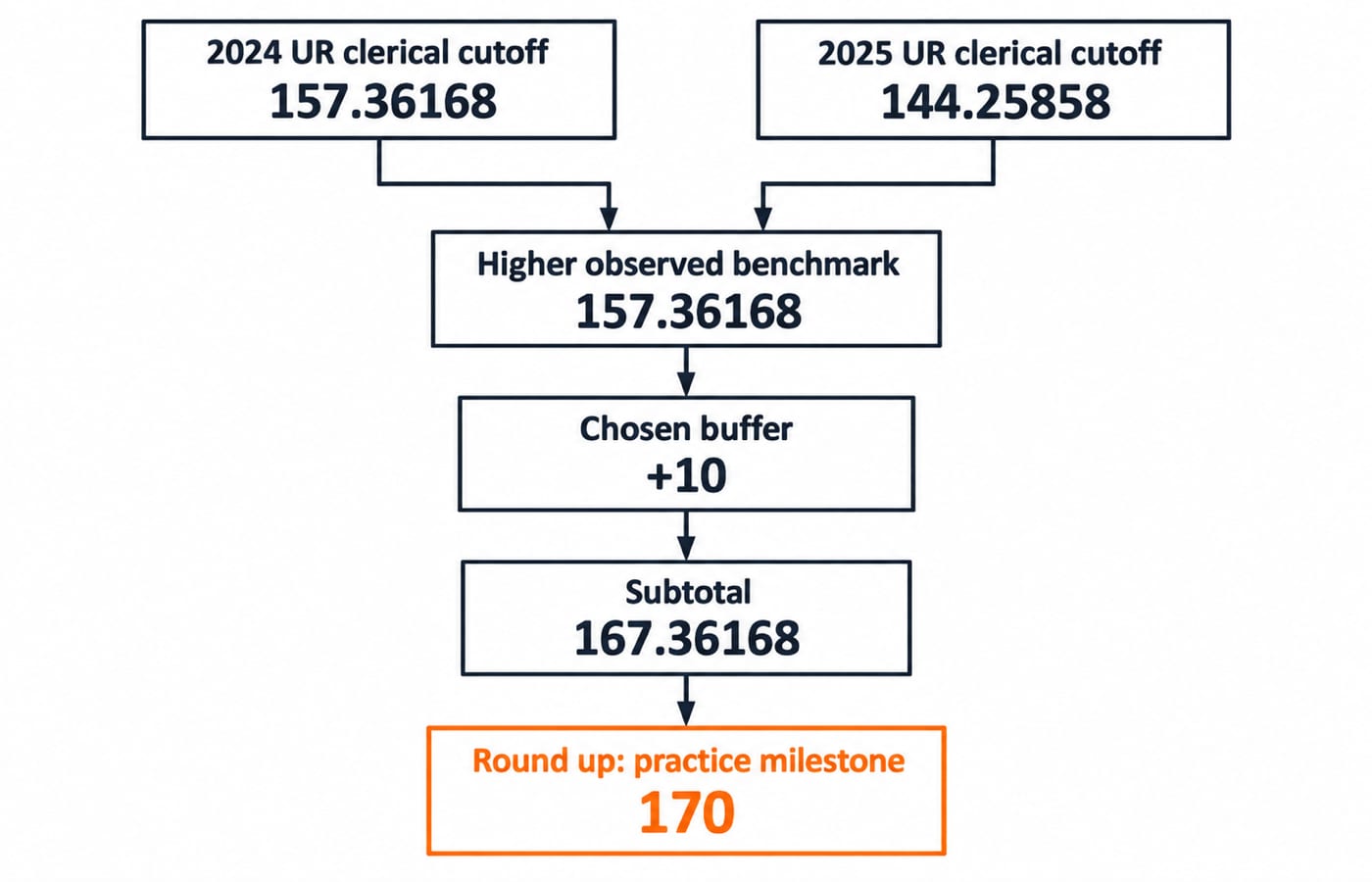
Using the higher observation makes the reference conservative within this small sample. Substitute your own category's comparable rows, and use the appropriate lists for DEO.
Test the target against repeated mock performance
Use these illustrative, already calculated mock totals to test the milestone. Compare papers with similar coverage and conditions, including how you handle pauses and interruptions.
Block | Five scores | Scores in ascending order | Median |
|---|---|---|---|
Before correction | 158, 164, 161, 167, 160 | 158, 160, 161, 164, 167 | 161 |
After correction | 168, 172, 170, 171, 169 | 168, 169, 170, 171, 172 | 170 |
With five scores, the median is the third sorted value. Initially, the gap is 170 − 161 = 9 marks. The best score, 167, hides how much lower the middle performance sits.
In the second block, the median reaches 170, the minimum is 168, and three of five scores meet or exceed 170. That shows better consistency. Record the low score alongside the median so one strong attempt does not dominate your judgement.
Use the score gap to choose the next week's work
Here is an illustrative correction schedule: six 45-minute sessions = 270 minutes.
Error cause | Sessions | Minutes |
|---|---|---|
Calculation errors | 2 | 90 |
Misreading questions | 2 | 90 |
Forgotten facts | 1 | 45 |
Attempted guesses to review | 1 | 45 |
Total | 6 | 270 |
Allocate sessions to your own recurring error patterns. Transfer the review method from the mock-analysis error ledger: log the question, error cause, corrective action and retest outcome.
A rising total with repeated mistakes needs closer inspection. Use your next comparable test block to see whether corrections hold. If you miss one session, five sessions give 5 × 45 = 225 minutes; carry the remaining 45 minutes forward. Keep missed work visible instead of lowering the milestone to make the diary look complete.
Keep the target provisional and the next step specific
Create one worksheet containing your category and list, official historical benchmark, chosen buffer, current five-test median and next review date. Review the target after a comparable test block, using both performance and recurring errors to decide the next correction sessions.
If you are also preparing for CGL, inspect SSC CGL Complete Preparation 2026 and its stated coverage for that exam.
Today, retrieve your own result row, record why you chose your buffer and calculate the gap between your practice milestone and your latest five-test median.
Keep learning
SSC MTS Eligibility and Selection Process: Age, Qualification and Stages
Check your qualification date and birth-date window before planning preparation. This dated SSC MTS example explains age relaxation, the two CBE sessions and Havaldar's additional physical tests.
Updated 5 Oct 20264 min readSSC CGL

SSC CGL Cutoffs Explained: Compare Tiers, Posts and Categories
A practical test for deciding whether two SSC CGL cutoff figures are genuinely comparable, with completed-result examples and a worksheet for rejecting mismatched rows.
Updated 19 Aug 20265 min readSSC CGL
SSC CGL Mock Analysis: Build an Error Ledger That Guides Every Revision
Turn each useful mock error or delay into evidence, a focused drill, a retest date, and a clear decision to close or reopen the row.
Updated 17 Aug 20265 min readSSC CGL
SSC CGL Post Duties and Posting Patterns: A Preference Guide
Compare SSC CGL posts by duty family, eligibility, posting uncertainty and personal fit. Use the worked scoring method to build an order you would genuinely accept.
Updated 15 Aug 20266 min readSSC CGL