SSC MTS Eligibility and Selection Process: Age, Qualification and Stages
Check your qualification date and birth-date window before planning preparation. This dated SSC MTS example explains age relaxation, the two CBE sessions and Havaldar's additional physical tests.
KnowledgeGate Team
Exam prep & CS education
Updated 5 Oct 20264 min read
Before preparing for SSC MTS, settle two questions: do you meet the eligibility conditions, and which selection stages apply to your post? Age on the specified cut-off date matters. MTS and Havaldar follow different routes; this 2025 illustration explains the checks to repeat using your own cycle's notice.
Start by separating MTS from Havaldar
SSC's MTS and Havaldar Examination 2025 notice, dated 26 June 2025, distinguishes Multi-Tasking (Non-Technical) Staff in central ministries, departments and offices from Havaldar in CBIC/CBN.
Post | Selection route |
|---|---|
MTS | Computer-based examination (CBE) |
Havaldar | CBE plus Physical Efficiency Test (PET) and Physical Standard Test (PST) |
A shared notification does not make every stage common. For preparation options, browse the government-exam preparation categories.
Scope note: All rule figures below come from SSC's 2025 notice; worked examples illustrate them. Your cycle may differ. Verify eligibility and stages against its notice and subsequent corrigenda on ssc.gov.in.
Check qualification and nationality before age
The qualification requirement was Matriculation or equivalent from a recognised board by 1 August 2025. A degree was not required.
Consider two recognised Class 10 pass results:
Candidate A: declared on 31 July 2025, before the deadline, so the qualification-date condition is met.
Candidate B: declared on 2 August 2025, after the deadline, so that condition is not met.
Keep documentary proof that your pass result was declared by the deadline.
Nationality rules include specified non-Indian categories requiring eligibility certificates. Affected applicants should read the complete nationality clause. For a separate examination comparison, see SSC CGL post eligibility.
Apply the correct age band and date-of-birth window
The 2025 age reference date was 1 August 2025. Before applicable relaxation, the inclusive birth-date windows were:
Post band | Earliest DOB | Latest DOB |
|---|---|---|
Ordinary MTS, 18–25 | 2 August 2000 | 1 August 2007 |
A few MTS posts and Havaldar, 18–27 | 2 August 1998 | 1 August 2007 |
Assume no relaxation and all other conditions satisfied:
Candidate | DOB | Within 18–25 window? | Within 18–27 window? |
|---|---|---|---|
A | 2 August 2000 | Yes | Yes |
B | 1 August 2000 | No | Yes |
C | 2 August 2007 | No | No |
B falls one day before the first window opens. C turns 18 one day after the reference date. Use the published DOB window, not rounded age or today's age. Match the DOB in your application to your Matriculation certificate, and identify the post's band before deciding eligibility.
Treat age relaxation as a documented claim
SC/ST upper-age relaxation was five years; OBC relaxation was three. PwBD and ex-servicemen have separate conditions. Do not casually stack concessions or assume EWS status grants age relaxation.
For applicable OBC relaxation, 25 + 3 = 28 and 27 + 3 = 30. With OBC relaxation, the earliest date of birth moves back three years:
2 August 2000 becomes 2 August 1997.
2 August 1998 becomes 2 August 1995.
The latest date stays 1 August 2007 because only the upper age limit changes. Candidate B above fits the relaxed 18–25 window only if a valid relaxation applies. Check the applicable certificate format and crucial date; category evidence must support the claim.
Understand how the two CBE sessions affect selection
Under the 2025 SSC notice, both sessions were mandatory, with an ordinary duration of 45 minutes each and additional time for eligible candidates.
Session | Subject | Questions | Marks |
|---|---|---|---|
I | Numerical and Mathematical Ability | 20 | 60 |
I | Reasoning Ability and Problem Solving | 20 | 60 |
II | General Awareness | 25 | 75 |
II | English Language and Comprehension | 25 | 75 |
Session I had no negative marking. Session II deducted one mark per wrong answer.
Worked raw scores:
Session I: 15 maths + 12 reasoning correct = 27 correct. Score = 27 × 3 = 81/120.
Session II: 18 awareness + 17 English correct = 35 correct. With 10 wrong and 5 unanswered, 35 + 10 + 5 = 50 questions. Score = (35 × 3) − 10 = 105 − 10 = 95/150.
Session I qualification gates Session II evaluation. MTS merit uses Session II with normalisation; do not add the sessions into a merit score.
Minimum qualifying percentages applied to both sessions: UR 30%, OBC/EWS 25%, all other categories 20%. On Session I's 120 marks, these give 120 × 0.30 = 36, 120 × 0.25 = 30, and 120 × 0.20 = 24. They are not selection cut-offs.
Follow the correct route through allocation and verification
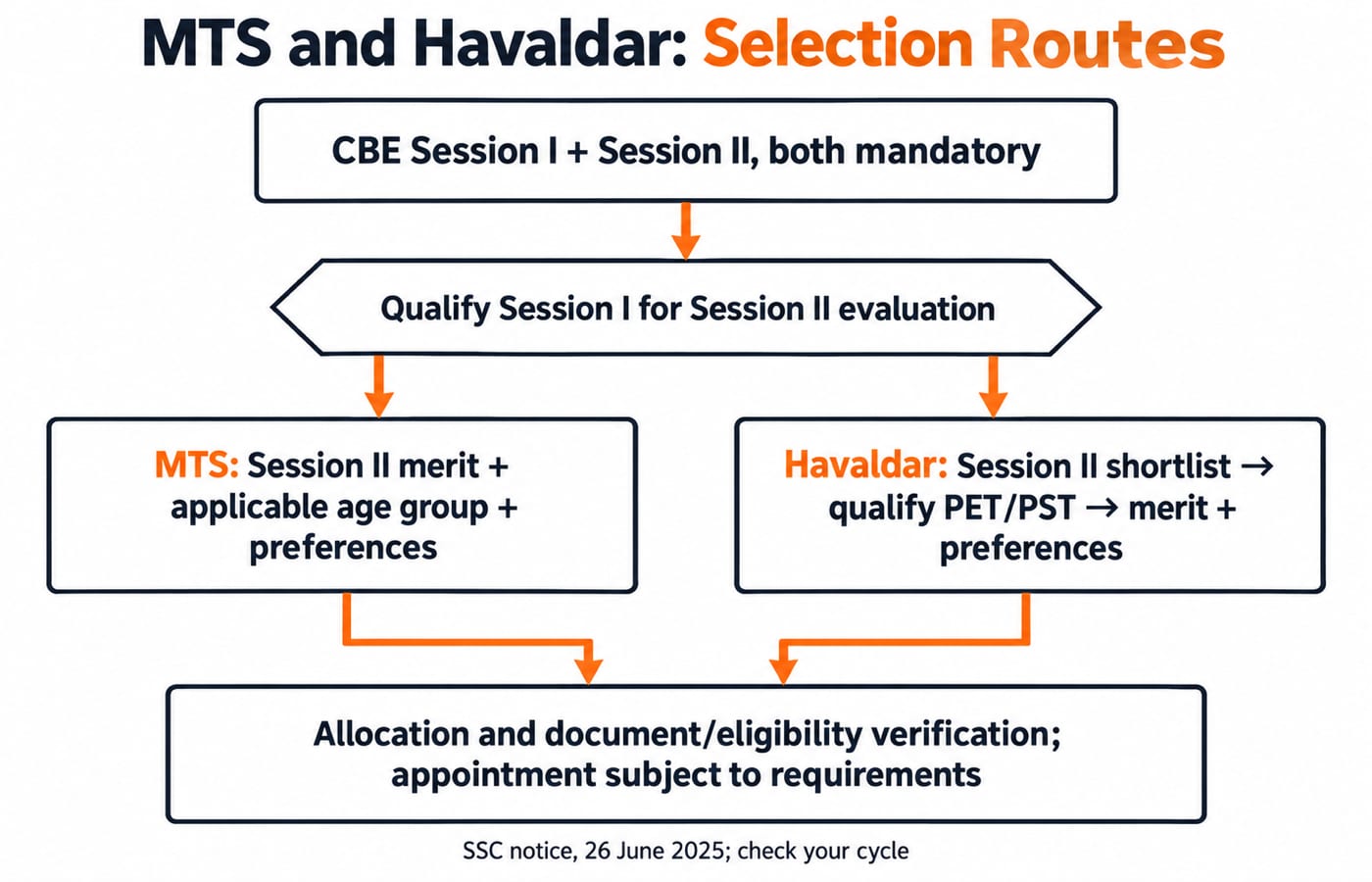
Havaldar requires qualifying PET/PST after shortlisting through Session II. Candidates who fail PET/PST can still be considered for MTS if otherwise eligible.
MTS allocation uses Session II merit, age group and post/location preferences. For candidates eligible for both age groups, vacancies in the 18–25 group are filled first. Preferences restrict consideration; they do not guarantee your first choice.
User departments conduct document verification after the final result. Keep educational, DOB and category evidence ready.
Finish with a personal eligibility checklist
Record your exact post and cycle, DOB window, qualification result date, nationality condition, relaxation evidence, selection route, documents and preferences. Save your cycle's notice and subsequent corrigenda from the official SSC portal.
Complete this check before choosing preparation. If also exploring CGL or shared subject foundations, consider the SSC CGL Tier 1 course. It covers reasoning, quantitative aptitude, English and general awareness, but is a CGL course. Compare its coverage with your MTS syllabus before purchasing.
Keep learning
SSC CHSL Cutoff Trends: Compare Results and Set a Target Score
Compare the right CHSL result rows before choosing a practice target. Work through a historical benchmark, a personal buffer and two mock-test blocks to decide what to improve next.
Updated 30 Sep 20264 min readSSC CGL
SSC CGL Cutoffs Explained: Compare Tiers, Posts and Categories
A practical test for deciding whether two SSC CGL cutoff figures are genuinely comparable, with completed-result examples and a worksheet for rejecting mismatched rows.
Updated 19 Aug 20265 min readSSC CGL
SSC CGL Mock Analysis: Build an Error Ledger That Guides Every Revision
Turn each useful mock error or delay into evidence, a focused drill, a retest date, and a clear decision to close or reopen the row.
Updated 17 Aug 20265 min readSSC CGL
SSC CGL Post Duties and Posting Patterns: A Preference Guide
Compare SSC CGL posts by duty family, eligibility, posting uncertainty and personal fit. Use the worked scoring method to build an order you would genuinely accept.
Updated 15 Aug 20266 min readSSC CGL