

Software Maintenance MCQs: 11 Solved Re-engineering and Reverse Engineering Questions
Attempt 11 published Software Maintenance MCQs, then use the worked explanations to separate reverse engineering, refactoring, re-engineering and perfective maintenance.
KnowledgeGate Team
Exam prep & CS education
Updated 19 Nov 20267 min read
Reverse engineering, re-engineering, refactoring and maintenance concern existing software, so one phrase can reverse an MCQ answer. Choose each answer by the direction of the activity before checking the explanation. For wider context, use the wider Software Engineering revision for teaching and CS exams.
1. Distinguishing maintenance activities
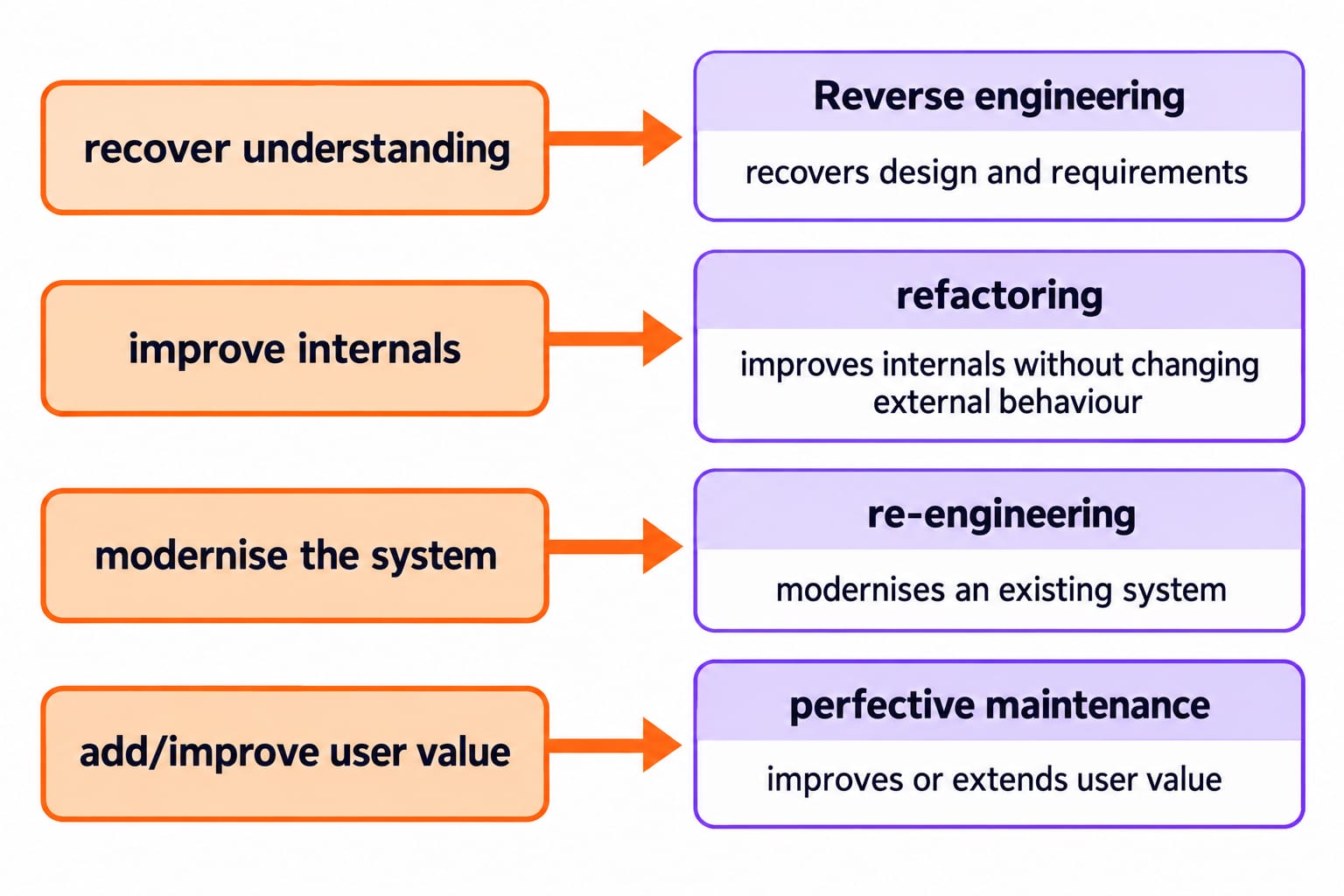
Before choosing, label each item recover understanding, improve internals, modernise the system, or add/improve user value. This exposes distractors pointing in another direction.
Reverse engineering recovers design and requirements, refactoring improves internals without changing external behaviour, re-engineering modernises an existing system, and perfective maintenance improves or extends user value. The UGC NET CS learning and practice routes place these distinctions in the wider syllabus.
All 11 question headings open the Software Maintenance learning page because the individual bank pages are unavailable.
2. Questions 1 and 11: recover design and requirements from existing software
Question 1
Exam source: DSSSB 2021, Computer Science, TGT Shift 5.
Process of recovering the design and the requirement specification of a product from an analysis of its code is called ______.
(a) Software analysis
(b) Software engineering
(c) Software reverse engineering
(d) Software return engineering
Correct answer: (c) Software reverse engineering.
Implementation leads back to design and requirements. The other choices are too broad or unnamed.
A legacy payroll application has 4 undocumented modules, 18 database tables, and only code. Engineers recover Payroll -> Tax -> Ledger -> Payslip and infer R-12: gross pay 50,000 with tax 5,000 produces net pay 45,000, since 50,000 - 5,000 = 45,000. Recovering this understanding without adding a feature is reverse engineering.
Question 11
Exam source: Bihar STET 2025, Computer Science.
Reverse engineering is primarily used for:
(a) Creating new software from scratch
(b) Improving software performance
(c) Understanding and documenting existing software
(d) Testing software components
Correct answer: (c) Understanding and documenting existing software.
The immediate outputs are a module map, recovered rules and documentation. Performance work or testing may follow, but neither is the primary recovery purpose.
3. Questions 2 and 3: refactor internals without changing behaviour
Question 2
Exam source: TPSC 2025, Computer Science, Programmer.
In the context of software engineering, what is “refactoring” ?
(a) Adding new features to the software
(b) Removing unnecessary features from the software
(c) Modifying code to improve performance or readability without changing its functionality
(d) Rewriting the entire software
Correct answer: (c) Modifying code to improve performance or readability without changing its functionality.
External behaviour is the boundary. Before refactoring, calculateDiscount(1200, 10) gives 1200 x 10 / 100 = 120, then 1200 - 120 = 1080. After extracting a discountAmount helper and renaming x to price, it must still return 1080. All 24 regression tests must preserve their visible results. Refactoring can target readability or performance, but does not always improve runtime.
Question 3
Exam source: UGC NET 2018, Computer Science, Paper 2 (July).
Which of the following statements is/are True?
P: Refactoring is the process of changing a software system in such a way that it does not alter the external behaviour of the code yet improves the internal architecture.
Q: An example of refactoring is adding new features to satisfy a customer requirement discovered after a project is shipped.
(a) P only
(b) Q only
(c) Both P and Q
(d) Neither P nor Q
Correct answer: (a) P only.
P preserves behaviour, so calculateDiscount(1200, 10) remains 1080. Q adds capability, making it enhancement or perfective work. A new loyaltyPoints output changes what the user receives.
4. Questions 4 and 8: separate reverse engineering from re-engineering
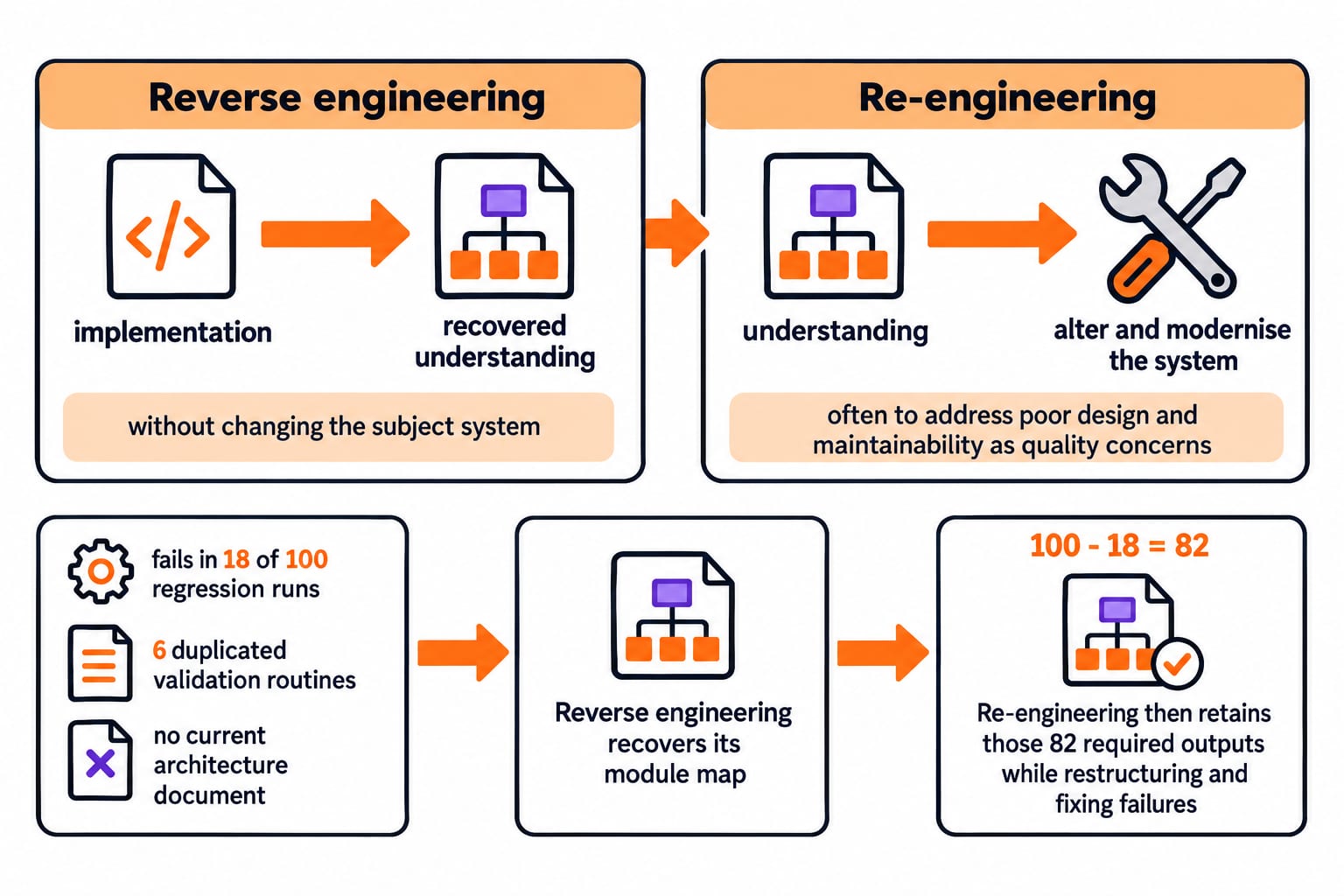
Reverse engineering moves from implementation toward recovered understanding without changing the subject system. Re-engineering uses that understanding to alter and modernise the system, often to address poor design and maintainability as quality concerns.
Question 4
Exam source: UGC NET 2018, Computer Science, Paper 2 (December).
Which of the following statements is/are true?
P: Software Reengineering is preferable for software products having high failure rates, having poor design and/or having poor code structure.
Q: Software Reverse Engineering is the process of analysing software with objective of recovering its design and requirements specification.
Choose the correct answer from the code given below.
(a) P only
(b) Q only
(c) Both P and Q
(d) Neither P nor Q
Correct answer: (c) Both P and Q.
P gives reasons to re-engineer. Q describes recovery from software to design and requirements.
In a hypothetical case, a legacy service fails in 18 of 100 regression runs, has 6 duplicated validation routines and no current architecture document. The other 100 - 18 = 82 runs pass. Reverse engineering recovers its module map. Re-engineering then retains those 82 required outputs while restructuring and fixing failures. These are teaching values, not industry data.
Question 8
Exam source: TPSC 2026, Junior Forensic Digital Analyst.
Reverse engineering differs fundamentally from re-engineering because reverse engineering
(a) Modifies the internal design while preserving external functionality
(b) Converts conceptual designs into operational code
(c) Generates higher-level abstractions from existing lower-level artifacts
(d) Replaces obsolete modules with optimized versions
Correct answer: (c) Generates higher-level abstractions from existing lower-level artifacts.
Reverse engineering analyses an existing system and recovers a higher-level representation without altering the subject system. Option A describes restructuring, B describes forward engineering, and D changes the software, so those activities belong outside the defining reverse-engineering direction.
5. Questions 5, 9 and 10: re-engineering scope and design recovery
Question 5
Exam source: UGC NET 2017, Computer Science, Paper 2 (November).
Software re-engineering is concerned with:
(a) Re-constructing the original source code from the existing machine (low-level) code program and modifying it to make it more user-friendly.
(b) Scrapping the source code of a software and re-writing it entirely from scratch.
(c) Re-organising and modifying existing software systems to make them more maintainable.
(d) Translating source code of an existing software to a new machine (low-level) language.
Correct answer: (c) Re-organising and modifying existing software systems to make them more maintainable.
Re-engineering improves the structure and maintainability of an existing system. It does not require a full rewrite or mere machine-language translation.
Question 9
Exam source: UGC NET 2018, Computer Science, Paper 2 (July).
Reasons to re-engineer a software include :
P : Allow legacy software to quickly adapt to the changing requirements
Q : Upgrade to newer technologies/platforms/paradigm (for example, object-oriented)
R : Improve software maintainability
S : Allow change in the functionality and architecture of the software
Code :
(a) P, R and S only
(b) P and R only
(c) P, Q and S only
(d) P, Q and R only
Correct answer: (d) P, Q and R only.
P, Q and R cover adaptation, migration and maintainability. S joins functionality change with architecture change, but arbitrary functional change does not define re-engineering.
In a hypothetical migration, 40 acceptance tests retain their outputs while a component moves from Java 8 to Java 21. The team replaces 3 duplicated data-access modules with 1 shared module and reduces 12 documented cyclic dependencies to 0. The acceptance baseline shows what stays stable.
Question 10
Exam source: UGC NET 2009, Computer Science, Paper 2.
Reverse engineering is the process which deals with:
(a) Size measurement
(b) Cost measurement
(c) Design recovery
(d) All of the above
Correct answer: (c) Design recovery.
Design recovery reconstructs module boundaries, relationships and other design-level abstractions from an existing implementation. Size measurement is a software-metrics activity and cost measurement is a project-estimation activity, so neither makes option D correct.
6. Questions 6 and 7: restructuring and perfective maintenance
Question 6
Exam source: UGC NET 2020, Computer Science, Paper 2 (June).
Modifying the software by restructuring is called
(a) Adaptive maintenance
(b) Corrective maintenance
(c) Perfective maintenance
(d) Preventive maintenance
Correct answer: (c) Perfective maintenance.
Follow the official answer key's classification here. Corrective fixes discovered faults, adaptive responds to a changed environment, and preventive anticipates future risks. Perfective is the keyed answer for restructuring, though other contexts may classify a restructuring task differently.
Question 7
Exam source: UGC NET 2018, Computer Science, Paper 2 (December).
Software products need perfective maintenance for which of the following reasons?
(a) To rectify bugs observed while the system is in use
(b) When the customers need the product to run on new platforms
(c) To support new features that users want it to support
(d) To overcome wear and tear caused by the repeated use of the software
Correct answer: (c) To support new features that users want it to support.
Direction separates the choices. Fixing a wrong 5% tax calculation is corrective. Moving from operating system version 12 to 14 is adaptive. Adding a CSV export for 10,000 records is perfective. Software suffers no physical wear through repeated execution, so D imports a hardware metaphor.
7. Answer key, diagnostic and the next practice step
Question | 1 | 2 | 3 | 4 | 5 | 6 | 7 | 8 | 9 | 10 | 11 |
|---|---|---|---|---|---|---|---|---|---|---|---|
Answer | C | C | A | C | C | C | C | C | D | C | C |
Do not choose C by pattern; reasoning transfers to another paper.
Reverse engineering moves
code -> design/requirements.Refactoring changes internals while external behaviour stays stable.
Re-engineering reorganises and modernises an existing system for maintainability.
Perfective maintenance improves or extends value for users.
Build a four-column error log: recovered understanding, unchanged behaviour, system modernisation, and user-facing improvement. For every miss, record the activity's direction, retry the linked pair, and explain why the nearest distractor points elsewhere.
Continue with NTA-UGC-NET Paper 2 for guided learning. The IBPS SO IT Officer Software Engineering Professional Knowledge guide offers a role-specific revision context. Keep the four activity directions visible when solving a mixed set.
Go deeper with the full courseUGC NET Computer Science (Paper 1 + Paper 2)
Keep learning
Basic Introduction to Software Engineering MCQs and Short Answers: 10 Solved Questions
Attempt eight objective questions and two structured short answers, then use the worked reasoning to find exactly which software engineering distinctions need revision.
Updated 13 Nov 20267 min readUGC NET Computer Science
Software Engineering Basics Explained: SDLC, Process Models and Worked Example
Learn how software engineering extends beyond coding, how major process models differ, and how to choose and apply one in a constructed student portal project.
Updated 30 Oct 20266 min readUGC NET Computer Science
Software Testing in Software Engineering: Black-Box, White-Box and Cyclomatic Complexity with a Worked Example
Turn one precise score-classifier requirement into black-box test cases, basis paths, a cyclomatic-complexity calculation and a focused regression suite.
Updated 16 Aug 20266 min readUGC NET Computer Science
Software Requirements in Software Engineering: SRS, Elicitation and Validation with a Worked Example
Turn vague stakeholder needs into precise, testable software requirements. Follow one mock-test portal from elicitation and SRS writing to acceptance tests and traceability.
Updated 14 Aug 20266 min readUGC NET Computer Science