SBI PO Exam Pattern and Marking Scheme: Stage-by-Stage Score Guide
Understand what each SBI PO stage does, how wrong objective answers affect a mock score, and how Phase II and Phase III convert into the final merit score.
KnowledgeGate Team
Exam prep & CS education
Updated 8 Sep 20265 min read
SBI PO aspirants often remember the section names but mix up which stage only screens, where negative marking applies, and which scores reach the final merit list. This guide reads the pattern stage by stage and works through two scoring examples. Every official detail below comes from SBI's dated 2025-26 advertisement CRPD/PO/2025-26/04, read with its 4 September 2025 corrigendum. These documents describe that cycle, not the next one, so recheck the official SBI notification for your recruitment cycle.
SBI PO exam pattern at a glance: three phases, three different jobs
The selection route has three phases. Phase I is the Preliminary Examination. Phase II is the Main Examination, which contains an objective test and a descriptive test. Phase III brings together a psychometric test, group exercise and personal interview.
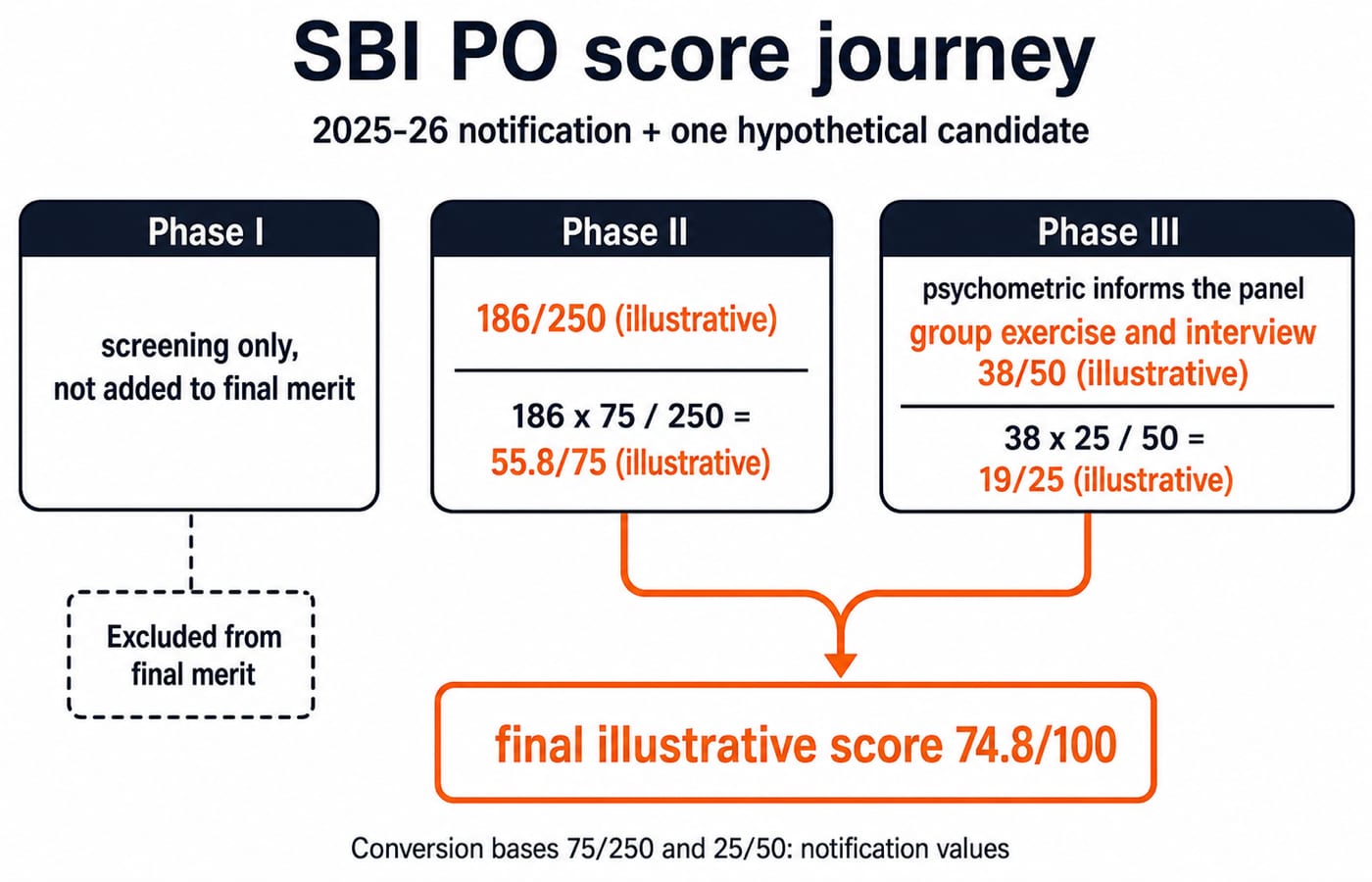
These stages do not contribute in the same way. Prelims marks are used to shortlist candidates and are not added to the final merit list. Candidates must qualify Phase II and Phase III separately, while their scores from those later phases build the final merit score.
Keep one mental model in view: Prelims opens the gate, Mains builds most of the merit score, and Phase III completes the selection picture. That distinction should shape both your preparation order and your mock analysis.
SBI PO Prelims pattern: accuracy inside separate section clocks
SBI's 2025-26 notification specified a 100-mark online objective test. English Language had 40 questions, while Quantitative Aptitude and Reasoning Ability had 30 questions each. Every section had its own 20-minute window, making three distinct time blocks rather than one freely shared hour.
That structure changes how you review a mock. Check English attempts and accuracy inside its 20 minutes, then do the same for Quant and Reasoning. A strong overall total cannot recover time left unused in one section after that section's clock closes. Your review should therefore record where time went, which question types caused delays, and whether hurried errors appeared near the end of each block.
The notice specified no sectional cutoff at this stage. Category-wise shortlisting used aggregate marks, but that is not a reason to neglect any timed section or invent a universal safe-attempt target.
SBI PO Mains pattern: objective depth plus typed communication
The Main objective test had 170 questions for 200 marks across three hours, with separate section timings:
Reasoning and Computer Aptitude: 40 questions, 60 marks, 50 minutes.
Data Analysis and Interpretation: 30 questions, 60 marks, 45 minutes.
General Awareness, Economy and Banking Knowledge: 60 questions, 60 marks, 45 minutes.
English Language: 40 questions, 20 marks, 40 minutes.
After the objective test, candidates typed a 30-minute descriptive test worth 50 marks. Under the revised pattern, candidates answered three tasks: one email, one situation analysis, and either one report or one precis.
This is a wider demand than Prelims. Mains also demands sustained attention across several different tasks. Preparation must cover deeper objective work and written communication under a clock. For help allocating those demands across a study week, read SBI PO Prelims, Mains and Final Stage: A 12-Hour Week Plan.
SBI PO marking scheme: calculate the cost before guessing
For objective tests in both Prelims and Mains, a wrong answer attracted a penalty equal to one-fourth of the marks assigned to that question. An unanswered question attracted no penalty. This rule concerns objective questions, not the descriptive paper.
Consider an illustrative one-mark mock with 68 correct answers, 20 wrong answers and 12 blanks:
Correct marks = 68 x 1 = 68.
Penalty = 20 x 0.25 = 5.
Corrected score = 68 - 5 = 63.
Now suppose four uncertain answers among those 20 wrong attempts had been left blank. There would be 16 wrong answers:
Revised penalty = 16 x 0.25 = 4.
Revised score = 68 - 4 = 64.
Difference = 64 - 63 = exactly 1 mark higher.
This illustrates the cost of inaccurate guessing, not a rule to skip every difficult question. If a question carries a different mark value, calculate its penalty as 0.25 x the marks assigned to that specific question.
SBI PO final score conversion: how Mains and Phase III combine
Phase II carried 250 raw marks and was normalised to 75. Group exercise plus interview carried 50 raw marks and was normalised to 25. Together, these produced a final merit score out of 100. Psychometric findings could be placed before the interview panel, but the notice did not assign a separate psychometric mark in this conversion.
Take a hypothetical candidate, not a cutoff. A Mains score of 186 out of 250 converts as:
186 x 75 / 250 = 55.8 out of 75.
A group exercise plus interview score of 38 out of 50 converts as:
38 x 25 / 50 = 19 out of 25.
Combined score = 55.8 + 19 = 74.8 out of 100.
SBI PO course map: prepare for the stage you are actually facing
Match your main study block to the next selection demand, while keeping a small bridge to the stage after it.
Stage | Preparation demand | KnowledgeGate next step |
|---|---|---|
Prelims | Timed accuracy across English, Quant and Reasoning | |
Mains | Deeper objective work plus typed communication | |
Phase III | Personality consistency and spoken judgement |
The broader SBI PO Exam Preparation hub brings structured lessons, practice questions and mock tests together. Build the immediate stage first, but keep descriptive writing active before Mains so the typed component does not become a last-minute surprise.
The short version: verify the notice, then train the scoring behaviour
Prelims screens candidates. Mains combines objective depth with typed descriptive work. Under the cited notice, a wrong objective answer lost one-fourth of the mark assigned to that question, and Phase II plus Phase III determined final merit. Before fixing section counts, timings or cutoff assumptions for a new cycle, reopen the current SBI notification. If you are moving beyond Prelims, train for Mains now. If you are still building your base, begin with the first-stage course already mapped above.
Keep learning
SBI SO Syllabus: Section-by-Section Study Map for IT Aspirants
Build an IT/System study map around your exact SBI post. Use a historical exam table, original worked exercises and an eight-hour sample week to turn topic lists into practice.
1 Oct 20265 min readSBI Exams
SBI SO Preparation Strategy: A 12-Week Role-Specific Plan
Build an SBI SO plan around the exact Specialist Cadre Officer post you are targeting. This guide gives an 11-hour weekly calendar, diagnostics, repair loops and separate written-test and interview branches.
Updated 24 Sep 20266 min readSBI Exams
SBI SO Exam Pattern and Marking Scheme: Post-Wise Routes Explained
There is no single SBI SO paper pattern. Use this guide to identify your post's route, understand qualifying and merit components, and build a timetable from the official notice.
Updated 22 Sep 20264 min readSBI Exams
SBI Clerk Preparation Mistakes: 7 Errors and Practical Fixes
High effort can still produce weak results when the study system rewards attempts, note collection and packed timetables. This guide replaces seven common errors with practical weekly actions.
Updated 21 Sep 20265 min readSBI Exams