SBI PO Group Exercise: A 4-Step Evidence-Based Contribution Framework
Speak less, but make each contribution testable. Turn the practice brief's own numbers into one proposal, answer a challenge with the right denominator, and rehearse three timed entries.
KnowledgeGate Team
Exam prep & CS education
Updated 23 Aug 20265 min read
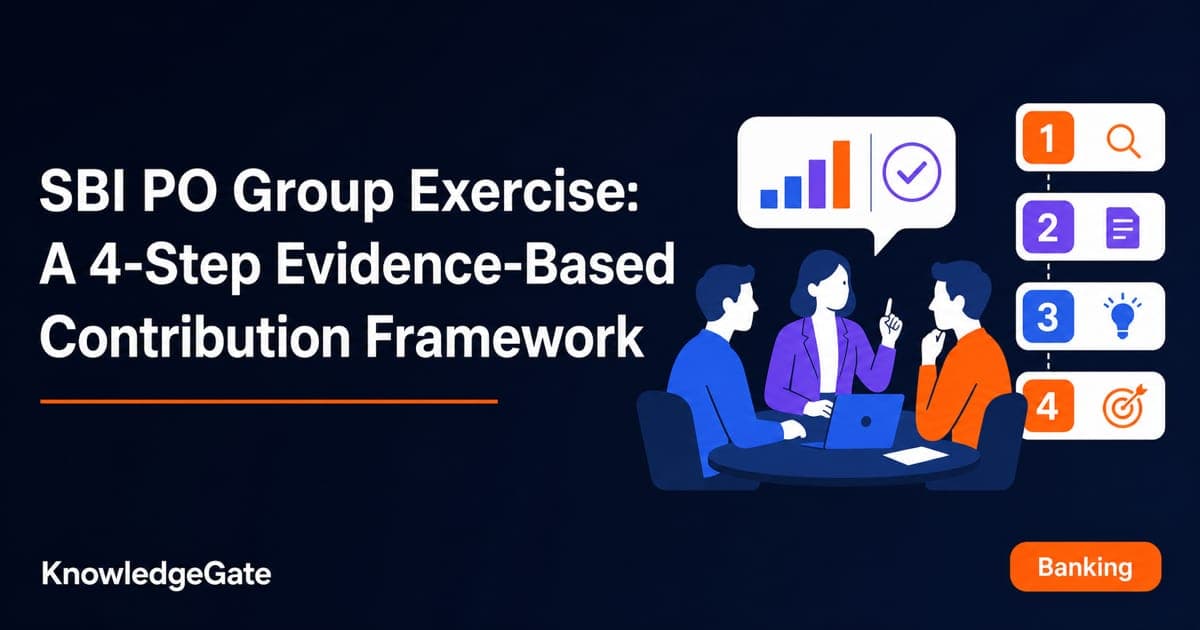
More airtime does not automatically mean a stronger SBI PO Group Exercise contribution. A loud point without a traceable premise gives the group little to examine, while a short point can move the discussion when it connects evidence to a decision. Use this four-step claim -> evidence -> reasoning -> hand-off framework. One claim, one traceable fact, the reason it changes the decision, and a question that hands the point back for testing.
SBI PO Group Exercise: what the official notification establishes
The SBI Recruitment of Probationary Officers advertisement dated 18 June 2026 calls Phase III Psychometric Test, Group Exercise & Personal Interview. It assigns maximum marks of 20 to the Group Exercise and 30 to the Interview, and leaves the minimum qualifying marks to the Bank. Those 50 Phase III marks are normalised to 25 of the 100-mark final merit list, against 75 for the Mains written test, so a quarter of your rank is settled in a room where you speak. What the advertisement does not fix is the topic, group size, speaking order, duration or behavioural checklist.
Everything the advertisement leaves open, including the sample prompt below, its numbers and every timing that follows, is practice scaffolding rather than an SBI rule. Your call letter and information handout carry the actual instructions. For the wider stage map, read SBI PO Syllabus and Exam Pattern 2026: All Stages Decoded.
SBI PO Group Exercise contributions: claim, evidence, reasoning and hand-off
Use four connected steps:
Step | Job | Sentence cue |
|---|---|---|
Claim | Answer the group's question once. |
|
Evidence | Give a prompt fact or labelled assumption. |
|
Reasoning | Show why it changes the choice. |
|
Hand-off | Invite testing, extension or synthesis. |
|
The hand-off keeps the point answerable and lets others add value to it. Rank evidence as prompt data, a dated attributable source, a transparent estimate, then an illustrative anecdote. Omit an unsupported remembered statistic.
SBI PO Group Exercise worked example: turn five prompt figures into one proposal
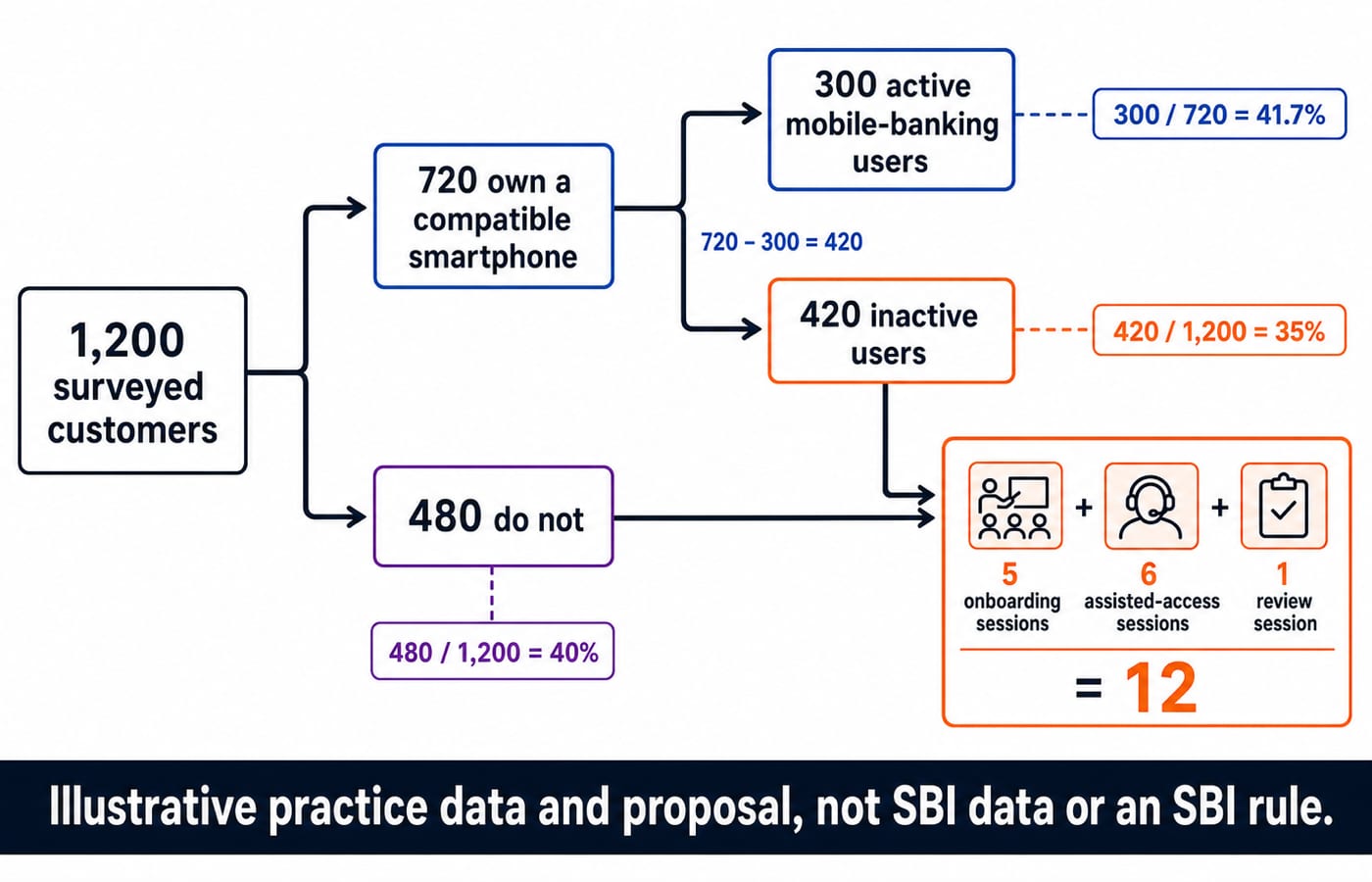
The practice brief gives five numbers. A bank outreach team has surveyed 1,200 customers and can run 12 outreach sessions. Of the 1,200, 720 own a compatible smartphone, 300 of those 720 already use mobile banking, and 480 do not own a compatible smartphone.
Calculate before recommending:
Inactive phone owners:
720 - 300 = 420.Adoption among phone owners:
300 / 720 x 100 = 41.7%, about42%.Inactive phone owners among all surveyed:
420 / 1,200 x 100 = 35%.Customers without compatible phones among all surveyed:
480 / 1,200 x 100 = 40%.
I would not make the programme digital-only. The practice brief leaves two similarly sized unmet groups: 420 smartphone owners who are not active users and 480 customers without a compatible phone. I suggest five onboarding sessions, six assisted-access sessions and one review session. That gives us
5 + 6 + 1 = 12. Can we add a fraud-safety check to both service tracks?
The near-even 5:6 service split reflects the groups' similar scale; session twelve checks results. It is not a proven capacity plan. Attendance, staffing and outcome data are still needed.
SBI PO Group Exercise evidence: repair a challenged claim
You say, Digital adoption is low. Another participant asks, Low compared with what? Repair it with the right denominator: In this practice brief, 300 of 720 smartphone owners use mobile banking, about 42%, leaving 420 phone owners as the onboarding gap. Here, 300 of 720 answers adoption among phone owners. Using 300 of 1,200 would answer adoption among all surveyed customers, a different question.
If challenged, say: The 5:6 split is a starting allocation based on group size, not a forecast of attendance or impact. We would need session capacity and uptake data before finalising it. Retract an unverifiable number: I cannot verify that figure, so I will withdraw it and keep the argument to the data in the prompt.
SBI PO Group Exercise airtime: contribute three times without dominating
Try a fictional rehearsal with 8 participants and 12 minutes. A neutral equal-share reference is 12 x 60 / 8 = 90 seconds per person. Treat that as a reference point rather than a quota, because a real discussion never divides evenly.
Plan three purposeful entries totalling 80 seconds: a 35-second frame using claim, evidence, reasoning and hand-off; a 25-second build on a peer's fraud-safety point; and a 20-second synthesis near the end. Check: 35 + 25 + 20 = 80 seconds. Usefulness, not filling the 90-second reference, is the target.
Between entries, record two listening notes: one exact idea from a peer and one unresolved trade-off. In the second entry, name the peer's idea before adding to it. In the final synthesis, state the common ground, open risk and next test instead of repeating your first contribution.
SBI PO Group Exercise mistakes: replace volume with evidence discipline
Mistake | Why it happens | What goes wrong | What to do instead |
|---|---|---|---|
Inventing a statistic | Chasing authority. | Untraceable number. | Withdraw any number that cannot be sourced or traced to the prompt. |
Stacking five facts without a claim | Chasing quantity. | No clear decision. | Limit one contribution to one claim and one decisive piece of evidence. |
Interrupting | Silence feels like failure. | Poor listening. | Record a listening note instead of interrupting. |
Repeating a popular point louder | Agreement feels safe. | No new value. | Say |
SBI PO vs IBPS PO: Pattern, Difficulty & Career Differences shows that the two recruitment routes are not interchangeable. A remembered IBPS format or a coaching checklist tells you nothing about how SBI runs Phase III; the advertisement and your call letter do.
SBI PO Group Exercise practice: run one 30-minute evidence drill
Spend 5 minutes reading a prompt and sorting notes into given / inferred / unknown; 7 checking three figures and denominators; 8 drafting an opening, challenge response and synthesis; 6 delivering those entries on a timer; and 4 reviewing each for claim, evidence, reasoning and hand-off. Check: 5 + 7 + 8 + 6 + 4 = 30 minutes.
On a missed day, use 12 minutes: 3 to mark the prompt, 3 to verify one figure, 4 to speak two contributions, and 2 to review. Check: 3 + 3 + 4 + 2 = 12. Consistency beats an unrealistic marathon. Keep the written stages on their own schedule through SBI PO Exam Preparation, which is a separate routine from this drill.
SBI PO Group Exercise: the short version and honest next step
Remember: make one claim, cite one traceable fact, explain why it matters, and hand the point back to the group. Check the denominator, remove unsupported numbers and do not repeat a point merely for airtime.
Your need | Next step |
|---|---|
Starting the written foundation | |
Deepening written-stage preparation | |
Practising Phase III communication | Use the drill and follow current SBI instructions. |
Start tonight with the 12-minute version: mark one prompt, verify one figure, speak two contributions, review. By exercise day the habit you want is checking the denominator before you open your mouth.
Keep learning
SBI SO Cutoffs: Check Corrections and Build a Practice Target
A cutoff becomes useful only when its post, category and score basis match your comparison. Work through a real SBI correction and a hypothetical target-setting exercise to plan your next mocks.
5 Oct 20264 min readSBI Exams
SBI SO Syllabus: Section-by-Section Study Map for IT Aspirants
Build an IT/System study map around your exact SBI post. Use a historical exam table, original worked exercises and an eight-hour sample week to turn topic lists into practice.
1 Oct 20265 min readSBI Exams
SBI SO Preparation Strategy: A 12-Week Role-Specific Plan
Build an SBI SO plan around the exact Specialist Cadre Officer post you are targeting. This guide gives an 11-hour weekly calendar, diagnostics, repair loops and separate written-test and interview branches.
Updated 24 Sep 20266 min readSBI Exams
SBI SO Exam Pattern and Marking Scheme: Post-Wise Routes Explained
There is no single SBI SO paper pattern. Use this guide to identify your post's route, understand qualifying and merit components, and build a timetable from the official notice.
Updated 22 Sep 20264 min readSBI Exams