समास (Samas) for Teaching Exams: Types, Vigraha and Worked Examples
Learn a repeatable way to classify Samas through vigraha, relation clues, प्रधानता and context, with Tatpurush markers, practice items and correction drills.
KnowledgeGate Team
Exam prep & CS education
Updated 2 Sep 20266 min read63 views
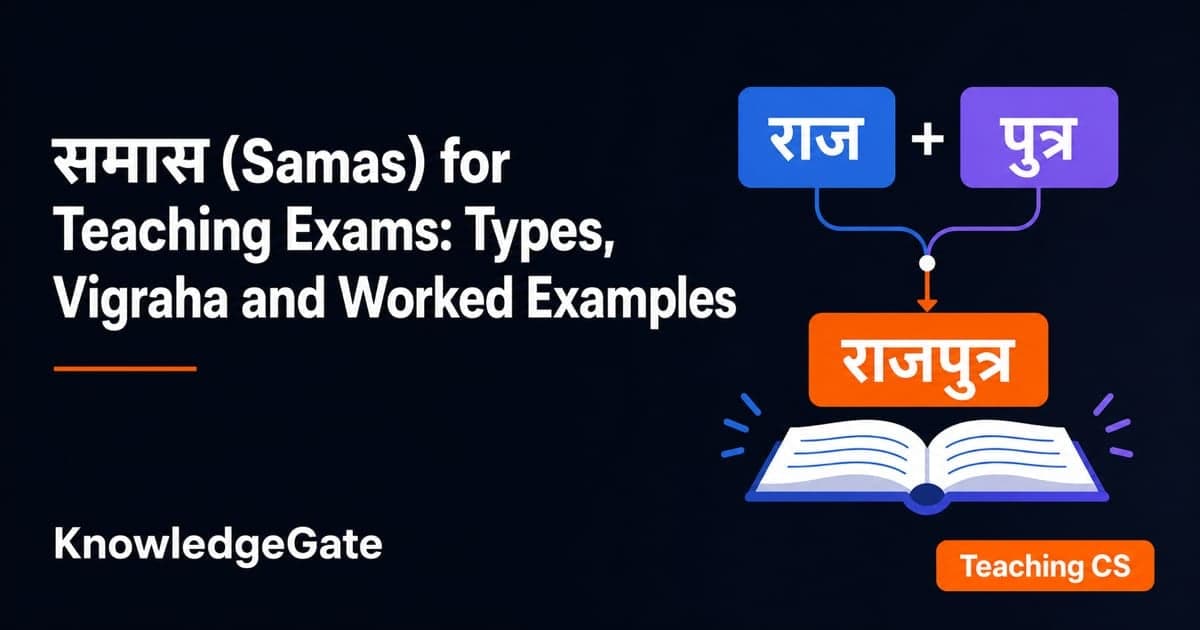
Many learners can recite the six names of समास but still misclassify a word by starting from its appearance. The reliable route is विग्रह, the hidden relation, प्रधान पद and context. This method suits CTET, State TETs, NET and teaching-recruitment aspirants without assuming a paper pattern.
संबंधित लेख: मुहावरे और लोकोक्तियाँ और CTET भाषा की तैयारी.
समास, समस्त पद and विग्रह: build the base first
समास joins two or more meaningful पदों concisely into one समस्त पद, leaving part of their semantic relation unstated. In राजपुत्र, राज is पूर्वपद, पुत्र is उत्तरपद, राजपुत्र is समस्त पद, and राजा का पुत्र is विग्रह. The omitted का identifies सम्बन्ध तत्पुरुष.
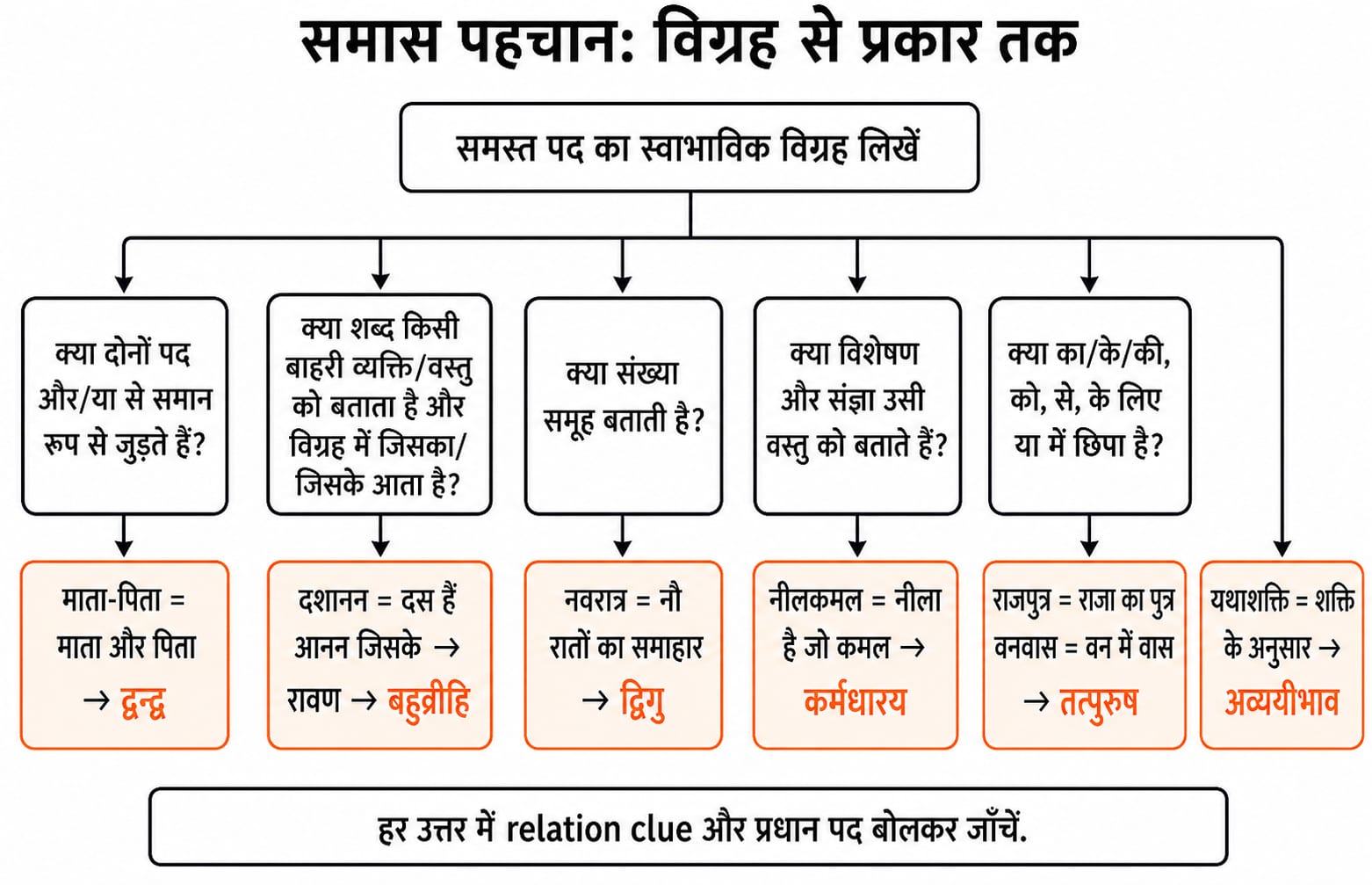
Use three steps: expand naturally; mark और, का/के/की, से, के लिए, में, के अनुसार or जिसका/जिसके; then locate प्रधानता in पूर्वपद, उत्तरपद, both पद, or an outside referent. प्रधान is what the compound mainly names, not the longer or later word.
समास explains meaning; संधि explains a sound or letter change at a boundary. देव + आलय shows the vowel junction in देवालय, while देव का आलय reveals सम्बन्ध तत्पुरुष. A word can therefore invite both analyses.
समास के छह प्रकार: memorisation से पहले प्रधानता
प्रकार | कौन प्रधान | विग्रह संकेत | worked example |
|---|---|---|---|
अव्ययीभाव | पूर्वपद | के अनुसार/प्रति/भर | यथाशक्ति = शक्ति के अनुसार |
तत्पुरुष | उत्तरपद | hidden कारक marker | राजपुत्र = राजा का पुत्र |
कर्मधारय | उत्तरपद, same referent | adjective describes noun | नीलकमल = नीला है जो कमल |
द्विगु | numeral-led समूह | number plus aggregate | नवरात्र = नौ रातों का समाहार |
द्वन्द्व | both पद | और/या | माता-पिता = माता और पिता |
बहुव्रीहि | neither पद | जिसका/जिसके, outside bearer | दशानन = दस हैं आनन जिसके, अर्थात रावण |
राजपुत्र is not द्वन्द्व because it does not mean राजा और पुत्र. नीलकमल is कर्मधारय when it names the कमल itself. दशानन is बहुव्रीहि when it names रावण, not a collection of faces. A defensible विग्रह controls the answer.
Many exam-oriented treatments use this six-type list. Some grammatical treatments place कर्मधारय and द्विगु inside the wider तत्पुरुष family, so follow the terminology in the applicable verified syllabus and official answer key when a paper uses another hierarchy.
समास पहचानने का decision tree: 12 worked compounds
Check in this order: और/या joining equal पद suggests द्वन्द्व; an outside bearer with जिसका/जिसके suggests बहुव्रीहि; a number forming a group suggests द्विगु; adjective and noun naming one object suggest कर्मधारय; a hidden कारक with उत्तरपद प्रधान suggests तत्पुरुष; an indeclinable expression suggests अव्ययीभाव. Meaning still controls the answer.
समस्त पद और विग्रह | relation clue | प्रकार और प्रधानता |
|---|---|---|
प्रतिदिन = प्रत्येक दिन | प्रति | अव्ययीभाव, पूर्वपद |
यथाशक्ति = शक्ति के अनुसार | के अनुसार | अव्ययीभाव, पूर्वपद |
राजपुत्र = राजा का पुत्र | का | सम्बन्ध तत्पुरुष, उत्तरपद |
हस्तलिखित = हाथ से लिखा हुआ | से | करण तत्पुरुष, उत्तरपद |
वनवास = वन में वास | में | अधिकरण तत्पुरुष, उत्तरपद |
नीलकमल = नीला है जो कमल | same कमल | कर्मधारय, उत्तरपद |
महापुरुष = महान है जो पुरुष | same पुरुष | कर्मधारय, उत्तरपद |
नवरात्र = नौ रातों का समाहार | समाहार | द्विगु, समूह |
त्रिलोकी = तीन लोकों का समाहार | समाहार | द्विगु, समूह |
माता-पिता = माता और पिता | और | द्वन्द्व, both पद |
सुख-दुःख = सुख और दुःख | और | द्वन्द्व, both पद |
दशानन = दस हैं आनन जिसके | जिसके, रावण | बहुव्रीहि, outside referent |
Classify all 12 before checking. Missing यथाशक्ति, हस्तलिखित, नवरात्र and दशानन gives 8/12: one अव्ययीभाव-clue, कारक-marker, numeral-versus-group and outside-referent error each. Rewrite those four विग्रह, explain प्रधानता aloud, then reattempt them after a gap.
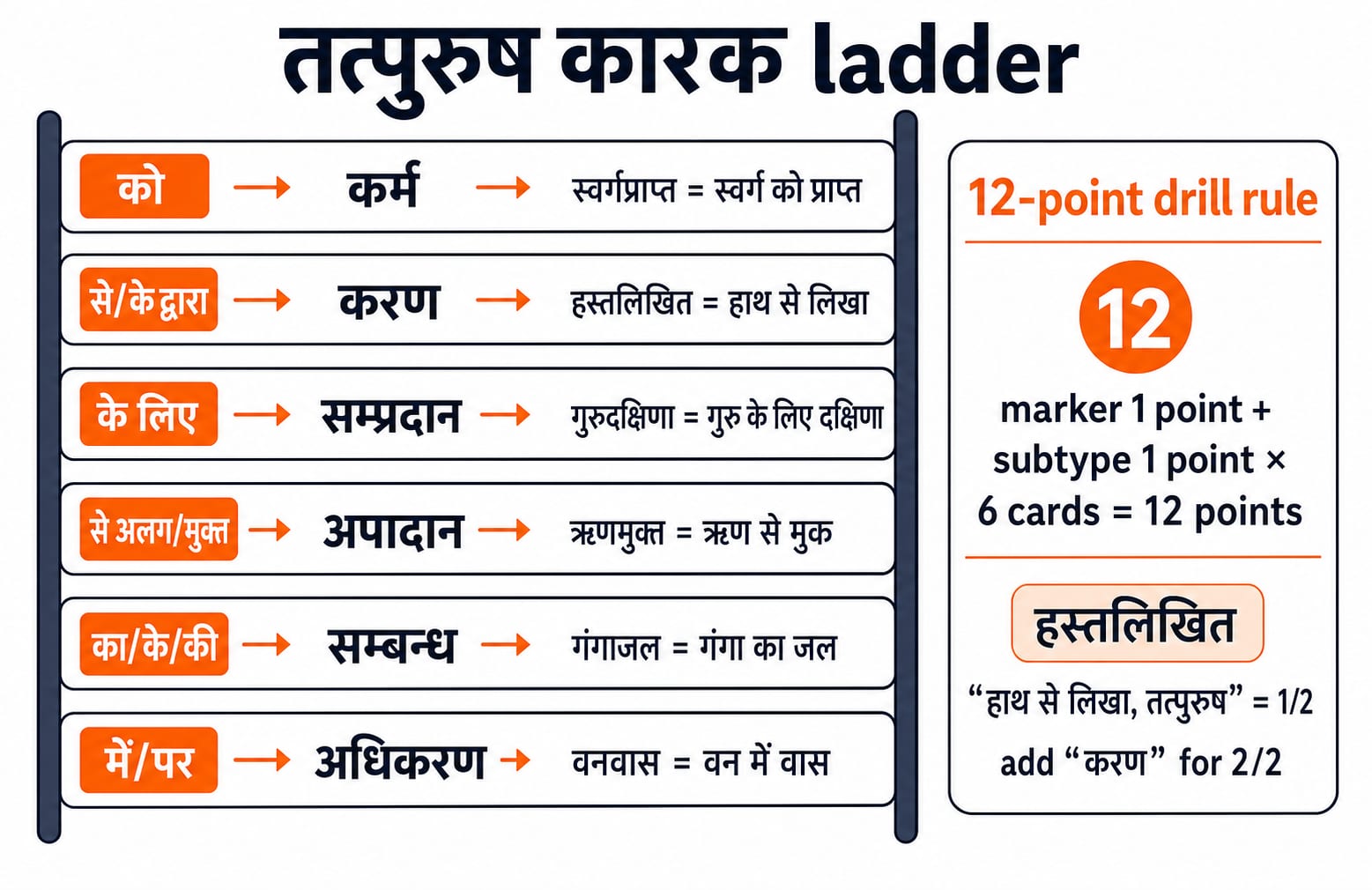
तत्पुरुष के उपप्रकार: छिपा कारक marker निकालें
सम्बन्ध | marker | exact विग्रह |
|---|---|---|
कर्म | को | स्वर्गप्राप्त = स्वर्ग को प्राप्त |
करण | से/के द्वारा | हस्तलिखित = हाथ से लिखा हुआ |
सम्प्रदान | के लिए | गुरुदक्षिणा = गुरु के लिए दक्षिणा |
अपादान | से अलग/मुक्त | ऋणमुक्त = ऋण से मुक्त |
सम्बन्ध | का/के/की | गंगाजल = गंगा का जल |
अधिकरण | में/पर | वनवास = वन में वास |
If a question asks for the subtype, answer in two layers: तत्पुरुष, specifically करण तत्पुरुष.
Make six cards using those compounds. Each earns one point for the marker and one for the subtype, so 6 × 2 = 12 points. हस्तलिखित = हाथ का लिखा earns 0/2; हाथ से लिखा, तत्पुरुष earns 1/2; adding करण makes it 2/2.
Do not force a memorised marker. माता-पिता naturally means माता और पिता, not माता के पिता, so it remains द्वन्द्व.
कर्मधारय, द्विगु and बहुव्रीहि: context breaks the tie
नीलकमल names a blue कमल, so it is कर्मधारय. त्रिलोकी names the group of three लोक, so it is द्विगु. त्रिनेत्र, when used for शिव, means तीन हैं नेत्र जिसके, so the outside bearer makes it बहुव्रीहि. A numeral alone does not prove द्विगु.
Compare two sentences. दुकान में पीताम्बर रखा है names the garment: पीला है जो अम्बर, कर्मधारय. काव्यांश में “पीताम्बर” शब्द कृष्ण के लिए प्रयुक्त हुआ है names कृष्ण: पीला अम्बर है जिसका, बहुव्रीहि.
For bare words, state the assumed referent. नीलकंठ meaning the blue throat itself can be कर्मधारय; as a name for शिव, नीला है कंठ जिसका is बहुव्रीहि. सप्तर्षि, सात ऋषियों का समूह, is द्विगु under this convention.
Teaching exams में समास कैसे पूछा जा सकता है
Possible formats include choosing a विग्रह, identifying a type or subtype, matching relations, finding the differently classified item, and resolving a compound in context. The wider CTET Language I and II strategy places grammar inside language preparation.
वनवासका सही विग्रह? Aवन और वास, Bवन का वास, Cवन में वास, Dवन से वास. Answer: C, अधिकरण तत्पुरुष.द्वन्द्व कौन-सा है? A
गंगाजल, Bमाता-पिता, Cनीलकमल, Dयथाशक्ति. Answer: B, because both पद join throughऔर.त्रिनेत्रशिव के लिए हो तो प्रकार? A द्विगु, B कर्मधारय, C बहुव्रीहि, D अव्ययीभाव. Answer: C, because it names an outside bearer.हस्तलिखितका तत्पुरुष उपप्रकार? A करण, B सम्प्रदान, C सम्बन्ध, D अधिकरण. Answer: A, fromहाथ से लिखा हुआ.
After a mixed set, tag misses V for विग्रह, P for प्रधानता, K for कारक, and C for context. In 20 items with V=3, P=1, K=2, C=0, the six misses are led by three विग्रह and two कारक errors. Repair those before another full set, using the broader review method in the CTET mock-test strategy.
समास की common traps and exact fixes
mistake | why it fails | replacement test |
|---|---|---|
two nouns means द्वन्द्व | fails on राजपुत्र | insert |
numeral always means द्विगु | त्रिनेत्र may name शिव | group or outside bearer? |
adjective plus noun is always कर्मधारय | पीताम्बर may name कृष्ण | identify the real referent |
| confuses बहुव्रीहि and सम्बन्ध | outside possessor or internal relation? |
Memorising only the final type makes close options indistinguishable. Treating संधि and समास as mutually exclusive also mishandles देवालय. Keep a notebook with समस्त पद | विग्रह | relation clue | प्रकार/उपप्रकार.
For the four errors in the 8/12 set, use a six-minute repair: minute 1 write यथाशक्ति = शक्ति के अनुसार; minute 2 mark पूर्वपद प्रधान and अव्ययीभाव; minute 3 write हस्तलिखित = हाथ से लिखा and करण; minute 4 write नवरात्र = नौ रातों का समाहार and द्विगु; minute 5 write दशानन = दस हैं आनन जिसके and बहुव्रीहि; minute 6 cover and classify all four again. This is a practice device, not a performance guarantee.
समास का short version and next practice move
Write the विग्रह first.
Mark the hidden relation and identify what is प्रधान.
Use
औरfor द्वन्द्व and a group meaning for द्विगु.Use
जिसका/जिसकेplus an outside referent for बहुव्रीहि.Recover the कारक marker for तत्पुरुष.
Let sentence context override a memorised label.
Reconstruct राजपुत्र, यथाशक्ति, हस्तलिखित, नवरात्र, माता-पिता and दशानन from memory. Attempt 12 mixed items, tag misses with V/P/K/C, and retry only the missed relations.
Use the CTET Paper 1 course for the primary-level route, the CTET Paper 2 course for the upper-primary route, or the Govt Teaching Eligibility Tests category to compare the currently listed CTET and UPTET options. Before the next topic, choose five compounds from your notes and write समस्त पद | विग्रह | प्रधानता | प्रकार for each.
Keep learning

Curriculum and School Environment for Teaching Exams: Concepts, Caselets and Worked Examples
Learn to separate curriculum from syllabus, diagnose school conditions, audit alignment with numbers, and solve teaching-exam caselets logically.
Updated 26 Oct 20266 min readCTET & UPTET

Inclusive Education and Special Needs for Teaching Exams: Concepts, Cases, and Common Traps
Learn to separate inclusion from integration, match barriers to supports, and solve teaching-exam caselets through one fully worked classroom redesign.
Updated 25 Oct 20266 min readCTET & UPTET

Guidance, Counselling and Mental Health for Teaching Exams: Concepts, Cases and Exam Traps
Learn to separate guidance, counselling and mental-health support, then apply the distinctions to learner cases without crossing a teacher's professional boundaries.
Updated 23 Oct 20266 min readCTET & UPTET

Classroom Management and Communication for Teaching Exams: Complete Notes and Worked Scenarios
Connect classroom management, communication, feedback, discipline, and teacher immediacy, then practise an exam-style vignette with a step-by-step solution.
Updated 19 Oct 20266 min readCTET & UPTET