RRB NTPC Syllabus 2026: CBT 1 and CBT 2 Topics Decoded, and What Changes Between Stages
CBT 1 and CBT 2 share the same three subjects. See what changes in depth, purpose and post level, then prepare one syllabus that scales across both stages.
KnowledgeGate Team
Exam prep & CS education
Updated 1 Aug 20265 min read
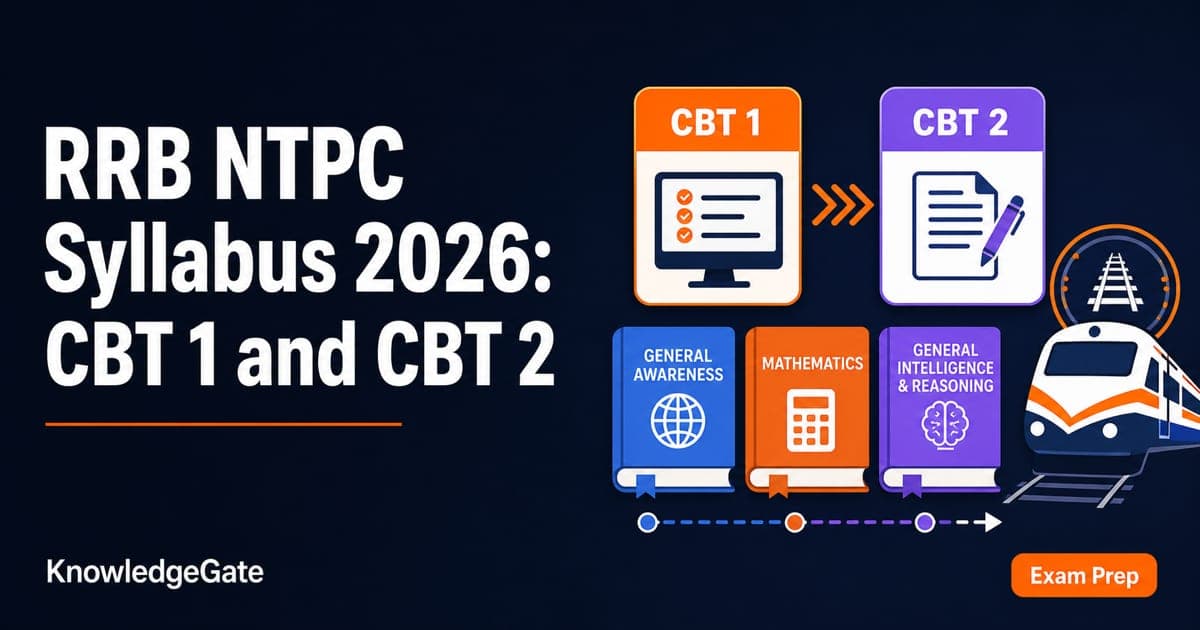
The RRB NTPC syllabus looks much larger when CBT 1 and CBT 2 are treated as separate exams. They actually test the same three subjects. What changes is paper size, depth and post level: roughly one hundred questions at CBT 1 against roughly one hundred and twenty at CBT 2, drawn from one syllabus, so the efficient plan is to build one foundation and then raise it to CBT 2 level.
The first principle: same subjects, two depths
Both computer-based stages cover Mathematics, General Intelligence and Reasoning, and General Awareness. CBT 2 does not suddenly add a fourth subject. It asks you to use the same syllabus with stronger accuracy, speed and depth.
CBT 1 is the common screening stage used to shortlist candidates. CBT 2 is the central merit stage and is organised at the level applicable to the post. That distinction changes preparation priority even when the topic names stay the same.
Take the exact question counts, marks, duration, negative marking and normalisation policy from the current CEN on the official RRB application portal, for your region and cycle. A previous paper is useful evidence about question style, but it is not the governing notice.
CBT 1: the common screening stage
CBT 1 is a single common paper for the notified NTPC posts. Recent patterns have used roughly one hundred questions across the three subjects in ninety minutes, with General Awareness taking the largest single share, ahead of Mathematics and Reasoning.
Its purpose is breadth and shortlisting. You need enough command of the whole syllabus to clear the screening gate, so a preparation plan that completes only favourite chapters is fragile. General Awareness recall must be quick, common arithmetic methods must be available without a long search, and familiar Reasoning types must be recognised on sight.
CBT 1 scores have generally served to shortlist candidates rather than form the final merit by themselves. So prepare seriously for the stage, but do not let screening-level practice become the ceiling of your preparation.
CBT 2: the deciding stage
CBT 2 keeps Mathematics, Reasoning and General Awareness but tests them in a longer, deeper paper. Recent notices have specified around one hundred and twenty questions, roughly twenty more than CBT 1 in a comparable slot, with a larger General Awareness block and more demanding application in Mathematics and Reasoning.
This stage is tied to the level of the post. NTPC posts split into an undergraduate group and a graduate group, and you sit the CBT 2 paper set for the group you applied under, so two aspirants studying one syllabus can face different papers. Which posts sit in which group, and the qualifications each one needs, are worked through in the RRB NTPC eligibility guide. More questions do not mean a new syllabus. They mean more coverage of that syllabus and less room for shallow preparation.
CBT 2 deserves the bulk of serious mixed practice because it is central to merit. Build methods at CBT 2 depth even while preparing for CBT 1. The earlier screening paper then becomes a faster, broader use of the same knowledge rather than a separate project.
What changes between CBT 1 and CBT 2
Four changes matter:
Paper load: roughly one hundred questions at CBT 1 against roughly one hundred and twenty at CBT 2, so about twenty more to place in a comparable slot.
Difficulty: Mathematics can require more multi-step arithmetic and data interpretation, while Reasoning can include heavier arrangements and puzzles.
Post level: one common CBT 1 paper for everyone, then a CBT 2 paper set by the group of the post you applied for, undergraduate or graduate.
Selection weight: CBT 1 opens the gate; CBT 2 is central to merit.
The subject list does not change. Your preparation should therefore move vertically, from clean concepts to speed and mixed application, rather than horizontally into a supposed new syllabus.
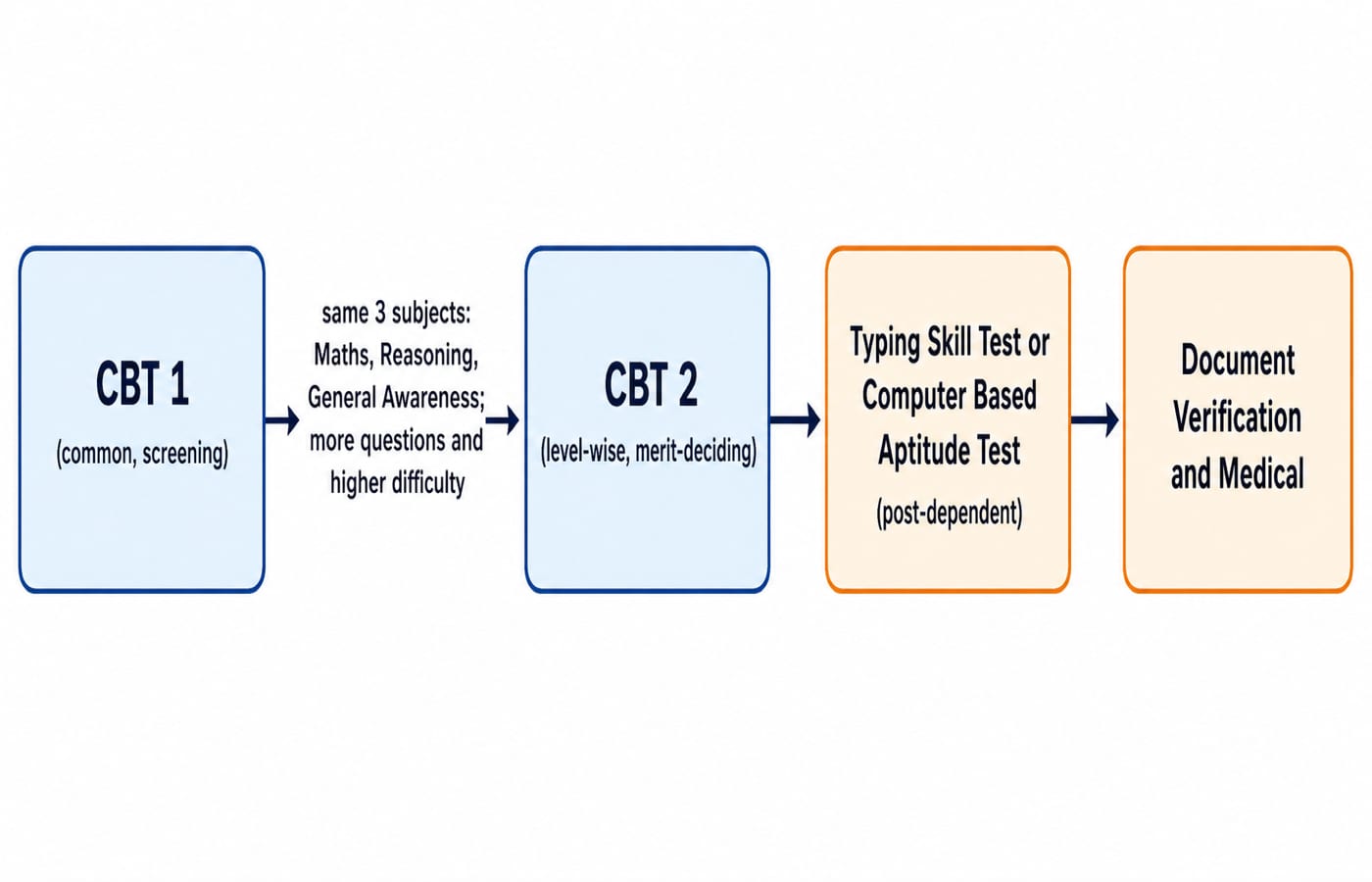
After CBT 2 the route branches by post. Typing posts such as junior clerk cum typist go to a Typing Skill Test, while the traffic posts such as Station Master go to a Computer Based Aptitude Test. Document Verification and a Medical Examination close the process, and the medical standard applied depends on the post.
The subject-by-subject topic map
Mathematics
Start with number system, decimals and fractions, ratio and proportion, percentage, profit and loss, averages, time and work, and time-speed-distance. Add simple and compound interest, mensuration, elementary algebra, geometry and elementary statistics.
These chapters are connected. Ratio supports percentage, percentage supports profit and loss, and rate reasoning supports time and work as well as speed and distance. Learn the relationship, then practise it in different wording.
General Intelligence and Reasoning
The recurring map includes analogies, number and alphabet series, coding-decoding, mathematical operations, syllogisms, Venn diagrams, seating and puzzle arrangements, direction sense, statement-conclusion and data sufficiency.
Classify the question before solving it. A short diagram for directions, a set model for syllogisms and a clear table for arrangements reduce mental load. CBT 2 asks for the same habits under a heavier mix.
General Awareness
Cover current affairs, Indian history and the freedom struggle, geography, Indian polity and the Constitution, basic economics, general science, and static GK such as sports, awards, books and important days.
General Awareness has carried the largest question share in both stages in recent patterns. Keep current affairs steady, but build a revisable static core instead of relying on last-minute reading.
Exam-day rules to verify on the official portal
Recent notifications have specified negative marking, including a deduction of one-third of a mark for a wrong answer, and normalisation for multi-shift papers. Category-wise qualifying marks, and how the two computer-based scores are combined, can also move between cycles.
Confirm all of them from the CEN for your cycle. A forwarded PDF, a coaching screenshot or a table copied from an older article can preserve the right syllabus and still carry the wrong administrative rule. Read the notice before deciding attempt strategy.
RRB NTPC preparation order: concepts, focused sets, then mixed CBT 2 sets
Prepare each topic once at concept level, practise it first in focused sets, and then raise it into mixed CBT 2 sets. Use timed CBT 1 papers to test breadth and quick selection, not to define the maximum difficulty you will study.
For a comparison with another multi-stage government exam, read the SSC CGL syllabus areas guide and the explanation of the SSC CGL tier structure. The exact subjects differ, but the distinction between a screening stage and a deciding stage is useful.
Then follow the subjects in the RRB NTPC Complete Preparation Course, scaling the same foundation from CBT 1 speed to CBT 2 depth, and browse the Railways exam category for the other railway exams that lean on these same three subjects.
Keep learning
Browsers and Search Engines MCQs: 9 Solved Questions with Explanations
Solve nine published browser and search engine questions, check each answer, and rebuild the browser, cache, crawler and indexing distinctions that exam distractors blur.
Updated 6 Oct 20267 min readTeaching Recruitment (Computer Science)
IT Act, 2000 Explained: Key Sections, Digital Signatures and Worked Exam Examples
Build an exam-ready map of the IT Act, then apply it to an exact digital-signature walkthrough and a section 43, 66, 66C and 66D caselet.
Updated 2 Oct 20266 min readTeaching Recruitment (Computer Science)
Emerging Trends Introduction MCQs: 12 Solved Questions with Explanations
Solve 12 Emerging Trends Introduction questions with clear answer logic, exam-year labels and a compact trap check for focused revision.
Updated 27 Sep 20268 min readTeaching Recruitment (Computer Science)
MS Word Basics MCQs with Answers: 12 Solved Questions Explained
Work through 12 MS Word questions covering everyday commands, page layout, formatting, links, file features and mail merge. Each answer explains the decisive clue and the closest distractor.
Updated 25 Sep 20267 min readTeaching Recruitment (Computer Science)