DSSSB TGT Computer Science Section B Syllabus, Decoded Block by Block
Turn the long Section B topic list into seven teachable clusters. See what each core CS block contains, where to place the lighter areas and how to revise it.
KnowledgeGate Team
Exam prep & CS education
Updated 30 Jul 20266 min read245 views
DSSSB TGT Computer Science Section B can look like one long, flat topic list. It is easy to lose weeks just deciding what to study next.
Regrouped, that list is six core Computer Science blocks plus one supporting cluster, and the order below puts the heaviest blocks first.
What Section B is in the DSSSB TGT paper
The DSSSB TGT CBT has two parts. Section A covers general ability and teaching-related areas. Section B tests the Computer Science knowledge required for the teaching post you have applied for.
Both belong to the same one-tier test, so your timetable and mocks must cover them together from the beginning.
The current advertisement specifies the Section B question count and marks. Confirm them at dsssb.delhi.gov.in for your post code rather than using an older notice. The Govt Teaching Jobs category places DSSSB beside related recruitment routes.
Six core blocks and one supporting cluster
The blocks, in study order:
Programming fundamentals and OOP: data types, control flow, functions, arrays, pointers and OOP.
Data structures: linked lists, stacks, queues, trees, graphs, searching, sorting and time cost.
Database Management Systems: ER and relational models, keys, normalization, joins, grouping and transaction basics.
Operating systems: processes, scheduling, synchronization, deadlocks, memory management and file systems.
Computer networks: OSI and TCP/IP layers, addressing, devices and protocols.
Digital logic and computer organization: number systems, Boolean algebra, gates, flip-flops, CPU components and memory hierarchy.
Supporting cluster: foundational maths, web technologies and software engineering.
Work from the advertisement, not from this list alone: assign every official topic phrase to one of these clusters, and open an eighth bucket for anything that will not fit. The DSSSB Computer Science syllabus: what to study in every block walks that sort line by line across the whole syllabus, Section A included.
Block by block: what each one actually asks
Programming fundamentals and OOP
Cover data types, operators, control flow, functions, program tracing, arrays, strings and pointers. For OOP, know classes, objects, encapsulation, inheritance, polymorphism and abstraction through small examples. Be ready to trace short programs and distinguish related terms. The usual ask is the final printed value of a short loop, or the boundary case where it breaks.
Data structures
Cover arrays, linked lists, stacks and queues before moving to trees and graphs. Learn each structure's representation, operations, uses and time cost. Add tree terminology and traversals, then compare searching and sorting procedures. Draw state changes after each operation instead of relying on memorised notes. Expect to be asked what a stack or queue holds after a stated sequence of pushes and pops, or the traversal order a given tree produces.
Database Management Systems
Build from ER and relational models to keys, constraints, normalization and transaction basics. Practise SQL filtering, joins, grouping and simple subqueries. Use small schemas: write a query, then predict its result before you run it. Understand why keys and decomposition matter instead of memorising labels. Questions here want the output of a small two-table query, or the highest normal form a given relation already satisfies.
Operating systems
Cover processes and states, CPU scheduling, synchronization, deadlocks, memory management and file systems. Separate policy from mechanism: a scheduling algorithm chooses a process, while a context switch performs the change. Use timelines and tables to make state changes visible. You will be asked which process a stated scheduling rule runs next, given arrival and burst times.
Computer networks
Study OSI and TCP/IP layers as functional maps. Add addressing, routing and switching, devices, error and flow concepts, transport, and application protocols. For every protocol, know its purpose and layer, which eliminates options faster than memorising abbreviations. The ask is to match a protocol, device or address to the correct layer and function.
Digital logic and computer organization
Begin with number systems, Boolean algebra and gates, then study combinational and sequential circuits, including flip-flops. In organization, cover CPU components, instruction execution, memory hierarchy and input-output. Rebuild key calculations and truth tables often enough that your formula sheet stays a check, not a crutch. Expect a base conversion, a Boolean expression to simplify, the output of a small gate or flip-flop arrangement, or the unit that performs a named step of instruction execution.
Supporting maths and applied topics
Foundational mathematics supports logic, representation and algorithms. The lighter applied side covers web basics, HTML, protocols, software life-cycle models, requirements, design and testing. Here the ask is single-fact recall: which life-cycle model suits a stated situation, which HTML tag or HTTP method does a named job, which testing level catches a described defect. Revise it later, but do not leave those marks to guesswork.
Which blocks are heavy and which are light
Judging by the spread of the syllabus and the time the taught DSSSB TGT Computer Science sequence gives each area, programming, data structures, DBMS, OS and networks deserve the largest early share. Digital logic and computer organization also need repeated problem practice. Web technologies and software engineering can take a smaller, later slot.
That is a preparation emphasis, not an official weightage table. If the current advertisement carries a topic distribution, that document decides.
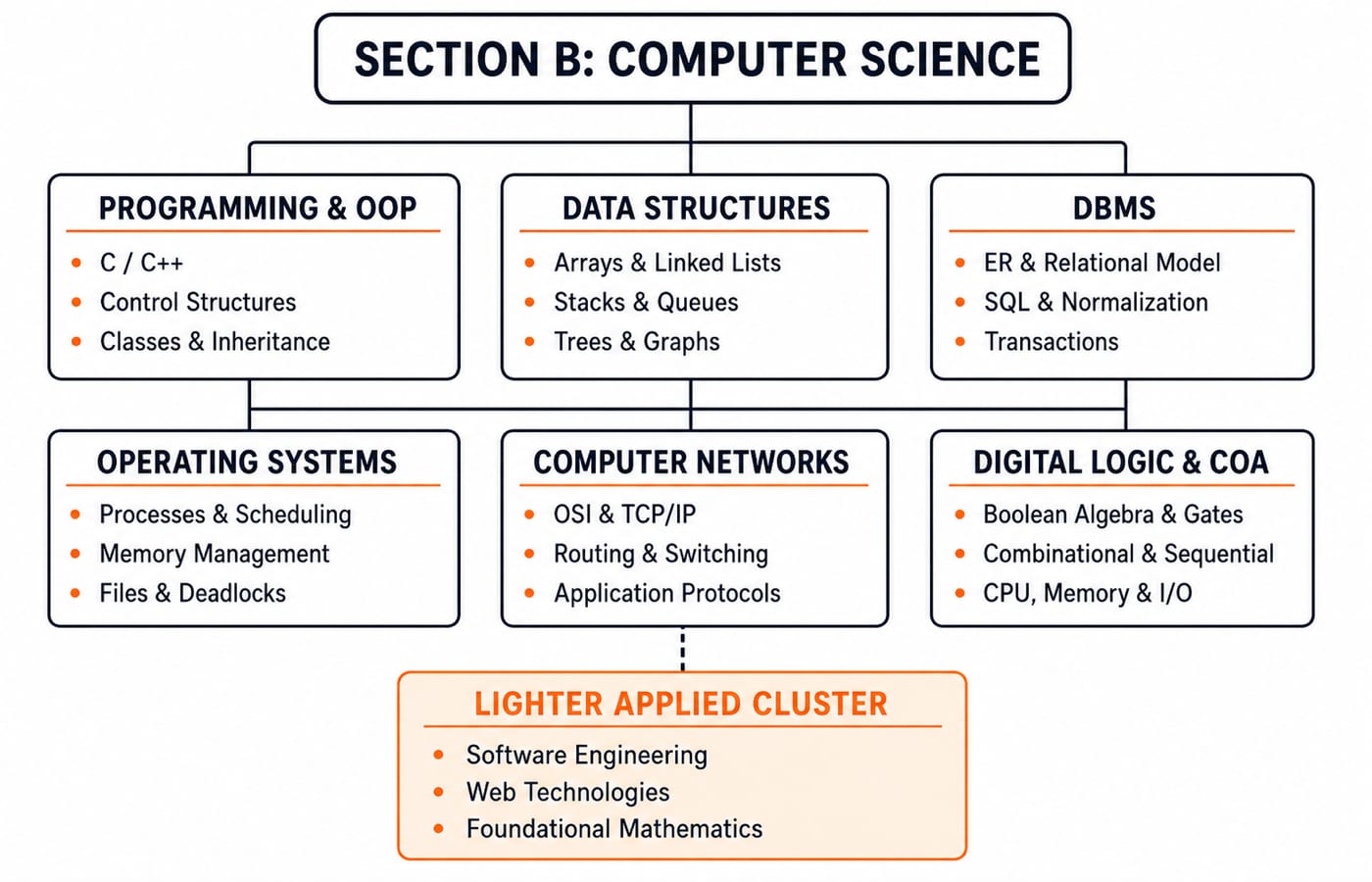
Each week, give most problem-solving time to the five heavy core blocks, maintain digital logic and organization with short drills, and reserve one compact session for the applied cluster. Rotate the blocks so none disappears for several weeks.
How the subject paper differs from Section A
Section A asks for breadth across general ability and teaching-oriented content. Section B asks whether you can work with Computer Science concepts in enough depth to distinguish, trace and calculate.
The preparation methods should therefore differ. Section A benefits from frequent short timed sets. Section B needs concept lessons followed by topic questions and mixed technical revision. Read the DSSSB Section A subject-by-subject strategy for the other half of the paper.
A strong CS score cannot rescue an ignored Section A, so put both halves into full mocks well before your final revision phase.
Turning the syllabus into a revision plan
Ten weeks is a workable span, so stretch or compress these phases to suit your own runway. In weeks 1 to 5, finish one pass through programming, data structures, DBMS, OS and networks, attaching previous-year questions immediately after each sub-topic. In weeks 6 to 8, add digital logic, organization and supporting maths while keeping the first five alive through mixed sets. In weeks 9 to 10, close web and software-engineering gaps and begin full-paper mocks.
For every wrong question, tag the matching block and sub-topic. A weekly error count then tells you what to revise next. Re-solve errors after a gap, because recognition on the same day is not recall.
The short version and your next step
The short version is six core blocks, programming and OOP, data structures, DBMS, OS, networks, and digital logic with organization, plus a lighter supporting cluster. Study the core first, but map every line against the current DSSSB advertisement because it controls the exact wording, question count and marks.
Use the DSSSB TGT Computer Science Section B course for the taught block sequence or the DSSSB TGT Computer Science bundle when you want both sides of the exam coordinated. Then practise the map block by block against DSSSB previous-year questions, never at random.
For courses, previous-year papers with solutions and full-length mock tests, start at our DSSSB exam preparation hub.
Keep learning
Browsers and Search Engines MCQs: 9 Solved Questions with Explanations
Solve nine published browser and search engine questions, check each answer, and rebuild the browser, cache, crawler and indexing distinctions that exam distractors blur.
Updated 6 Oct 20267 min readTeaching Recruitment (Computer Science)
IT Act, 2000 Explained: Key Sections, Digital Signatures and Worked Exam Examples
Build an exam-ready map of the IT Act, then apply it to an exact digital-signature walkthrough and a section 43, 66, 66C and 66D caselet.
Updated 2 Oct 20266 min readTeaching Recruitment (Computer Science)
Emerging Trends Introduction MCQs: 12 Solved Questions with Explanations
Solve 12 Emerging Trends Introduction questions with clear answer logic, exam-year labels and a compact trap check for focused revision.
Updated 27 Sep 20268 min readTeaching Recruitment (Computer Science)
MS Word Basics MCQs with Answers: 12 Solved Questions Explained
Work through 12 MS Word questions covering everyday commands, page layout, formatting, links, file features and mail merge. Each answer explains the decisive clue and the closest distractor.
Updated 25 Sep 20267 min readTeaching Recruitment (Computer Science)