C-CAT Rank to CDAC Course: How Seat Allotment and Preferences Work
Your C-CAT rank is only one input. See how rank, course choices, centre choices and counselling rounds work together, then build a preference order around your career goal.
KnowledgeGate Team
Exam prep & CS education
Updated 19 Aug 20265 min read
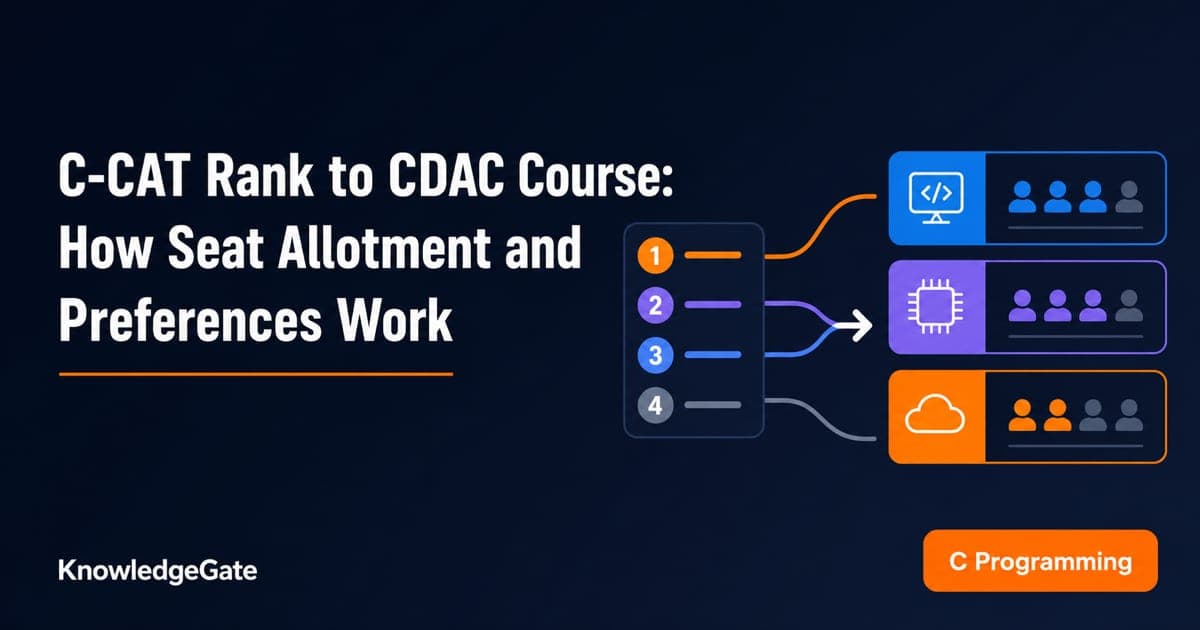
You have written C-CAT, but the important decision is not over. A rank does not automatically "get you a course". It places you in a merit order, which is then matched against the course and centre preferences you submitted.
That distinction matters. Two candidates who want different careers should not copy the same preference list, even if their ranks look similar. The allotment system has no view on your career. It reads only the order you submitted.
From C-CAT score to rank
C-CAT is written in three sections, A, B and C, and different C-DAC diplomas count different combinations of them. That is why there is no single C-CAT rank. A candidate who writes all three sections is ranked separately in each combination that applies, and category-wise merit lists operate inside those. The same score can sit high in one course group and much lower in another, so read your rank as a position in a named merit list rather than as one number about you.
Do not build a counselling plan around a scoring formula remembered from an old video or discussion thread. Check the current scoring, normalisation and merit-list rules in the official C-DAC counselling documents. The rules can change between admission cycles.
Think of the process in two stages:
Your test performance decides where you stand in the relevant merit order.
The counselling system tries to allot the highest available preference for which you are eligible when your turn is considered.
Rank affects when you get access to the remaining seats. Preference order affects which one the system tries first.
How CDAC seat allotment works
During counselling, seats are matched against submitted combinations of programme and training centre. Your list may therefore contain the same diploma at several centres, followed by another diploma at one or more centres.
When your turn comes, the system works down your ordered list. It looks for the first choice that is available and valid for your merit position and category. If an earlier choice is unavailable, it checks the next one. Counselling may run over multiple rounds as candidates accept, decline or move according to that cycle's rules.
This has three practical consequences:
A higher merit position usually gives you an earlier choice from the seats still available.
A preference placed higher is considered before one placed lower.
A choice you never submit cannot be allotted to you, even if a seat later becomes available.
Closing ranks are outcomes, not promises. They depend on the admission cycle, category, programme, centre, seat availability and the preferences submitted by candidates ahead of you. Use previous closing ranks only to create a range of ambitious, realistic and safer choices. Confirm the current figures and round mechanics on the official site instead of memorising a fixed cutoff.
For a useful comparison of how ordering changes an allotment outcome, see SSC CGL Posts Explained: How to Set Your Preference Order. The entities differ, but the decision rule is similar: the system cannot infer a preference you did not express.
The CDAC course ladder
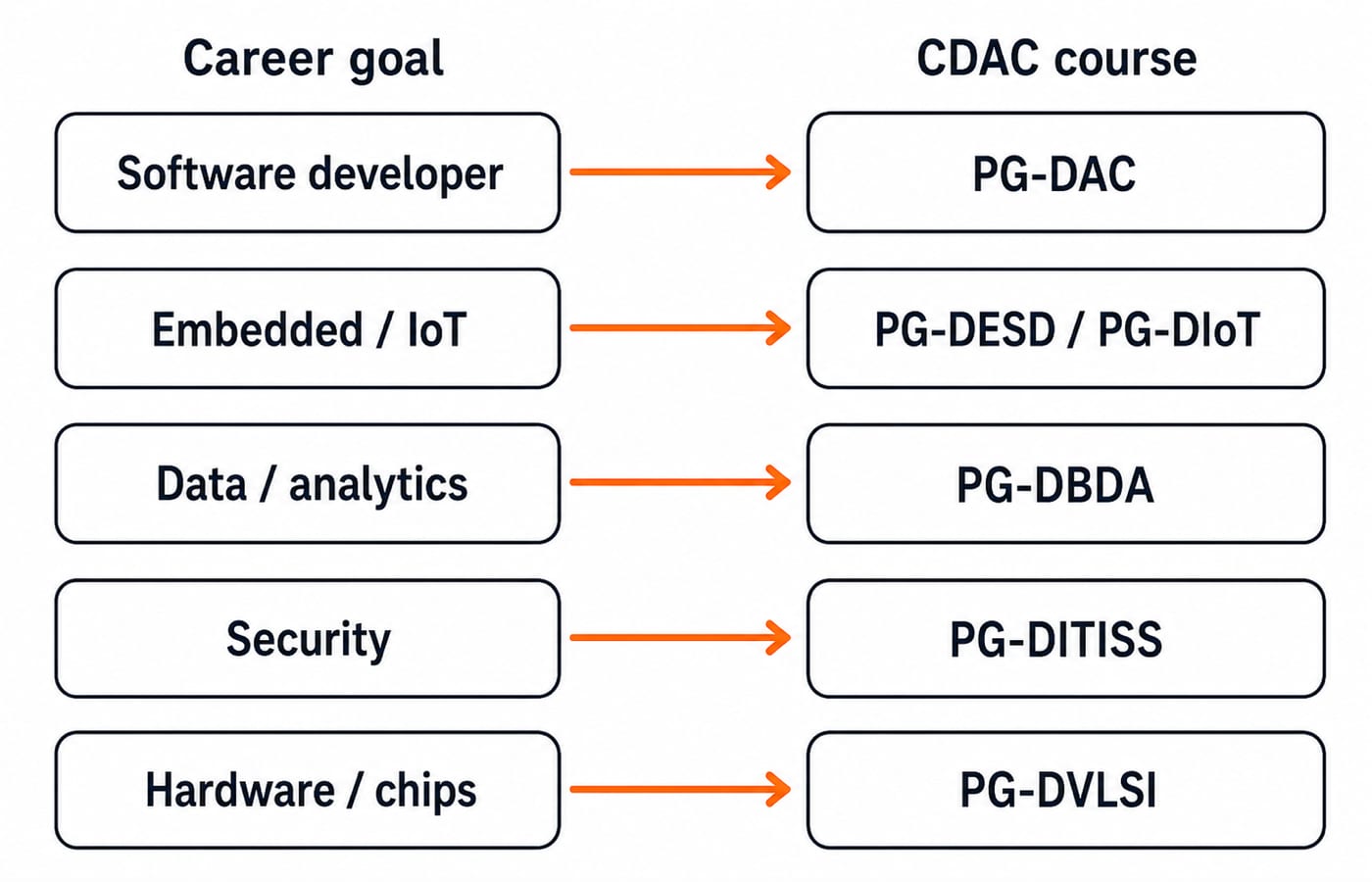
The right diploma is the one that takes you towards the work you want to do. Common choices include:
Diploma | Main direction | Suitable starting interest |
|---|---|---|
PG-DAC | Software development | Programming, application development and software roles |
PG-DESD | Embedded systems | Low-level programming, devices and embedded development |
PG-DITISS | Information security | Systems, networks and security |
PG-DBDA | Big-data analytics | Data processing, analytics and data platforms |
PG-DIoT | Internet of Things | Connected devices, sensors and IoT systems |
PG-DVLSI | VLSI design | Digital hardware and chip design |
PG-DHPCSA | High-performance computing | Systems and compute-intensive work |
Eligibility and the required section combination are fixed per admission cycle, so confirm both for your target diploma before assuming that one rank applies identically to every option on this list.
The destination matters as much as admission. If you are choosing between software, data, security and systems tracks, Technical Interview Prep: OS, DBMS, CN and OOP Answers gives you a practical view of the subjects that appear later in interviews.
Setting your preference order the smart way
Start with career direction, not with somebody else's idea of prestige. Write down the kind of role you want, then identify the diplomas that serve it. After that, compare centres and your realistic admission range.
A simple method is to divide the list into three bands:
Ambitious choices: programmes and centres you strongly want, even if past outcomes suggest they may be difficult.
Realistic choices: combinations that fit your likely range and career goal.
Safer choices: acceptable combinations you would genuinely join if the earlier options are unavailable.
Keep the order truthful. If you would choose PG-DESD at Centre X over PG-DAC at Centre Y, place it higher. Do not put a choice first merely because it is popular. The system follows the order you submit, not the explanation in your head.
Also separate "I prefer another option" from "I would never join this option". Leaving a strong, acceptable preference blank can cost you an allotment in a later round. Adding a choice you would refuse, however, creates a different problem. Fill the list broadly, but only with combinations you can honestly accept.
Before submission, check every line for the correct programme and centre. Then save your final ordering so that you can interpret an allotment without guessing what you entered.
The lever you actually control
Once counselling begins, you cannot control how other candidates order their choices or which seats remain. Your strongest lever comes earlier: improve the written-test performance that establishes your rank, then submit a deliberate preference list.
For that test, the KnowledgeGate question bank carries over 900 C-programming questions, over 1,500 on data structures and thousands more across Operating Systems, DBMS and Computer Networks. These are the CS fundamentals that support C-CAT preparation before counselling begins.
Use CS Fundamentals for Exams & Placements to connect those subjects instead of preparing them as isolated facts. Your goal is not merely to recognise a topic. You should be able to solve under test conditions and diagnose why a wrong option is wrong.
The short version and next step
Your C-CAT rank feeds a preference-based allotment. Choose diplomas by career goal, order course-centre combinations honestly, include every acceptable choice, and verify current closing ranks and counselling rules on cdac.in.
If you are still before the test, work to one route rather than three. CDAC C-CAT Preparation: A 60-Day, Section-wise Study Plan sets that route out day by day, and CDAC C-CAT 2026: Complete Preparation is the version with the teaching, practice and mocks already assembled. Counselling choices matter, but a stronger merit position gives those choices more room to work.
Keep learning

Browsers and Search Engines MCQs: 9 Solved Questions with Explanations
Solve nine published browser and search engine questions, check each answer, and rebuild the browser, cache, crawler and indexing distinctions that exam distractors blur.
Updated 6 Oct 20267 min readTeaching Recruitment (Computer Science)

IT Act, 2000 Explained: Key Sections, Digital Signatures and Worked Exam Examples
Build an exam-ready map of the IT Act, then apply it to an exact digital-signature walkthrough and a section 43, 66, 66C and 66D caselet.
Updated 2 Oct 20266 min readTeaching Recruitment (Computer Science)
Emerging Trends Introduction MCQs: 12 Solved Questions with Explanations
Solve 12 Emerging Trends Introduction questions with clear answer logic, exam-year labels and a compact trap check for focused revision.
Updated 27 Sep 20268 min readTeaching Recruitment (Computer Science)
MS Word Basics MCQs with Answers: 12 Solved Questions Explained
Work through 12 MS Word questions covering everyday commands, page layout, formatting, links, file features and mail merge. Each answer explains the decisive clue and the closest distractor.
Updated 25 Sep 20267 min readTeaching Recruitment (Computer Science)