RRB NTPC Study Plan for Working Aspirants: A Realistic 12-Hour Week
A practical weekly timetable for employed RRB NTPC aspirants, with daily outputs, a 12-week cycle, diagnostic calculations and a no-debt recovery rule.
KnowledgeGate Team
Exam prep & CS education
Updated 2 Aug 20266 min read

A full working day, a commute and family duties can make six-hour daily schedules feel like instructions written for someone else. Twelve hours a week is what an employed aspirant can actually hold: 45 to 75 minutes on weekdays, four hours on Saturday, 2.5 on Sunday. RRB NTPC selection runs through CBT 1, CBT 2, a typing skill or computer-based aptitude test where the post calls for one, and document verification. Both written stages draw on the same three areas: mathematics, general intelligence and reasoning, and general awareness.
RRB NTPC preparation with a job starts with an honest 12-hour ceiling
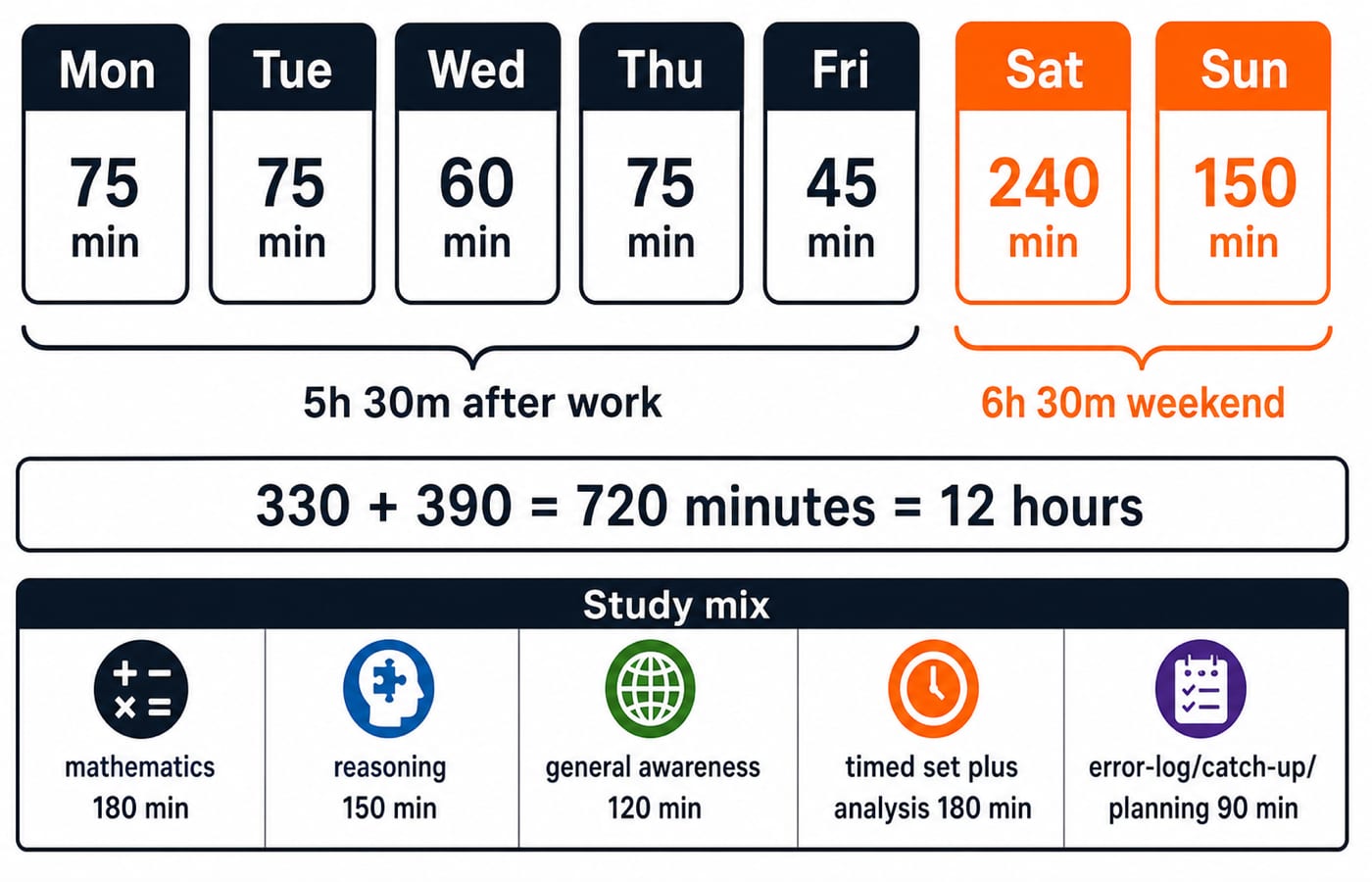
Capacity comes first. Five weekday sessions of 45 to 75 minutes give 5.5 hours, and Saturday's four plus Sunday's 2.5 give 6.5. That is 5.5 + 6.5 = 12 hours, or 720 minutes, and it stays the ceiling. A schedule that only works if you take casual leave is not repeatable.
Three things get protected inside those 720 minutes: weekday contact with all three CBT areas, one weekend timed set with a full analysis pass, and a written error log you actually reread. Everything else is negotiable.
For a second worked version of the same constraint, UGC NET Preparation for Working Professionals applies the weekday-plus-weekend split to a subject paper.
The exact RRB NTPC 12-hour weekly timetable
Day | Minutes | Study output | Running weekly total |
|---|---|---|---|
Monday | 75 | Mathematics: 45 learn + 30 drill | 1h 15m |
Tuesday | 75 | Reasoning: 45 learn + 30 drill | 2h 30m |
Wednesday | 60 | General awareness: 30 notes + 30 closed-book recall | 3h 30m |
Thursday | 75 | Timed drill: 45 mathematics + 30 reasoning | 4h 45m |
Friday | 45 | 25 error re-solves + 20 formula or fact recall | 5h 30m |
Saturday | 240 | 90 mixed set + 90 analysis + 30 general awareness + 30 catch-up | 9h 30m |
Sunday | 150 | 60 mathematics repair + 45 reasoning repair + 30 general-awareness review + 15 planning | 12h |
Allocation: mathematics 180 minutes = 3 hours; reasoning 150 = 2.5 hours; general awareness 120 = 2 hours; mixed set plus analysis 180 = 3 hours; error-log, catch-up and planning 90 = 1.5 hours. Total: 720 minutes = 12 hours. If a week ends with nothing to catch up on, spend Saturday's catch-up slot on the error log.
Turn the weekly plan into a 12-week, 144-hour preparation cycle
Weeks | Purpose | Hours per week | Phase hours |
|---|---|---|---|
1 to 4 | Build concepts and a baseline: 5h concepts + 3h topic drills + 2h general awareness + 1h error work + 1h buffer | 12 | 12 x 4 = 48 |
5 to 8 | Timed practice and repair: 3h concept repair + 4h timed practice + 2h general awareness + 2h analysis + 1h buffer | 12 | 12 x 4 = 48 |
9 to 11 | Mixed sets and revision: 2h revision + 3h section drills + 2h general awareness + 4h mixed-set work and analysis + 1h buffer | 12 | 12 x 3 = 36 |
12 | Consolidate: 2h light revision + 3h section drills + 2h general awareness + 3h mixed set and analysis + 2h error-log work | 12 | 12 x 1 = 12 |
The check is 48 + 48 + 36 + 12 = 144 hours.
Twelve weeks is a planning window you set for yourself, not a countdown tied to a notified date. Let evidence move the boundaries: if the week 8 timed sets still show one weak section, repeat weeks 5 to 8 instead of starting revision on schedule.
Every 45-to-75-minute session must finish with an output
Monday mathematics, say time and work: 5 minutes recalling formulas, 30 learning one method, 25 solving 10 questions, 10 reworking the errors and 5 recording the next action. The output of those 75 minutes is ten marked attempts plus one error-log entry.
On a long workday, cut to 30 minutes: 5 minutes closed-book recall, 15 solving six selected questions, 10 tagging the mistakes as concept, recall, or careless or time-pressure. That short version stands in for the day's session. It does not stand in for sleep.
If designing every session yourself is the part that slips first, the Railway Exam Preparation Courses listing shows what a prebuilt weekly sequence looks like.
A worked diagnostic decides where next week's 12 hours go
Build your own 60-question planning set, 20 from each area, and sit it once a fortnight. One week's result: mathematics 20 attempted, 16 correct and 4 wrong; reasoning 18 attempted, 15 correct and 3 wrong; general awareness 15 attempted, 9 correct and 6 wrong; 7 left unattempted.
Totals: 53 attempted, 40 correct and 13 wrong. Accuracy on attempted questions is 40 / 53 x 100 = 75.5%. By section, mathematics 16 / 20 = 80%, reasoning 15 / 18 = 83.3%, general awareness 9 / 15 = 60%. Score it in accuracy rather than marks, because the marking rules for your cycle live in the notification on rrbapply.gov.in. That 60% decides next week.
The 13 wrong plus 7 unattempted make 20 non-correct outcomes: 5 concept, 7 recall, 3 careless and 5 time-pressure. Check: 5 + 7 + 3 + 5 = 20.
Move 30 minutes from reasoning enrichment and 30 from Saturday catch-up to general-awareness recall. General awareness rises from 120 to 180, reasoning falls from 150 to 120, and catch-up loses 30. Total: 720 minutes, with analysis intact. Change next week, not the whole cycle.
General awareness rewards a fixed core more than broad reading, and computer awareness is the block that repays study first. RRB NTPC Computer Awareness: Hardware, Software, Memory and Storage is a worked pass through it.
Missed workdays need triage, not a weekend punishment
Missing Wednesday and Thursday costs 60 + 75 = 135 minutes. Recover 60 by adding 30 each to Saturday and Sunday. The week closes at 720 - 135 + 60 = 645 minutes, or 10 hours 45 minutes. Drop 75.
Preserve the timed set and analysis, one weak-area repair block, closed-book general-awareness recall, then new content. Use the recovered hour for 30 minutes of recall and 30 on the most frequent mathematics or reasoning error.
Restart on Monday. Do not carry lesson debt or treat sleep, commute safety and work deadlines as study resources.
Use mocks to buy decisions, not just scores
Keep 90 minutes for the timed set and 90 for the review. The review is the half people skip and the half that changes next week. Count what you did not understand, what you did not recall, what you lost carelessly and what you left to the clock.
Spend 35 minutes on the 5 concept errors, 25 on the 7 recall errors, 15 on the 3 careless ones and 15 on the 5 time-pressure cases. Total: 35 + 25 + 15 + 15 = 90. Then set at most three repairs for the week: one concept to relearn, one recall set to rebuild and one pacing decision to test.
SSC CGL Mock Test Strategy runs the same review loop in more detail, including which errors are worth a re-attempt.
The short version: protect 12 useful hours and review them every Sunday
Use a Sunday dashboard with five entries: planned minutes, completed minutes, questions attempted, accuracy on attempted questions and the top repeated error. A real week might read 720 planned, 645 completed, 96 attempted and 72 correct, so 72 / 96 x 100 = 75%. If the same top error appears twice, give it one 30-minute repair block rather than raising the 12-hour ceiling.
Small weekday outputs, one protected set-plus-analysis block, evidence-led reallocation and a clean Monday restart are what make 12 hours a week hold for three months. Post-wise eligibility, vacancies and the exact stage rules for your cycle come from your regional RRB notice and your call letter. If you would rather not build the sequence yourself, the RRB NTPC Complete Preparation Course covers CBT 1 and CBT 2 in that order.
Keep learning

RRB NTPC Posts Explained: Match Duties and Skill Tests to Your Preference Order
Compare the six graduate roles in CEN 06/2025 by typical duties, work setting, medical standard and skill stage. Then build a personal preference order using elimination and a weighted example.
Updated 16 Aug 20266 min read95 viewsRRB NTPC

RRB NTPC Normalisation and Cutoffs: Read Raw Marks, Percentile and RRB Score
Learn what raw marks, percentile, RRB Score and Normalized Marks mean, then use worked examples to compare your score with the correct cutoff row.
Updated 14 Aug 20264 min read64 viewsRRB NTPC
RRB NTPC PYQ Analysis: Separate CBT 1 Screening From CBT 2 Merit
Do not mix CBT 1 and CBT 2 questions in one notebook. Use separate ledgers to measure screening coverage, later-stage accuracy, error types and repair actions.
Updated 12 Aug 20265 min readRRB NTPC

RRB NTPC CBAT Preparation: Build Accuracy Across All Five Tests
Find the weak process hidden by one total practice score. Build a separate CBAT baseline, run precise repair drills, and retest every battery on fresh material.
Updated 10 Aug 20265 min readRRB NTPC