BTSC Lab Assistant Preparation Plan for Working Candidates: 12 Hours a Week
A practical eight-week preparation system that fits around a full-time job, keeps every notified syllabus area visible and turns test errors into the next week's work.
KnowledgeGate Team
Exam prep & CS education
Updated 28 Jul 20265 min read
A BTSC Lab Assistant plan must survive your job. Every block needs a purpose, the weekend cannot become an impossible rescue mission, and one missed shift must not trigger a restart.
Twelve hours a week works only if they land on what a Lab Assistant notice actually asks about: core science, laboratory practice, computers and any other area your discipline lists. Every sequence below is a worked example, so check each label against the current BTSC notice for your discipline first.
Fix the 12-hour week before choosing topics
Short weekday sessions and protected weekend blocks repeat better than five ambitious late nights. The same principle runs through this UGC NET preparation plan for working professionals.
Base week:
Day | Work |
|---|---|
Monday | 75 minutes of computer concepts |
Tuesday | 75 minutes of core science |
Wednesday | 75 minutes of laboratory knowledge or procedure |
Thursday | 75 minutes of computer questions |
Friday | First recovery buffer |
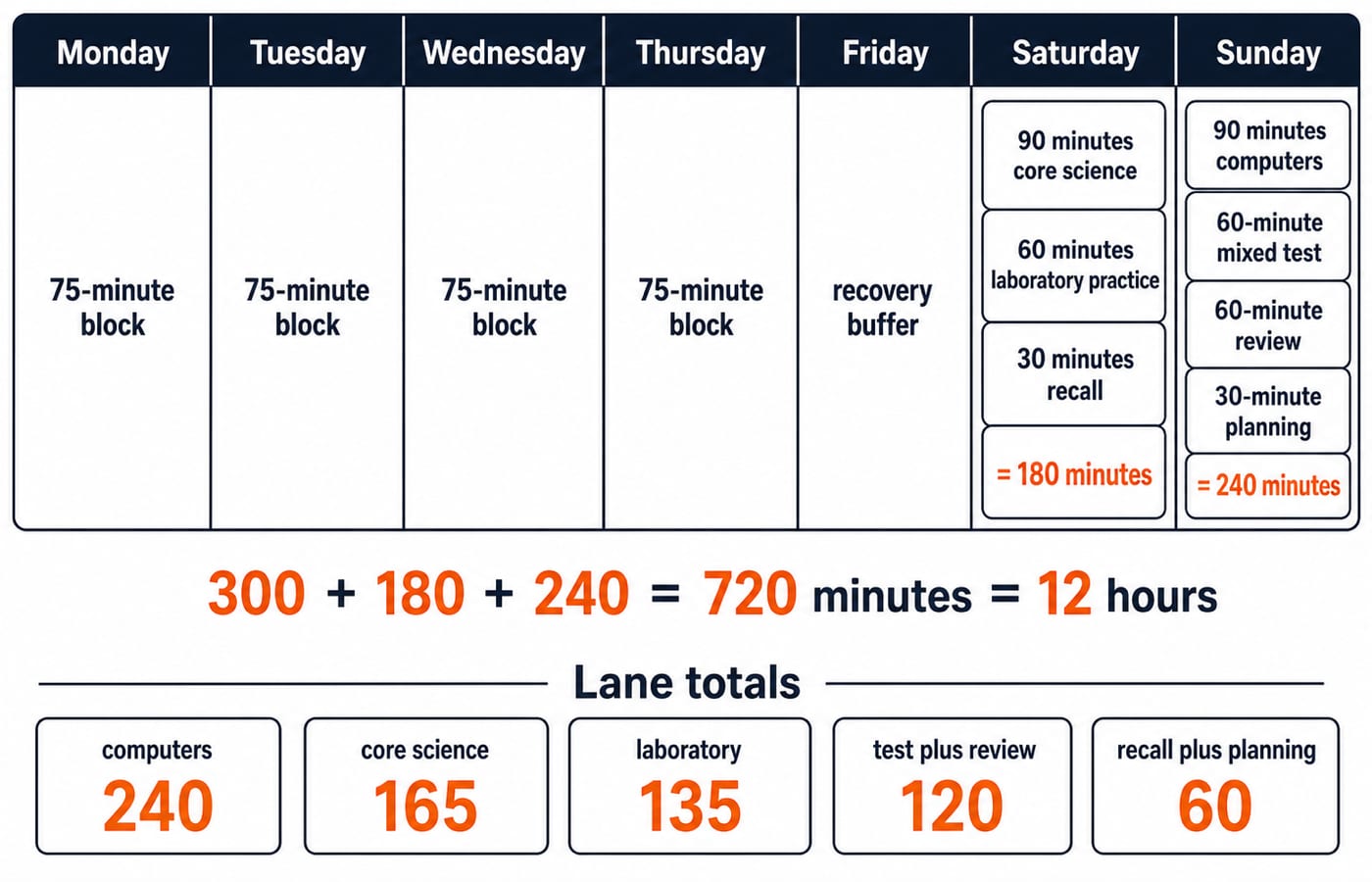
Saturday | 90 minutes core science, 60 minutes laboratory practice, 30 minutes closed-book recall |
Sunday | 90 minutes computers, 60-minute mixed test, 60-minute review, 30-minute next-week planning |
The total is 4 x 75 + 180 + 240 = 720 minutes = 12 hours. Lane totals are computers, 75 + 75 + 90 = 240 minutes; core science, 75 + 90 = 165; laboratory work, 75 + 60 = 135; test plus review, 60 + 60 = 120; and recall plus planning, 30 + 30 = 60. That split reflects how much ground each lane must cover on a first pass, not a BTSC weighting; move minutes between lanes once you have your own notice.
Turn the current syllabus into four visible lanes
Before Week 1, copy every line from the current BTSC notice for your exact Laboratory Assistant discipline into a tracker. Tag it core science, laboratory, computers or other notified area. Do not assume disciplines share the same content.
In an illustrative 20-line tracker, suppose 6 lines are core science, 4 laboratory, 8 computers and 2 other notified areas. Mark 5 strong, 9 partial and 6 unseen. Start with the 6 unseen lines, then the 9 partial lines, while mixed tests keep strong lines active.
Each discipline's notice comes from the Bihar Technical Service Commission at btsc.bihar.gov.in, and that document, not any coaching page, decides what goes into the tracker. Use the Govt Jobs category alongside it to compare the live BTSC complete-course and test-series options.
Weeks 1 to 4: complete one controlled coverage cycle
Swap any label that differs from your notice:
Week 1: computer fundamentals, one physics or measurement unit, laboratory instruments and safety.
Week 2: operating systems or data structures, one chemistry unit, measurement technique.
Week 3: DBMS or networks, one biology or mathematics unit, one experimental procedure.
Week 4: the two weakest unfinished lines, cumulative recall and a catch-up block.
Every 75-minute concept block is 45 minutes learn + 15 minutes closed-book recall + 15 minutes questions. Completion requires a one-page recall sheet and at least 8 checked questions or prompts, not just a lecture.
Computer Science or IT candidates can use the BTSC Lab Assistant complete course for the computer lane. If your discipline is chemistry, biology or physics, it still covers only one of your four lanes, so the science and laboratory lines stay on your tracker.
If 15 of 20 lines have a first pass by Week 4, coverage is 15/20 x 100 = 75%. Carry the remaining 5 into the next cycle.
Weeks 5 to 8: shift hours from coverage to retrieval
Now allocate 3 hours to computer consolidation, 2 to core science, 1.5 to laboratory recall or procedure checks, 2 to sectionals and the mixed test, 2.5 to error repair and retesting, and 1 to buffer or planning. Check: 3 + 2 + 1.5 + 2 + 2.5 + 1 = 12 hours.
Week 5 closes the 5 unfinished lines. Week 6 runs two weak-lane sectionals. Week 7 repeats the two largest error buckets. Week 8 runs a cumulative mixed test and audits every line. With more time, repeat Weeks 5 to 8 using harder questions. With less, protect the mixed test and error repair, cutting low-priority new content before review.
The SSC CGL last 60 days plan carries an error-sheet and missed-day method you can lift straight into this schedule. Take the method from it and leave its subject lists and exam rules behind.
Make one mixed test produce next week's plan
Build the weekly test yourself from tracker lines you have already studied. Its job is to set next week's priorities, not to imitate the shape of a real BTSC paper.
Of 40 questions, attempt 32: 24 correct, 8 wrong and 8 unattempted. Attempted accuracy is 24/32 x 100 = 75%; coverage is 32/40 x 100 = 80%. Read those two percentages rather than a total score: marks per question and any negative-marking rule come from the current notice, and inventing one trains you to attempt at the wrong rate.
Classify the 16 non-correct responses as 3 concept gaps, 2 recall failures, 2 rushed reads, 1 poor time choice and 8 unattempted. Allocate 90 minutes to concept repair, 60 to unfamiliar blank topics, 45 to timed reading and attempt-control drills, and 45 to retesting the original 16. The check is 90 + 60 + 45 + 45 = 240 minutes. Remove a response from the error sheet only after a closed-book retest.
CS or IT candidates can use the BTSC Lab Assistant CS test series for unit and full-length practice.
Recover missed work without restarting the plan
Use a three-level recovery rule:
If one 75-minute weekday block is missed, recover 45 minutes Friday and 30 after Sunday's review. The week reaches
720 - 75 + 45 + 30 = 720 minutes. Keep the planning block.If Saturday's 180 minutes is lost, recover only 75 minutes on Friday and 45 on Sunday. Complete
720 - 180 + 120 = 660 minutes = 11 hours, deferring the lowest-priority 60 minutes to Week 4 or Week 8 catch-up.If an emergency removes Tuesday's 75-minute science block and Thursday's 75-minute computer-question block,
720 - 75 - 75 = 570 minutesremain. Restore 75 on Friday and add a 30-minute Sunday priority retest:570 + 75 + 30 = 675 minutes = 11 hours 15 minutes. Move the remaining 45 minutes to the next catch-up week. Protect the mixed test and review.
Below 6 completed hours, repeat the phase's two highest-priority lines next week. Never restart, catch up overnight, or double two full days into one.
The short version and tonight's next step
Protect 12 hours, keep all four syllabus lanes visible, use Weeks 1 to 4 for controlled first-pass coverage, and use Weeks 5 to 8 for retrieval and repair. Let one mixed test rewrite next week's priorities. Missed-day recovery is part of the system, not evidence that the plan failed.
Tonight, create the four-lane tracker. Classify the illustrative 20 lines, or your actual notified lines, as strong, partial or unseen. Then calendar four 75-minute weekday blocks, Saturday's 180 minutes and Sunday's 240 minutes.
Keep learning
BTSC Lab Assistant Physics Lab: Instruments, Readings and Error Calculations
Learn a fixed method for selecting lab instruments, reading their scales, correcting zero error and reporting calculated results with sensible uncertainty.
Updated 16 Aug 20266 min readBTSC Lab Assistant

BTSC Lab Assistant Biology Lab: Microscopy and Specimen Handling Guide
Build an exam-ready microscopy workflow through a labelled onion wet mount, a checked cell-size estimate, safe specimen handling, and six common errors.
Updated 14 Aug 20265 min readBTSC Lab Assistant
BTSC Lab Assistant Job Profile: Records, Equipment Care and Daily Lab Workflow
Build a realistic CS/IT Laboratory Assistant role model around readiness checks, auditable registers, safe fault handling and evidence-based handover.
Updated 12 Aug 20265 min readBTSC Lab Assistant
BTSC Lab Assistant PYQ Analysis: Sort Common and Trade Topics
Turn a mixed PYQ score into a useful repair plan. This method separates common and trade topics, codes each miss and assigns revision time from your own errors.
Updated 10 Aug 20266 min readBTSC Lab Assistant