ISRO CS Preparation for Working Graduates: 12-Hour Weekly Plan
A practical 720-minute home-study plan for working CS graduates, built around repair blocks, short sets, verbal recall and Sunday review.
KnowledgeGate Team
Exam prep & CS education
Updated 26 Jul 20266 min read124 views
A broad CS syllabus is not your only problem after graduation. The harder problem is protecting useful study time after a full workday, and proving afterwards that a weak topic was actually repaired. ISRO Scientist/Engineer 'SC' (Computer Science) expects depth across data structures, operating systems, DBMS, networks, software engineering, discrete mathematics, digital logic and computer organisation, and it tests that depth in a single time-bound written paper. Twelve hours a week cannot buy breadth across all of that, so every one of the 720 minutes below goes to the two subjects your own last diagnostic proved weakest. The rest of our ISRO material sits in the ISRO preparation category.
1. Fix the 12-hour budget before choosing subjects
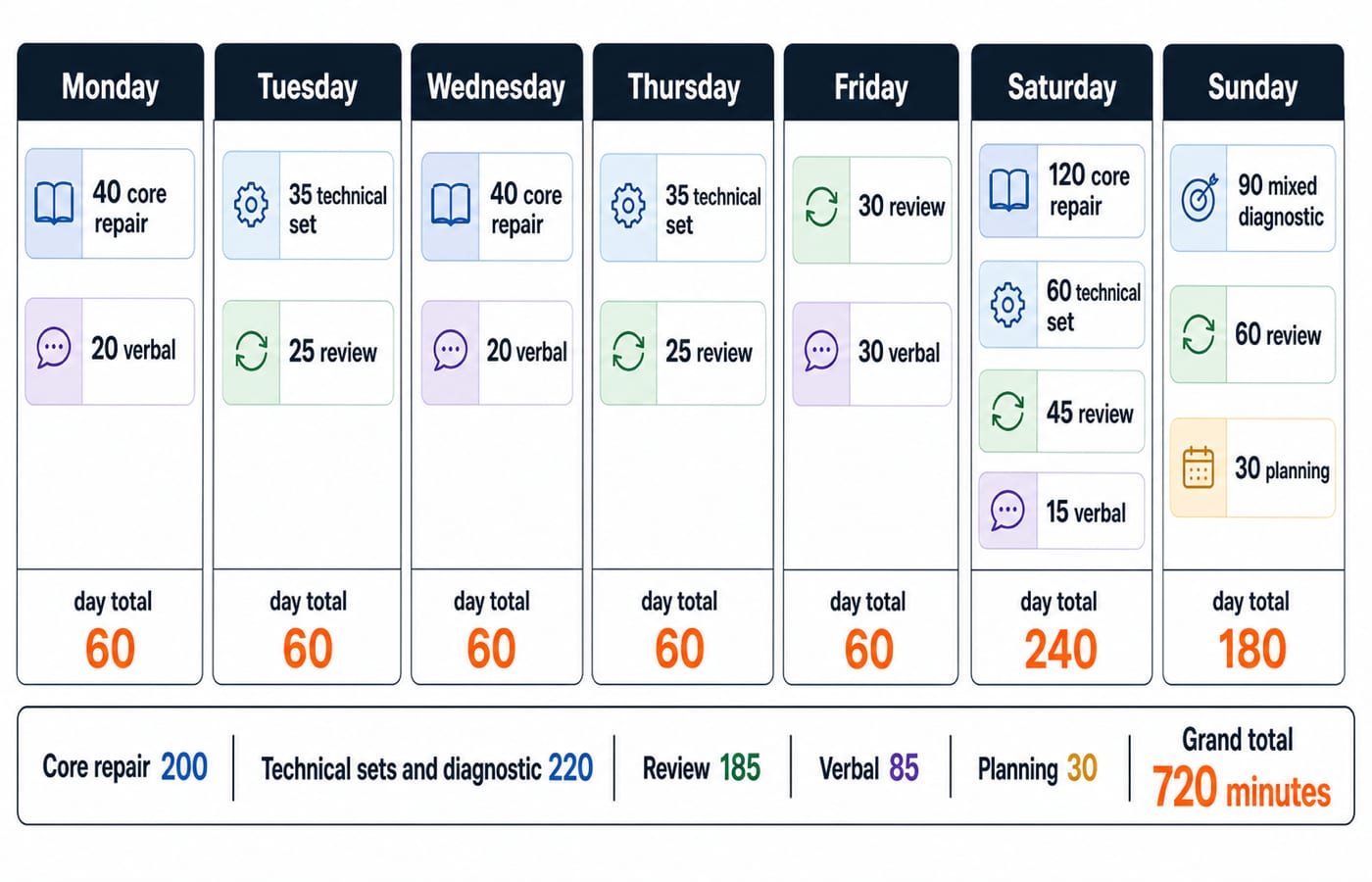
Protect seven blocks before deciding what to study: Monday to Friday get 60 minutes each, Saturday gets 240 minutes, and Sunday gets 180 minutes. The full calculation is (5 x 60) + 240 + 180 = 300 + 420 = 720 minutes = 12 hours. Weekdays therefore carry 5 hours and the weekend carries 7 hours.
Now assign every minute a job: 200 minutes for core repair, 220 for technical sets and the Sunday diagnostic, 185 for review and error logging, 85 for verbal explanation, and 30 for next-week planning. Recheck it: 200 + 220 + 185 + 85 + 30 = 720. A commute, lunch break or early morning can host a block, provided its purpose stays visible.
2. Use one baseline to decide what needs repair
Sit a 60-question, 90-minute diagnostic at home before you open a single subject. Use five equal lanes of 12 questions across the core ISRO CS subjects: Operating Systems, DBMS, Computer Networks, DSA, and computer organisation with digital logic. Suppose the correct counts are OS 7/12, DBMS 9/12, CN 6/12, DSA 8/12 and COA 9/12.
Total correct is 7 + 9 + 6 + 8 + 9 = 39, so overall accuracy is 39 / 60 x 100 = 65%. By lane, OS is 7 / 12 = 58.3%, DBMS is 9 / 12 = 75%, CN is 6 / 12 = 50%, DSA is 8 / 12 = 66.7%, and COA is 9 / 12 = 75%. Repair CN first and OS second. Keep the two 75% lanes in mixed practice. If you are arriving from GATE preparation with notes already made, ISRO CS Syllabus vs GATE CS: Overlap, Gaps, and Revision Plan shows which of those notes transfer and which gaps you still have to close.
3. Make each weekday block small enough to start after work
Fix week one before it starts. On Monday, repair CN subnetting for 40 minutes, then explain the method aloud for 20. On Tuesday, attempt an eight-question CN set for 35 minutes and review it for 25. On Wednesday, repair OS page replacement for 40 minutes and explain a trace for 20. On Thursday, attempt an eight-question OS set for 35 minutes and review it for 25. On Friday, consolidate both error logs for 30 minutes and explain the two hardest corrections for 30.
Stop at minute 60. If a solution is unfinished, log the exact next step instead of turning the block into a late night. Every session must leave one visible output: a corrected note, a scored set or a recorded explanation. A watched lesson without a recall check is not a finished block.
4. Use the weekend for depth, a full diagnostic and next-week planning
Saturday provides 240 counted minutes: 60 for CN repair, 60 for OS repair, 60 for a mixed technical set, 45 for solution review and 15 for one verbal explanation. The sum is 60 + 60 + 60 + 45 + 15 = 240. Take a 10-minute break after each hour, outside the counted study time. Four focused hours need not mean four uninterrupted hours.
Sunday provides 180 minutes: a 90-minute mixed diagnostic, 60 minutes reviewing every wrong or guessed answer, and 30 minutes choosing the next week's two repair lanes. The weekend load is 240 + 180 = 420 minutes = 7 hours. The UGC NET preparation plan for working professionals has more tactics for defending a fixed weekly slot against a job, which is the part most working aspirants lose first.
5. Close the loop on a short technical set
Take host address 192.168.10.130/26 from Tuesday's CN set. A /26 prefix leaves 32 - 26 = 6 host bits, so each block contains 2^6 = 64 addresses. The last-octet blocks are 0-63, 64-127, 128-191 and 192-255. Since 130 lies inside 128-191, the network address is 192.168.10.128 and the broadcast address is 192.168.10.191. The usable range is 192.168.10.129 through 192.168.10.190, giving 64 - 2 = 62 usable hosts.
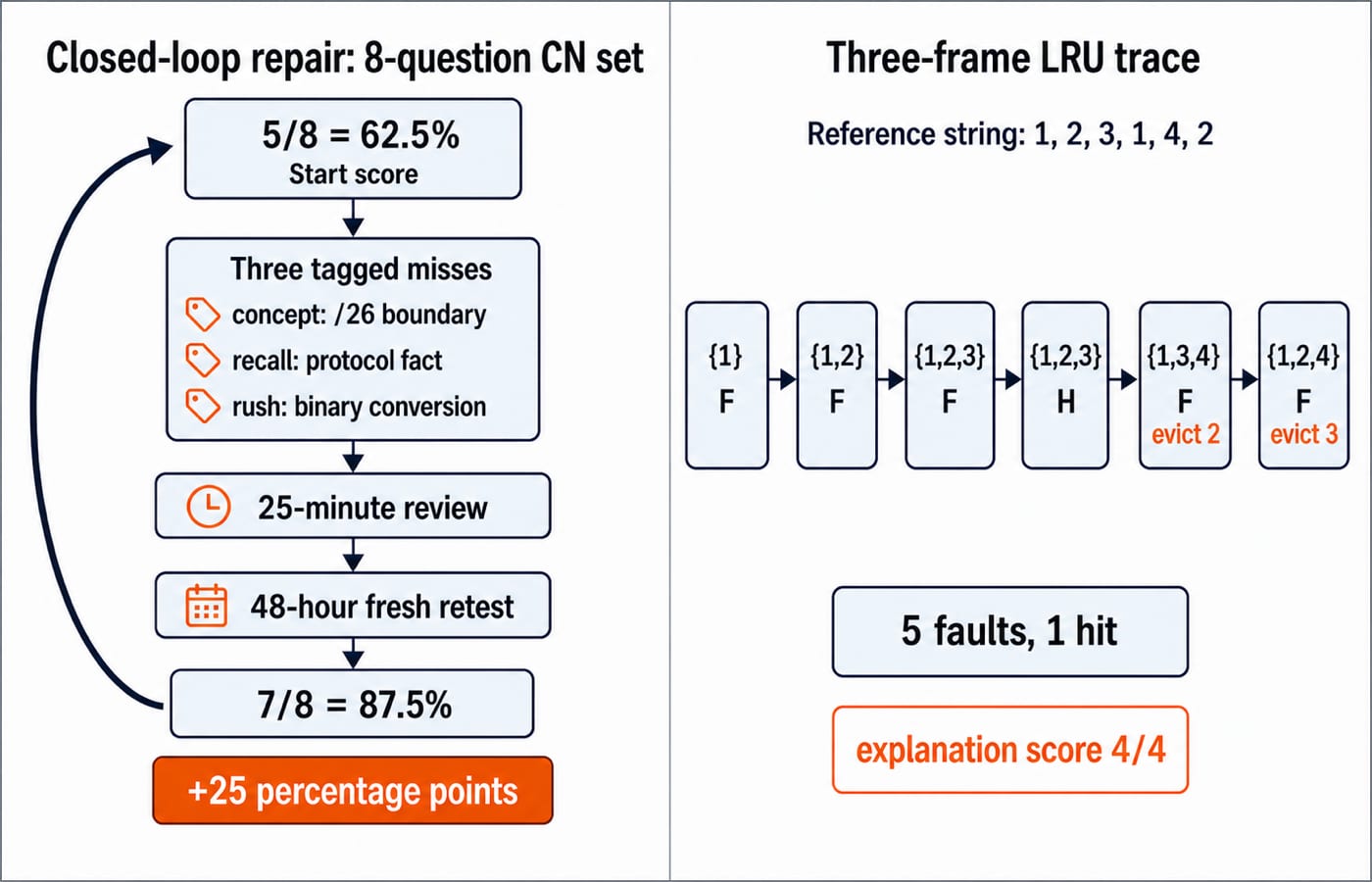
Score the whole set too. A first pass of 5/8 is 62.5%. Tag the three misses as concept for the /26 boundary, recall for a protocol fact, and rush for a binary conversion. After 25 minutes of review, take a fresh eight-question set 48 hours later. A score of 7/8 = 87.5% is an improvement of 87.5 - 62.5 = 25 percentage points. Reading a solution is only the middle of repair. The loop closes when you solve a fresh value without notes.
6. Use verbal explanation as a strict understanding test
Use this 90-second prompt: "With three frames, trace LRU for the reference string 1, 2, 3, 1, 4, 2 and explain every replacement." Reference 1 faults and gives {1}. Then 2 faults to give {1,2}, and 3 faults to give {1,2,3}. The next 1 is a hit and becomes most recently used. Reference 4 faults, evicts 2, and gives {1,3,4}. The final 2 faults, evicts 3, and gives {1,2,4}. The result is 5 faults and 1 hit.
Score the explanation out of four: one point for naming the LRU rule, one for updating recency after the hit on 1, one for choosing the correct victim when 4 arrives, and one for reaching five faults. Anything below 4/4 returns to the next repair block. Plain spoken reasoning exposes a missing transition that silent rereading can hide.
7. Let the error log choose next week, not guilt
Keep five columns: subject, exact prompt, error type, corrected rule and fresh-test result. Then let one threshold pick next week's lanes for you. Below 60% earns two repair blocks, 60% through 79.9% earns one, and 80% or above stays in mixed sets. The baseline therefore gives priority to CN at 50% and OS at 58.3%. DSA at 66.7% qualifies for one block under the same rule, but it waits: a third repair lane would push the week past 720 minutes.
Build each eight-question set from ISRO CS previous-year questions on the repair topic first, then top it up with ordinary topic practice. A set you can actually mark in 25 minutes is worth more than a hundred questions you never review. Before you commit to a subject order, check the official ISRO current opportunities page and the dated notice that applies to you. Confirm eligibility while you are at it: ISRO CS Eligibility: Degree Branches, Equivalence and Marks Checks walks the branch and equivalence rules before you spend a term of evenings on this.
8. Short version and the next 60 minutes
Protect 720 minutes, let the baseline choose two weak lanes, alternate repair with short sets, explain one corrected concept aloud, and let Sunday review assign the next week. Schedule the first five 60-minute blocks before opening any resource. If you would rather not assemble the sequence yourself, the ISRO Scientist/Engineer 'SC' (Computer Science) course already carries the subject coverage, previous-year discussion, full-length mocks and interview guidance in order. If all you were missing was the discipline, the timetable above is enough on its own. Start by protecting the first hour.
Keep learning

ISRO Scientist CS Cutoff Trends: How to Set Your Target Score
A remembered cutoff is useful only when you know its score scale and recruitment stage. Compare two historical CS notices, calculate an illustrative buffer and use weaker mocks to plan your next repair week.
30 Sep 20264 min readISRO Recruitment
ISRO CS Theory of Computation and Compiler Design PYQs: 7 Solved Questions
Seven exact ISRO Theory of Computation and Compiler Design previous-year questions, with options, correct answers and clear explanations.
21 Sep 20266 min read136 viewsISRO Recruitment
ISRO CS Computer Organization and Architecture PYQs: 7 Solved Questions
Seven exact ISRO Computer Organization and Architecture previous-year questions, with options, correct answers and clear explanations covering cache, memory, control units, interrupts and addressing modes.
21 Sep 20266 min read68 viewsISRO Recruitment
ISRO CS Data Structures and Algorithms PYQs: 6 Solved Questions
Six exact ISRO Data Structures and Algorithms previous-year questions, with options, correct answers and explanations covering arrays, trees, searching, BFS and sorting.
21 Sep 20265 min read166 viewsISRO Recruitment