RRB NTPC Eligibility and Exam Pattern: Levels, Posts and the Selection Stages Explained
Work out whether you belong in the undergraduate or graduate post band, then trace the CBT, post-specific test, document and medical stages that follow.
KnowledgeGate Team
Exam prep & CS education
Updated 22 Jul 20265 min read103 views
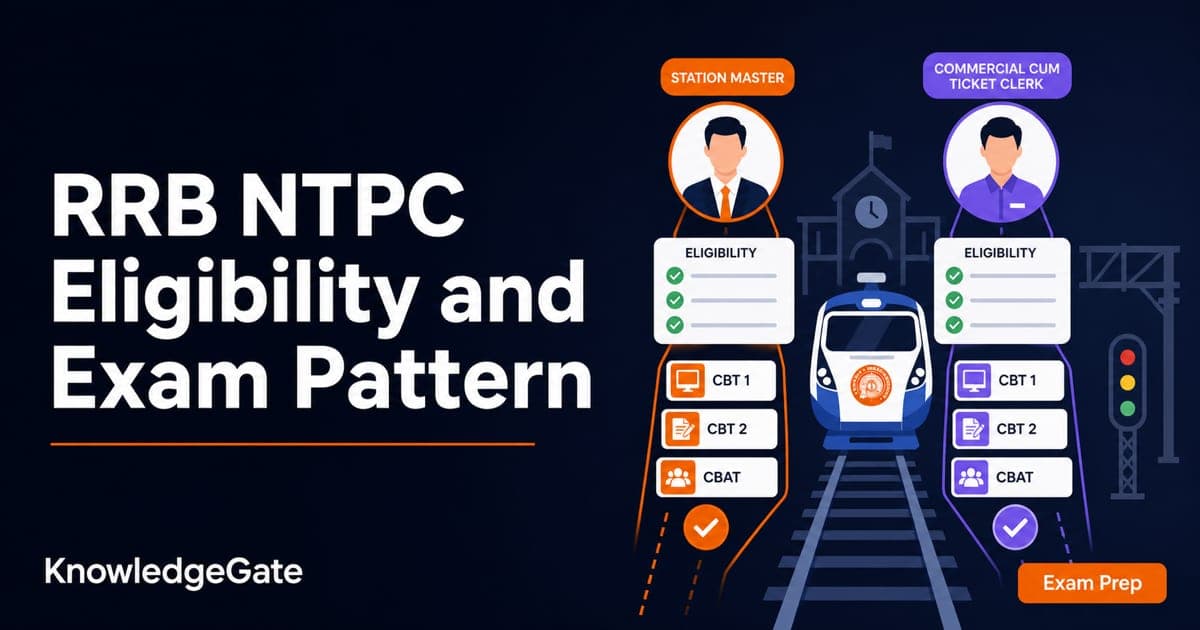
RRB NTPC is not one exam for one job. It is a common recruitment route for several railway posts across two education levels, and your qualification decides which set you can choose. Once you know that band, the exam stages and post-specific tests become much easier to read.
Related reading: NTPC post and skill-test map and NTPC normalisation and cutoffs.
Why NTPC is a family of posts, not a single job
NTPC stands for Non-Technical Popular Categories. The recruitment brings together clerical, accounts, commercial, traffic and station-side roles that do not belong to the technical recruitment stream.
The first useful split is educational:
Undergraduate-level posts need a 12th pass or the equivalent stated in the notification.
Graduate-level posts need a bachelor's degree, or the qualification stated for that role.
Identify your band before you think about exam strategy, then compare the roles inside it. The live post list, pay levels and qualification wording are reset every cycle, so open the official RRB application portal and read that cycle's Centralised Employment Notice, or CEN, before you submit preferences.
The two post levels and representative roles
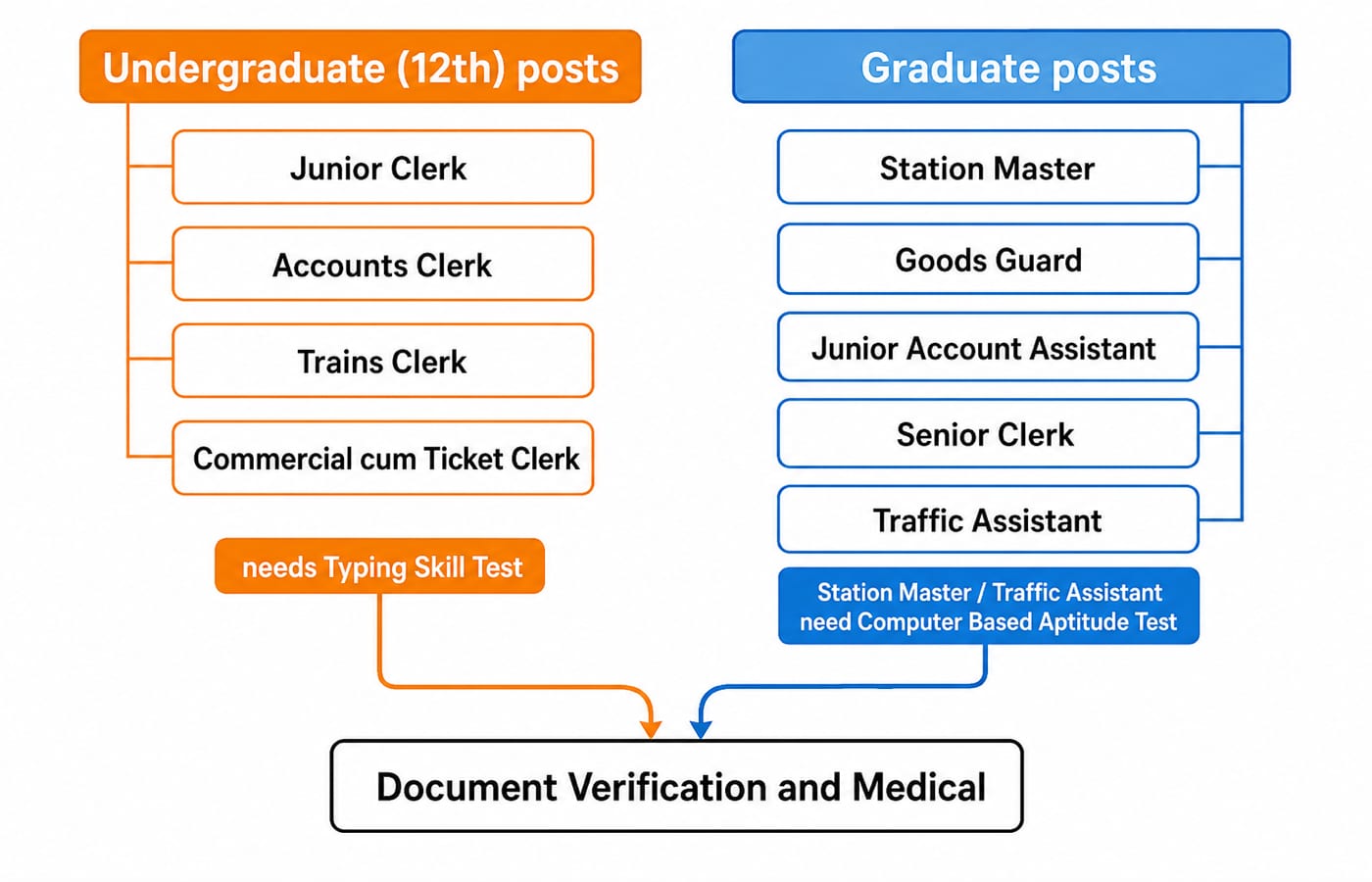
The undergraduate band commonly includes roles such as Junior Clerk cum Typist, Accounts Clerk cum Typist, Trains Clerk, and Commercial cum Ticket Clerk.
The graduate band commonly includes Station Master, Goods Guard or Train Manager, Junior Account Assistant cum Typist, Senior Clerk cum Typist, and Traffic Assistant.
Which of these posts appear, how many vacancies each carries and which Railway Recruitment Boards you can choose are reset every cycle. The band structure and the extra test attached to each kind of role have been far more stable, which is why those are worth learning once.
Educational qualification
For an undergraduate-level post, the baseline is a pass in 12th standard or an equivalent qualification recognised by the notice. A typing requirement does not move a post into a different education band; it is a post-specific proficiency check at a later stage.
For a graduate-level post, the baseline is a bachelor's degree in any discipline. The trap is timing, not subject. The notice fixes a date by which the qualification must already be complete, so awaiting a result or expecting your degree just after that date is a rejection at Document Verification, however well the CBTs went.
A graduate can often list undergraduate-band posts as well, which widens the choice without making it free. Every post you list carries its own skill test, medical category and preference consequence, and an allotment you did not want is still an allotment.
Age limit and relaxations
Age in RRB NTPC is measured on a reference date fixed by the notice, not on the day you apply. Two things follow. The upper limit is not a single number across the recruitment, because the undergraduate and graduate bands are advertised with their own windows, so a post open to you in one band can be closed in the other. And because the reference date moves with the cycle, an aspirant inside the window last time can be outside it now.
Relaxation on the upper limit is available to SC, ST, OBC, PwBD and ex-servicemen candidates, claimed against a certificate in the prescribed format and read on that same reference date. A certificate that has expired or was issued in the wrong format loses the relaxation outright rather than delaying it, and an age window remembered from an older recruitment is not evidence about this one. Citizenship and nationality conditions are checked at the same stage.
So an eligibility check that holds has four lines: your post band, the date your qualification was completed, your date of birth against the stated reference date, and the category certificate you intend to claim against. Three out of four is a rejected application.
The exam pattern and its post-dependent branch
The broad selection path is shared, but one branch depends on the post:
CBT 1 is the common computer-based screening stage. It tests Mathematics, General Intelligence and Reasoning, and General Awareness.
CBT 2 tests the same three subject areas at the level specified for the post band and plays the central role in merit.
The post-specific stage is either a Typing Skill Test or a Computer Based Aptitude Test, depending on the post.
Document Verification and Medical Examination confirm certificates and fitness for the allotted post.
That third branch is the one to check before you rank preferences:
Post you applied for | Stage that attaches after the CBTs |
|---|---|
Junior Clerk cum Typist, Accounts Clerk cum Typist, Senior Clerk cum Typist, Junior Account Assistant cum Typist | Typing Skill Test |
Station Master, Traffic Assistant | Computer Based Aptitude Test |
Trains Clerk, Commercial cum Ticket Clerk, Goods Guard or Train Manager | Neither; the CBTs lead straight to Document Verification |
The two CBTs are not the same job twice. CBT 1 rewards a fast, clean first pass across broad coverage; CBT 2 rewards holding accuracy through denser, multi-step work, so the shift between RRB NTPC CBT 1 and CBT 2 is worth planning before the CBT 1 result arrives.
The official notice is the authority for question counts, durations, negative marking, normalisation and the exact role of every stage. Learn the route first, then attach this cycle's numbers to it.
What determines final selection
CBT 1 primarily acts as a screening gate. CBT 2 is the main merit stage, with scores normalised where the official process requires it. A skill or aptitude test can be qualifying or can contribute in the manner specified for the post.
Document Verification is not a formality if a qualification, category or name record does not match, and medical fitness matters just as much. Safety-related roles carry stricter vision and fitness standards, so a high preference and a competitive score do not override the post's medical category.
Tie-breaking and allotment follow rules stated in advance, so two candidates on the same score are not separated arbitrarily. Final selection is a chain: an eligible post choice, competitive CBT 2 performance, the post-specific test where one applies, matching documents, and the medical category your post demands. A break anywhere ends the attempt.
Choosing your posts and the next step
Start with eligibility, not vacancy excitement. Mark your education band, remove any role whose medical or skill requirement does not suit you, and then rank the remaining posts by work profile, pay level and location implications.
Once the band is fixed, what to study and in what order is the next question, and the RRB NTPC syllabus study map sets that out subject by subject. The same eligibility-before-preference discipline drives an SSC CGL post preference order on a very different post list.
Once your target posts are clear, use the RRB NTPC Complete Preparation Course to prepare stage by stage. Keep the Railways exam category beside it for related guidance, and return to the current CEN before making the final application choices.
Keep learning
Browsers and Search Engines MCQs: 9 Solved Questions with Explanations
Solve nine published browser and search engine questions, check each answer, and rebuild the browser, cache, crawler and indexing distinctions that exam distractors blur.
Updated 6 Oct 20267 min readTeaching Recruitment (Computer Science)
IT Act, 2000 Explained: Key Sections, Digital Signatures and Worked Exam Examples
Build an exam-ready map of the IT Act, then apply it to an exact digital-signature walkthrough and a section 43, 66, 66C and 66D caselet.
Updated 2 Oct 20266 min readTeaching Recruitment (Computer Science)
Emerging Trends Introduction MCQs: 12 Solved Questions with Explanations
Solve 12 Emerging Trends Introduction questions with clear answer logic, exam-year labels and a compact trap check for focused revision.
Updated 27 Sep 20268 min readTeaching Recruitment (Computer Science)
MS Word Basics MCQs with Answers: 12 Solved Questions Explained
Work through 12 MS Word questions covering everyday commands, page layout, formatting, links, file features and mail merge. Each answer explains the decisive clue and the closest distractor.
Updated 25 Sep 20267 min readTeaching Recruitment (Computer Science)