RISC vs CISC Architecture MCQs: 11 Solved Questions Explained
Attempt 11 RISC versus CISC PYQs, then use the explanations and revision table to separate textbook architecture signals from tempting reversals.
KnowledgeGate Team
Exam prep & CS education
13 Sep 20267 min read
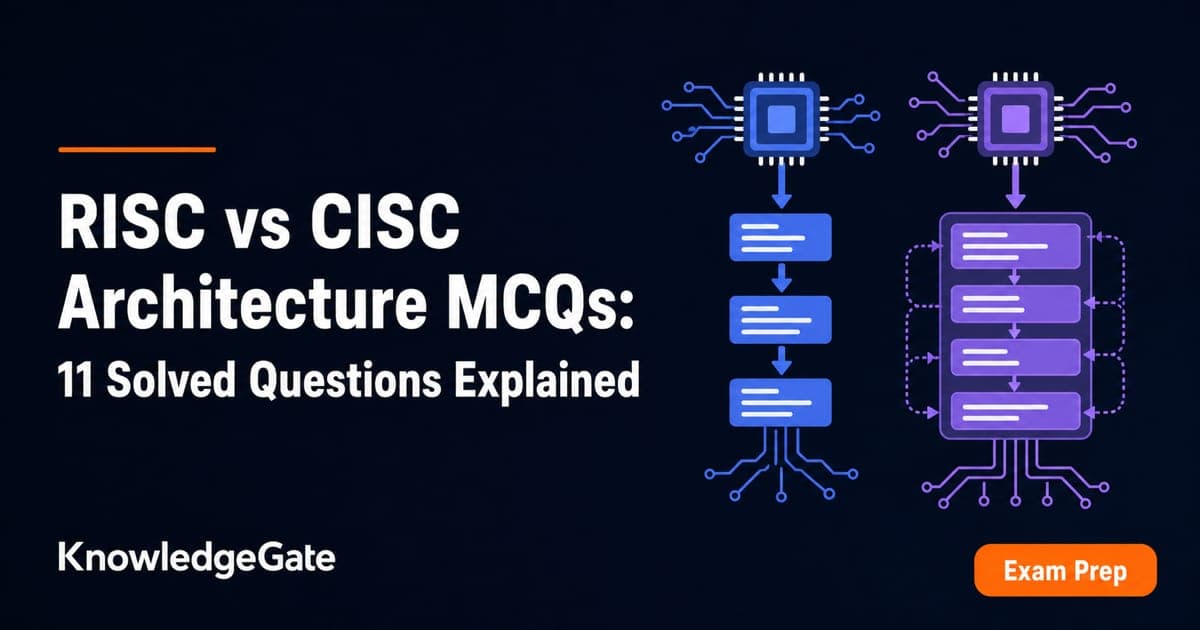
RISC-versus-CISC questions rarely stop at expanding the acronyms. They combine fixed versus variable instruction length, load-store versus memory-operand execution, hardwired versus microprogrammed control, addressing modes, compiler work and pipelining. Treat each option as a bundle of claims: eliminate any choice that reverses one of those paired signals, then explain why the remaining distractors fail.
1. RISC architecture MCQs on the core design features
Q1. GATE 2018.
Consider the following processor design characteristics.
I. Register-to-register arithmetic operations only
II. Fixed-length instruction format
III. Hardwired control unit
Which of the characteristics above are used in the design of a RISC processor?
(a) I and II only
(b) II and III only
(c) I and III only
(d) I, II and III
Answer: (d) I, II and III. The classic RISC model keeps arithmetic between registers, uses regular fixed-length formats and favours hardwired control. Together, these choices simplify decoding and support efficient pipelining, though a modern implementation need not match every textbook feature perfectly.
Q2. UGC NET December 2019.
The Reduced Instruction Set Computer (RISC) characteristics are:
(a) Single cycle instruction execution
(b) Variable length instruction formats
(c) Instructions that manipulates operands in memory
(d) Efficient instruction pipeline
Choose the correct characteristics from the options given below:
(a) (a) and (b)
(b) (b) and (c)
(c) (a) and (d)
(d) (c) and (d)
Answer: (c) (a) and (d). Regular, simple instructions are designed for fast execution and pipeline-friendly flow in the textbook RISC model. Variable-length formats and instructions that directly manipulate operands in memory are CISC-side cues here.
Q3. UGC NET Paper 2 (December) 2025.
Which of the following are characteristics of RISC architecture:
A. Large instruction set with many addressing modes.
B. Fixed instruction length.
C. Emphasis on software rather than hardware.
D. Simple instruction that execute in one cycle.
Choose the correct answer from the options given below:
(a) A, B Only
(b) B, C, D Only
(c) A, C, D only
(d) A, B, C, D
Answer: (b) B, C, D Only. Fixed length and simple execution fit RISC, while the compiler or other software carries more responsibility for arranging simple instructions. A is rejected because a large instruction set with many addressing modes is the CISC cue.
2. RISC vs CISC MCQs on load-store design, instruction sets and addressing modes
Q4. UGC NET 2021.
Given below are two statements
Statement I: CISC computers have a large of number of addressing modes.
Statement II: In RISC machines memory access is limited to load and store instructions.
In light of the above statements, choose the correct answer from the options given below
(a) Both Statement I and Statement II are true
(b) Both Statement I and Statement II are false
(c) Statement I is true but Statement II is false
(d) Statement I is false but Statement II is true
Answer: (a) Both Statement I and Statement II are true. Statement I reflects the broader addressing-mode set associated with CISC. Statement II describes a load-store RISC ISA, where explicit load and store instructions carry memory traffic. Review the first half alongside addressing modes and instruction formats.
Q5. ISRO 2009.
Compared to CISC processors,RISC processors contain:
(a) More register and smaller instruction set
(b) larger instruction set
(c) less registers and smaller instruction set
(d) more transistor elements
Answer: (a) More register and smaller instruction set. The intended comparison is a larger general-purpose register file and a smaller, simpler instruction set. Transistor count is an implementation detail, not a defining ISA distinction.
Q6. Beltron Programmer Shift-2 2025.
Which characteristic distinguishes RISC from CISC instruction sets?
(a) RISC supports fewer registers; CISC has larger register files.
(b) RISC uses variable-length instructions; CISC uses fixed-length.
(c) RISC has fewer, simpler instructions; CISC has complex, multi-cycle instructions.
(d) RISC relies on microcode; CISC uses hardwired control.
Answer: (c) RISC has fewer, simpler instructions; CISC has complex, multi-cycle instructions. Each distractor reverses the textbook comparison: RISC commonly has more registers, uses regular fixed-length formats and favours hardwired control. These are ISA-level study cues, not a claim that every modern processor is purely RISC or CISC.
3. RISC architecture MCQs on decoding, control and pipelining
Q7. MPPSC 2025.
What is the purpose of RISC (Reduced Instruction Set Computer)?
(a) To Fetch the instruction from memory
(b) To establish regularity of execution and ease of decoding
(c) To store the results in memory
(d) To execute the instructions
Answer: (b) To establish regularity of execution and ease of decoding. Fetching, executing and storing are generic processor activities, so they do not distinguish RISC. The tested design purpose is regular instruction behaviour and simpler decoding, which also makes pipeline staging more predictable. For the broader ISA sequence of fetch, decode and execute, format arithmetic, addressing modes and flags, use Instruction Set Architecture MCQs; this set stays on RISC-versus-CISC design signals.
Q8. TPSC Programmer 2026.
Which of the following is NOT a characteristic of RISC architecture ?
(a) Simple instruction set
(b) Hardwired control unit
(c) Complex addressing modes
(d) Load-store architecture
Answer: (c) Complex addressing modes. Simple instructions, hardwired control and load-store organisation form the expected RISC cluster. Complex addressing modes belong on the CISC side of this comparison.
Q9. DSSSB TGT 2024.
Which of the following is characteristic of a RISC (Reduced Instruction Set Computer) processor?
(a) Microprogrammed control
(b) Instruction that manipulate operands in memory
(c) Fixed-length, easily decoded instruction format
(d) A large number (typically from 100 to 250) of instructions
Answer: (c) Fixed-length, easily decoded instruction format. That pairing is the tested RISC signal. The other choices point to the textbook CISC side: microprogrammed control, memory-operand instructions and a large instruction repertoire. Regular decoding also helps explain pipelining in computer architecture, but it does not prove that one ISA always outperforms another.
4. RISC vs CISC matching and combined-concept MCQs
Q10. UGC NET Paper I June 2025.
Match List - I with List - II:
List - I | List - II |
|---|---|
A. CISC Processors | I. Operating system controls overall assignment of tasks |
B. RISC Processors | II. Uses explicit parallelism |
C. EPIC Processors | III. These possess so many processing features, making the job of machine language programmers easier |
D. Multicore Processors | IV. Have a small instruction set |
(a) A-II, B-I, C-IV, D-III
(b) A-III, B-IV, C-II, D-I
(c) A-II, B-IV, C-I, D-III
(d) A-III, B-II, C-IV, D-I
Answer: (b) A-III, B-IV, C-II, D-I. CISC maps to III because its many processing features ease machine-language programming. RISC maps to IV, EPIC to II through explicit parallelism, and multicore to I through operating-system task assignment. Keep EPIC with explicit parallelism and RISC with the small instruction set.
Q11. CDAC CCAT 2017.
Which of the below option is correct?
(a) RISC architecture is LOAD-STORE architecture.
(b) RISC architecture is more compiler intensive while CISC architecture is compiler friendly.
(c) RISC processors have reduced number of instruction classes while CISC architecture have huge number of instruction classes.
(d) All of the above
Answer: (d) All of the above. Premise (a) gives explicit load and store memory access. Premise (b) states the textbook comparison in which the compiler composes more simple operations for RISC, and premise (c) contrasts fewer RISC instruction classes with the larger CISC repertoire. Since all three premises hold in the model being tested, the combined option is correct.
5. RISC vs CISC MCQ answer map and recurring traps
Signal | RISC side | CISC side | Questions that use it |
|---|---|---|---|
Instruction repertoire | fewer, simpler | larger, more complex | Q3, Q5, Q6, Q10, Q11 |
Format | fixed-length, easy decode | often variable-length | Q1, Q2, Q3, Q6, Q9 |
Memory model | load/store only | instructions may operate on memory | Q1, Q2, Q4, Q9, Q11 |
Control and flow | typically hardwired and pipeline-friendly | typically microprogrammed and harder to regularise | Q1, Q2, Q6, Q7, Q8, Q9 |
Use a fixed order when a new option set looks confusing:
Identify whether the statement concerns the ISA, control implementation or execution pipeline.
Eliminate choices that reverse fixed and variable length or hardwired and microprogrammed control.
Test every premise separately before accepting an
All of the aboveoption.
Do not use transistor count or a universal speed claim as the defining test. The questions come from GATE, UGC NET, ISRO, MPPSC, Beltron Programmer, TPSC, DSSSB and CDAC CCAT, but the same small group of contrasts keeps returning.
6. RISC vs CISC MCQ practice: the short version and next step
RISC: fewer/simple + fixed format + load/store + hardwired control + regular pipeline.
CISC: broader/complex + often variable format + richer addressing + memory-capable instructions + commonly microprogrammed control.
Format check: fixed and easy to decode points to the textbook RISC side.
Memory check: explicit loads and stores point to RISC; memory-operand instructions point to CISC.
Control check: hardwired is the usual RISC cue; microprogrammed is the usual CISC cue.
This is the textbook contrast used by these questions, not a declaration that modern CPUs fall into pure categories. Re-attempt only the questions whose distractor you still cannot explain. If you need the whole subject sequence, use GATE Guidance by Sanchit Sir. To compare the broader subject-course catalogue, start from the GATE category.
Keep learning
Instruction Formats and Addressing Modes MCQs: 12 Solved Cross-Concept Questions
Solve 12 cross-concept COA questions that connect addressing-mode choices with PC rules, memory references, opcode fields, and byte-aligned instructions.
3 Oct 20267 min readComputer Organization MCQs
Interrupt-Driven I/O MCQs: 12 Solved Questions with Explanations
Attempt 12 previous-year interrupt-driven I/O questions, then check each answer with a concise explanation. The set covers ISR order, vectoring, priority, and CPU-time numericals.
28 Sep 20268 min readComputer Organization MCQs
Bitmap and Pixmap MCQs: 12 Solved Pixel Depth and Memory Questions
Build a reliable pixel-memory method through 12 live MCQs covering bitmaps, pixmaps, lookup tables, uncompressed storage, refresh rates, masks, and dithering.
Updated 25 Sep 20267 min readComputer Organization MCQs
Assembly & Assembler Design MCQs: 11 Solved PYQs Explained
Attempt 11 published PYQs on assembler directives, language levels, tables, register-pair instructions, debugging and fixed-width arithmetic, then check each worked explanation.
Updated 24 Sep 20267 min readComputer Organization MCQs