RISC versus CISC rarely arrives in GATE as a request to write two definitions. It appears as several plausible statements, and one reversed fact about registers, instruction length or code size can sink the whole choice.
The reliable method is to remember the design decision that produces the table, then use the CPU-time equation whenever a question asks which machine is faster. Instruction count by itself is never enough.
1. The one design choice everything follows from
RISC means Reduced Instruction Set Computer. Its usual design preference is a small set of simple, regular instructions, with arithmetic performed on registers and explicit load and store instructions moving data between registers and memory. More sequencing work falls to the compiler.
CISC means Complex Instruction Set Computer. It offers a larger set of richer instructions, more addressing possibilities and instructions that may combine memory access with computation. More complexity sits in instruction decoding and hardware control.
The exam shorthand is useful:
RISC uses simpler instructions and may need more of them.
CISC uses more complex instructions and may need fewer of them.
This is a design tendency, not a speed verdict. A program's time also depends on cycles per instruction and clock rate. Modern processors may also combine ideas from both families, so words such as “always” deserve suspicion in a true-false statement.
2. The difference table you must be able to reproduce
Feature | RISC | CISC |
|---|---|---|
Instruction set | Smaller and simpler | Larger and richer |
Instruction length | Typically fixed | Often variable |
Instructions for one task | Usually more | Usually fewer |
Memory access | Load-store design | Memory operands may be allowed |
General-purpose registers | Typically many | Traditionally fewer |
Addressing modes | Few and simple | Many |
Control unit | Usually hardwired | Usually microprogrammed |
CPI | Low and relatively uniform | Higher and more variable |
Code size | Usually larger | Usually more compact |
Pipeline handling | More regular | More complex |
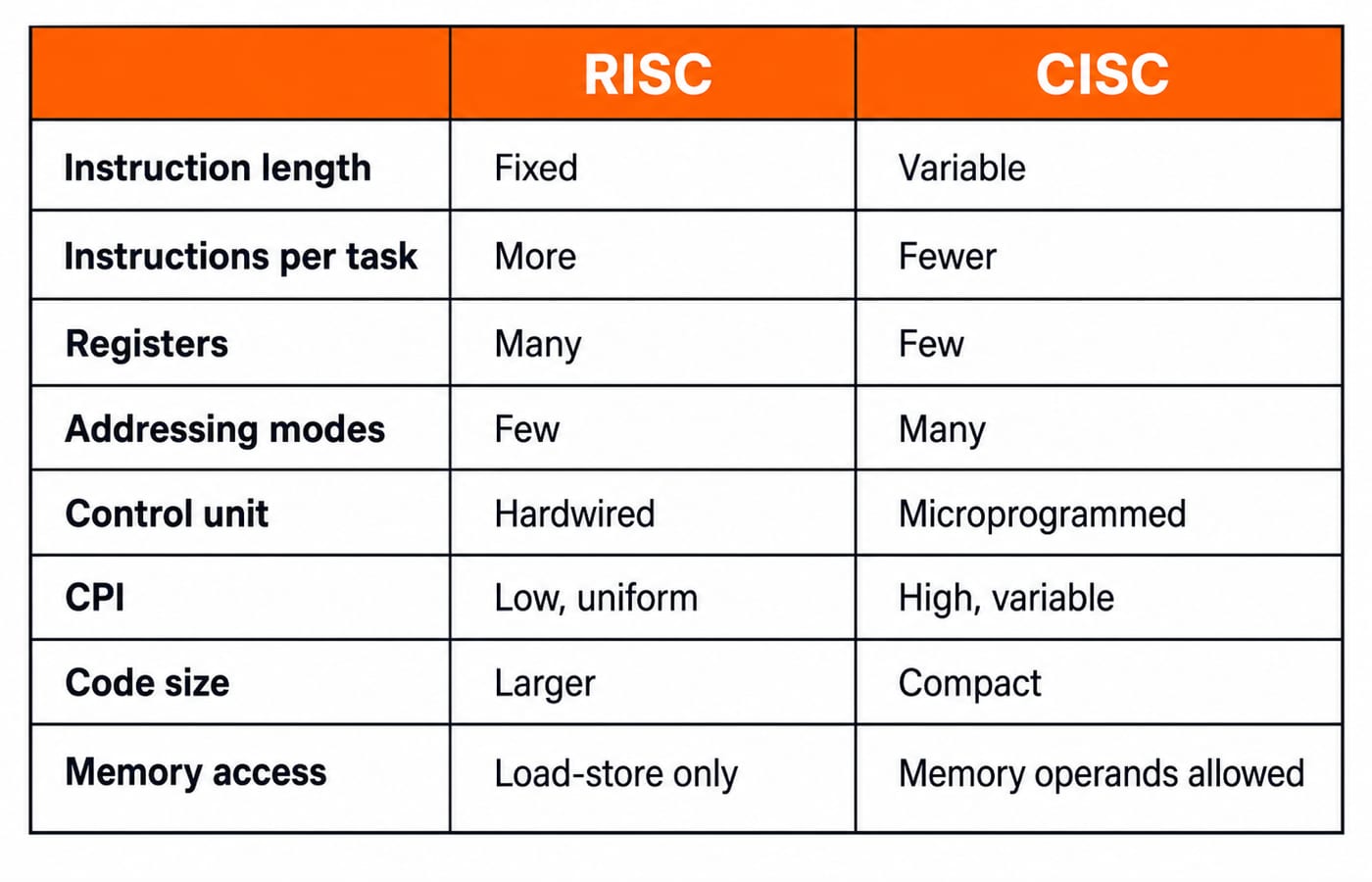
Do not memorise the rows as isolated pairs. Fixed instruction shapes and few addressing modes simplify decode. Simple decode supports hardwired control and a regular pipeline. A load-store design needs many registers and often uses more instructions, which can enlarge the code. One design choice generates the rest.
The nearby topic is instruction encoding. The addressing modes and instruction formats guide shows why operand location and field layout affect both decoder complexity and instruction length.
3. The instruction-count illusion: a worked example
Suppose the task repeats the assignment A = B + C one million times, with all three variables in memory. Assume simplified machines chosen to expose the performance equation.
A CISC machine can express each assignment as one memory-to-memory instruction. Its assumed parameters are:
Instruction count: 1 x 1,000,000 = 1,000,000.
CPI: 8 cycles per instruction.
Clock rate: 200 MHz = 200 x 10^6 cycles per second.
CPU time is:
instruction count x CPI / clock rate
So CISC time is:
(1,000,000 x 8) / (200 x 10^6)
= 8,000,000 / 200,000,000
= 0.04 seconds = 40 milliseconds
Now use a RISC sequence with four instructions per assignment: load B, load C, add the registers and store A. Its assumed parameters are:
Instruction count: 4 x 1,000,000 = 4,000,000.
CPI: 1.2 cycles per instruction.
Clock rate: 500 MHz = 500 x 10^6 cycles per second.
RISC time is:
(4,000,000 x 1.2) / (500 x 10^6)
= 4,800,000 / 500,000,000
= 0.0096 seconds = 9.6 milliseconds
For these machines, the speed ratio is 40 / 9.6 = 4.166.... The RISC machine is therefore about 4.17 times as fast even though it executes four times as many instructions.
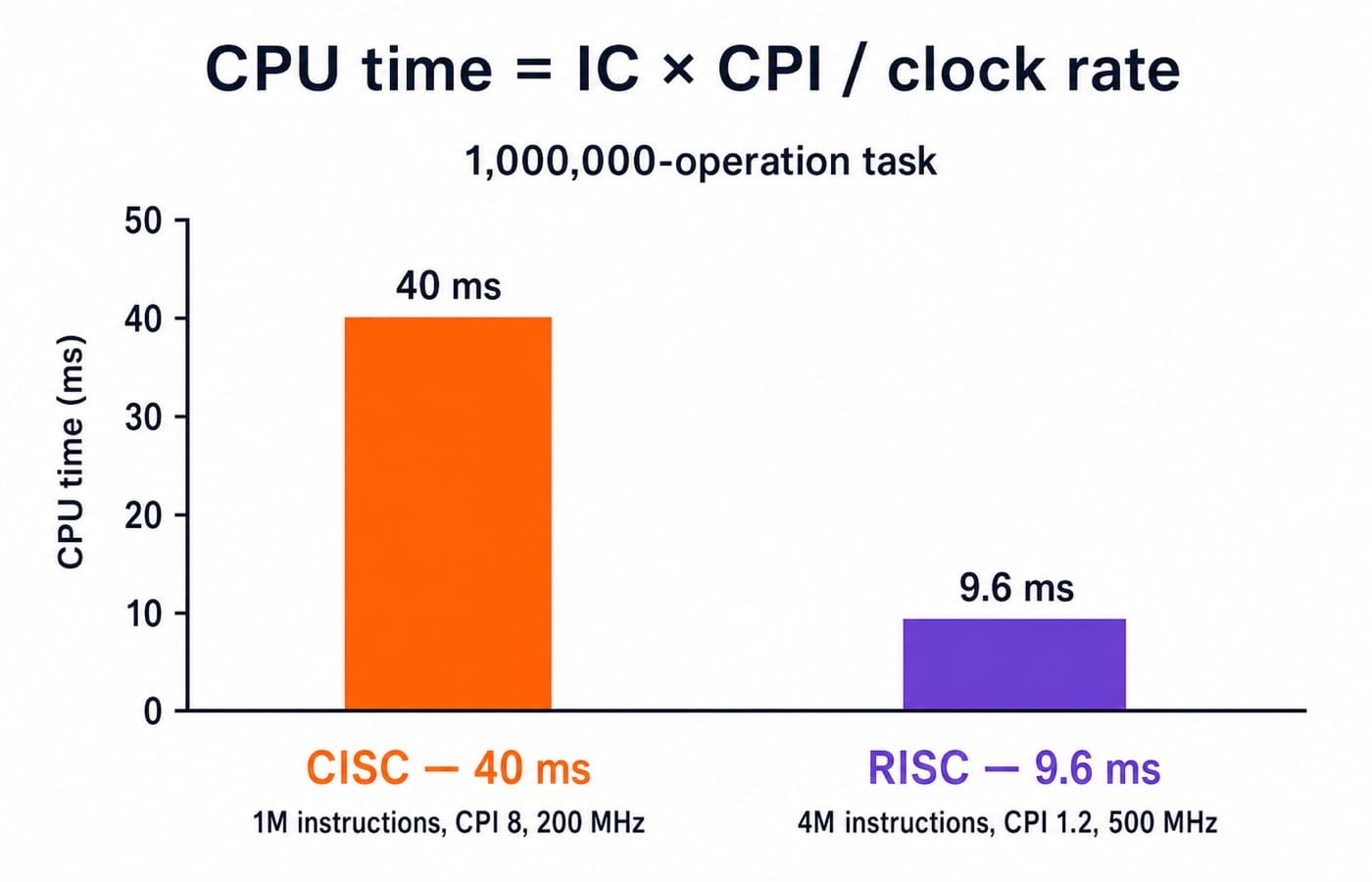
Check the moral carefully. The calculation does not prove that every RISC processor beats every CISC processor. It proves that fewer instructions do not guarantee lower CPU time. Use all three factors given in the question.
4. Why RISC pipelines better
A pipeline works best when each instruction moves through predictable stages. Fixed-length instruction fields simplify fetch boundaries and decoding. A small set of simple operations makes stage work more regular. A load-store rule also keeps arithmetic instructions away from variable memory behaviour.
CISC instructions may vary in length and may perform several lower-level actions. That makes direct pipelining harder. Modern CISC processors commonly decode complex instructions into simpler internal micro-operations, which can then travel through a regular execution pipeline.
This is why RISC and pipelining are tested together. Simplicity is not merely aesthetic. It reduces irregular work in fetch and decode and helps sustain throughput. The pipelining in Computer Architecture post connects that regularity to hazards, stage timing and CPI.
5. The traps GATE builds these on
Test each statement against the design driver and the performance equation.
“CISC has more general-purpose registers.” False in the standard comparison. RISC designs are associated with more registers.
“RISC uses variable-length instructions.” False in the standard model. Fixed-length instructions support regular decoding.
“RISC programs use fewer instructions.” False as a general claim. Simple load-store sequences can need more instructions.
“CISC always executes faster because its programs are shorter.” False. CPU time depends on instruction count, CPI and clock rate.
“RISC always executes faster.” Also false. The numerical values and workload decide.
“RISC code is usually more compact.” False in the standard comparison. More instructions generally enlarge code.
“Hardwired control is associated with RISC.” True as the conventional pairing.
“Microprogrammed control is associated with CISC.” True as the conventional pairing.
Absolute claims are the favourite trap. “Usually associated with” is not the same as “must have,” especially in modern implementations.
6. How GATE tests this and the official pointer
Expect MSQ or multiple-choice sets that mix true and false architecture statements, a CPU-time numerical, or a pairing between control-unit style and instruction-set design. A question may also join RISC features to pipeline behaviour.
Computer Organization and Architecture belongs to the official GATE CS syllabus. Its exact scope and any mark-share information must be checked on the official GATE portal for the relevant cycle. Do not build a preparation decision around a remembered weightage.
KnowledgeGate's practice bank has about 1,800 Computer Organization and Architecture questions. Use statement sets to practise precision and numericals to force the full equation. The GATE category provides the wider exam route.
7. The short version and your next step
RISC is the simple, regular, load-store side of the comparison, typically with fixed-length instructions, many registers, hardwired control and low CPI. CISC is the richer, variable side, with memory operands, more addressing modes, microprogrammed control and compact code. These are standard associations, while actual speed comes from instruction count x CPI divided by clock rate.
Rework the 40 ms versus 9.6 ms example without looking at the steps. Then study the full architecture sequence in GATE Guidance by Sanchit Sir and test the distinctions under time pressure in the GATE test series. If you can rebuild the table from the design choice, the true-false rows stop feeling arbitrary.