Booth’s Algorithm MCQs: 10 Solved Recoding and Multiplication Questions
Practise ten Booth’s Algorithm questions, from signed two’s-complement decoding and transition counts to radix-4 partial products.
KnowledgeGate Team
Exam prep & CS education
Updated 11 Sep 20267 min read
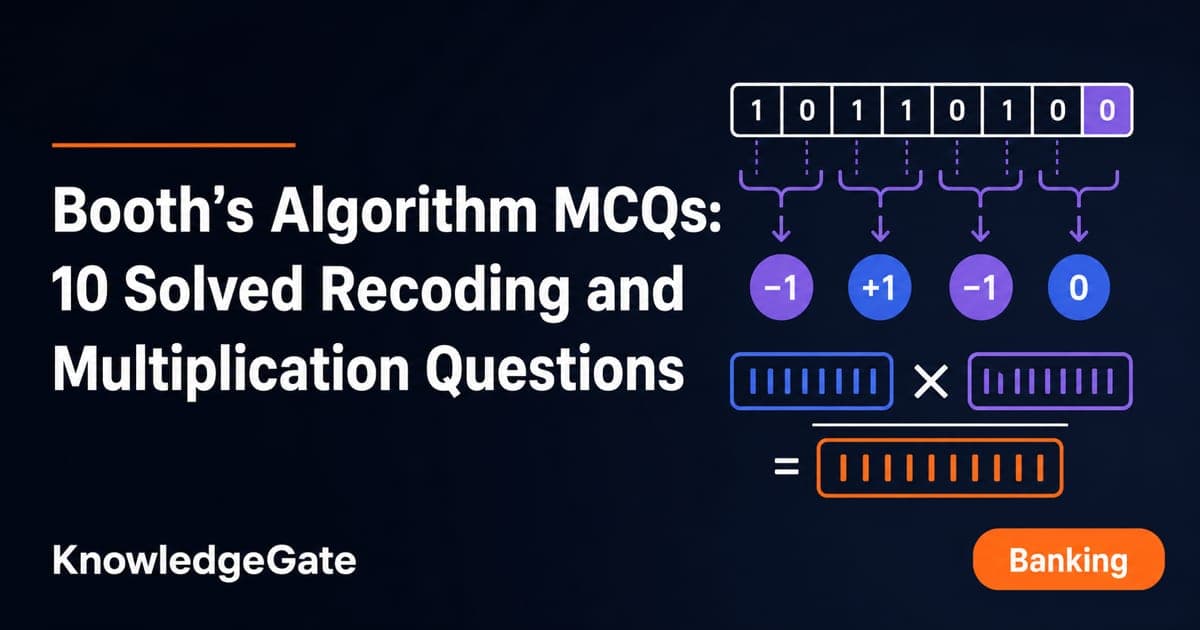
Booth questions are usually lost on pair direction, the appended q_-1 = 0, signed two’s-complement width, or the difference between radix-2 and radix-4 recoding, not on multiplication itself. The relevant Booth’s algorithm skills are recognition, signed decoding, recoding, operation counts and partial products. Attempt each before opening the answer. Keep a full paper trace for Questions 3, 8 and 9. If pair direction or shifts are unclear, revisit the Booth’s Algorithm lesson.
Booth’s algorithm rules to use in every question
For radix-2 Booth recoding, use this table:
Current pair | Action before shift |
|---|---|
| no arithmetic |
| add |
| subtract |
| no arithmetic |
The first bit is the current multiplier bit, the second is the previous lower bit, and the initially appended bit is q_-1 = 0. Every cycle ends with an arithmetic right shift. However, an additions/subtractions question counts only 01 and 10 transitions.
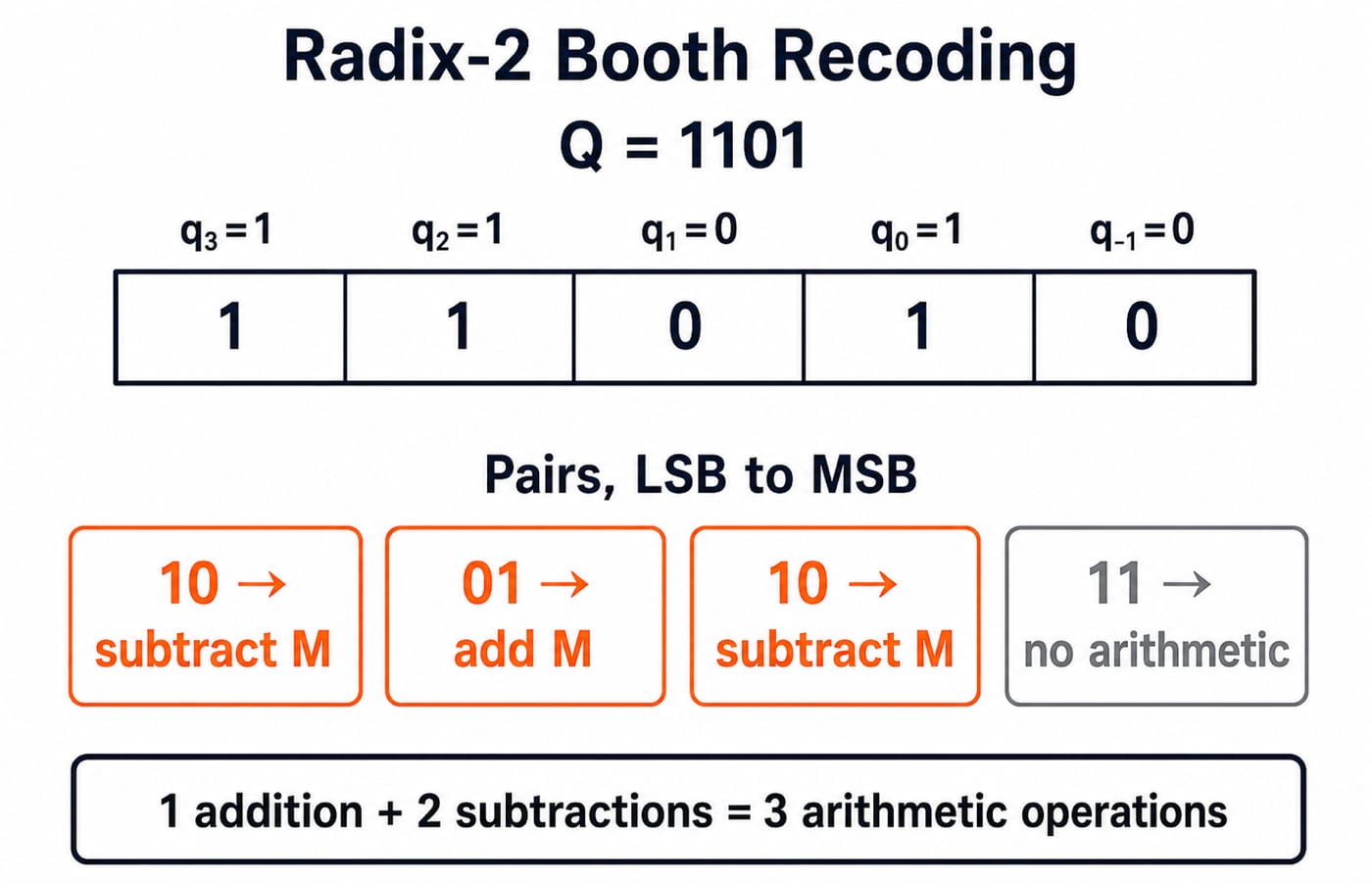
For Q = 1101, the LSB-first pairs are q0q-1 = 10, q1q0 = 01, q2q1 = 10, q3q2 = 11. They mean subtract, add, subtract, no arithmetic, so the count is one addition plus two subtractions. Always retain the stated width: 11101 is -3 at 5 bits, while 1100 is -4 at 4 bits.
Booth’s algorithm basics and signed-register interpretation
Question 1: identify what Booth’s algorithm does
BPSC 2024, PGT Tier-3
What is Booth’s algorithm used for?A. Binary to decimal conversion
B. Decimal to binary conversion
C. Binary multiplication
D. More than one of the above
E. None of the aboveAnswer: C. Binary multiplication. Booth’s algorithm multiplies signed binary numbers represented in two’s complement. It recodes runs in the multiplier into additions, subtractions and arithmetic shifts; it is not a base-conversion procedure.
Question 2: decode two signed registers before multiplying
Coal India 2020
The multiplicand register and multiplier register of a hardware circuit implementing Booth's algorithm hold (11101) and (1100) respectively. The result shall be:A. 812₁₀
B. -812₁₀
C. -12₁₀
D. 12₁₀Answer: D. 12₁₀. At 5-bit width, invert 11101 and add one: 00010 + 1 = 00011, so it represents -3. At 4-bit width, 1100 represents -4. Therefore (-3) x (-4) = +12. Reading either pattern as unsigned gives the wrong operands.
For a register trace, use 4-bit working registers: M = 1101 (-3), -M = 0011 (+3), A = 0000, Q = 1100 (-4), Q_-1 = 0.
Cycle | Pair and arithmetic | Post-shift |
|---|---|---|
1 |
|
|
2 |
|
|
3 |
|
|
4 |
|
|
The final AQ = 00001100, which is 12.
Recoding negative multipliers and spotting efficient bit patterns
Question 3: recode -57 with signed Booth digits
GATE 2005, Information Technology. Open the source question.
Using Booth's Algorithm for multiplication, the multiplier -57 will be recoded asA. 0 -1 0 0 1 0 0 -1
B. 1 1 0 0 0 1 1 1
C. 0 -1 0 0 1 0 0 0
D. 0 1 0 0 -1 0 0 1Answer: A. 0 -1 0 0 1 0 0 -1. The 8-bit two’s-complement form of -57 is 11000111. After appending q_-1 = 0, the LSB-first pairs are 10, 11, 11, 01, 00, 00, 10, 11. Their digits are -1, 0, 0, +1, 0, 0, -1, 0. Reverse that list for the option’s MSB-to-LSB display. Audit it numerically: -2^6 + 2^3 - 2^0 = -64 + 8 - 1 = -57.
Question 4: choose the multiplier with the fewest transitions
Consider the following pattern of multiplier:
(a) 010101010101 (b) 111111111111 (c) 1111100111000
Which of the above string will give best performance for Booth's multiplication algorithm?A. Only (a)
B. Only (b)
C. Only (c)
D. Both (b) & (c)Answer: B. Only (b). With the appended zero, pattern (a) alternates and causes 12 arithmetic actions. Pattern (b) is one uninterrupted run of ones and causes only the first LSB-side action. Pattern (c) causes three actions. Booth recoding rewards long runs, not a multiplier’s unsigned size.
Count additions and subtractions from multiplier transitions
Question 5: count operations for Q = 1101
UPLT 2026
If the multiplier Q is 1101 (-3 in decimal) and 4 bit registers are in use, then in Booth's technique for multiplication the number of addition and subtractions required are:A. 1 addition and 2 subtractions
B. 2 additions and 1 subtraction
C. 1 addition and 1 subtraction
D. 0 addition and 2 subtractionsAnswer: A. 1 addition and 2 subtractions. Scanning from the LSB gives 10, 01, 10, 11, meaning subtract, add, subtract, no arithmetic. That is one 01 pair and two 10 pairs.
Question 6: count operations in a 16-bit multiplier
Indian Space Research Organization 2009
The two numbers given below are multiplied using the Booth's algorithm Multiplicand: 0101 1010 1110 1110 Multiplier: 0111 0111 1011 1101 How many additions/subtractions are required for the multiplication of the above two numbers?A. 6
B. 8
C. 10
D. 12Answer: B. 8. The multiplicand bits do not affect this count. In multiplier 0111 0111 1011 1101, additions (01) occur at i = 1, 6, 11, 15; subtractions (10) occur at i = 0, 2, 7, 12. That is 4 + 4 = 8 arithmetic operations.
Question 7: audit a 12-bit transition count
Consider the following Booth’s multiplication: Multiplicand: 1011 0111 1111 Multiplier: 0101 1100 1001 Which of the following represents the number of arithmetic operations are required in the multiplication?A. 5
B. 6
C. 7
D. 8Answer: D. 8. For multiplier 0101 1100 1001, additions (01) occur at i = 1, 4, 9, 11, while subtractions (10) occur at i = 0, 3, 6, 10. The other four pairs are 00 or 11, so four additions plus four subtractions gives eight. Counting ones instead of transitions does not solve this question.
GATE NAT: audit all 16 Booth pairs without skipping a boundary
Question 8: count 13 operations in the GATE 2025 multiplier
GATE 2025, Set 2. Open the source question.
The following two signed 2’s complement numbers (multiplicand M and multiplier Q) are being multiplied using Booth’s algorithm:
M: 1100 1101 1110 1101 and Q: 1010 0100 1010 1010
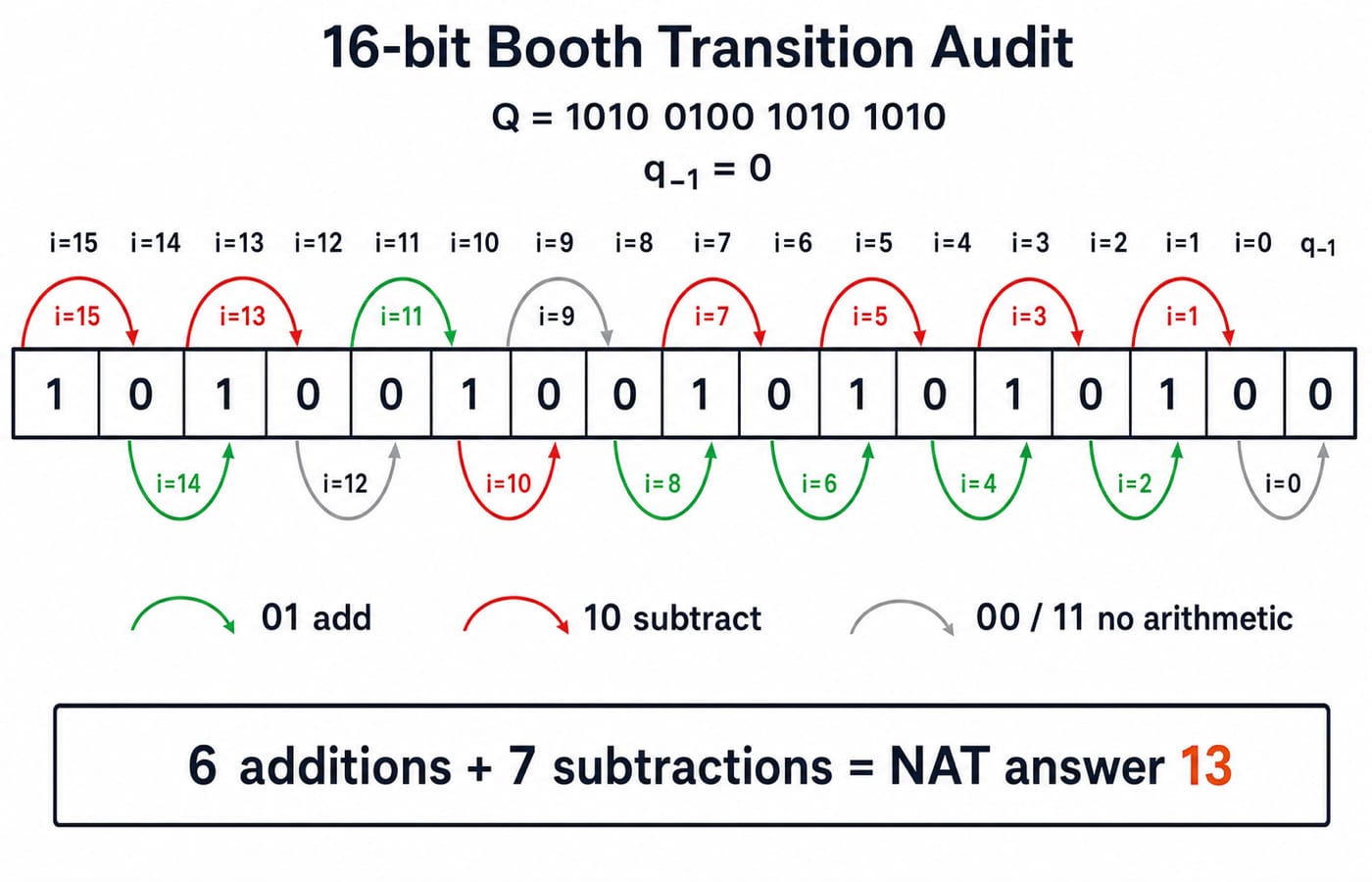
The total number of addition and subtraction operations to be performed is ___________. (Answer in integer)None. This is a NAT question.Answer: 13. Append q_-1 = 0 to Q = 1010 0100 1010 1010. The six 01 pairs are at i = 2, 4, 6, 8, 11, 14; the seven 10 pairs are at i = 1, 3, 5, 7, 10, 13, 15. Hence 6 additions + 7 subtractions = 13 operations. At i = 0, q0 = 0 beside the appended zero gives 00, so there is no operation. The sign-side transition at i = 15 still counts.
Bit-pair partial products and the final two's-complement product
Question 9: complete a radix-4 bit-pair recoding table
GATE 2006, Information Technology. Open the source question.
When multiplicand Y is multiplied by multiplier X = xₙ₋₁xₙ₋₂ ....x₀ using bit-pair recoding in Booth's algorithm, partial products are generated according to the following table.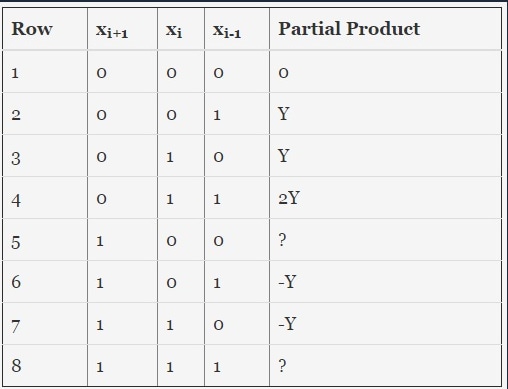
The partial products for rows 5 and 8 areA. 2Y and Y
B. -2Y and 2Y
C. -2Y and 0
D. 0 and YAnswer: C. -2Y and 0. This is modified radix-4 Booth recoding, whose triplet rule is d = -2x_(i+1) + x_i + x_(i-1). For row 5, triplet 100 gives d = -2, so the partial product is -2Y. For row 8, triplet 111 gives d = -2 + 1 + 1 = 0, so its partial product is 0. Do not apply the radix-2 pair table from Questions 3 to 8 to this radix-4 triplet table.
Question 10: convert the signed product back to eight bits
UPLT 2026
Let A = 1111 1010 and B = 0000 1010 be two 8-bit 2's complement numbers. What will their product in 2's complement be?A. 1101 0101
B. 1010 0101
C. 1100 0100
D. 1001 1100Answer: C. 1100 0100. Decode A = 1111 1010 as -6 and B = 0000 1010 as +10, giving -60. In the 8-bit width used by the options, +60 = 0011 1100. Invert it to 1100 0011, then add one to get 1100 0100. Decoding that result independently gives 196 - 256 = -60, confirming both sign and magnitude.
Diagnose the miss and choose the next practice step
The key skills are signed representation, recoding and runs, pair direction, transition counting, radix-2 and radix-4 recoding, and requested-width conversion.
Use this correction checklist:
Write the multiplier width.
Append
q_-1 = 0.Scan every bit in order and record its pair.
Count only
01and10. For a final product, verify sign and decimal magnitude separately.
Redo Questions 2, 3, 8 and 9 without the answers. Use Booth’s Algorithm Explained: Signed Binary Multiplication, Full Trace and Exam Traps when the four-cycle register trace is unclear; return here to test recoding, transition counts, radix-4 partial products and width checks. Repair signed representation with Number Systems and Base Conversions Explained.
Continue with GATE Guidance by Sanchit Sir for a structured GATE sequence, or CS Fundamentals for Exams & Placements for broader computer-organisation revision.
Keep learning
Instruction Formats and Addressing Modes MCQs: 12 Solved Cross-Concept Questions
Solve 12 cross-concept COA questions that connect addressing-mode choices with PC rules, memory references, opcode fields, and byte-aligned instructions.
3 Oct 20267 min readComputer Organization MCQs
Interrupt-Driven I/O MCQs: 12 Solved Questions with Explanations
Attempt 12 previous-year interrupt-driven I/O questions, then check each answer with a concise explanation. The set covers ISR order, vectoring, priority, and CPU-time numericals.
28 Sep 20268 min readComputer Organization MCQs

Bitmap and Pixmap MCQs: 12 Solved Pixel Depth and Memory Questions
Build a reliable pixel-memory method through 12 live MCQs covering bitmaps, pixmaps, lookup tables, uncompressed storage, refresh rates, masks, and dithering.
Updated 25 Sep 20267 min readComputer Organization MCQs
Assembly & Assembler Design MCQs: 11 Solved PYQs Explained
Attempt 11 published PYQs on assembler directives, language levels, tables, register-pair instructions, debugging and fixed-width arithmetic, then check each worked explanation.
Updated 24 Sep 20267 min readComputer Organization MCQs