AI Agent Architecture and Program Types MCQs: 11 Solved Questions
Eleven solved AI agent MCQs with the trap in each one named: current-percept rules, sensor versus actuator, goal versus utility scoring, and what counts as learning.
KnowledgeGate Team
Exam prep & CS education
Updated 14 Aug 20268 min read
AI agent questions look like vocabulary tests, but they hide four distinctions: current percept versus percept history, sensor versus actuator, goal versus utility, and fixed behaviour versus learning. Eleven solved questions below test those four one at a time, backed by three worked examples: a utility comparison between two routes, a sensor-to-actuator trace, and a learning update from four trials. Revise them alongside the UGC NET preparation courses and test series. Commit to an option before reading its answer, because recognition is not recall.
1. Agent architecture and program types: the one-page concept map
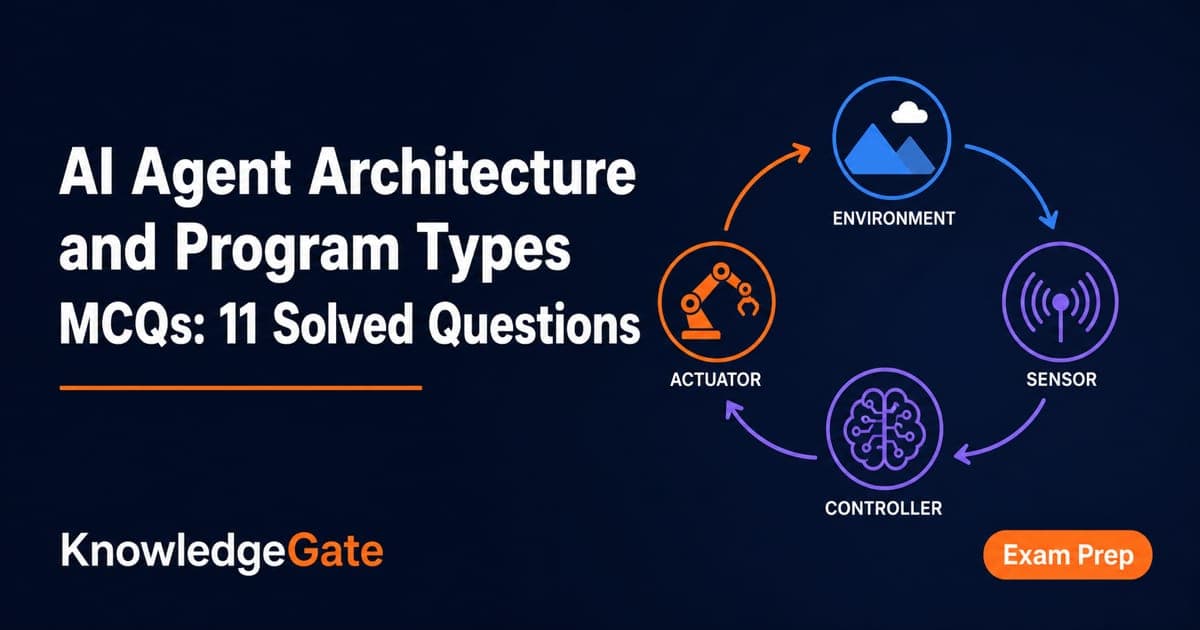
Start with the exact split: agent = architecture + agent program. Sensors turn environmental stimuli into percepts. The program maps a percept or percept sequence to an action. Actuators execute that action.
Program type | Information used | Decision rule | Typical trap |
|---|---|---|---|
Simple reflex | Current percept only | Apply a condition-action rule | Giving it history |
Model-based reflex | Internal state updated from percept history | Apply rules to the state | Confusing state with a goal |
Goal-based | Possible actions and a goal | Choose an action that reaches the goal | Assuming it ranks successes |
Utility-based | Outcomes and utility values | Choose the best utility | Treating utility as pass or fail |
Learning | Experience and feedback | Improve the performance element | Treating observation as learning |
These labels can combine in a richer system. In an MCQ, identify the defining feature being tested.
A delivery robot has two routes to its charging dock, and both succeed. Route A takes 4 minutes, uses 8 energy units, and has collision risk 0.10. Route B takes 6 minutes, uses 4 energy units, and has collision risk 0.01.
Define the illustrative score U = -time - 0.5(energy) - 20(risk).
U(A) = -4 - 0.5(8) - 20(0.10) = -4 - 4 - 2 = -10U(B) = -6 - 0.5(4) - 20(0.01) = -6 - 2 - 0.2 = -8.2
A goal-based rule accepts both routes, because both reach the dock. The utility rule chooses B, since -8.2 > -10. That one comparison is the whole difference between goal-based and utility-based agents. For the wider Paper 2 picture, the UGC NET Computer Science high-yield topics list shows where agents sit among the other units.
2. Recognising valid AI agent types: Questions 1-2
Scan for standard family names before comparing option order. Utility-based is recognised. “Unity based” is the distractor here.
Question 1, UPPSC Polytechnic Lecturer 2022
Which of the following is not a type of Artificial Intelligence (AI) agent?

A. Learning AI agent
B. Goal-based AI agent
C. Unity based AI agent
D. Simple reflex AI agent
Answer: C. Unity based AI agent. Learning, goal-based, and simple reflex are recognised program types. Unity is not a type in this taxonomy. Resist the urge to read “Unity” as “utility”: a utility-based agent would be a valid type, so quietly correcting the spelling turns the right answer into a wrong one. Judge the term exactly as printed.
Question 2, Indian Space Research Organization 2025
Which of the following is not a type of Artificial Intelligence agent?

A. Simple AI agent (Simple Reflex Agent)
B. Unity based AI agent
C.  Learning AI agent
D. Goal based AI agent
Answer: B. Unity based AI agent. The concept repeats Question 1, but the letter changes because the distractor moved from C to B. Do not memorise a letter from a near-duplicate. Find the concept in the current list.
3. Utility-based agents and “happy” states: Questions 3-5
“Happy” and “unhappy” are informal shorthand for more and less desirable outcomes. Utility orders or scores outcomes, letting an agent compare two successes instead of asking only whether the goal was reached.
Question 3, UPPSC Polytechnic Lecturer 2022
In Artificial Intelligence (AI), which agent deals with happy and unhappy state?

A. Simple reflex agent
B. Model based agent
C. Learning agent
D. Utility based agent
Answer: D. Utility based agent. Both routes reach the dock, but utilities -10 and -8.2 show which is preferable under the rule. A simple reflex agent instead maps the current percept directly to an action, without ranking outcomes.
Question 4, UGC NET 2021
Which agent deals with the happy and unhappy state?

A. Utility‐based agent
B. Model‐based agent
C. Goal‐based Agent
D. Learning Agent
Answer: A. Utility‐based agent. A goal supplies a success condition, while utility ranks outcomes that both meet it. A model-based agent maintains internal state from percept history. That represents the world but does not itself judge desirability.
Question 5, UGC NET 2017
In Artificial Intelligence (AI), which agent deals with happy and unhappy state ?

A. Simple reflex agent
B. Model based agent
C. Learning agent
D. Utility based agent
Answer: D. Utility based agent. Utility supplies the preference scale. A near-duplicate stem does not guarantee the same answer letter, so locate the concept in the current option list before committing.
4. Agent body, controller, sensors, and actuators: Question 6
The architecture is an agent's physical side: a body carrying sensors and actuators. The controller is the program between them, reading percepts and issuing commands. Statements that swap those roles are the standard trap.
Question 6, UGC NET 2025
Consider the following statements regarding Agent systems:

A. Agent system comprises of an agent and an environment on which it acts.
B. The controller part of an agent receives percepts from its body and sends commands to the environment.
C. Agents act in the world through actuators which are non-noisy and always reliable.
D. The actuators of an agent convert stimuli into percepts.

Choose the correct answer from the options given below:

A. A, B Only
B. B, D Only
C. C, D Only
D. B, C, D Only
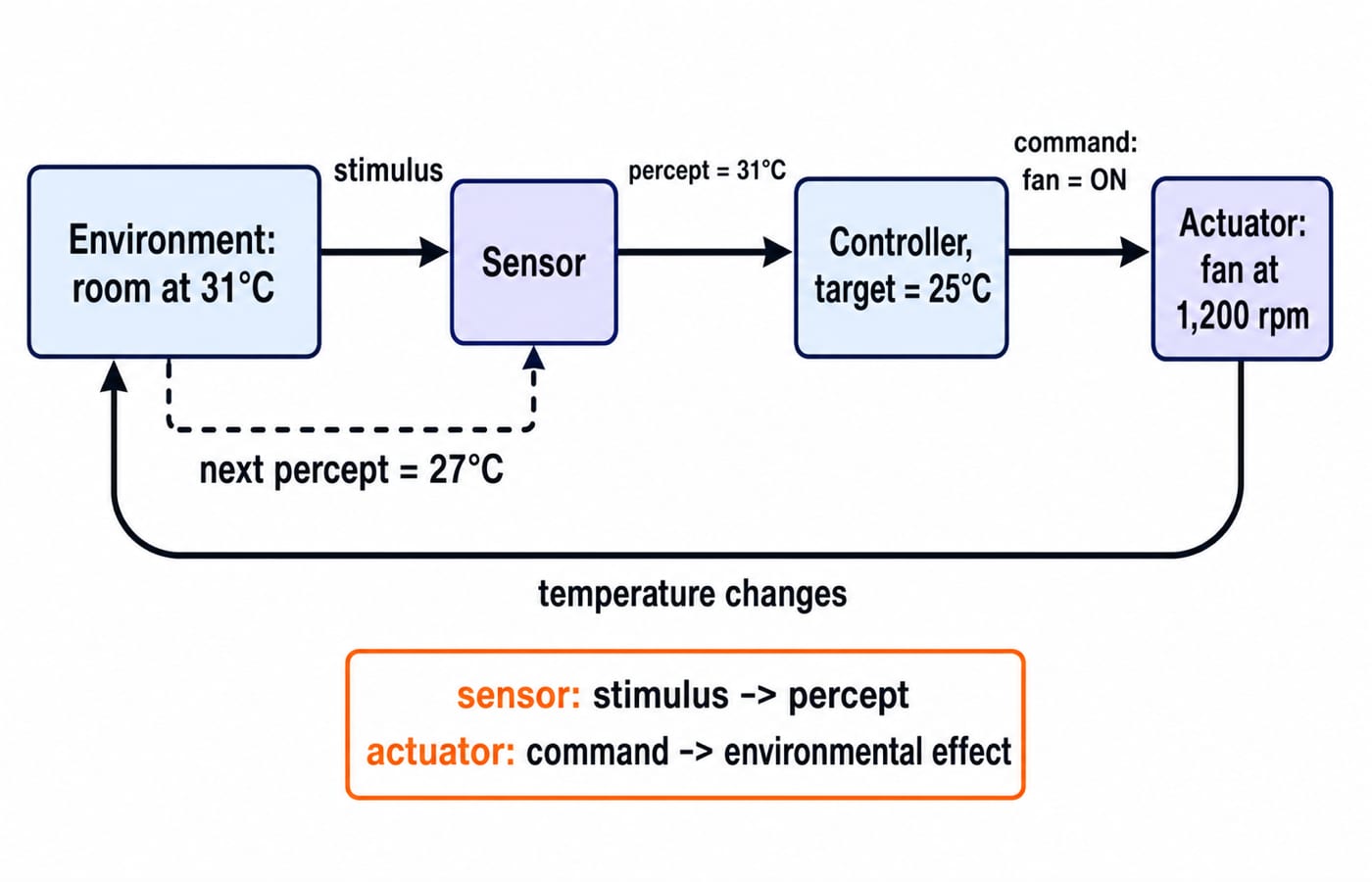
Answer: A. A, B Only. Statement A establishes the agent-environment pair. Statement B describes the control path correctly: the controller issues a command, an actuator carries it out, and the environment changes. Statement C is false because actuators are noisy and can fail, which is why an agent senses again after acting. Statement D reverses the two roles: sensors turn stimuli into percepts, while actuators turn commands into effects.
Trace one cycle in a thermostat agent. A sensor reports the percept 31°C. The controller compares it with the 25°C target and sends the command fan = ON. The fan actuator runs at 1,200 rpm, the room cools, and the next percept is 27°C. Nowhere in that loop does an actuator produce a percept, which is exactly why statement D fails.
5. Simple reflex agents and environment properties: Questions 7-9
Question 7, RSSB 2022
Choose the correct statements -
 (i) Simplex reflex agents take decisions on the basis of the current percepts and past history.
 (ii) When uniqueness in the agents current state completely determines the next state of the agent, the environment is said to be deterministic.
 (iii) The environment is semi-dynamic if the environment itself does not change with the passage of time but the agent's performance score does.

A. (i) and (iii)
B. (i) and (ii)
C. (ii) and (iii)
D. All of the above
Answer: C. (ii) and (iii). Statement (i) is false because a simple reflex agent uses the current percept and nothing earlier. Statement (ii) is a compressed statement of determinism: the current state and the chosen action together fix the next state, with no random element. Statement (iii) is the definition of a semi-dynamic environment: the world itself stays still while the clock alone erodes your performance score, as it does in timed chess.
Question 8, UGC NET 2018
In Artificial Intelligence (AI), a simple reflex agent selects actions on the basis of_________.

A. current percept, completely ignoring rest of the percept history.
B. rest of the percept history, completely ignoring current percept.
C. both current percept and complete percept history.
D. both current percept and just previous percept.
Answer: A. current percept, completely ignoring rest of the percept history. For IF obstacle_ahead = true THEN turn_right, that current percept produces turn_right; no earlier percept is consulted. A model-based agent would update internal state from earlier percepts.
Question 9
Which of the following are properties of Simple Reflex Agent

A. Simple reflex agents act only on the basis of the current percept, ignoring the rest of the percept history
B. This agent function only succeeds when the environment is fully observable
C. Infinite loops are often unavoidable for simple reflex agents operating in partially observable environments
D. All of the above
Answer: D. All of the above. A rule keyed to the current percept can only be right if that percept carries everything the decision needs, which is why full observability is the stated condition. When part of the state is hidden, the same percept keeps firing the same unhelpful action and the agent cycles forever. Randomising the rule is the standard escape from that loop.
6. Learning versus choosing the best goal-reaching action: Questions 10-11
Question 10, UGC NET 2018
An agent can improve its performance by

A. Perceiving
B. Responding
C. Learning
D. Observing
Answer: C. Learning. Perceiving and observing supply information, and responding produces an action. Learning changes the policy, model, or rule used for later choices.
Action A produced rewards [1, 0, 1, 0], so its average is (1 + 0 + 1 + 0) / 4 = 2 / 4 = 0.50. Action B produced [1, 1, 1, 0], so its average is (1 + 1 + 1 + 0) / 4 = 3 / 4 = 0.75. A sample-mean learner now prefers B on the next greedy trial, because 0.75 > 0.50. That change of preference is the learning; perceiving the rewards was not.
Question 11
_____________agents takes action that are  not only  based on goals but also the best way to achieve the goal ,

A. Goal Based Agent
B. Utility Based Agent
C. Model Based Agent
D. Simple Reflexive Agent
Answer: B. Utility Based Agent. Both routes reach the dock, but U(A) = -10 and U(B) = -8.2 supply “the best way” under the rule. Goal-based reasoning alone checks whether the destination is reachable.
7. Answer strip, trap checklist, and the next revision step
Answer strip: 1-C, 2-B, 3-D, 4-A, 5-D, 6-A, 7-C, 8-A, 9-D, 10-C, 11-B.
Score yourself out of 11, then pick the next move:
9-11: Revise only the reasons behind your misses.
6-8: Redraw the five program types and retry after one day.
0-5: Rebuild the sensor-program-actuator loop before attempting more MCQs.
The recurring traps are Unity versus utility, goal versus utility, sensors versus actuators, false memory in a simple reflex agent, and counting observation as learning. Write one corrective sentence for every miss, then read why PYQ practice beats collecting more material before your next round.
Five of these eleven questions come from UGC NET papers, so NTA-UGC-NET Paper - 2 is the natural next step. Two come from UPPSC Polytechnic Lecturer papers, and the UPPSC Polytechnic Lecturer 2025 (CS) course covers the same unit.
Keep learning
Intelligent and Rational Agents in AI: PEAS, Worked Decisions and Exam Traps
Learn what makes an AI agent rational, specify its task with PEAS, update a belief using Bayes' rule, and see why coordination matters in multi-agent systems.
Updated 7 Oct 20266 min readML & Data Science
A* Search Algorithm: Step-by-Step Worked Example, Heuristics and Exam Traps
Learn A* from first principles, follow every relaxation on a weighted graph, and test optimality, tie-breaking, parent updates and heuristic quality.
Updated 2 Oct 20266 min readML & Data Science
Philosophical and Theoretical Approaches to AI: Four Classical Views, Major Schools and a Worked Example
Separate the goals, engineering schools and philosophical claims behind AI. Then compare four classical approaches through one route-choice problem.
Updated 27 Sep 20265 min readML & Data Science
Artificial Intelligence for GATE: An 8-Week Topic-by-Topic Study Plan
Turn a 12-hour weekly budget into an eight-week AI study cycle with dependency-led concepts, hand-solved traces, timed sets, and error-driven revision.
25 Sep 20265 min readML & Data Science