A team-project bullet can look impressive on paper, then collapse when an interviewer asks who built a component, why a database was chosen, or how a percentage was measured. A polished bullet is only the first step: before a technical interview, trace every technology, action verb and number to evidence, then state its boundary honestly. Treat the Campus Events API as an illustration and replace every route, file, workload and result with evidence you can reproduce from your own project.
Treat Every Resume Project Claim as an Interview Contract
Read each project bullet as an interview contract. It usually contains four claim types: scope, such as event-search and registration APIs; mechanism, such as an index or constraint; result, such as p95 latency; and ownership, meaning the exact routes and tests you wrote. Every noun, verb, adjective and number invites a follow-up question.
Prefer evidence-bearing verbs. "Implemented" points towards code, "measured" towards a repeatable method, and "integration-tested" towards a test and result. Labels such as "scalable", "production-ready", "secure" and "end-to-end" have no useful boundary by themselves. Keep one only when you can define the test, evidence and limit behind it.
The wider Resume for Freshers: Clear the First Screen guide can help with overall structure. A defensible project claim is one you can defend under technical questioning.
Build a Claim Ledger Before Rewriting the Bullet
Build a six-column ledger. Delete or soften any phrase whose proof cell remains empty.
Exact draft phrase | What I personally built | Proof artifact | Measurement method | Boundary or caveat | Likely interviewer probe |
|---|---|---|---|---|---|
Full-stack event platform |
| Diffs, pull requests and files | Code walkthrough | Teammates built UI, authentication and deployment | Trace one request |
Improved performance |
| Saved k6 output and query plans | Same script, fixture and limits | Local Docker run, not production | Why this index order? |
Prevented duplicate sign-ups | Unique constraint and | Migration plus integration test | 20 identical concurrent requests | One registration path | Why not check then insert? |
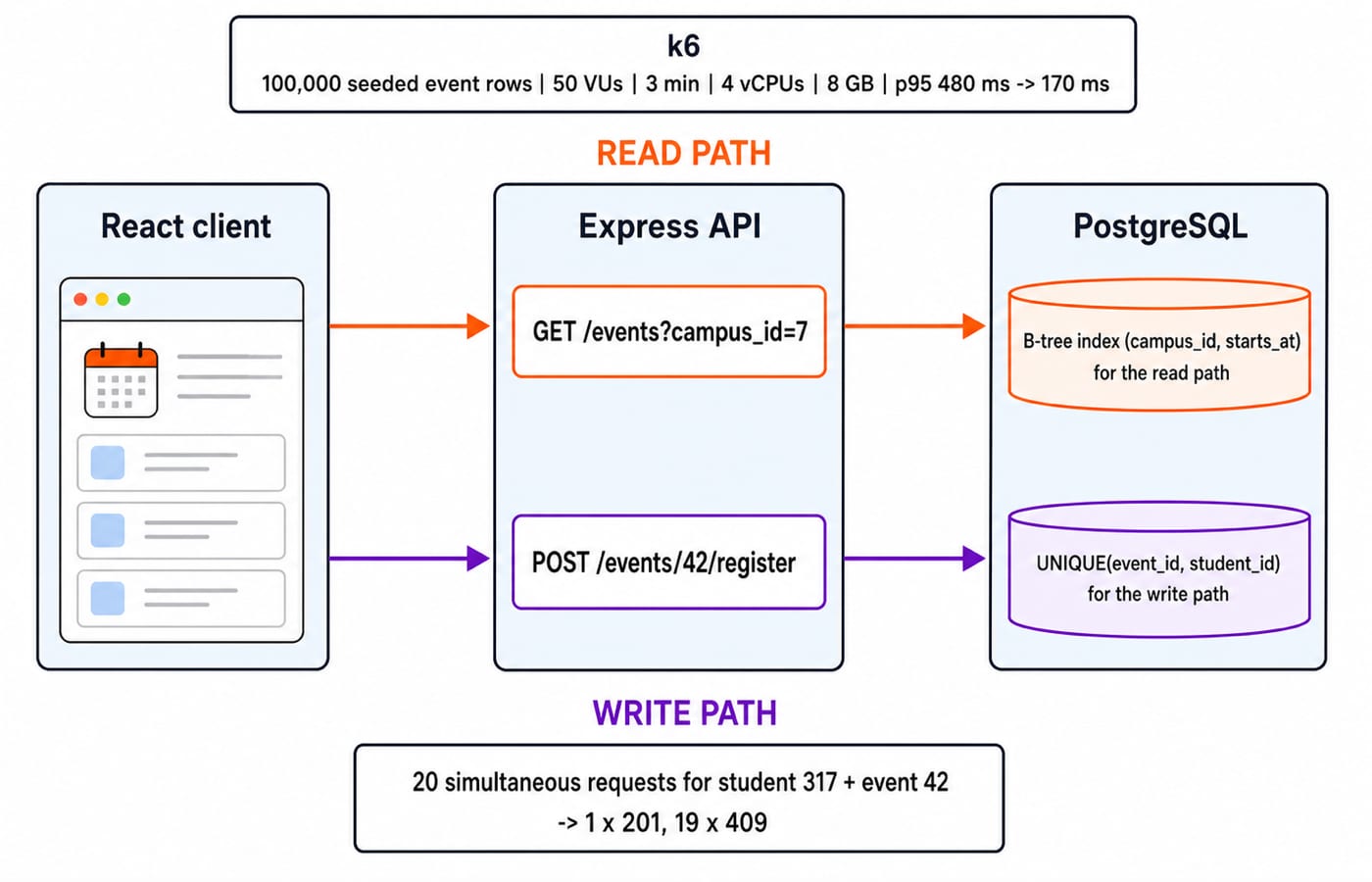
The evidence ledger records a 3-person project with 100,000 seeded event rows. Its k6 script runs 50 virtual users for 3 minutes in Docker Compose limited to 4 vCPUs and 8 GB memory. Keep diffs or pull requests for ownership, migration and test files for mechanisms, saved k6 output for metrics, and EXPLAIN (ANALYZE, BUFFERS) before and after the index. Do not use these values unless you can reproduce them.
Worked Example: Rewrite a Vague Bullet Into Defensible Claims
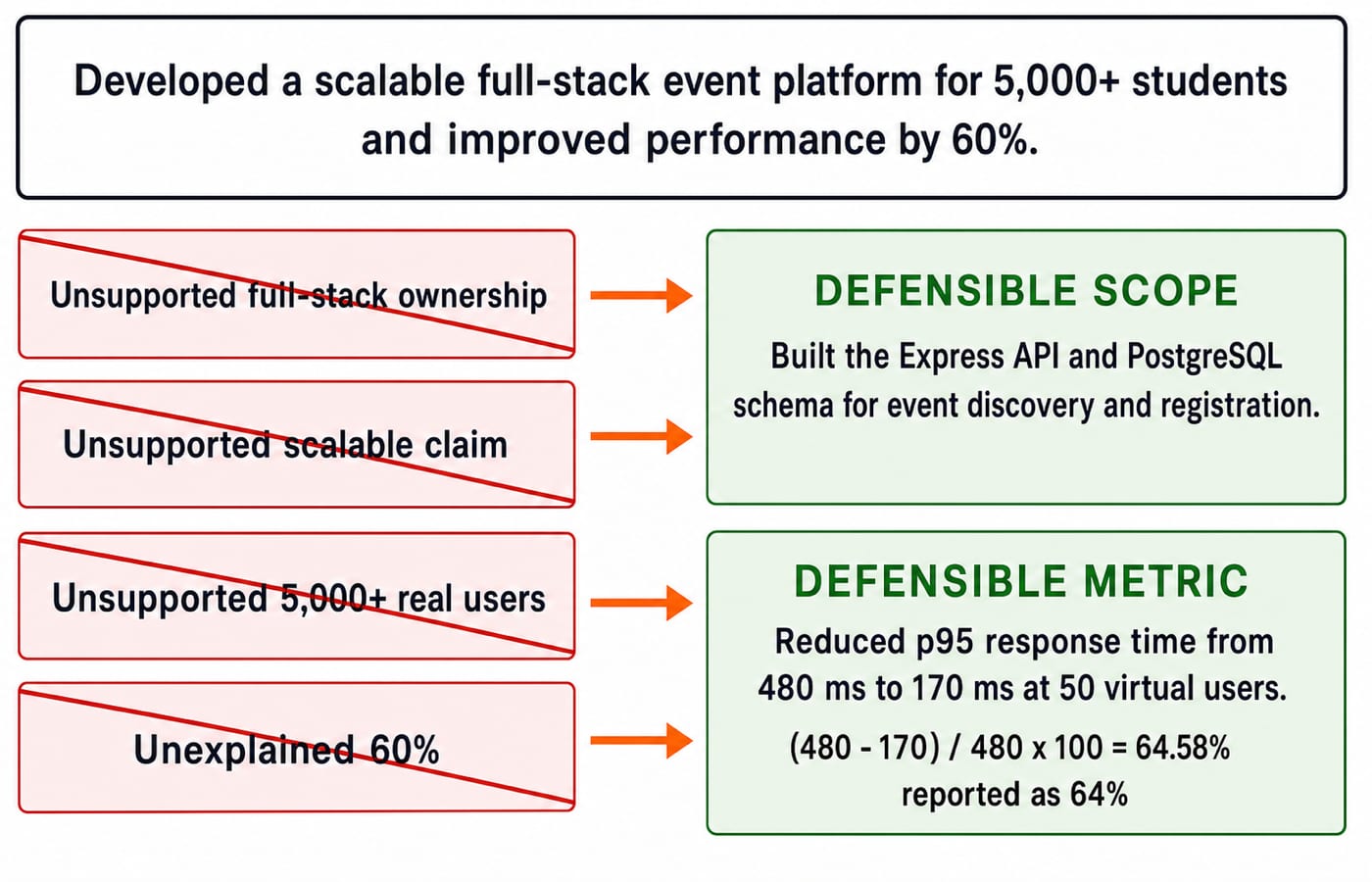
Start with the weak line: "Developed a scalable full-stack event platform for 5,000+ students and improved performance by 60%."
Audit each part. Remove "full-stack" because the candidate did not build the React UI. Remove "5,000+ students" because seeded rows are not users. Remove "scalable" because one local test cannot establish production scale. Discard the unexplained 60% and recompute from the saved runs.
Two defensible replacement lines are:
"Built event-search and registration APIs in Express and PostgreSQL for a 3-person campus events project."
"Added a
(campus_id, starts_at)index, cutting local k6 p95 latency from 480 ms to 170 ms at 50 virtual users; prevented duplicate sign-ups withUNIQUE(event_id, student_id)verified by 20 concurrent requests."
Calculate the latency reduction step by step. The absolute reduction is 480 - 170 = 310 ms. Relative to the 480 ms baseline, 310 / 480 = 0.645833.... Therefore, (480 - 170) / 480 x 100 = 64.58%. If you want a whole-number claim, round down to 64%, not up to 65%.
If the second line is too long, retain the mechanism and measurement boundary, not "scalable". The words "local" and "50 virtual users" say exactly what was tested in that environment.
Defend the Architecture and the Trade-off, Not Just the Stack
For the read path, the React client sends GET /events?campus_id=7. The Express controller validates campus_id. PostgreSQL filters on campus_id = 7, applies starts_at >= NOW(), orders by starts_at, and returns 20 rows. The (campus_id, starts_at) B-tree index supports an equality filter on its first column, followed by a date range and ordering on its second. Before attributing the latency change to the index, save the seeded fixture's observed plans showing the change from a sequential scan to an index scan.
For the write path, student 317 calls POST /events/42/register. PostgreSQL enforces UNIQUE(event_id, student_id). Of 20 simultaneous identical requests, one inserts a row and returns HTTP 201; the other 19 hit the uniqueness rule and map to HTTP 409. An application-only "check then insert" can race because multiple requests may pass the check before any insert completes.
PostgreSQL was selected because this project needed relationships, transactions and database-enforced uniqueness. Without a benchmark of the same workload, no speed comparison with MongoDB is defensible.
Defend Testing and Performance Numbers Without Inflating Them
A 170 ms p95 means that 95% of measured requests completed in 170 ms or less during that specific run. It is not the average, and it is not the worst request. Compare baseline and changed runs only when the endpoint, fixture, script, duration and resource limits are unchanged.
Test coverage is not a production claim. The candidate can report 18 unit tests and 6 integration tests, including the 20-request duplicate-registration case. Saying "24 tests passed" reports a test result; it does not prove the system is bug-free, secure or ready for arbitrary traffic.
Every number needs its boundary sentence: "local Docker test", "100,000 seeded rows", "50 virtual users", "3 minutes" and "p95". Do not rename seeded rows as active users. Do not call 50 virtual users 50 simultaneous registrations. Do not turn one endpoint's result into a claim about the whole application. A precise boundary makes a number credible because it tells the interviewer what the measurement does and does not cover.
State Personal Contribution Clearly in a Team Project
Use a three-part answer: team goal, my implementation, integration boundary.
We built the campus events product as a 3-person team. I implemented the two API routes, schema migration, index, uniqueness handling, 18 unit tests, 6 integration tests and the k6 script. My teammates built the React UI, authentication and deployment; I integrated with their contracts but do not claim those parts.
"We" fits the product outcome, while "I" identifies verifiable personal work. Do not invent a contribution percentage. Establish ownership with files, pull requests, design notes and a live code walkthrough. If you need practice explaining this boundary clearly, the Interview & Resume Preparation Course focuses on explanation and delivery.
Rehearse the Technical-Round Probe Ladder and Failure Cases
Rehearse four questions on the same project, in increasing depth:
Draw the request flow.
Why is
campus_idfirst in the composite index?Why return HTTP 409 for duplicate registration?
Would this handle 5,000 requests per second?
The defensible final answer is: "I did not test 5,000 requests per second. My evidence is limited to the stated 50-VU local run, so I would load-test the deployed environment and inspect database saturation before making that claim."
Then run three ownership checks. Open the migration, trace one request from route to SQL, and change the duplicate-registration test. If you cannot do these without hand-waving, narrow the bullet before the interview.
Technical-interview patterns vary by employer. Check an employer's own role or assessment instructions when available. Revise the underlying subjects with Technical Interview: OS, DBMS, CN & OOP Prep and use DSA Interview Questions for Placements when your target role tests coding, without assuming every employer covers the same subjects.
The Short Version and the Next Action
Apply this formula in ten minutes: precise scope + mechanism or decision + reproducible result + boundary. Underline every project noun, verb, adjective and number. Attach one proof artifact to each, then cut or soften anything you cannot reproduce or explain.
Use the Resume & Interview category for the complete preparation path. Use Coding for Placements only if this audit exposes coding fundamentals that need practice. A smaller claim you can defend is stronger than a bigger claim you have to evade.