NIACL AO Role: Underwriting, Claims and Career Paths Explained
NIACL AO work before you choose the exam: underwriting, claims and administration, the Generalist and Specialist routes, and where a career can go.
KnowledgeGate Team
Exam prep & CS education
Updated 16 Aug 20265 min read

Clearing the officer exam tells you little about the desk itself: whether you will handle proposals, claims, branch administration or specialist IT work. Underwriting decides whether a proposed risk should be taken on. Claims decides what a reported loss is actually worth. Administration keeps both answerable to whoever reads the file next.
NIACL decides your actual posting, department, authority and duties, and every official specific lives in the recruitment notice for your cycle.
NIACL AO role at a glance: one designation, several work settings
NIACL's 7 August 2025 advertisement recruited Scale I Generalists and Specialists. It describes that exercise, not the next cycle.
Across settings, officers flag gaps, act within authority, record reasons and escalate the rest. Not every AO underwrites or settles claims daily.
Workstream | Question being answered | Typical output |
|---|---|---|
Underwriting | Should the proposed risk proceed, and on what authorised terms? | Documented recommendation or escalation |
Claims | What do policy and evidence support? | Verified claim note or escalation |
Administration | What action, record or coordination is due? | Service record, correspondence or control evidence |
NIACL AO underwriting work: assess a proposal without inventing the answer
Underwriting is pre-loss assessment: check a proposal and its evidence, spot inconsistencies, seek what is missing, then recommend, decide or escalate within your assigned rules and authority.
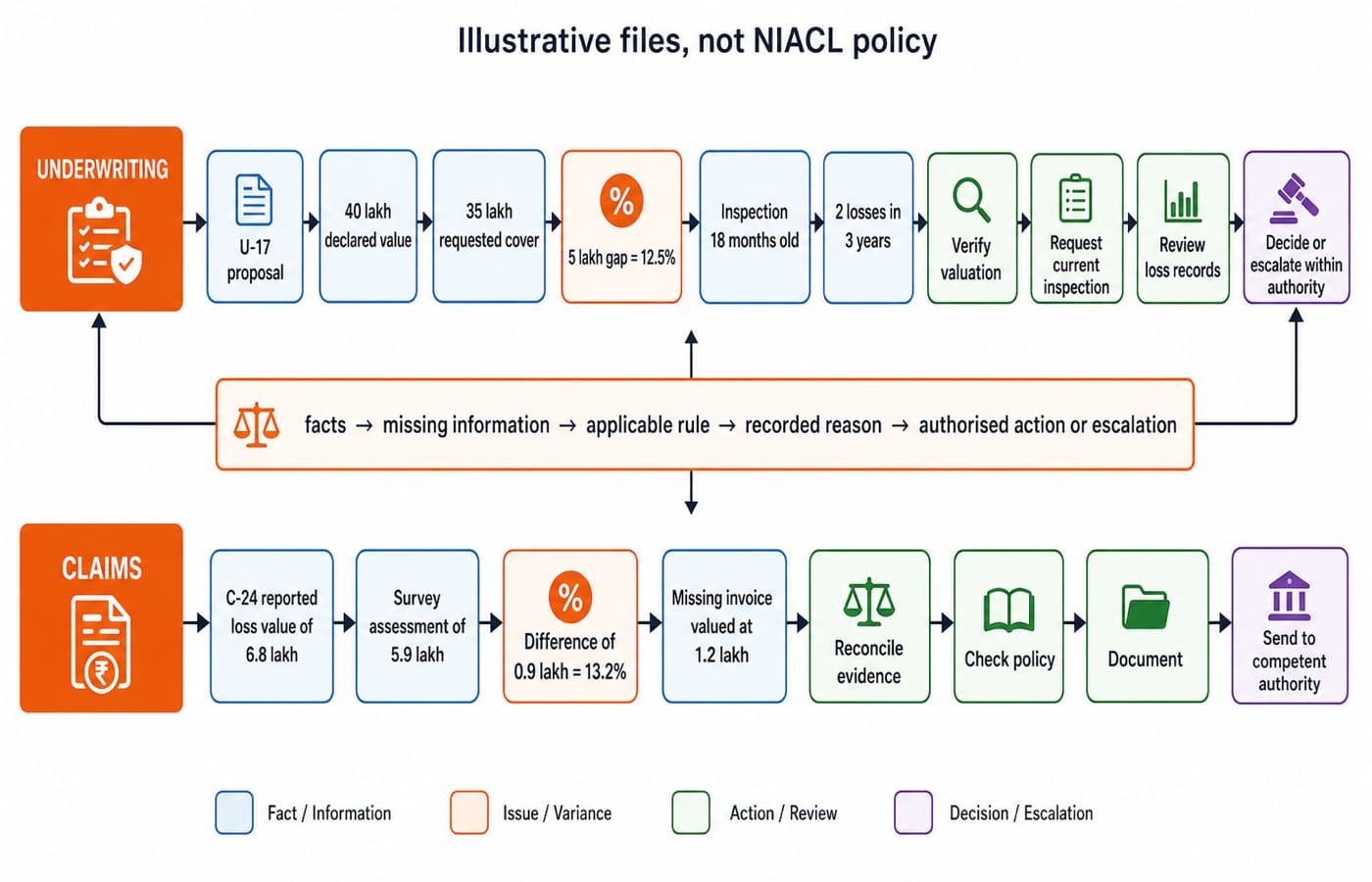
Consider File U-17, a training case with invented numbers. A small business declares a replacement value of 40 lakh but requests cover of 35 lakh. The stated-value gap is:
40 lakh - 35 lakh = 5 lakh
5 lakh / 40 lakh x 100 = 12.5%
The electrical inspection is also 18 months old, and the proposer reports 2 losses in 3 years. The disciplined response is not automatic rejection. Flag the 12.5% gap, verify the valuation basis, request a current inspection, examine both loss records, then route the file under applicable underwriting rules.
NIACL AO claims work: separate the claimed amount, evidence and authority
Claims is post-loss work: it checks a reported loss against the policy, documents and authorised process after the event. Neither workstream lets an officer bypass a survey, policy wording, fraud controls or approval limits.
In File C-24, another invented case, the claimant reports a fire loss value of 6.8 lakh. The survey assessment is 5.9 lakh, while an equipment invoice valued at 1.2 lakh is missing. The difference is:
6.8 lakh - 5.9 lakh = 0.9 lakh
0.9 lakh / 6.8 lakh x 100 = 13.235...%, approximately 13.2%
The officer-style action is to reconcile the 0.9 lakh difference, obtain or formally record the missing 1.2 lakh invoice, check coverage and exclusions, document the reasoning, and send the file to the competent authority.
NIACL AO administrative work: keep the insurance process moving and auditable
Administration connects the insurance process. Depending on the desk and system, it can include service requests, endorsements, correspondence, registers, data checks, handovers, escalations, coordination and control evidence.
Take an illustrative 10:00 queue of 8 files: 3 complete endorsement requests, 2 claims missing one document each, 2 proposals awaiting inspection, and 1 escalated complaint with a 16:00 response deadline. That gives 3 ready files, 4 needing a documented request or follow-up, and 1 needing immediate owner confirmation and escalation. Accurate records, traceable reasons, timely requests and clean handovers are what keep those five open files moving instead of stalling unnoticed.
NIACL AO Generalist and Specialist routes: how the two streams differ in daily work
The 2025 advertisement recruited across two streams, Generalist and Specialist, the latter including IT.
Route | What the work typically involves |
|---|---|
Generalist | Rotating across the core desks: assessing proposals, checking reported claims, and keeping records, requests and handovers auditable. |
IT Specialist | The systems, applications and data that underwriting, claims and administration depend on, alongside standard officer duties. |
These are tendencies, not fixed desks: a Generalist is not confined to underwriting and claims, and a Specialist may also handle administration, controls or coordination. If you are preparing the IT route, the NIACL AO IT Specialist Preparation track covers the prelims and mains scope. For the stream-by-stream comparison, including what each written stage tests and where the extra study hours go, work through NIACL AO Job Profile: Underwriting, Claims and the Administrative Career Track.
NIACL AO career paths: breadth, specialisation and promotion
The 2025 notice described the appointment as Scale I. It said selected candidates could be posted or transferred anywhere in India per company requirements, with a minimum 5-year initial-posting stay. It also said Specialists could, at company discretion, be required to remain in the same specialisation for at least 10 years while remaining eligible for promotion under company rules.
Career growth tends to run in three directions:
Breadth: working across proposal assessment, claims handling and the administrative controls that link them, so you can move between desks.
Depth: going deep in one function, becoming the underwriter who sizes up proposals or the claims officer who tests reported losses against policy and process.
Responsibility: taking on wider authority and sign-off, and the people, controls and decisions behind handovers, escalations and approvals. Promotion itself runs on company rules and internal policy you read only after joining, so treat a coaching-forum claim about grade timelines as the weakest source you have.
The 10-year condition makes specialisation a real career commitment, while the all-India posting terms make mobility part of the choice.
Is the NIACL AO role right for you? Score five parts of the work
Rate how you feel about the five things this job asks for most, using 0 = dislike, 1 = can tolerate, 2 = enjoy:
Document precision: you can check proposals, evidence and records for missing details or inconsistencies.
Deciding on incomplete information: you can chase what is missing, then recommend, decide or escalate within your authority.
Explaining your decisions: you can explain how documents, rules and evidence back what you recommended or settled.
Rule-bound work: you can stay inside authorised processes, approval limits, fraud controls and documentation rules.
Variable posting and allocation: you are ready for your posting, department and daily work to vary with company requirements.
The total is out of 10. 8-10: explore seriously; 5-7: compare adjacent officer paths; 0-4: investigate first.
Meera scores 2 + 2 + 1 + 2 + 1 = 8. Evidence-heavy underwriting or claims work suits her. Both 1s tell her to investigate communication and mobility, not assume job fit.
Compare paths in IBPS SO IT Officer vs IBPS PO, or in SBI PO vs IBPS PO: Pattern, Difficulty & Career Differences.
NIACL AO role: the short version and the next useful step
Underwriting examines proposed risk. Claims examines reported loss. Administration makes actions traceable and coordinated. Career growth adds breadth, depth or responsibility under company rules. Posting and department decide the real mix.
Only IT Specialist aspirants should use NIACL AO 2026 IT Specialist for structured prelims-and-mains preparation. Before acting on any stream, posting, tenure or promotion detail, open NIACL's official recruitment page and read the notice for your cycle.
Keep learning

NIACL AO Cutoff Trends: Set a Practical Target Score
Read NIACL published Generalist and IT Specialist cutoffs without mixing stages or streams. Apply declared buffers and sectional checks to set a practical mock target.
Updated 21 Aug 20264 min readNIACL
NIACL Assistant Regional Language Test: 14-Day Preparation Plan
Build regional-language confidence through a clear diagnostic, daily drills, an error log, and a light final-day review. Use this plan alongside your current NIACL call letter.
Updated 20 Aug 20265 min readNIACL
NIACL AO vs Assistant: Choose by Role, Mobility and Exam Track
Compare NIACL's AO and Assistant routes using past official notices, then choose with mobility filters, preparation deltas and a five-point fit test.
Updated 18 Aug 20265 min readNIACL
NIACL AO Descriptive Test: A 4-Week Essay and Letter Writing Practice Plan
Build typed essay and formal-letter fluency in four weeks with fixed practice blocks, worked examples, pressure drills, and a scoring loop that guides each rewrite.
Updated 14 Aug 20265 min readNIACL