A fresher often copies every language, framework and cloud tool encountered in class into one skills block, then worries when an interviewer points at any one of them. Keep only skills backed by evidence you can explain. Asha’s 12-keyword list becomes six defensible skill groups after each claim is tied to an artefact, action and explainable decision.
Resume skills evidence: what earns a place
Evidence has three parts: an artefact you can show, an action you performed, and a decision or failure you can explain. Honest sources are a project, assessed coursework or lab work, and repeated independent practice. Place the skills block within the wider Resume & Interview Preparation journey, because its claims must survive screening and questioning.
Use this four-point evidence scale:
0: Watched or read only, with no output. Omit it.
1: Completed a guided exercise and still need notes. Use only in a labelled basic or coursework line when relevant.
2: Used in one project or assessed assignment, with a contribution you can explain. It can enter the main block.
3: Used repeatedly, with a debugged failure and a trade-off you can discuss. It is a strong skill.
Main skills should normally score 2 or 3. An “80% Java” bar or four stars for SQL proves nothing because the measure is unknown. A fact such as 28 tests can be questioned and defended.
Audit twelve resume keywords with an evidence ladder
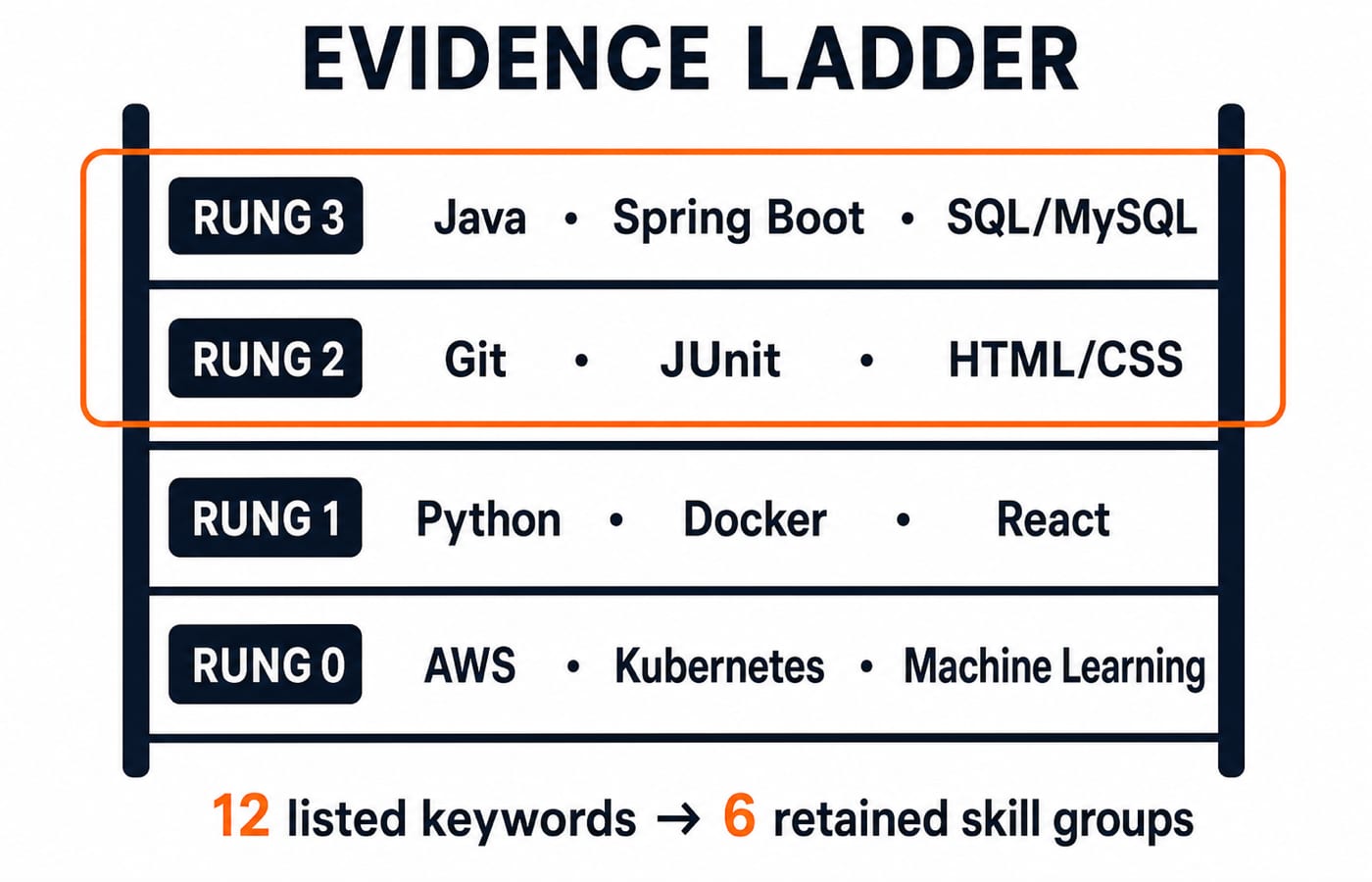
Synthetic candidate Asha completed a six-week, three-person Campus Issue Tracker. Her record contains 7 Spring Boot REST endpoints, a 6-table MySQL schema, 14 tested SQL queries, 28 JUnit tests, 34 Git commits, 3 reviewed pull requests, and 4 responsive HTML/CSS screens.
Her old list has exactly 12 items. Scoring each one gives:
Score | Skills | Evidence decision |
|---|---|---|
3 | Java; Spring Boot; SQL/MySQL | Retain as core skills |
2 | Git; JUnit; HTML/CSS | Retain as working knowledge |
1 | Python; Docker; React | Guided coursework or tutorial only, so keep out of the main block |
0 | AWS; Kubernetes; Machine Learning | Lessons watched, no artefact, so remove |
The audit accounts for all 12 keywords: 3 + 3 + 3 + 3 = 12. Asha retains the six score-2/3 groups, keeps the three score-1 items out of the main block, and removes the three score-0 items. Omission is accuracy, not weakness.
Resume skills section rewrite: from a long list to defensible claims
Here is the weak version:
Skills: Java; Spring Boot; SQL/MySQL; Git; JUnit; HTML/CSS; Python; Docker; React; AWS; Kubernetes; Machine Learning.
It mixes demonstrated ability with brief exposure, supplies no proof, and gives the interviewer six weak directions in which to probe. The improved block is shorter:
Core: Java; Spring Boot and REST APIs; SQL/MySQL
Working knowledge: Git; JUnit; HTML/CSS
Follow it immediately with this supporting project bullet:
Campus Issue Tracker, three-person project completed in six weeks: implemented 7 REST endpoints and role-based access, designed a 6-table MySQL schema with 14 tested queries, wrote 28 JUnit tests, and contributed 34 commits across 3 reviewed pull requests.
The compact block helps a recruiter scan. The project bullet carries the proof. For the broader order of education, projects and skills, use Resume for Freshers: Clear the First Screen.
Group resume skills by real proficiency
Asha needs two labels. Core holds score-3 skills, while Working knowledge holds score-2 skills. An Exposure line adds keywords without proof, so it stays off the resume. The private 0-to-3 audit is a decision tool, not a percentage, star rating or progress bar.
Order each group by role relevance, then evidence strength. For a Java backend role, Asha leads with Java, Spring Boot and REST APIs, and SQL/MySQL. Git and JUnit precede HTML/CSS.
Before shrinking the font or adding a third line, cut any skill that cannot tie to an evidence row below.
Connect every important skill to a project, coursework or practice record
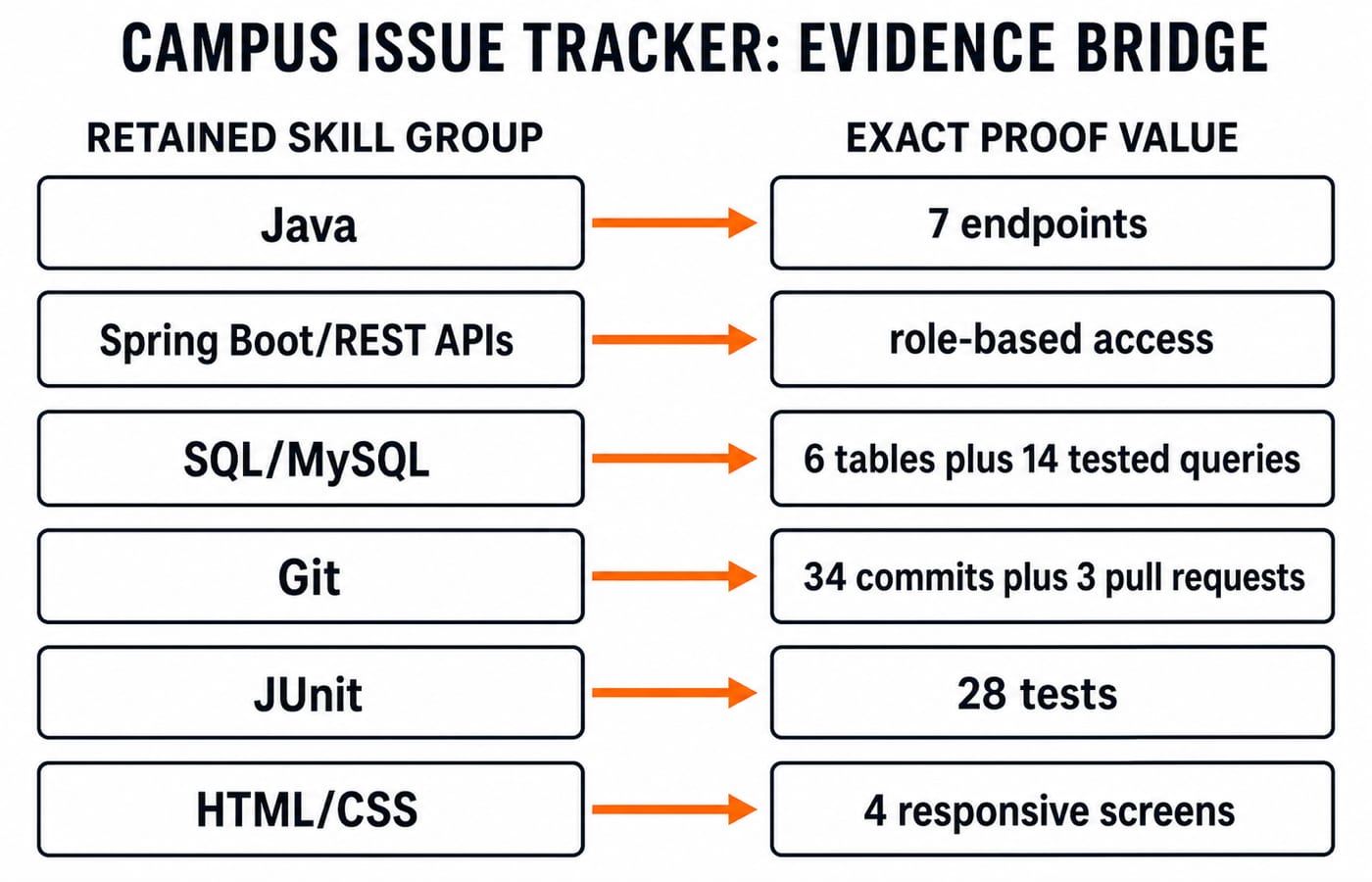
This evidence map makes every retained claim traceable:
Skill group | Artefact and Asha's action | Checkable evidence |
|---|---|---|
Java | Campus Issue Tracker backend, implemented request handling and role-based access | 7 REST endpoints |
Spring Boot/REST APIs | Campus Issue Tracker API, built and debugged endpoints | 7 endpoints and role-based access |
SQL/MySQL | Database schema, designed tables and tested queries | 6 tables and 14 queries |
Git | Repository history, contributed changes and responded to review | 34 commits and 3 reviewed pull requests |
JUnit | Test suite, wrote checks for backend behaviour | 28 tests |
HTML/CSS | User interface, built responsive pages | 4 screens |
A fresher without a substantial project can use assessed work: Database Systems coursework, four weeks: designed a 5-table library schema, wrote 10 join queries, and normalised the schema to 3NF. This supports SQL/MySQL as working knowledge. Lecture attendance cannot support it as a core skill.
Use counts you can reconstruct from a repository, assignment or notes. Never invent users, performance gains or accuracy percentages.
Tailor a skills section to the job description without keyword stuffing
Suppose a job lists exactly: Java, Spring Boot, REST APIs, SQL, Git, Docker and AWS. Asha's evidence scores are Java = 3, Spring Boot = 3, REST APIs = 3 because she built 7 endpoints, SQL = 3, Git = 2, Docker = 1, and AWS = 0.
She leads with Java, Spring Boot and REST APIs, and SQL/MySQL, then retains Git under working knowledge. She omits AWS. Docker stays out until she can explain an independently written Dockerfile, image build, container run, and one debugged failure. Matching a job-description word is not permission to claim it.
Accurate aliases such as SQL/MySQL and Spring Boot and REST APIs can help matching while reading naturally. Never add a synonym you cannot explain. This skills-block filter stops here. Resume Tailoring for a Job Description: Match Evidence Without Keyword Stuffing owns the wider evidence matrix and bullet rewrite for the rest of the resume.
Resume skills interview test: defend each word under questioning
Stress-test every retained skill: explain it in 60 seconds, point to the artefact, and answer a failure or trade-off question. Asha should explain why she chose a 6-table relational schema, how a duplicate issue request returned HTTP 409, what one JUnit test checked, and what changed after one of the 3 pull-request reviews.
Those answers come from work on 7 endpoints and 28 tests, not from unsupported confidence. A watched AWS lesson cannot become production experience. Use Technical Interview: OS, DBMS, CN & OOP Prep to prepare subject explanations.
The deletion rule is firm: if you cannot survive two follow-up questions on a skill, practise until it reaches score 2 or remove it before applying.
Resume skills section: the short version and next step
Use this five-step checklist:
Collect your project, coursework and practice artefacts.
Score every claimed skill from 0 to 3.
Retain scores 2 and 3 in the main skills block.
Group the retained set by real proficiency.
Attach every important skill to a project or coursework fact.
In Asha's worked example, 12 keywords became 6 defensible skill groups supported by 7 endpoints, 6 tables, 14 queries, 28 tests, 34 commits, 3 pull requests and 4 screens. If you want structured help refining the final document and preparing to defend it, the Interview & Resume Preparation Course is the next step.