Infosys Interview Questions for Freshers: Technical, Project and HR Answers
Prepare for technical, project, coding and HR follow-ups with a worked project defence, SQL query, coding trace, answer models and a seven-day plan.
KnowledgeGate Team
Exam prep & CS education
Updated 10 Sep 20265 min read
A fresher can memorise fifty definitions and still struggle when an interviewer starts from one resume line, asks two follow-ups, then changes tone for HR. This guide gives you representative technical, project, coding and HR questions with worked answer structures. Infosys does not publish one fixed public question list for every drive, so treat your role and call instructions as authoritative, not this article as an official paper.
Infosys interview questions: know the round before rehearsing answers
Use Infosys Interview Process: What to Prepare at Each Stage for the stage-by-stage route; here, focus on answers. Roles and drives can change the order and depth, so do not assume universal round, question or time counts. Infosys Careers says legitimate hiring includes at least one virtual or in-person interview, never requires a fee and should be authenticated through official channels.
Evidence to read | What it decides | Your output |
|---|---|---|
Interview call or drive notice | Role, mode, round order, documents | One-page checklist |
Resume and project repository | Likely technical follow-ups | 12-question defence sheet |
Job description | Required language and skills | Six priority concepts |
Infosys project interview questions: defend one project under follow-ups
BookBridge is a fictional Spring Boot and MySQL library-loan API for 12,000 sample books and 1,500 sample students. The candidate owned POST /loans, validation and its transaction. Rehearse:
Explain the project in 90 seconds.
Why MySQL here?
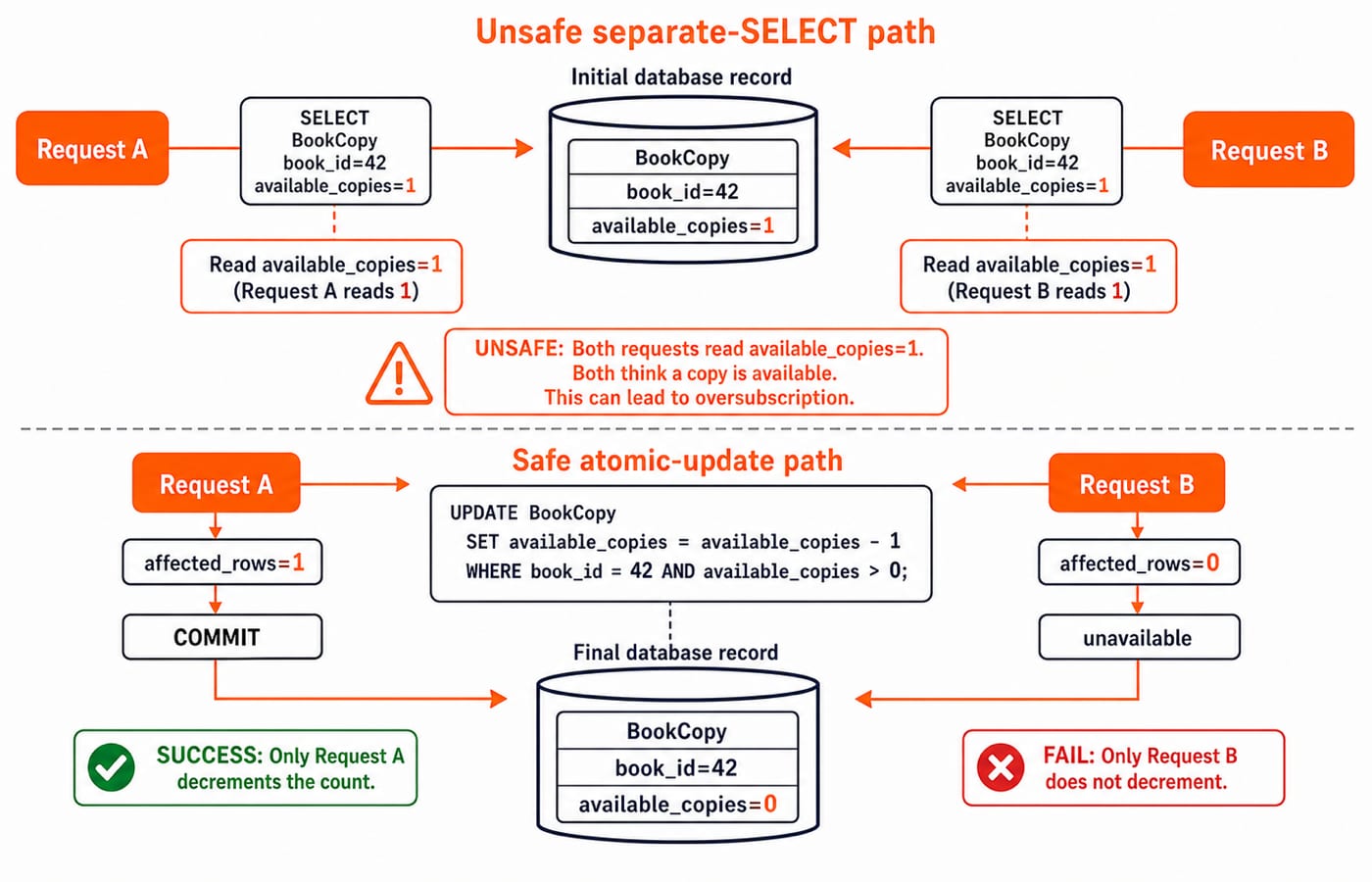
What happens if two students request the last copy?
Describe one bug and how you isolated it.
For book_id=42, available_copies=1. Separate SELECT checks let A and B both read 1 before either writes. Instead run:
UPDATE BookCopy
SET available_copies = available_copies - 1
WHERE book_id = 42 AND available_copies > 0;
A gets affected_rows=1, commits and leaves 0. B gets affected_rows=0 and returns unavailable. Combining the check and decrement means only one request claims the copy. Explain that reasoning before naming transactions or locks.
Infosys technical interview questions: answer one more why
Prompt | What the answer must say |
|---|---|
Process versus thread? | Threads share code, heap and process resources, but have separate stacks, registers and program counters. |
Overloading versus overriding? | Overloading selects a signature at compile time, such as |
TCP versus UDP? | TCP reliability and ordering suit file transfer. UDP's low overhead suits a live voice packet. |
What do ACID properties protect? | BookBridge must not insert a loan without decrementing its copy; concurrent requests must preserve valid state. |
Given Loan(loan_id, student_id, book_id, returned_at) rows (1,101,42,NULL), (2,101,55,NULL), (3,101,63,NULL), (4,205,77,NULL), (5,205,81,'2026-07-01'), find students with at least three open loans:
SELECT student_id, COUNT(*) AS open_loans
FROM Loan
WHERE returned_at IS NULL
GROUP BY student_id
HAVING COUNT(*) >= 3;
Result: student_id=101, open_loans=3. WHERE removes returned rows before grouping; HAVING filters the computed count afterward. Test a (returned_at, student_id) index with EXPLAIN rather than declaring it universally optimal.
Infosys coding and pseudocode questions: show the trace
Prompt: return the second distinct largest value in [12, 4, 19, 19, 7] without sorting. Track (largest, second):
(-infinity,-infinity) -> (12,-infinity) -> (12,4) -> (19,12) -> (19,12) -> (19,12)
Ignore the duplicate 19; 7 changes nothing. The answer is 12, with O(n) time and O(1) space. For an empty array or one distinct value, return an optional empty result or throw a documented exception, never 0. For [-5,-2,-9], the pair ends at (-2,-5), so the answer is -5.
Use INFOSYS Superset for structured company-specific practice across aptitude, reasoning, verbal, pseudocode, writing and coding preparation.
Infosys HR interview questions: turn claims into evidence
Prepare structures, not scripts: Tell me about yourself; Why do you want to join Infosys?; What is one strength and one weakness?; Tell me about a team disagreement; Are you open to relocation or shifts?; and What would you like to ask us? Use HR Interview Questions for Freshers: How to Answer Honestly for more practice. Keep relocation and shift answers truthful.
A 75-second model: “I am a final-year B.Tech IT student. DBMS and OOP are my strongest subjects. I built BookBridge with Spring Boot and MySQL, owned its loan transaction and fixed the last-copy race using a conditional update and affected-row check. I now seek an entry-level development role.”
For “Why Infosys?”, match one verified job-description or official-call detail to evidence from your work. Avoid “best company” and invented culture, project or growth guarantees.
Model STAR scenario, replace with true details: a four-person project lost two days to an API payload disagreement; its demo stayed on day 10. The candidate ran a 15-minute 9:30 a.m. sync for three mornings, froze bookId, studentId and dueDate in a shared Postman collection, and owned integration. It finished on day 9; the team demonstrated on day 10.
Infosys mock interview scorecard: test clarity and depth
Score direct answer, technical reason, evidence or trace and follow-up honesty from 0 to 2. Zero is missing, 1 is vague, and 2 is specific and defensible. Maximum: 8. This is KnowledgeGate's practice device, not an Infosys scoring system.
The concurrency answer scores 2 + 2 + 2 + 1 = 7/8: direct, reasoned and supported by book_id=42 plus affected-row values. Guessing the isolation level instead of verifying it loses one mark. Repeat only that weakness.
Infosys interview preparation: a seven-day, 11-hour-45-minute plan
Day | Time | Task |
|---|---|---|
1 | 90 min | Mark every resume line; write 12 likely questions. |
2 | 120 min | DBMS and SQL; speak 10 answers. |
3 | 120 min | OS, OOP and networks; speak 15 short answers. |
4 | 120 min | Trace three coding problems, including second largest. |
5 | 90 min | Record six HR answers. |
6 | 105 min | Run two 30-minute mocks; review for 45 minutes. |
7 | 60 min | Re-read the call; revise only weak answers. |
Sum: 1:30 + 2:00 + 2:00 + 2:00 + 1:30 + 1:45 + 1:00 = 11:45. Miss a day? Keep the Day 6 mock, cut core-CS prompts from 15 to 8, and do not move all speaking practice to the final night. The Interview & Resume Preparation Course offers guided technical and HR practice plus personal review.
Infosys interview questions: the short version and next step
Know every resume line, prepare one project to follow-up depth, speak core-CS answers aloud, trace code on paper and build honest HR evidence. Use the scorecard during final practice. If you need company-specific resources, explore Company-Specific Placement Courses. Before the interview, verify the exact role and instructions in your own official Infosys communication.
Keep learning
Accenture Coding Questions: 4 Patterns with Solved Dry Runs
Stop memorising company-question lists. Learn four reusable coding patterns through precise examples involving strings, arrays, digits, and matrices.
Updated 2 Oct 20265 min readCompany-Specific Prep
Accenture Placement Preparation: 4-Week, 56-Hour Study Plan
Turn four preparation lanes into a practical weekly calendar. Start with a baseline, move hours towards your errors, and recover missed sessions without cramming.
Updated 27 Sep 20265 min readCompany-Specific Prep
Capgemini Interview Questions: Technical and HR Rounds with Model Answers
Practise clear technical and HR answers through Java, SQL, a coding trace and one consistent project story. Each example shows what to say and how to support it.
Updated 25 Sep 20265 min readCompany-Specific Prep
Capgemini Drive Mistakes: Stage-by-Stage Rejection Risks and Fixes
Diagnose the controllable evidence gaps behind common Capgemini drive risks. Repair your CV, timed practice, code traces, project proof and behavioural stories with worked drills.
Updated 24 Sep 20266 min readCompany-Specific Prep