Capgemini Technical Interview Process: Pseudocode, CS Fundamentals and Project Questions
Build an evidence-first Capgemini interview plan with a traced pseudocode exercise, a concurrency case, a measured project story and a 300-minute rehearsal.
KnowledgeGate Team
Exam prep & CS education
Updated 7 Aug 20266 min read
Clearing a pseudocode-style assessment does not prepare you to explain that code out loud, defend CS fundamentals or prove what you built. Those are three separate demands, and Capgemini's own careers pages say how many technical interviews you sit depends on the position, so no generic stage list outranks your posting, your invitation and your recruiter instructions. What travels across every version of the route is evidence you can defend: a trace you can narrate, a CS concept tied to a failure you can describe, and a project number you measured yourself. Practice for a named company sits under company-specific placement preparation.
1. Capgemini technical interview process: the four published steps and what overrides them
Source | What to extract | What it settles |
|---|---|---|
Job posting | Role, required skills, responsibilities | Which skills the technical round can draw on |
Your invitation | Assessment name, platform, instructions | Which test you actually sit, and when |
Candidate portal and recruiter | Application status, interview format, next action | Your route, stage by stage |
Capgemini India recruitment page | The four published steps | The framework the recruiter is working from |
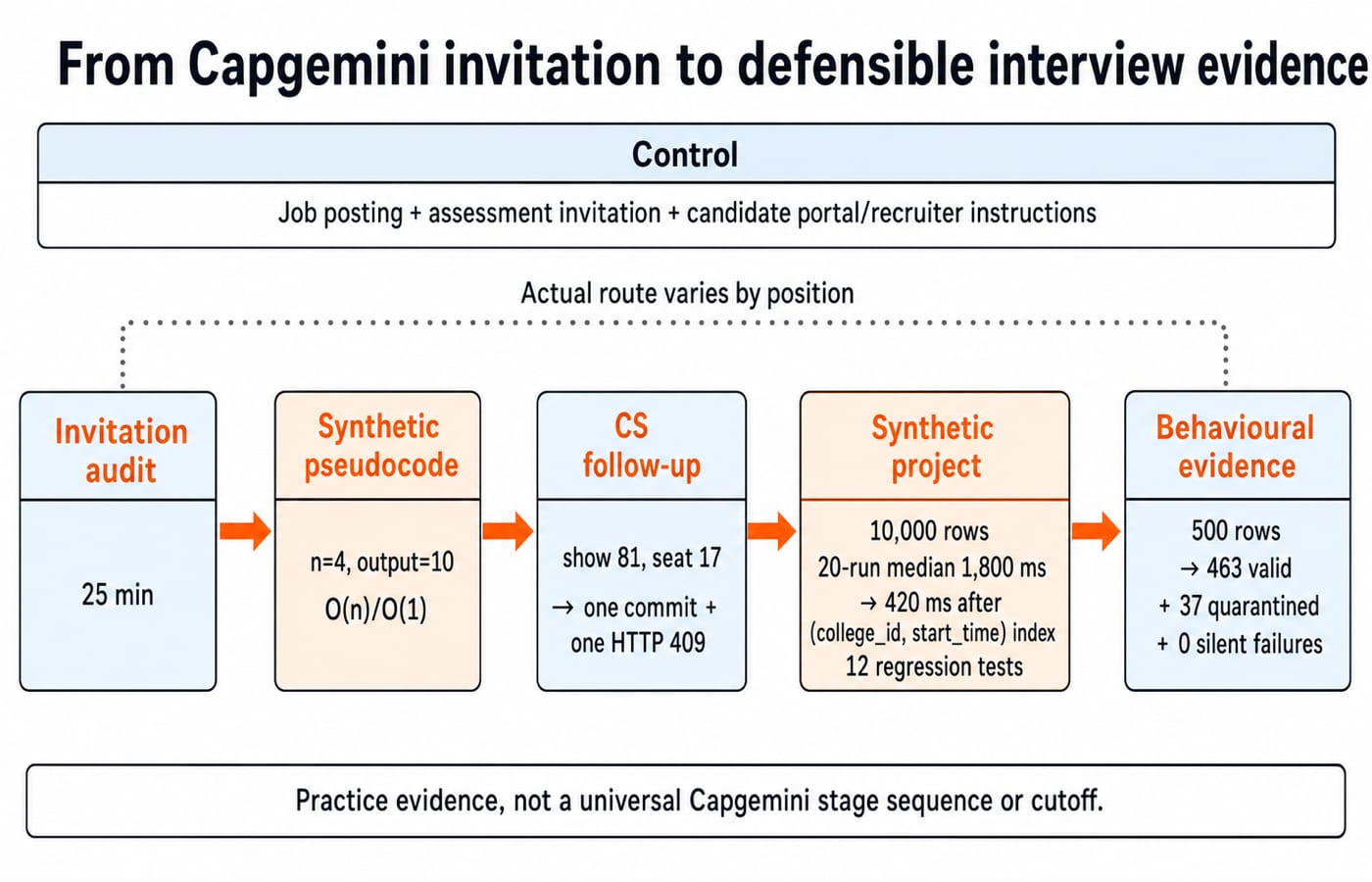
Capgemini's India recruitment process publishes four steps: the application, screening and position mapping, the interview process, then onboarding and placement. Step three has its own order. An HR screening comes first, by video call or phone. Proctored online technical and language assessments follow where applicable. One or two technical interviews are then held by video or in person, depending on the position, and a successful technical evaluation is followed by an HR behavioural interview and document submission in the candidate portal. For fresh graduates the same page lists the typical stages as an online aptitude test, a coding or technical assessment, a group discussion for select roles, the technical interview and the HR interview. The Capgemini Superset Course carries videos and practice questions for those sections.
One detail worth acting on before any of it: Capgemini states that interview communication is sent only through its official recruitment system, with Microsoft Teams invites for virtual interviews. An interview invite or offer that arrives from a personal email address should be reported to the Capgemini interview helpdesk rather than answered.
2. Pseudocode in the technical interview: trace the state before you give the output
Take this prompt. Set n = 4, x = 5, y = 2, total = 0. For i = 1 through n, add (x mod y) to total, 3 to x, then 1 to y.
i | x before | y before | x mod y | total after | x after | y after |
|---|---|---|---|---|---|---|
1 | 5 | 2 | 1 | 1 | 8 | 3 |
2 | 8 | 3 | 2 | 3 | 11 | 4 |
3 | 11 | 4 | 3 | 6 | 14 | 5 |
4 | 14 | 5 | 4 | 10 | 17 | 6 |
It prints 10. Be ready to say why the two increments come after the modulo and not before: move x = x + 3 and y = y + 1 above the total update and the four terms become 2, 3, 4 and 5, so the same loop prints 14. With n = 0 the loop never runs and it prints 0. Complexity is O(n) time and O(1) extra space. The screening round itself, including the game-based aptitude and English sections, is worked through in Capgemini Placement: Pseudocode, Game Aptitude & English.
3. Move from pseudocode to code without losing the explanation
static int score(int n) {
    if (n < 0) {
        throw new IllegalArgumentException();
    }
    int x = 5, y = 2, total = 0;
    for (int i = 1; i <= n; i++) {
        total = total + (x % y);
        x = x + 3;
        y = y + 1;
    }
    return total;
}
Check score(0) = 0, score(1) = 1 and score(4) = 10. Define the variables, trace one iteration, state the loop condition, name the edge case, then give complexity. Do not jump to 10. If asked for a dry run, reproduce the table.
4. CS fundamentals: one seat-booking race answers four DBMS questions
Two requests, A and B, arrive at 14:03:12 to reserve (show_id = 81, seat_no = 17). Without a constraint, both read available = true and both create a row. Add UNIQUE(show_id, seat_no) and do the insert inside a transaction. One commits, and the other's duplicate-key failure becomes HTTP 409 Seat already booked.
That single case answers four DBMS questions in the order a panel tends to ask them. Why did the duplicate happen? Isolation governs what one transaction sees of another, and at the default isolation level of a typical service both requests read available = true before either commits. Why not fix it in application code? A check then insert in the service stays racy, because both checks pass before either insert lands. What actually makes the seat safe? The unique constraint, which the database enforces however many requests race for it. What happens to the request that loses? Atomicity rolls its insert back whole, so it fails cleanly as a 409 instead of half-writing a booking. The same case seeds the follow-ups in the other three subjects:
Area | Definition | Project use | Trade-off |
|---|---|---|---|
OS | Process owns space; threads share it | Isolate workers | Sharing weakens isolation |
DBMS | Transaction groups work; constraint rejects duplicates | Protect one seat | Checks add write cost |
Networks | TCP orders and retries bytes | Explain request delivery | Reliability adds work |
OOP | Interface declares contract; implementation supplies behaviour | Swap booking service | Abstraction adds design cost |
For the subject-by-subject drill behind that table, work through Technical Interview Prep: OS, DBMS, CN and OOP Answers.
5. Project questions: turn a feature list into measured engineering evidence
Work one project all the way through. A four-person team built a Spring Boot and MySQL college-event API in three weeks. GET /events?collegeId=42&from=2026-01-01 queried 10,000 rows. Across 20 local runs the median response was 1,800 ms, and the query plan showed a full scan.
Add (college_id, start_time), keep the same dataset and the same 20-run method, then report a 420 ms median on the same machine. Add 12 regression tests for empty results, invalid dates and pagination.
Shape 60 seconds as problem -> ownership -> decision -> result -> trade-off. Put the college_id equality before the start_time range in the index. The index costs storage and write work. Qualify 420 ms as a local median. The Interview & Resume Preparation Course pairs resume review with mock technical and HR interviews if you want those 60 seconds challenged by someone else.
6. Rehearse the assessment-to-project hand-off in five evidence-first hours
Use exactly 300 minutes:
25 minutes: posting and invitation audit
55 minutes: trace and code
score(4) = 1070 minutes: seat-booking case and CS recall
90 minutes: record and challenge the
1,800 ms -> 420 msstory45 minutes: behavioural answer and role-fit questions
15 minutes: replay recording; note three weak claims
Rehearse one behavioural answer against a real failure. Four hours before the demo, 37 of 500 rows carry invalid dates. You add row-level validation and an error report, import the 463 valid rows, quarantine the 37 with a reason recorded against each, and ship with zero silent failures. Give it as situation, task, action and result, without blaming a teammate.
7. Capgemini technical interview process: the short version and next step
Carry four proofs into the room: I know what my own invitation asks of me, I can trace before I code, I can connect a CS concept to the failure case it prevents, and I can prove my project contribution with a baseline, an action, a result and a trade-off. Use the Capgemini course for the assessment sections and the interview course for the rehearsal. Then let your latest email from Capgemini, rather than a generic stage list, tell you which round comes next.
Keep learning
Accenture Coding Questions: 4 Patterns with Solved Dry Runs
Stop memorising company-question lists. Learn four reusable coding patterns through precise examples involving strings, arrays, digits, and matrices.
Updated 2 Oct 20265 min readCompany-Specific Prep
Accenture Placement Preparation: 4-Week, 56-Hour Study Plan
Turn four preparation lanes into a practical weekly calendar. Start with a baseline, move hours towards your errors, and recover missed sessions without cramming.
Updated 27 Sep 20265 min readCompany-Specific Prep
Capgemini Interview Questions: Technical and HR Rounds with Model Answers
Practise clear technical and HR answers through Java, SQL, a coding trace and one consistent project story. Each example shows what to say and how to support it.
Updated 25 Sep 20265 min readCompany-Specific Prep
Capgemini Drive Mistakes: Stage-by-Stage Rejection Risks and Fixes
Diagnose the controllable evidence gaps behind common Capgemini drive risks. Repair your CV, timed practice, code traces, project proof and behavioural stories with worked drills.
Updated 24 Sep 20266 min readCompany-Specific Prep