

REET Social Science Preparation: Priority Topics and an 8-Week Plan
Decide what to revise first using syllabus coverage and your diagnostic results. Use a nine-hour weekly plan, a diagnostic tally and worked practice examples to organise Social Studies preparation.
KnowledgeGate Team
Exam prep & CS education
Updated 23 Nov 20264 min read

If you keep adding chapters to your REET Level-2 notebook but cannot decide what to revise first, you need a coverage order. Combine syllabus coverage and demonstrated weaknesses to set priorities. A useful starting order combines syllabus coverage with demonstrated weaknesses, then leaves time to repair mistakes.
Start with the official Social Studies boundary
BSER's REET-2024 Level-II syllabus, page 25 specified 60 questions and 60 marks for Social Studies. Its scope includes history, geography, civics, Rajasthan studies and pedagogical issues.
For the REET-2024 cycle, use the Level-II syllabus as the reference; check your cycle's notification before applying these boundaries.
Keep two measures separate. A topic's share tells you how much of a particular paper it occupied. Your error rate tells you how much repair you need. The hours below cover Social Studies only; reserve separate time for languages and other sections.
Use a coverage order that keeps Rajasthan and pedagogy visible
Suggested study order
Order | Coverage | Study output |
|---|---|---|
1 | Constitution, government and local administration | Comparison cards for roles and powers |
2 | Physical geography, Indian resources and Rajasthan geography | Blank maps and cause-effect notes |
3 | Indian history plus Rajasthan history and culture | Timelines and matching grids |
4 | Remaining syllabus gaps identified through diagnosis | A checklist of unfinished topics |
Run pedagogy alongside every row. After studying a topic, ask which classroom activity would help children understand it and what evidence would show learning.
Keep Rajasthan drainage, water conservation, movements and cultural heritage visible in your checklist. Limit economics to the syllabus's resources, development and historical contexts. Change the starting order if your diagnostic exposes a larger weakness elsewhere.
When comparing overlapping exams, browse the teaching exam course catalogue, then match each resource to your syllabus.
Turn a paper tally into personal priorities
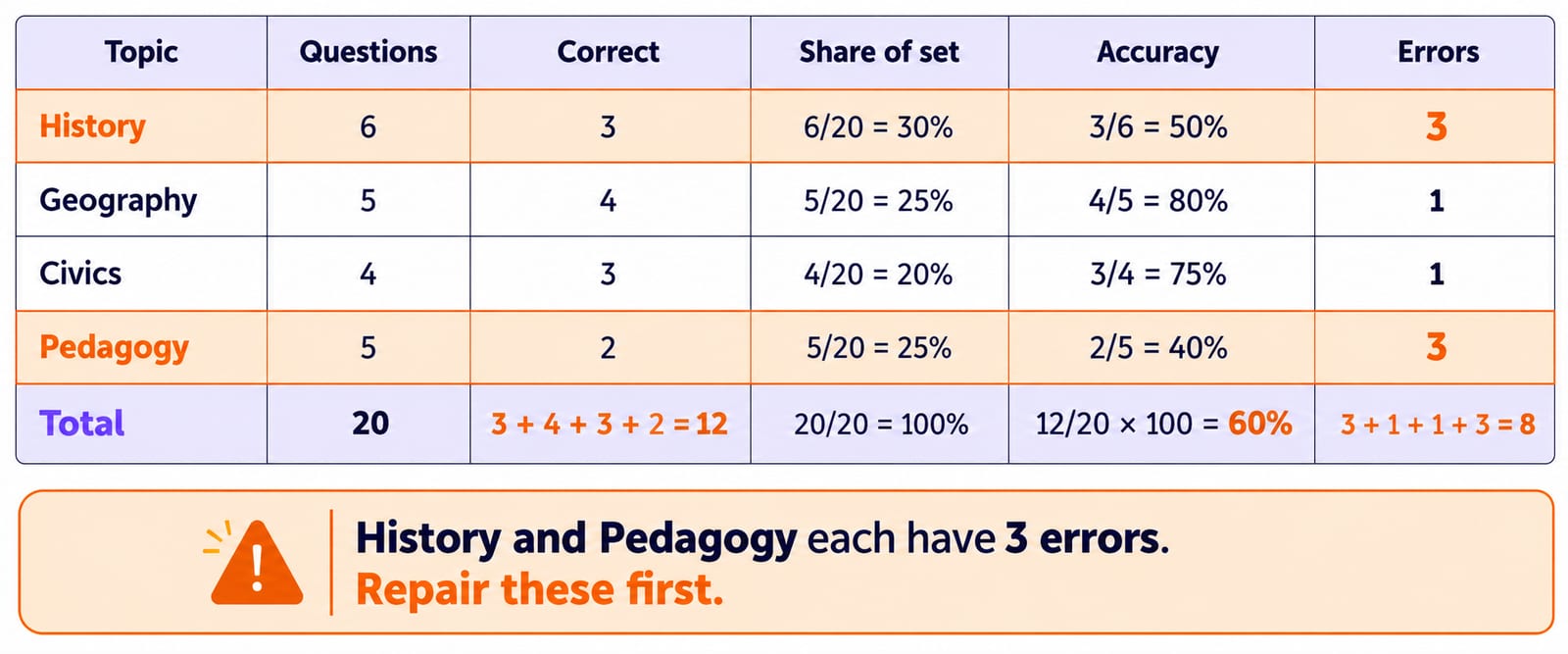
For an actual audit, use the REET-2024 Level-2 Shift-2 booklet and its matching final key from the official REET-2024 portal, reet2024.co.in. Record the booklet name, tag each Social Studies question with one primary topic and mark correctness. A second topic can be a note; do not count the question twice.
Here is a sample 20-question set with illustrative numbers:
Topic | Questions | Correct | Share of set | Accuracy | Errors |
|---|---|---|---|---|---|
History | 6 | 3 | 6/20 = 30% | 3/6 = 50% | 3 |
Geography | 5 | 4 | 5/20 = 25% | 4/5 = 80% | 1 |
Civics | 4 | 3 | 4/20 = 20% | 3/4 = 75% | 1 |
Pedagogy | 5 | 2 | 5/20 = 25% | 2/5 = 40% | 3 |
Total correct = 3 + 4 + 3 + 2 = 12; accuracy = 12/20 x 100 = 60%. Errors total 3 + 1 + 1 + 3 = 8. History and pedagogy each contribute three errors, so repair these first.
Build an eight-week plan around nine reliable hours
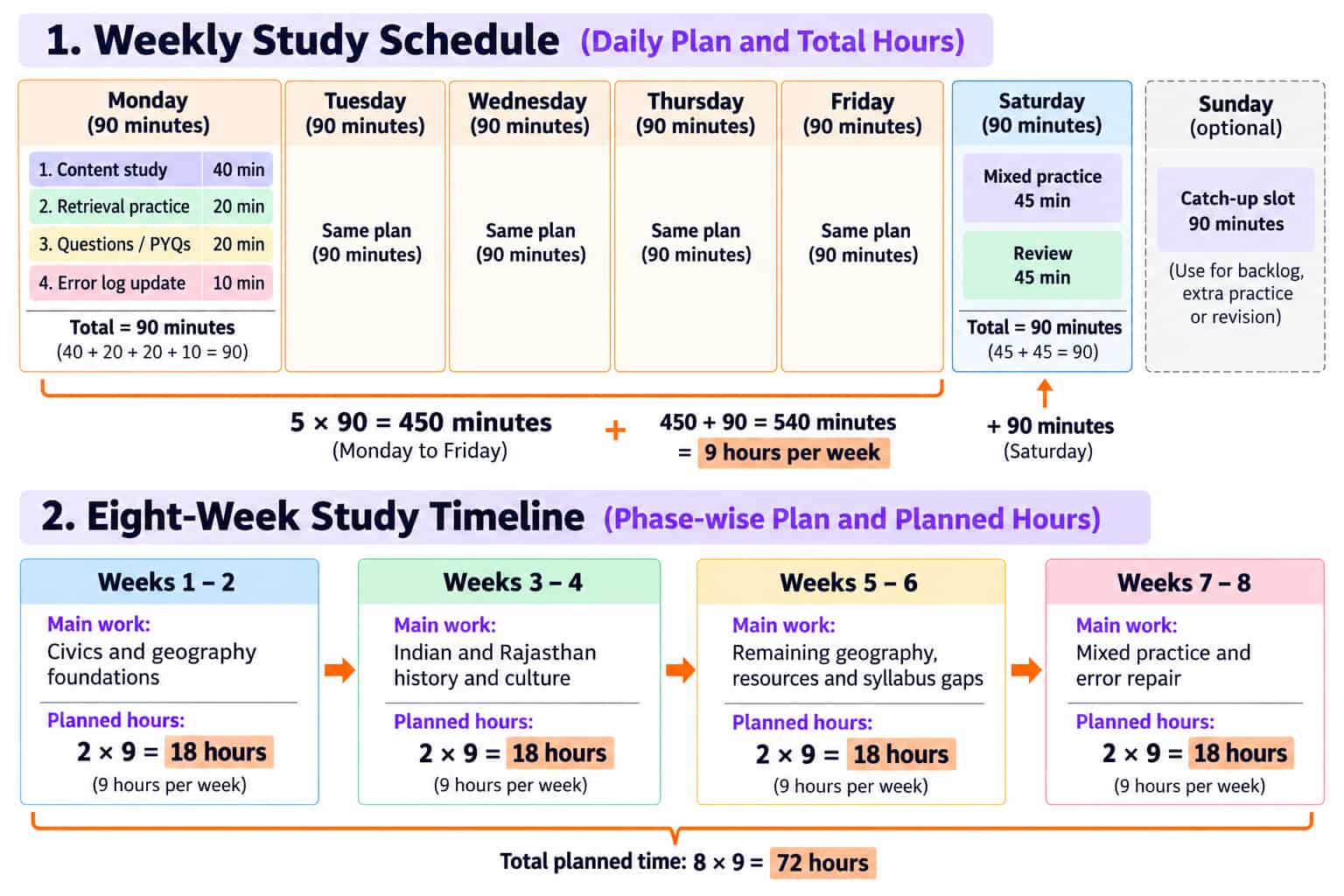
Monday to Friday at 90 minutes daily gives 5 x 90 = 450 minutes. Add Saturday's 90 minutes: 450 + 90 = 540 minutes, or 9 hours weekly. Across eight weeks, 8 x 9 = 72 planned hours. Sunday's optional 90-minute catch-up slot is outside this baseline.
Each weekday uses 40 minutes for content, 20 for retrieval, 20 for questions and 10 for the error log: 40 + 20 + 20 + 10 = 90. Saturday uses 45 minutes for mixed practice and 45 for review.
Weeks | Main work | Planned hours |
|---|---|---|
1-2 | Civics and geography foundations | 18 |
3-4 | Indian and Rajasthan history and culture | 18 |
5-6 | Remaining geography, resources and syllabus gaps | 18 |
7-8 | Mixed practice and error repair | 18 |
Each phase has 2 x 9 = 18 hours. Include one pedagogy application in each day's question work. In weeks 7-8, turn the 40-minute reading block into targeted repair.
One missed weekday leaves 9 - 1.5 = 7.5 hours; Sunday restores 9. Two missed weekdays plus Sunday give 9 - 3 + 1.5 = 7.5 hours. Carry forward a low-priority reading block, preserve review and avoid doubling tomorrow's workload.
Practise facts, map reasoning and classroom choices together
Try these two practice questions.
Map scale: A sketch uses 1 cm = 20 km. Two places are 3.5 cm apart. What distance does the sketch represent?
(a) 7 km
(b) 23.5 km
(c) 70 km
(d) 700 km
Answer: (c). Distance = 3.5 cm x 20 km/cm = 70 km. The centimetres cancel, leaving kilometres. This is straight-line distance on the sketch, not road distance.
Classroom choice: Pupils disagree about village water use. Which activity best develops enquiry and justification?
(a) Copy a definition.
(b) Memorise the teacher's conclusion.
(c) Compare observations from a supervised local survey and explain differences.
(d) Rank pupils by recall speed.
Answer: (c). Survey evidence lets pupils examine why observations differ. Copying a definition does not reveal the evidence behind a conclusion. The experiential pedagogy examples extend this connection between activity and reflection.
For preparation, practise chronological ordering, matching a feature to a place, and selecting an activity for a stated learning outcome.
Review mistakes before adding another mock
Keep a four-column error log:
Topic | Error type | Correction | Retest date |
|---|---|---|---|
Map scale | Multiplication/unit error | 3.5 x 20 = 70 km | Study days 3 and 7 after first practice on day 1 |
Use the teaching-exam mock review method to organise correction and retesting. Another set should check whether the logged error returns.
Suppose a fresh comparable set after repair gives 15/20 = 75%, against the earlier 12/20 = 60%. That is three additional correct answers and 75 - 60 = 15 percentage points. Check topic mix and difficulty before comparing scores.
Choose tomorrow's task and a resource that fits it
Mark unfinished official syllabus blocks, select the weakest block from your diagnostic and reserve the next 90-minute session. Give that session one concrete output, such as a corrected map or a comparison card you can reproduce without notes.
If you are also preparing for CTET, compare the CTET Paper 2 course with your overlapping pedagogy needs before choosing it. Compare syllabuses first: Rajasthan-specific Social Studies still needs separate coverage.
Go deeper with the full courseCTET Paper 1 2026 — प्राथमिक शिक्षक (कक्षा 1–5)
Keep learning

TPSC Computer Science Weightage: Rank High-Return Topics with Syllabus and PYQs
A fixed TPSC CS weightage chart would be convenient, but the official syllabus does not provide one. Learn to turn verified papers and diagnostic gaps into a personal revision order.
Updated 30 Oct 20265 min readTPSC Computer Science

UGC NET Computer Science high-yield topics: where practice volume and past emphasis concentrate
UGC NET Computer Science high-yield topics: which subjects to prioritise first, grounded in our question-bank density, and the solved sets to start drilling.
Updated 29 Oct 20266 min read242 viewsUGC NET Computer Science

TPSC Computer Science 14-Week Study Plan: Weekly Topics, PYQs and Mocks
Turn 8 to 12 reliable study hours into a practical weekly cycle of CS repair, PYQs, unit tests, full mocks and two evidence-led revision passes.
Updated 30 Oct 20266 min readTPSC Computer Science

REET Science Solved Questions: Explain the Concept and Eliminate Traps
Work through five original science questions, explain why the distractors fail, and turn each answer into a classroom explanation. Includes pressure and efficiency calculations.
Updated 17 Nov 20265 min readCTET & UPTET