

CG TET Eligibility and Selection: Paper-Wise Routes to Recruitment
Choose the teaching level first, then match your qualifications to the correct route. Worked examples show how academic percentages, TET qualification and recruitment checks answer different questions.
KnowledgeGate Team
Exam prep & CS education
Updated 22 Nov 20265 min read

CG TET paper choice starts with the classes you intend to teach and the qualification route your documents support. A qualifying result is a TET credential, while a teaching appointment follows a separate vacancy process. Historical TET24 route examples show how to check each condition.
Choose the teaching level before choosing a paper
Paper I concerns primary teaching, classes 1–5. Paper II concerns upper-primary teaching, classes 6–8. These are teaching levels, not consecutive selection rounds that everyone must clear.
A class-3 target points to the primary route. A class-7 target points to upper-primary eligibility. Someone interested in both levels must examine both routes separately; one result should not be treated as covering both.
For the paper pattern, syllabus and historical age treatment of another state TET, compare the Arunachal Pradesh TET eligibility, pattern and syllabus guide. That post owns Arunachal's state-specific pattern; Chhattisgarh qualification routes and the hand-off from TET eligibility to recruitment require the CG TET rules.
Match a primary-level qualification route precisely
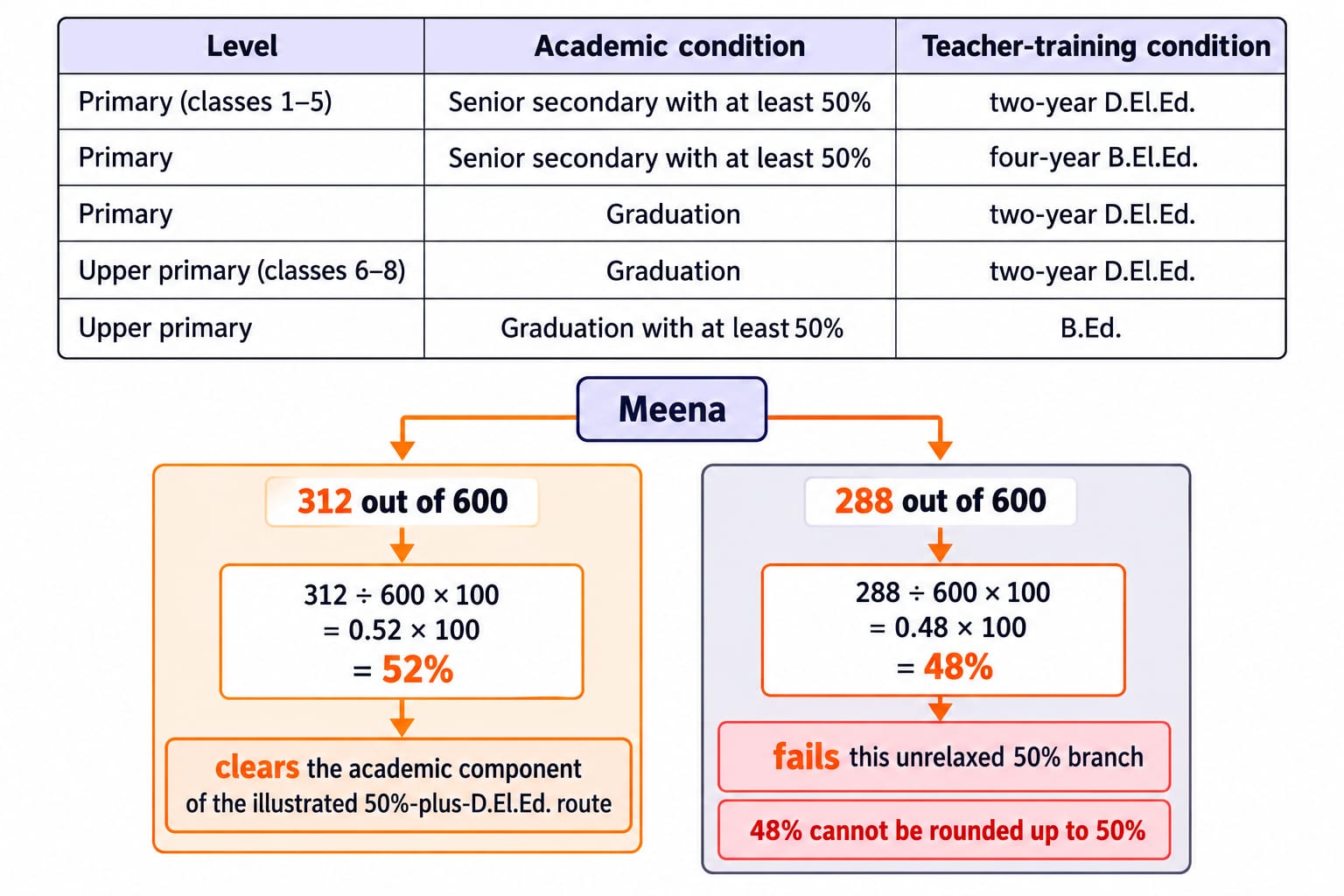
Read each row as a pair: the academic condition and its matching teacher-training condition belong together.
Level | Academic condition | Teacher-training condition |
|---|---|---|
Primary (classes 1–5) | Senior secondary with at least 50% | two-year D.El.Ed. |
Primary | Senior secondary with at least 50% | four-year B.El.Ed. |
Primary | Graduation | two-year D.El.Ed. |
Upper primary (classes 6–8) | Graduation | two-year D.El.Ed. |
Upper primary | Graduation with at least 50% | B.Ed. |
These are illustrative routes; the guidelines also carry legacy, integrated-degree and special-education alternatives.
A primary-route record contains a recognised two-year D.El.Ed. and a hypothetical senior-secondary score of 312 out of 600:
312 / 600 x 100 = 0.52 x 100 = 52%.
The 52% result clears the academic component of the illustrated 50%-plus-D.El.Ed. route. Recognition and documentary requirements remain separate checks.
A second record with 288 out of 600 gives 288 / 600 x 100 = 0.48 x 100 = 48%. That fails this unrelaxed 50% branch, not necessarily every possible route. Another permitted route or relaxation needs separate evidence; 48% cannot be rounded up to 50%.
The routes shown follow the SCERT guidelines issued for the 2024 cycle. Your own cycle's notification decides eligibility, including recognition and studying or completion conditions; use SCERT Chhattisgarh to locate official updates.
Check the upper-primary route without borrowing primary rules
The upper-primary rows reflect the same 2024-cycle guidelines. Graduation and professional teacher training are distinct requirements: an ordinary bachelor's degree alone does not establish either illustrated route.
An upper-primary record can pair a recognised B.Ed. with a hypothetical graduation total of 1,170 out of 1,800:
1,170 / 1,800 x 100 = 0.65 x 100 = 65%.
The 65% result clears the academic component of the graduation-50%-plus-B.Ed. example. That calculation does not establish every requirement for a class-7 vacancy.
Special-education, integrated-degree and legacy routes need their own exact clauses. Keep qualification titles, programme durations and recognition conditions intact. A similar-sounding programme is not automatically an equivalent qualification.
Separate studying status, category concessions and recruitment age
Compare your course recognition, the clause's admitted/studying/passed wording, required proof and qualification cut-off. Do not assume that only final-year trainees can apply, or that enrolment automatically satisfies every route.
Keep three different concessions separate:
Academic-percentage relaxation changes the percentage condition for a qualification route.
TET qualifying-threshold relaxation changes the threshold for a qualifying result.
Recruitment-age relaxation belongs to recruitment eligibility; it does not determine permission to sit the test.
The candidate with 48% would need an academic-percentage relaxation expressly covering her category and route, or a different permitted route. An age concession or lower TET pass threshold cannot repair that academic shortfall.
The UPTET eligibility and exam-structure explainer owns UPTET's two-paper structure and preparation transfer. Chhattisgarh qualification evidence and the recruitment hand-off require the CG TET rules.
Understand what a qualifying result actually gives you
The 2024-cycle guidelines distinguish a TET eligibility certificate from an appointment. The CTET eligibility, paper choice and certificate-validity explainer owns the national CTET validity question; CG TET rules govern the Chhattisgarh certificate-to-recruitment hand-off. The appointing authority checks documents before appointment. An admit card or permission to sit the examination is therefore not final confirmation that every qualification claim is valid.
A candidate who receives a qualifying result and retains the certificate has completed the TET stage. That result does not provide an appointment or clear a particular employer's selection process merely by qualifying.
Use the applicable CG TET result and certificate notice to interpret that credential. CTET pass rules cannot determine what a CG TET result means. Keep the certificate with the qualification documents that support the route you claimed.
Follow the separate recruitment process after CG TET
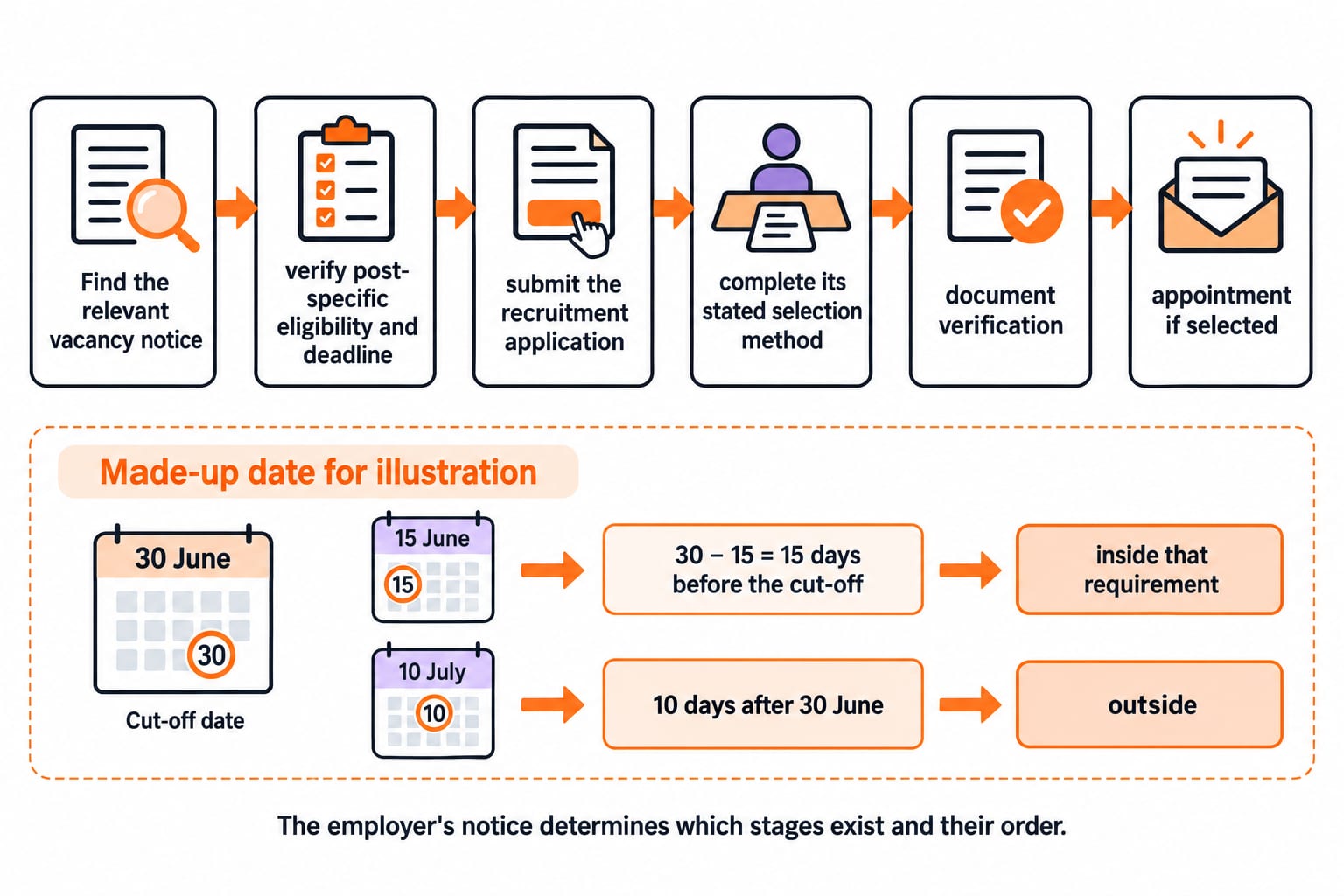
Use this as a framework for reading a vacancy notice, not a universally prescribed sequence of recruitment rounds:
Find the relevant vacancy notice -> verify post-specific eligibility and deadline -> submit the recruitment application -> complete its stated selection method -> document verification -> appointment if selected.
The employer's notice determines which stages exist and their order. Do not assume an interview, counselling round or particular weightage for TET marks. Applying for CG TET and applying for a teaching vacancy are separate actions.
Imagine a recruitment notice requires qualification completion by 30 June, a made-up date for illustration, not a date from any real notification. Completion on 15 June is 30 - 15 = 15 days before the cut-off, so it falls inside that requirement. Completion on 10 July is 10 days after 30 June, so it falls outside, even with an on-time application.
Completion date and certificate printing date can differ. The notice determines which evidence establishes completion by the required date.
Finish with a five-field eligibility check and a focused next step
Make an eligibility sheet with five fields: intended classes; exact qualification route; academic percentage; training, recognition and completion evidence; applicable exam and recruitment notices. The sample calculations are settled, but the notification and document checks remain personal.
Explore teaching eligibility courses after identifying your route. The CTET Paper 1 course for overlapping foundational topics covers child development and pedagogy, mathematics and EVS. Treat it as CTET preparation for shared foundations, not a CG TET-specific programme or evidence of CG TET eligibility.
Complete your eligibility sheet before choosing a preparation plan.
Go deeper with the full courseCTET Paper 1 2026 — प्राथमिक शिक्षक (कक्षा 1–5)
Keep learning
CG Pre B.Ed Exam: Eligibility, Paper Pattern and College Allotment
Check how qualification marks affect eligibility for the two-year B.Ed route, understand the paper's five sections, and see why merit rank and college choices both matter during allotment.
Updated 29 Oct 20264 min readGovt Exam Strategy

Coal India MT Recruitment Routes: CBT vs GATE Notice Checklist
Two Coal India Management Trainee notices can use different tests, disciplines and selection stages. Use this checklist to identify the route before preparing.
Updated 30 Oct 20265 min read115 viewsCoal India MT
Arunachal Pradesh TET: Paper I vs II Eligibility, Pattern and Syllabus
Choose the Arunachal TET paper for your teaching level, check recognised qualification routes, and organise subject content alongside pedagogy. Worked examples explain question shares and classroom error analysis.
Updated 21 Nov 20264 min readCTET & UPTET
SBI SO Exam Pattern and Marking Scheme: Post-Wise Routes Explained
There is no single SBI SO paper pattern. Use this guide to identify your post's route, understand qualifying and merit components, and build a timetable from the official notice.
Updated 30 Oct 20264 min read53 viewsSBI Exams