

Teaching Continuum: Memory Level to Reflective Level
The same rectangle lesson can test recall, explanation or investigation. Follow one garden example through all three teaching levels, then practise identifying the evidence that separates them.
KnowledgeGate Team
Exam prep & CS education
Updated 24 Nov 20266 min read

One rectangle lesson can ask learners to recite a formula, explain an area or investigate a design. The difference lies in the thinking demanded and the evidence produced. Memory names the formula, understanding explains the relationship, and reflection tests a design against alternatives. For broader teaching-exam planning, pair this distinction with the CTET and UPTET preparation guides. Apply the distinction to each practice stem below.
What changes along the teaching continuum?
At the memory level, learners retrieve taught facts or procedures. At the understanding level, they explain meanings and relationships. At the reflective level, they investigate a problem, consider alternatives, test a hypothesis and judge evidence.
These represent increasing cognitive demands, not permanent labels attached to learners. One learner can demonstrate all three within the same lesson.
Level | Teacher's prompt | Learner evidence | Suitable assessment |
|---|---|---|---|
Memory | State the area formula. | Recalls A = l × b. | Direct recall |
Understanding | Explain 6 × 2. | Two rows of six unit squares give 12. | Explanation with a representation |
Reflective | With 16 m of fencing, which whole-metre rectangle gives greatest area? | Compares four candidates and limits the conclusion. | Evidence-based justification |
Prerequisite recall supports later reasoning. Classify the intellectual task and evidence of learning, whether the teacher uses a lecture, worksheet, group activity or technology.
Memory level: retrieving the formula
A teacher has already taught the area and perimeter of rectangles. The teacher now asks learners to state these formulas from memory:
Area: A = l × b
Perimeter: P = 2(l + b)
Here, l means length and b means breadth. Reproducing both formulas accurately meets the demand. This is a clear memory-level task because the expected response retrieves previously taught information.
A quick recall check is: A = ___ × ___. The answer is length × breadth. Fluent recall helps learners compare rectangles without repeatedly searching for the formula.
However, correct recital does not show why area and perimeter measure different things. Nor should every formula-based numerical problem automatically be classified as memory: executing a memorised procedure and explaining its underlying relationship provide different evidence. Read the demand in the stem.
Understanding level: explaining 12 square metres
Now consider a rectangular garden 6 m long and 2 m wide. Learners draw two rows of six squares, each covering 1 m².
The calculation follows the drawing:
A = 6 × 2 = 12 m², counting the square units inside.
P = 6 + 2 + 6 + 2 = 16 m, adding the four boundary lengths.
The teacher asks, “Why is the area 12 m² rather than 16 m²?” A learner explains that twelve unit squares cover the garden, whereas 16 m measures the distance around its edge. Area uses square units; perimeter uses linear units.
The representation and explanation establish understanding. An answer containing only “12” gives insufficient evidence of that relationship.
For a transfer check, consider a 4 m by 4 m square: A = 4 × 4 = 16 m² and P = 4 + 4 + 4 + 4 = 16 m. Both gardens have the same perimeter but different areas. Explaining this comparison prepares learners to investigate; it does not yet prove which design is best.
Reflective level: testing a garden-design hypothesis
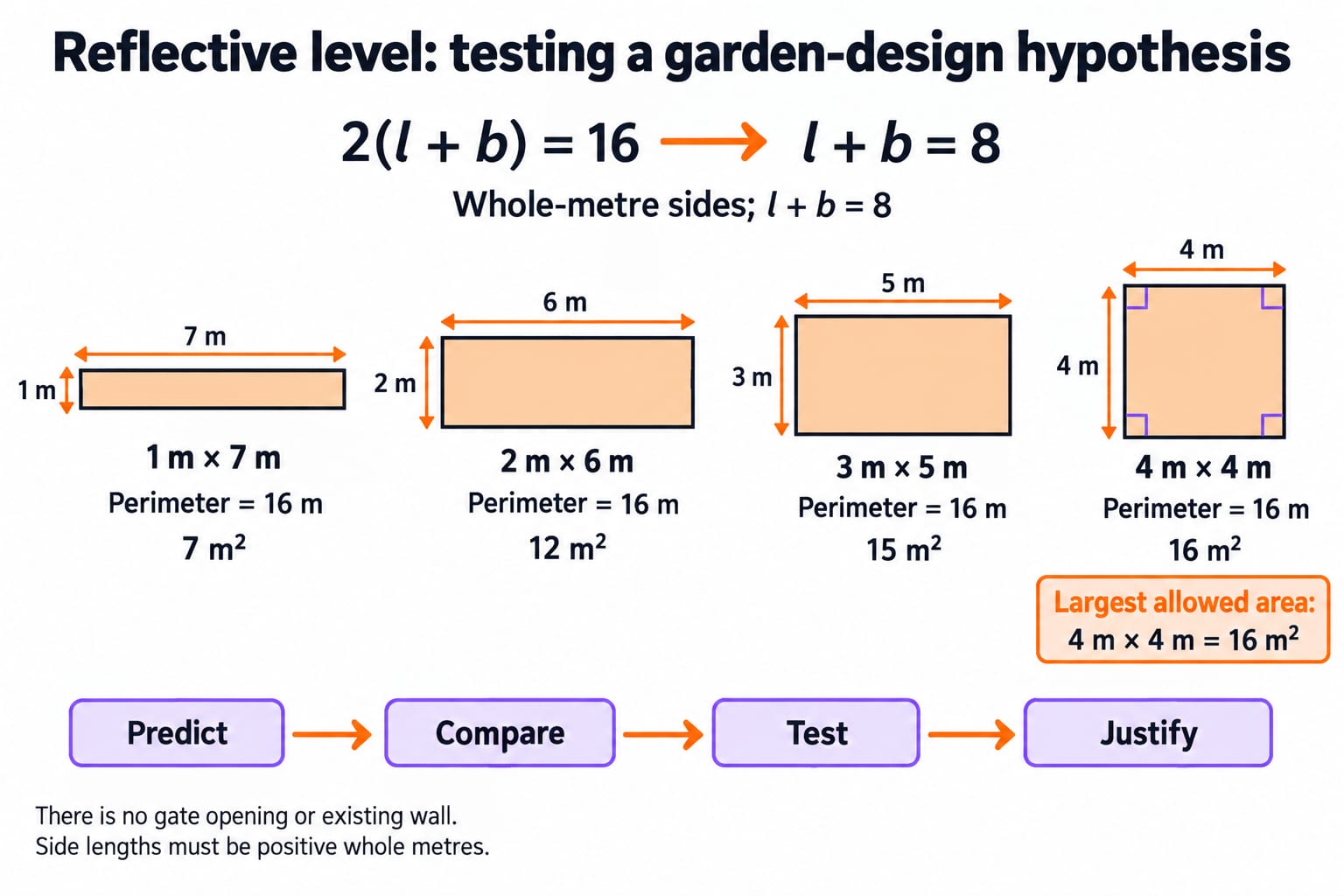
Set this problem: use exactly 16 m of fencing around all four sides of a rectangle and maximise planting area. There is no gate opening or existing wall. Side lengths must be positive whole metres.
Learners propose a hypothesis: “A more nearly square rectangle encloses more area.” They predict, then test the alternatives. From 2(l + b) = 16, dividing both sides by 2 gives l + b = 8.
The unordered pairs are (1, 7), (2, 6), (3, 5) and (4, 4). Swapping length and breadth only rotates a rectangle, so those orientations are duplicates.
Sides | Perimeter | Area |
|---|---|---|
1 m × 7 m | 2 × (1 + 7) = 16 m | 1 × 7 = 7 m² |
2 m × 6 m | 2 × (2 + 6) = 16 m | 2 × 6 = 12 m² |
3 m × 5 m | 2 × (3 + 5) = 16 m | 3 × 5 = 15 m² |
4 m × 4 m | 2 × (4 + 4) = 16 m | 4 × 4 = 16 m² |
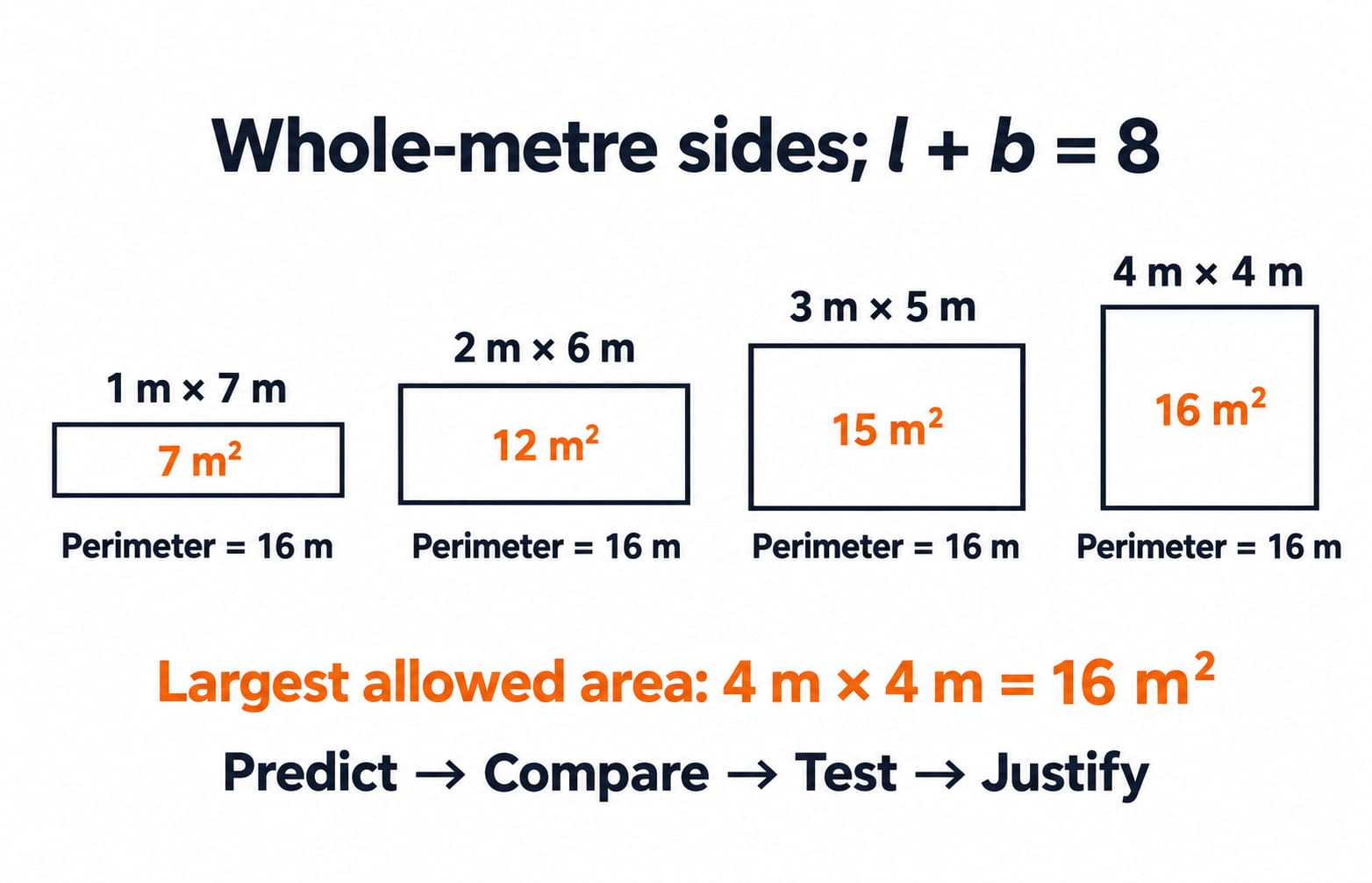
The 4 m × 4 m square wins among all allowed whole-metre rectangles. This table does not prove a result for every possible shape or unrestricted real-valued dimensions.
Reflection lies in proposing, testing, comparing and bounding the conclusion. Copying a teacher-dictated table would not demonstrate that reasoning. As with experiential pedagogy and the Kolb cycle, completing an activity needs analysis and testing to support deeper learning.
Classification traps: activity is not evidence of reflection
“They work in groups, so it must be reflective.” Group work looks learner-centred, but a group reciting formulas still demonstrates recall. Ask what decisions learners make, which alternatives they examine and how they justify their answer.
“Any why question proves understanding.” A rehearsed explanation can also be recited. Ask for a representation or a fresh comparison, such as why equal perimeters can enclose 12 m² and 16 m². This provides better evidence that learners grasp the relationship.
“Reflective is always the best level.” A lesson can need purposeful recall before conceptual explanation and inquiry. Choose the demand that serves the learning objective at that moment.
Reflective teaching also means more than remembering what happened in class: the learner must examine a problem and reason from evidence. Do not map these three levels one-to-one onto Bloom's taxonomy; use the distinctions within this model.
How exam-style stems test the distinction
UGC's Paper I syllabus lists memory, understanding and reflective levels under Teaching Aptitude. Consult the current wording on the official UGC NET portal and select Paper I, English.official UGC NET portal, choose Paper I, English. For CTET readers, the items below are original practice questions, not past-paper items.
Teacher-education textbooks commonly associate memory with Herbart, understanding with Morrison and reflection with Hunt, and matching items may use those pairings.
Use these options for all three original practice items:
(a) Memory
(b) Understanding
(c) Reflective
Item 1: A teacher asks learners to state the area formula exactly as taught.
Answer: (a). The decisive clue is retrieval of taught information.
Item 2: Learners explain why a 6 m × 2 m rectangle covers twelve 1 m² squares although its boundary measures 16 m.
Answer: (b). They explain the relationship between the representation, area and boundary measurement.
Item 3: Learners propose and test which whole-metre rectangle made with 16 m of fencing encloses most area, comparing all allowed side pairs.
Answer: (c). They test a hypothesis against evidence from the full candidate set.
Underline the required learner action, identify the evidence, then choose the highest level actually demonstrated. Readers preparing for technical teaching roles can apply this routine alongside teaching aptitude for CS recruitment exams.
The short version and a next step
Recall the formula, explain the area, investigate the design. The topic stays the same while the thinking and evidence change. The learner's explanation or investigation shows which level the task demonstrates.
Rewrite one familiar lesson prompt at each of the three levels. Beside each prompt, describe what learners must produce as evidence: a recalled fact, an explanation or a justified conclusion from tested alternatives.
For CTET readers seeking an optional structured preparation resource, the CTET Paper 1 course is a possible next step alongside this classroom practice.
Go deeper with the full courseCTET Paper 1 2026 — प्राथमिक शिक्षक (कक्षा 1–5)
Keep learning

User-Level vs Kernel-Level Threads for GATE: The Three Multithreading Models, Decided
Decide thread-model statements by asking who schedules the thread and what a blocking call stalls. Six worked judgements make the comparison concrete.
Updated 8 Aug 20265 min read58 viewsOperating Systems

MP Cooperative Bank Roles: Clerk-Level, Manager and Technical Posts Compared
Compare MP Cooperative Bank role families through three gates: official eligibility, practical work fit and the preparation gap you still need to close.
Updated 30 Oct 20265 min readMP Cooperative Bank

UP Police Computer Operator Eligibility: Education, O Level, Diploma and Typing
Check the three gates separately: school subjects, the accepted computer credential route and the qualifying typing test. Use the worked files and audit checklist before deciding your next step.
Updated 31 Oct 20265 min read163 viewsUP Police Computer Operator
KVS vs NVS Computer Science Syllabus: Shared Core and Post-Level Differences
Study the common PGT Computer Science core once, understand where KVS and NVS routes diverge, and build a source-checked plan for your exact post.
Updated 30 Oct 20265 min read59 viewsKVS & NVS