Python for GATE: CS vs DA Syllabus, Past-Paper Evidence and a 10-Week Plan
Choose the right Python preparation path for GATE CS or DA, then use two worked traces and three diagnostic gates to test your progress.
KnowledgeGate Team
Exam prep & CS education
Updated 1 Oct 20264 min read
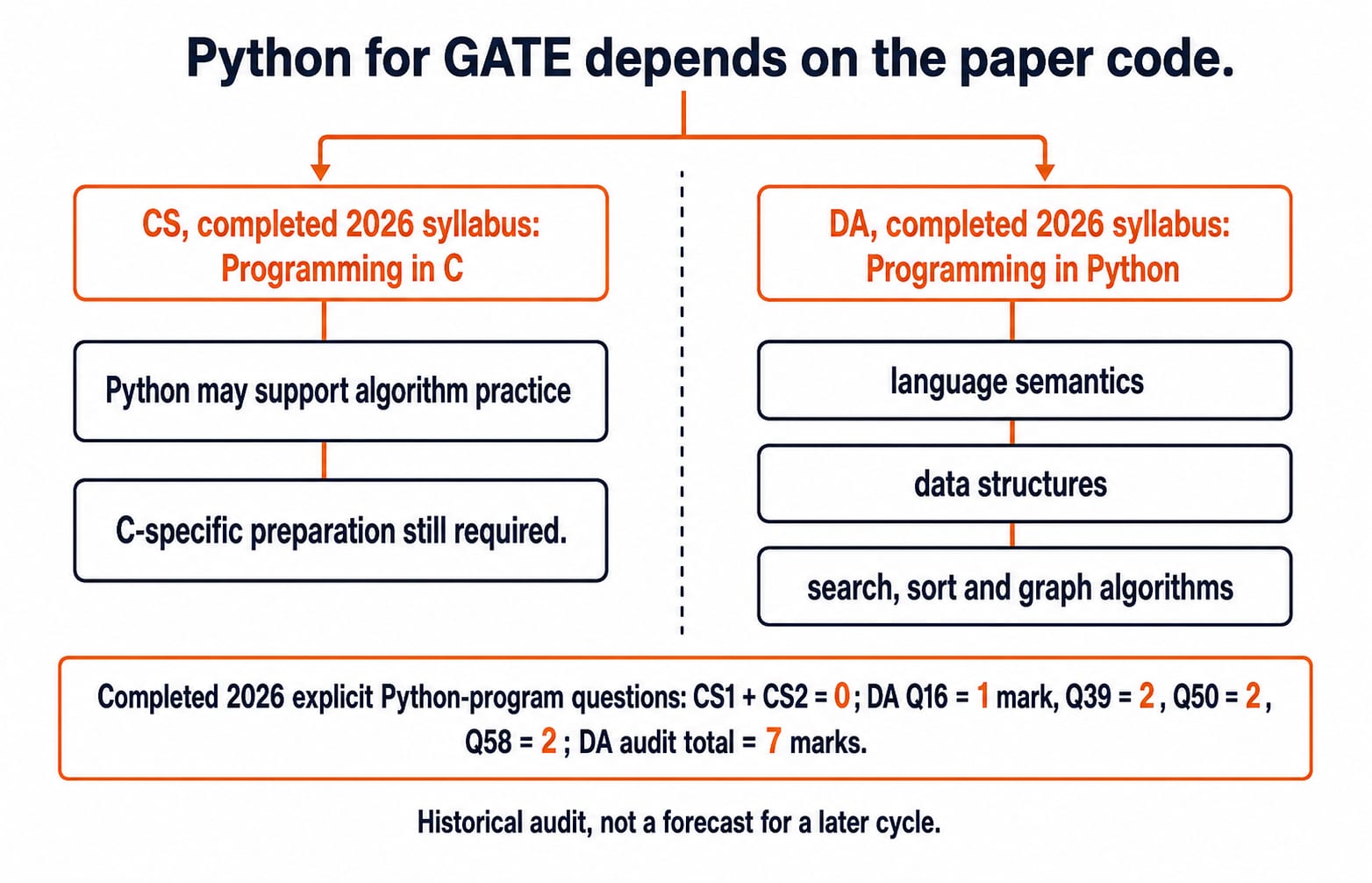
Python for GATE means different things in CS and DA. In the completed 2026 cycle, CS named C while DA named Python, so CS learners can use Python for algorithm practice but cannot substitute it for C preparation. DA learners need Python semantics alongside data structures and algorithms.
The completed 2026 syllabi named C for CS and Python for DA. Check IIT Guwahati's GATE 2026 test papers and syllabus page, then your attempt's syllabus.
1. Python for GATE starts with the paper code: CS or DA
Paper path | Language named in the completed 2026 syllabus | Consequence |
|---|---|---|
CS | C | Python can support algorithms, but cannot replace C preparation. |
DA | Python | Study Python semantics with named data structures and algorithms. |
CS needs C syntax, scope, arrays, pointers, runtime behaviour and tracing. DA needs mutability, default arguments, closures and recursion.
Use GATE Guidance by Sanchit Sir for the CS sequence and data structures work, and take the syllabus itself from the official page.
2. GATE CS and DA syllabus map: turn official labels into study blocks
Learner goal | Completed 2026 official scope | Suggested study resource | Proof skill |
|---|---|---|---|
Python semantics for DA | Programming in Python | Python for Placements within Python Programming | Predict output without running code |
Core data structures | DA: stacks, queues, linked lists, trees, hash tables. CS: arrays, stacks, queues, linked lists, trees, BSTs, heaps, graphs | DSA using Python for DA, or the GATE Data Structures block for CS | Trace insert, delete and lookup operations |
Searching and sorting | DA: linear and binary search, selection, bubble, insertion, merge and quick sort. CS: searching, sorting and hashing more broadly | DSA using Python or the GATE Algorithms block | Dry-run an array and justify time complexity |
Graph work | DA: traversals and shortest path. CS: also MST and broader design techniques | Matching Algorithms lessons | Trace BFS or DFS on a labelled graph |
The official syllabi set the scope; the study blocks are suggested resources, not official weightage. Both paths need algorithms, and Python alone leaves CS preparation incomplete.
3. Python weightage in GATE: audit the completed 2026 papers, do not forecast
DA question | Explicit Python focus | Marks in completed 2026 paper |
|---|---|---|
Q16 | Mutable default list | 1 |
Q39 | Recursive call count | 2 |
Q50 | Closures and captured lists | 2 |
Q58 | Recursive adjacent swaps | 2 |
Audit: 1 + 2 + 2 + 2 = 7 marks. Count only questions whose wording says "Python program" or "function in Python," not topics you happen to study using Python.
Completed 2026 CS1 and CS2 had no explicitly labelled Python question, consistent with that cycle naming C. This neither forecasts later cycles nor reduces Python's practice value. Apply the method to a GATE CS subject-weightage audit.
4. Worked examples: mutable defaults and recursive call counts
For completed GATE 2026 DA Q16, trace this code:
def append_to_lst(val, lst=[]):
    lst.append(val)
    return lst

print(append_to_lst(1))
print(append_to_lst(2))
print(append_to_lst(3, []))
Call 1 changes the default list from [] to [1] and retains it. Call 2 reuses it, producing [1, 2]. Call 3 gets a new explicit list, producing [3].
[1]
[1, 2]
[3]
That matches option B in the official answer key. A mutable default argument is created once and then carried between calls, so track object identity rather than values.
Completed GATE 2026 DA Q39 has base case n <= 0; otherwise it calls mystery(n-1) + mystery(n-2). Let A(n) count every activation, including base calls:
A(-1)=1,A(0)=1A(1)=1+A(0)+A(-1)=1+1+1=3A(2)=1+A(1)+A(0)=1+3+1=5A(3)=1+A(2)+A(1)=1+5+3=9A(4)=1+A(3)+A(2)=1+9+5=15
The answer is 15, which is option C in the official key. Count the base calls as activations too, not only the recursive branches.
5. Python preparation order for GATE: prerequisites before speed
DA order: syntax and core types; lists, tuples, dictionaries and mutability; functions, defaults, scope and closures; recursion and the runtime stack; stacks, queues, linked lists, trees and hash tables; searching and basic sorting; merge sort and quicksort; graphs, traversals and shortest path.
For CS, Python may support experiments, but C and the full syllabus stay central. Translation is unsafe when C semantics are tested.
Use three diagnostic gates:
After functions, predict Q16 without an interpreter.
After recursion, derive
A(4)=15andA(5)=1+15+9=25.After Sorting Algorithms: Complexity and Comparison, insertion-sort
[7, 2, 9, 2, 5]into[2, 2, 5, 7, 9]. The four passes use 1, 1, 3 and 3 element-to-key comparisons, totalling 8.
6. A 10-week Python plan at seven hours per week
Our 7-hour weekly model uses 3 hours for concepts, 2 for tracing and coding, 1 for timed questions and 1 for error repair.
Week | Focus |
|---|---|
1 | Syntax and core types |
2 | Lists, tuples, dictionaries and mutability |
3 | Functions, defaults, scope and closures |
4 | Recursion |
5 | Stacks, queues and linked lists |
6 | Trees and hash tables |
7 | Linear and binary search, plus simple sorts |
8 | Merge sort and quicksort |
9 | Graph representation, BFS, DFS and shortest path |
10 | Two mixed sets, then repair every error |
CS aspirants can replace Python-only hours with C. After a missed week, move the calendar instead of squeezing 14 hours into seven days. Keep 2 hours for tracing and coding and 1 for repair; trim only optional rewatching. Use GATE CS Exam Preparation for the wider sequence.
7. The short version and your next step
Confirm CS or DA. For DA, combine Python semantics with data structures and algorithms. For CS, keep C and the full syllabus central.
DA learners can use Python Programming for implementation practice, and CS learners can use GATE Guidance for subject order. If you would rather work alone, the official papers plus a written error log are enough.
The 2026 scope and 7-mark audit are historical. Take your syllabus, marks, pattern, question types, dates and rules from official GATE material.
Keep learning
Python Control Flow and Loops: if, for, while and Worked Traces
Learn to trace Python branches and loops without skipping a state change. Worked examples cover GCD, break and continue, loop else, nested loops, and common mistakes.
Updated 6 Oct 20265 min readPython
Python Modules and Packages Tutorial: Imports, Structure and Runnable Examples
Learn what Python imports bind, how a regular package fits together, and why package entry points should run with `python -m`. Build and trace every example yourself.
Updated 26 Sep 20266 min readPython
Pandas Basics in Python: Build, Clean and Analyse a DataFrame Step by Step
Follow one student dataset from its first DataFrame to a clean city summary, while learning how selection, missing values and vectorised calculations really work.
Updated 24 Sep 20265 min readPython
Python Operators and Expressions: Precedence, Types and Worked Output Traces
Trace Python expressions without guessing. This guide connects operator families, precedence, types, short-circuiting and exact output through worked examples.
Updated 23 Sep 20266 min readPython