MCQ, MSQ or NAT? Knowing the Question Type Is Half the Battle in GATE
GATE does not just test what you know. It tests whether you know the rules of each question type. MCQ, MSQ and NAT each reward a different strategy. Here is how to play each one.
KnowledgeGate Team
Exam prep & CS education
5 Jul 20265 min read425 views
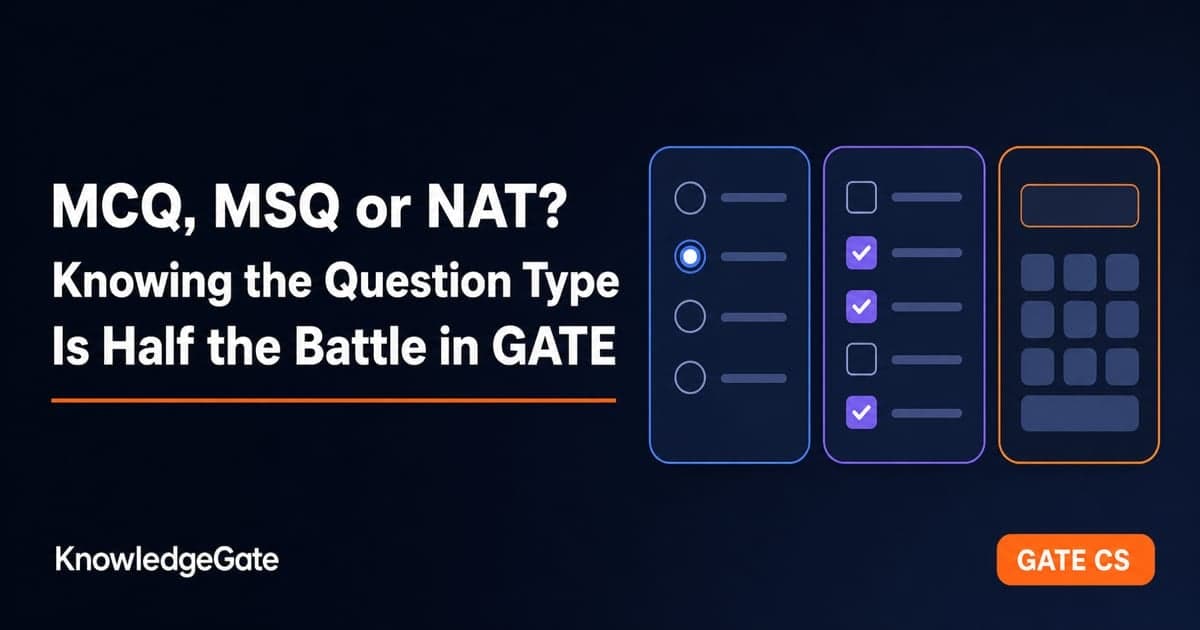
Two students can know exactly the same amount of computer science and walk out of GATE with very different scores. Often the difference is not knowledge. It is that one of them understood the question types and their marking rules, and the other lost marks to negative marking and careless answers. GATE mixes three question formats, each with its own rules and its own trap. Knowing which is which, on sight, is genuinely half the battle.
Related reading: DFA minimum-state questions and network delay numericals.
GATE question types: the three formats
Across the exam, questions come in three types. Our own practice bank leans hard towards one of them: of more than 42,000 questions, single-answer multiple-choice questions dominate at over 38,000, against roughly 1,400 numerical-answer questions and around 560 multiple-select ones. Read that as a warning about your practice, not a forecast of the paper. MCQs are what you will have drilled most, so the two formats that punish an untrained instinct are the two you will have seen least, and you have to go looking for them deliberately. The exact mix and marking scheme for each cycle are set out in the official GATE notification.
Multiple Choice Questions (MCQ)
The classic format: four options, exactly one correct. MCQs carry negative marking, typically one-third of the marks for a one-mark question and two-thirds for a two-mark question. Because there is a penalty, MCQs reward disciplined guessing: if you can eliminate two options, an educated guess is usually worth it; if you are staring at four equally plausible options with no idea, silence may be the better score.
Multiple Select Questions (MSQ)
Here one or more options can be correct, and, critically, there is no negative marking, but there is also usually no partial credit. You must select every correct option and no incorrect one to earn the marks. MSQs are dangerous precisely because they look like MCQs. Students who treat them the same way pick one option and stop, throwing away marks. The right instinct: evaluate every option independently as a true/false decision.
Numerical Answer Type (NAT)
No options at all. You compute a value and type it in. NAT questions carry no negative marking, which changes everything: you should always attempt them, because a wrong answer costs nothing. The trap here is precision. The question will specify how to round ("correct to two decimal places"), and a correct method with a sloppy final value still scores zero. Read the rounding instruction before you compute, not after.
Why the rules change your strategy
Put the marking rules side by side and a clear playbook emerges:
MCQ: negative marking. Guess only when you can eliminate options; otherwise weigh the risk.
MSQ: no negative marking, no partial credit. Judge every option; never leave one un-evaluated; do not over-select out of nervousness.
NAT: no negative marking. Always attempt. Obsess over the rounding instruction and the units.
This is why a student who knows the rules outperforms an equally knowledgeable one who does not. The NAT questions alone are "free" attempts. Leaving one blank is pure lost expected value.
A worked example: when an MCQ guess is worth it
Take a one-mark MCQ and suppose you guess blindly among its four options. Your chance of choosing the correct option is 1/4, which earns +1 mark. Your chance of choosing a wrong option is 3/4, which brings the one-third penalty. The expected value is therefore (1/4 multiplied by 1) minus (3/4 multiplied by 1/3), which in decimals is 0.25 minus 0.25, exactly zero.
Now suppose you can eliminate two options. You are left with a coin flip between the remaining two, so a 1/2 chance of gaining +1 mark and a 1/2 chance of losing one third of a mark. The expected value becomes 0.5 minus 0.167, which is about +0.33 marks. That is the practical rule in numbers: eliminating even two options turns a guess from break-even into clearly worth taking, while eliminating none leaves you a pure gamble with no expected gain.
Ask the same concept as a NAT or an MSQ and the decision changes, because neither carries negative marking. The expected value of any attempt is never negative, so a blank is always the worst option available. The same knowledge meets different formats, and the format alone decides the correct move. Repeat that decision across a full paper and it adds up to a rank band's worth of marks.
The MSQ arithmetic is harsher than it looks. With no partial credit, an MSQ carrying four options is four independent true/false judgements, and every one of them has to land. A single wrong tick, or one correct option left unselected, loses the whole mark. That is why rushing an MSQ costs more than rushing anything else on the paper.
Reading the type on exam day
Under time pressure, the format is easy to misread. Build these habits now, in practice, so they are automatic later:
Check the answer mechanism first. Radio buttons mean one answer (MCQ). Check-boxes mean multiple may apply (MSQ). A text field means you compute (NAT).
For MSQ, mentally tag each option true or false before selecting anything.
For NAT, underline the rounding and unit instruction the moment you read the question.
Track marks and negative marking as you go, so your attempt/skip decisions stay disciplined through the full paper.
Practise with the rules on
The only way these habits become reflexes is to practise in an environment that enforces the real marking. A GATE test series that applies the correct negative marking per question type teaches your instincts the true cost of a careless answer, something an untimed, unscored question list never will. A free GATE mock test is a good place to feel the difference before you commit to a full series.
This is the same reason previous-year questions beat a fresh question bank: the real papers train you on the real formats and the real traps. And once you are practising full papers, slot them into a proper schedule. Our six-month GATE CS plan puts mock tests exactly where they do the most good.
The takeaway: play each question type on its own rules
GATE rewards knowledge, but it also quietly rewards test-craft. Learn the three formats and their marking rules until you recognise each on sight, always attempt the no-penalty NAT and MSQ questions, guard against the MSQ "pick one and stop" trap, and never lose a computed answer to a rounding slip. Then go apply it across the full GATE preparation catalogue. Half the battle is knowing what you are looking at. Win that half for free.
Keep learning
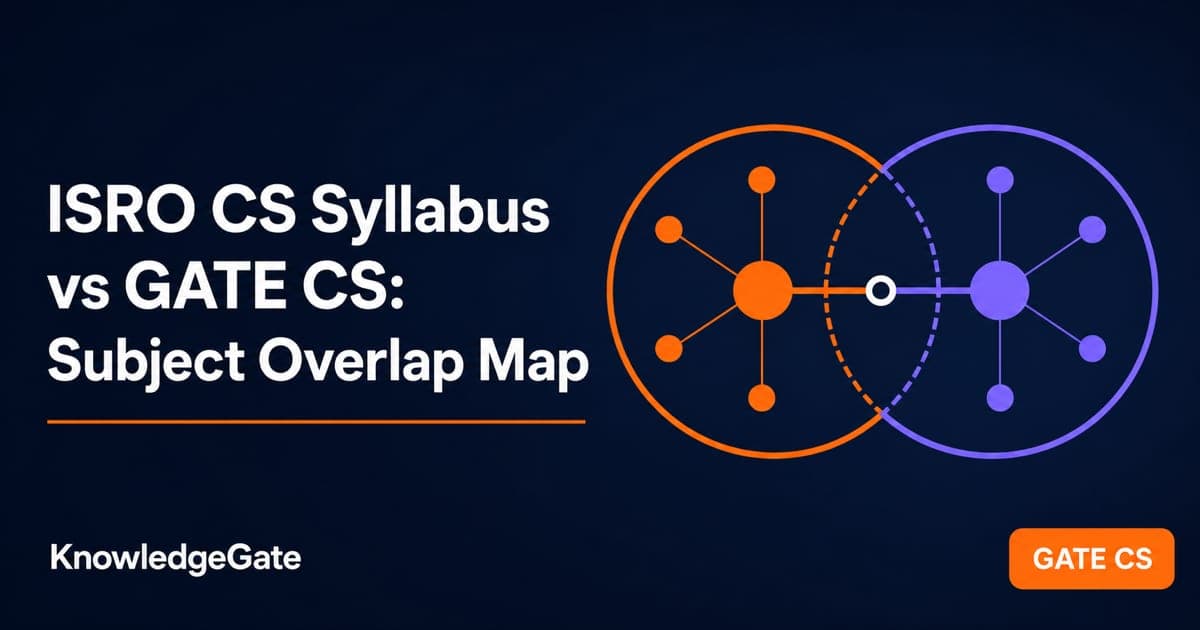
ISRO Scientist/Engineer CS Syllabus vs GATE CS: The Subject Overlap Map
See which core CS subjects transfer directly from GATE to ISRO, what drops out, how the question texture changes and where an ISRO-specific polish helps.
Updated 5 Oct 20264 min readGATE Strategy & Roadmap
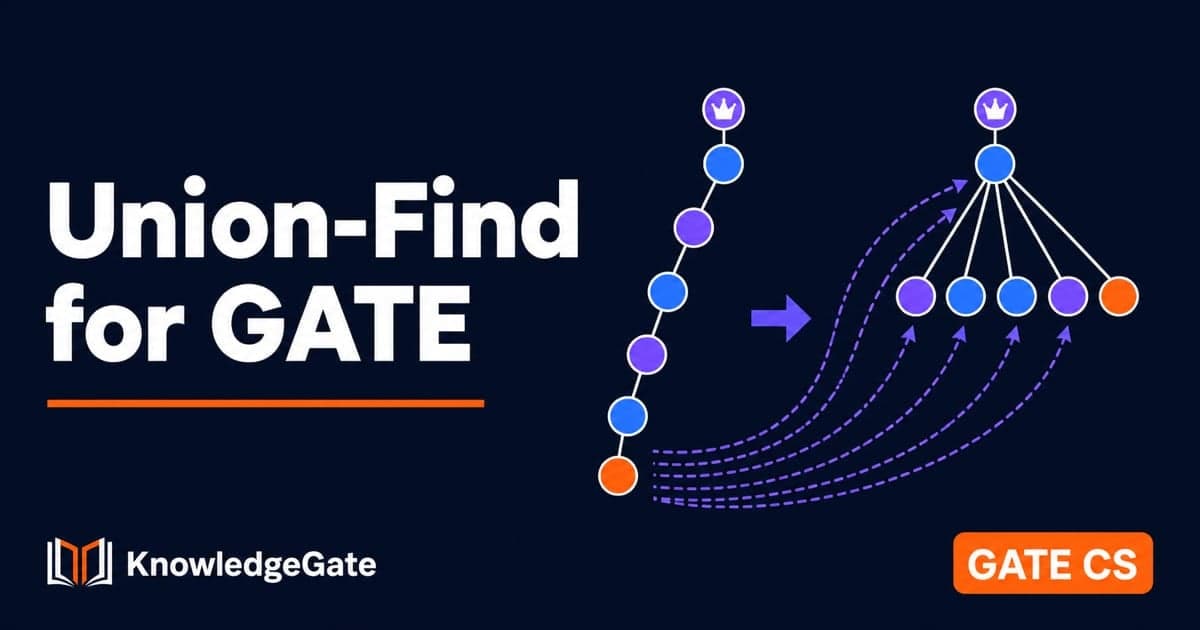
Union-Find for GATE: Union by Rank, Path Compression and the Near-Constant Bound
Trace seven unions, inspect the final ranks, then compress the deepest path by hand. The worked forest makes the inverse-Ackermann bound much less mysterious.
Updated 1 Oct 20265 min readGATE Strategy & Roadmap
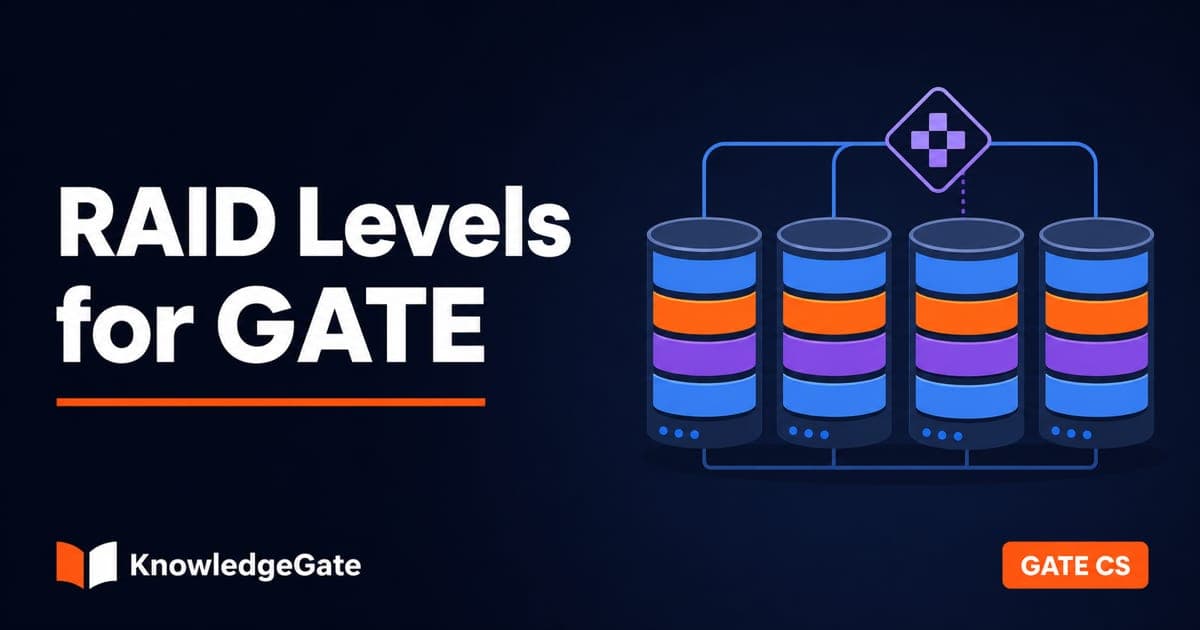
RAID Levels for GATE: Striping, Mirroring, Parity and the Two Capacity Formulas
Stop memorising RAID names in isolation. Tie each level to usable capacity, failure tolerance and write cost, then test the formulas on one eight-disk array.
Updated 26 Sep 20265 min read58 viewsGATE Strategy & Roadmap
Memory Interfacing for GATE: Chip-Count and Address-Decoding Numericals, Fully Worked
Separate words from bits, split the address correctly, and verify the result with a gap-free hexadecimal map. This guide works through depth and width expansion step by step.
Updated 24 Sep 20265 min read55 viewsGATE Strategy & Roadmap